Jump to Content
Lithium Sulfur Battery Market - Size, Share, Industry Trends, and Forecasts (2025-2035)
Lithium Sulfur Battery Market Scope & Overview
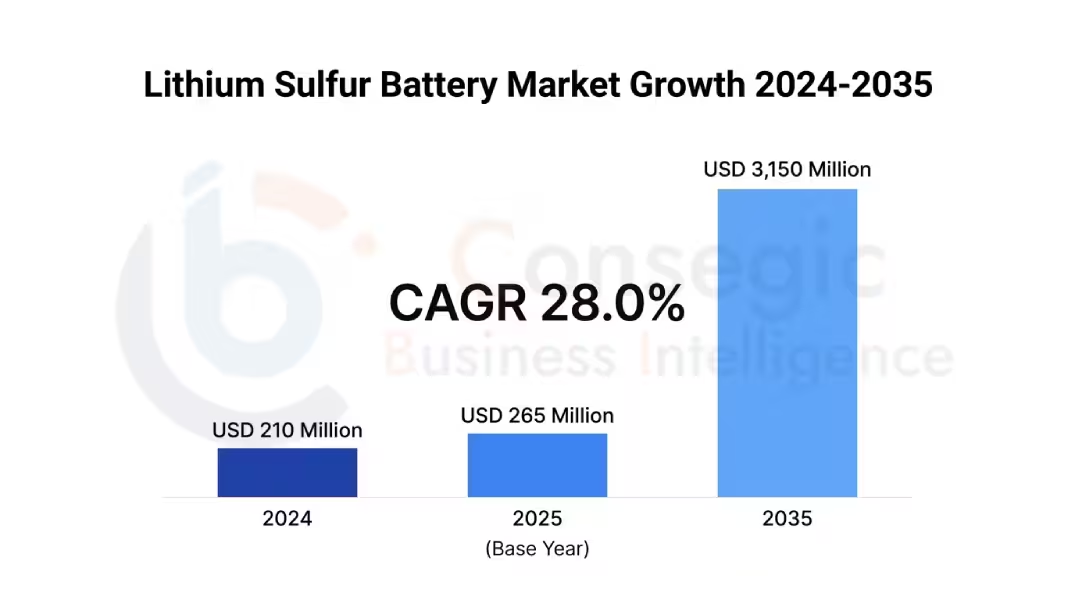
The global lithium sulfur battery market is an emerging and transformational segment of the advanced energy storage market with 2,500 to 2,600 Wh/kg (theoretical specific energy densities of) and a fundamental and low-cost supply of elemental sulfur feedstock, which is considered to be a significant material cost advantage over conventional lithium-ion battery cathode materials and which shows itself in lithium sulfur (Li-S) technology as the most promising near-term solution to applications with ultra-high energy density such as electric aviation, high-alt In 2024, the market size will be USD 210 Million, after which it will grow to USD 265 Million in 2025 (base year), and grow significantly to USD 3,150 Million by 2035. This growth trend shows a compound annual growth rate (CAGR) of 28.0 percent in the forecast period between 2026 and 2035, as a result of increasing demand in breakthrough energy storage technology beyond lithium-ion limits, large-scale research and development investment by aerospace and defense industry, technology breakthroughs to overcome the historical barriers to performance such as polysulfide shuttle effect and cycle life constraints, growing electric aviation development programs necessitating lightweight high-energy batteries, and increasing commercialization efforts to convert technology into in-laboratory demonstrators.
Regional Trends and Insights
- In 2025, the North American lithium-sulfur battery market is USD 93 million (35% of global market) and is projected to reach USD 1,103 million by 2035 at a 27.5% CAGR.
- In 2025, the European lithium-sulfur battery market is USD 80 million (30% of global market) and is projected to reach USD 945 million by 2035.
Lithium Sulfur Battery Market Insights:
Lithium sulfur batteries have entirely different electrochemical processes than the traditional lithium-ion technology, relying on conversion chemistry, and not on intercalation. At the time of discharge, lithium ions are then transported off of the metallic lithium anode to the sulfur cathode to form a series of lithium polysulfides Li2Sx (where x = 4-8) then turning to lithium sulfide Li2S and lithium disulfide Li2S2 to provide theoretical specific capacity of 1675 mAh/g of sulfur cathodes versus 140-200 mAh/g of conventional lithium-ion cathode materials Existing commercial prototype cells achieve 400-500 Wh/kg at cell level (scaling to 320-400 Wh/kg at pack level) utilizing sulfur as the 16 th most plentiful element in the Earth crust and a common by-product of refined petroleum products.
There are serious technical issues in the technology which have historically constrained commercial uses, such as the polysulfide shuttle effect where intermediate lithium polysulfides dissolve in liquid electrolytes and move between electrodes, leading to capacity loss and self-discharge, and as a lithium metal anode, dendrite growth that may lead to internal short circuits, volume increase of about 80% during lithiation causing mechanical stress and electrode degradation, low electrical conductivity of sulfur necessitating conductive additives and lithium metal anode issues including d Nevertheless, recent technological advances, such as the development of state-of-the-art cathode architecture based on carbon nanostructures confining polysulfides, solid-state and gel polymer electrolytes suppressing shuttle effects, and protective lithium anode surfaces have shown that laboratory cells can achieve 400-800 cycles at 80 percent capacity retention, and this is a significant advancement towards commercial feasibility in more specialized high-value applications.
Market Channel Distribution Analysis:
The lithium sulfur battery market is served by the four different channels of application that cater to the specialized end-users who are ready to trade in the existing performance limitations in favor of the unparalleled benefits in energy density. The overall market revenue mix shows that there is concentration in high-value aerospace and defense applications
Application Channel Breakdown (2025):
- Aerospace, UAVs & Defense Applications: USD 80 Million (30.0% of total market value)
- Aviation / eVTOL (Electric Vertical Takeoff and Landing): USD 69 Million (26.0% of market revenue)
- Portable Power used in Consumer and Industry: USD 53 Million (20.0% market share)
- Automotive and Transportation (Prototype/Demonstration): USD 32 Million (12.0% of market share)
- Other Specialised Applications (Space,Grid Storage,R&D): USD 31 Million (12.0% of total market value)
Investment in lithium sulfur battery research, development and early commercialization activities worldwide totaled USD 1,100 Million in 2024, with significant funding being an investment by major aerospace corporations, battery developers, defense contractors and government agencies to develop the technology to the next level of TRL 7-8 (system demonstration). Prototypes with 400-550 Wh/kg have been shown by leading technology developers such as Oxis Energy, Sion Power, Lyten and Theion and are currently working on pilot production facilities with planned facilities of 50-200 MWh/year.
Fundamental transition to the stage of early commercialization of the industry is in progress, and the Battery500 Consortium sponsored by the U.S. Department of Energy is working on the development of rechargeable lithium metal batteries with capacity over 500 Wh/kg, and the lithium sulfur research consortia funded through multiple different programs in the European Union are making progress in taking technology to commercial viability.
Lithium Sulfur Battery Market Dynamics (DRO)
Key Drivers:
Aviation Revolution Electric and Ultra-Lightweight Energy Storage Requirements.
The greatest structural force is the new electric aviation industry, which needs energy storage technology with particular energy density of 400-500 Wh/kg at pack level to make electric aircrafts with reasonable payload capacity and range performance. The present lithium-ion technology with 250-280 Wh/kg up to pack scale is not enough to power aircraft other than small unmanned aerial vehicles, and there is an urgent need to develop breakthrough battery technologies.
The electric aircraft market around the world consists of more than 240 development programs that include urban air mobility vehicles (eVTOL), regional-range electric aircrafts, high-altitude long-duration platforms and hybrid-electric aircrafts. Significant initiatives such as Eviation Alice, Heart Aerospace ES-30 and Airbus E-Fan X show increasing momentum and NASA research shows that lithium sulfur batteries with 400-500 Wh/kg could make regional electric airplanes with 500-800 km range and 19-50 passengers potentially transformative capability in sustainable aviation.
Military and Defense Applications that require a high energy density.
Military and defense applications are the prime early adopters who are prepared to pay the premium price due to benefits on energy density in soldier-portable power infrastructures, unmanned systems, and special equipment. In extended mission’s modern infantry soldiers carry 8-16 kg of batteries that provide communications, night vision, GPS and electronic systems. Lithium sulfur batteries with Wh/kg of 400+ could cut the weight of the battery by 50-80 percent and still provide the same duration of operation, and this would allow the soldier to move as far as they are required to conduct their investigations and maintain their missions.
Advanced battery technology has been defined as a strategic priority of the U.S. Department of Defense, and projects to this end, such as the Robust Portable Power program by DARPA and service-specific efforts to develop and use lithium sulfur technology to meet the military needs of ultra-lightweight, high-energy power.
Technology Innovations that deal with the past performance limitations.
The latest scientific developments to resolve the underlying technical issues open opportunities to commercial viability where several research groups and companies have shown significant gains in both cycle life, rate capability, and operational stability. More complicated cathode designs that include carbon nanotubes, graphene crystals, and metal-organic frameworks entrap polysulfides physically so they do not dissolve, and have been demonstrated in the lab with 500-800 cycles of capacity retention at 80 degrees Celsius.
The development of solid-state electrolytes embodies disruptive technology that removes liquid electrolytes that dissolve polysulfides and ceramics or glass ceramics based on sulfides have proven successful in blocking polysulfide and allowing sufficient ionic conductivity at room temperature.
Key Restraints:
Short Cycle Life and Calendar Life Disadvantages over Lithium-Ion Technology.
The greatest commercial hurdle is still lack of cycle life at mass-market operation, as the present lithium sulfur cells reach an operation of 300-600 cycles to 80 percent capacity retention under ideal conditions versus 1,000-3,000 or more cycles to commercial lithium-ion battery operation. This is a limitation in the cycle life of Li-S technology, which can only be used in situations where the benefits of energy density can overcome the limitations of longevity, and this is in aerospace, defence, and special purpose applications and not in mainstream automotive or grid storage.
The calendar life is a further fear, and long term stability tests have shown that the capacity continuously decreases during storage conditions by further reaction of polysulfide and lithium anode degradation, restricting use to long-service intervals, or strategic reserve services.
Scalability of manufacturing and Cost of production.
Although sulfur is an inexpensive and abundant material, overall the lithium sulfur battery production is a high cost matter because of the need of specific materials, intricate electrode-making, and moisture-controlled measures required of the lithium metal handling. Present cost of production of prototype Li-S cell is USD 300-600 per kilowatt hour against USD 130-180 per kilowatt hour of commercial lithium-ion batteries.
Lithium metal anode production needs extremely dry conditions (dew points lower than -60C) to avoid lithium oxidation and so special production plants with highly advanced environmental control systems are necessary, which are not needed in the production of normal batteries.
Regulatory Certification Requirement and Safety Concerns.
The lithium metal anodes are intrinsically unsafe because they have the potential to form dendrites, which may result in internal short circuits, or be reactively unstable to moisture which may cause thermal runaway. Although protective technologies can significantly reduce such risks, regulatory certification of use of these technologies in aviation and automotive use involves a lot of safety testing that defines that the technology is compliant with high standards such as DO-311A of aviation batteries and UN 38.3 transportation standards.
Future Opportunities:
Lithium Sulfur Technology Convergence, Solid-State.
The merger between solid-state electrolyte technology and lithium sulfur chemistry has the potential to provide a paradigm shift that could offer solutions to several underlying challenges at once. In solid-state Li-S batteries, dissolution of polysulfides is prevented by substituting liquid electrolytes with solid electrolytes (ceramic or polymer) and allows the use of lithium metal anodes by dendrite suppression and enhanced mechanical stability.
The initial laboratory results of solid-state Li-S cells are 400-500 Wh/kg and 700-1,000 cycles, which indicates the possibility of breakthrough performance that allows wider adoption of application such as automotive by the 2030-2035 period.
High-Altitude Pseudo-Satellites and Long-Endurance Platforms.
The ideal early application of lithium sulfur technology is offered by high-altitude pseudo-satellites (HAPS) at 18-25 km altitude operating over long periods of time to provide telecommunications and surveillance services. These systems need extremely lightweight energy storage of over 400 Wh/kg to be able to operate at night, and companies such as Airbus (Zephyr program) have shown successful operation of Li-S battery integration, allowing weeks or months of nonstop operation.
Hybrid Battery System Architectures.
Combination of lithium-ion primary batteries with additional Li-S packs Hybrid battery systems Hybrid battery systems that combine the benefits of Li-S with lithium-ion primary batteries are a near-term commercialization pathway, allowing the benefits of Li-S energy density to be taken advantage of to increase range, and the limitations of cycle life to be addressed by infrequent use. The solution will be able to provide 1,000+ km total range with premium electric vehicles and optimize the overall system cost and performance.
Market Segmentation Analysis
By Battery Type: Technology Architecture Analysis
Lithium Sulfur Batteries Liquid Electrolytes: The Standard Technology.
Liquid Li-S batteries in the market are showing a current market performance of USD 186 Million or 70.0% of the total market value in 2025 with a future forecast of USD 2,205 Million in 2035 with a CAGR of 27.5%. These systems have the benefit of using traditional organic liquid electrolytes, which contain special additives to prevent polysulfide shuttle effects, which makes the ionic conductivity and rate capability of these systems sufficient to be used in the present-day applications.
Leading developers, such as Oxis Energy and Sion Power, have shown prototype cells with cell-level performance of 400-450 Wh/kg and 400-500 cycles to 80 percent capacity retention, which is performance levels that are good enough to support first aerospace and defense applications where energy density benefits offset current performance constraints.
The Next Generation batteries are the Solid-State Lithium Sulfur Batteries.
USD 79 Million (30.0% of market value) solid-state Li-S batteries are the latest technology with better prospects in the long term, but have several drawbacks at the moment such as lower ionic conductivity at room temperature and complexity in manufacturing. This segment shows a projected growth of 29.5% CAGR, indicating a growing investment in research and a possibility of making breakthrough performances.
By Application: End-Use Market Analysis
Aviation and Aerospace: Premium Early adopter.
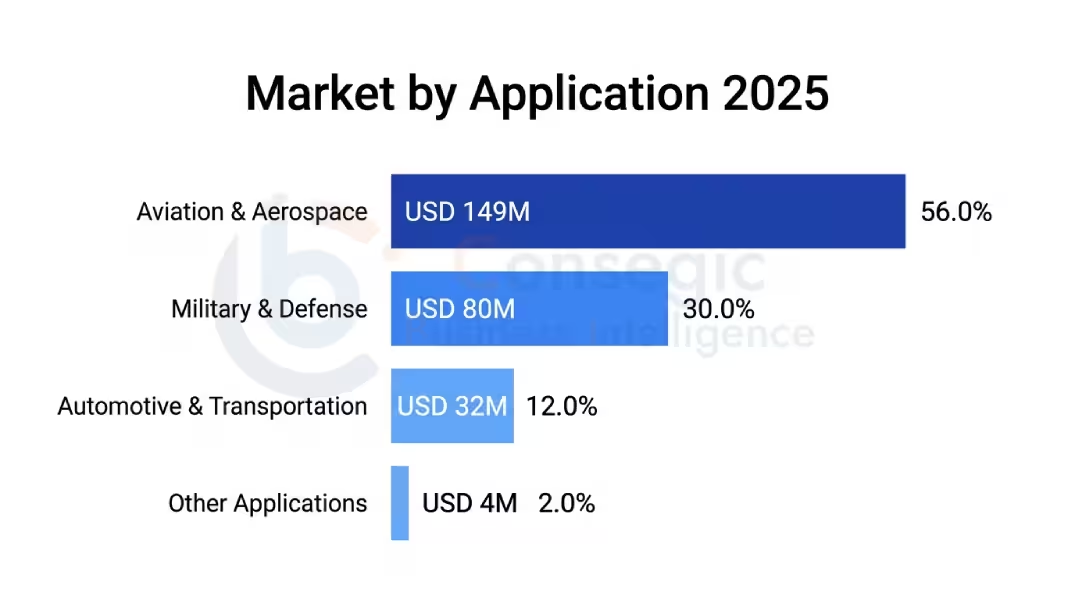
Aviation and aerospace applications USD 149 Million (56.0% of total market value) include electric aircraft, unmanned aerial vehicles, high-altitude platforms applications, and satellite applications. This market is ready to pay a high price as Li-S cells already reach USD 600-900/kWh of aerospace-quality products.
Military and Defense: Applications to Strategic Priority.
Examples of military and defense include the USD 80 Million (30.0% of market value) in soldier-portable power systems, military drones, and special communication systems. The defense procurement procedures reflect the willingness to pay more money to get the performance benefits, and the weight of the battery directly correlates with the increase in the mission capability.
Automotive and Transportation: Potential Future.
Automotive is USD 32 Million (12.0% of market value), which is at present because of prototype development and demonstration schemes. Large manufacturers continue Li-S research developments looking into future uses and the commercialisation is expected in the 2028-2032 timeframe unless cycle life issues are resolved successfully.
Other Applications
Other applications such as consumer electronics, grid storage have USD 4 Million (2.0% of market value) in terms of the potential future opportunities on the reduction of costs as and when the technology becomes a reality.
Regional Market Analysis
North America: Technological Leadership and Defense spending.
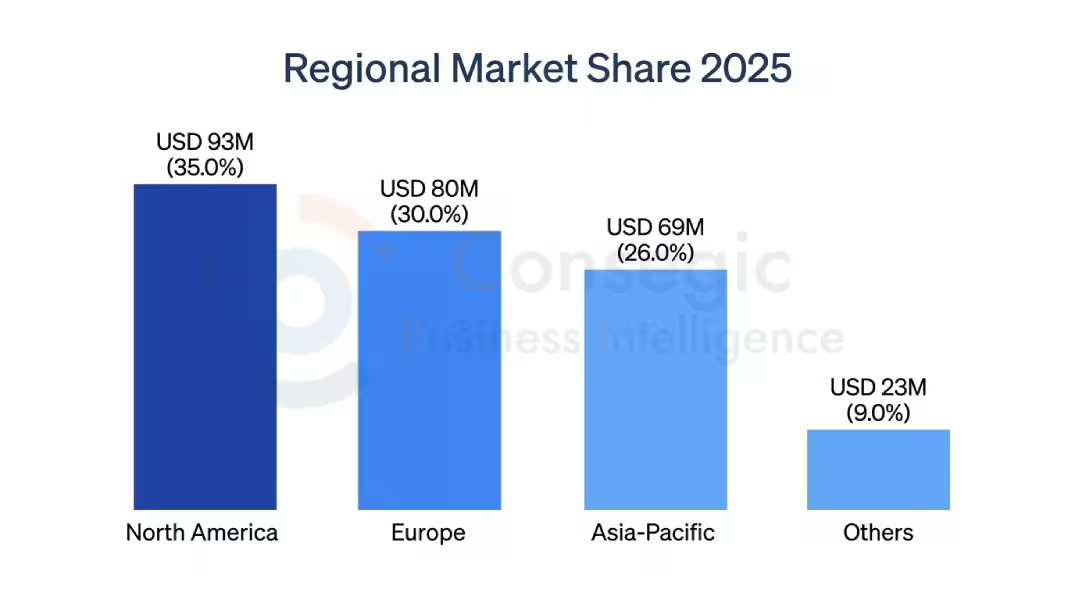
In North American lithium sulfur battery market, there comes USD 93 Million in 2025 that will translate to 35.0% of market value, and it is predicted that this market will grow to USD 1,103 Million in 2035 at 27.5% CAGR. The US controls the regional demand of 91.5 percent of market value with large investments in the defense and aerospace segments, the research institute, and government funding of advanced battery technology development.
The government of the United States has a considerable investment in the development of advanced battery technology amounting to USD 125 Million annually, with certain initiatives on the development of lithium sulfur, such as the Battery500 Consortium, DARPA efforts, and service-specific programs. Large defense firms such as Lockheed Martin and Northrop Grumman are also considering Li-S in unmanned systems and future generations.
Europe: Aviation Excellence and Focus.
European lithium sulfur battery market is valued at USD 80 Million in 2025, which is equivalent to 30.0% of global market value, and it is projected to increase to USD 945 Million in 2035. The UK takes up 38.5 percent of the regional market value and Germany takes 28.5 per cent on the basis of automotive research and aerospace usage.
Lithium sulfur funding European Commission funding has been allocated more than EUR 45 million under Horizon 2020 and Horizon Europe programmes, and Airbus continue to run Li-S evaluation programmes on possible future electric and hybrid-electric aircraft platforms.
Asia-Pacific: Production Potential and Increasing Investment.
In Asia-Pacific, the AP lithium sulfur battery market has a value of USD 69 Million in 2025 which is 26.0 of the global market value, and is expected to grow to USD 883 Million in 2035 at a 28.5 CAGR. China will lead market value regionally (48.5 percent), with enhanced battery technologies and more aerospace sector supported by its government.
LG Energy Solution, Samsung SDI and CATL are the major Asian battery companies with ongoing lithium sulfur research and development projects, with LG Energy Solution declaring intentions to realize pilot-scale production capacity by 2026-2027.
Other Regions
The other areas such as Latin America and Middle East and Africa sum up to USD 23 Million (9.0% of the world market) although current activity is still minimal but can grow in future once the technology matures and the cost of it reduces.
Competitive Landscape and Key Market Players
Market Leadership and Strategic Positioning
Oxis Energy Limited (United Kingdom) - Technological Innovation.
Oxis Energy is also the oldest lithium sulfur battery company that has been developing continuously over 15 years and has very large patent portfolio covering cathode architectures, electrolyte formulations and cell designs. The company has demonstrated prototype cells with 425 Wh/kg at cell level with 500 or more cycles, with initial commercialization during the aerospace and defence markets.
Sion Power Corporation (United States) - Defense Focus.
The Sion Power continues to hold a large presence in the military arena with contracts with the U.S. Department of Defense, and has created specialized Li-S batteries to run power to soldiers in portables and unmanned platforms. The technology of Licerion(r) used in the company uses secured lithium metal anodes with a prototype cell of 500 + Wh/kg.
Lyten, Inc. (United States) - Automotive Development.
Lyten also uses proprietary 3D architecture of graphene cathodes with a focus on automotive uses, and a pilot production line was commissioned in 2024 producing cells in commercial format, to be tried by OEMs. The company symbolizes top attempts to make Li-S technology a laboratory to automobile one.
Other Major Market players:
- LG Energy Solution (South Korea) - Build on its status as a leading producer of lithium-ion batteries to create next-generation Li-S technology.
- Theion (Germany) - Crystalline sulfur cathodes and solid-state electrolytes were developed.
- Zeta Energy (United States) - cathode architecture based on carbon nanotube.
- PolyPlus Battery Company (United States) - Lithium electrode technology, which is under protection.
- Samsung SDI (South Korea) - Initiatives in research on automotive applications.
- CATL (China) - Innovative Li-S researched battery technology.
Recent Industry Developments
Aerospace Demonstration Programs and Flight Tests (2024-2025)
Several aerospace corporations started programs of flight testing with lithium sulfur battery prototypes in unmanned aerial vehicles and experimental platforms. The Airbus Zephyr high-altitude pseudo-satellite came out as a successful demonstration of the extended flights using Li-S batteries, ensuring that its technology would work in the extreme aerospace environment and proved that the specialized use could be operational.
Pilot Production Facility Commissioning (2024-2025)
Li-S developers such as Lyten and Oxis Energy declared the construction of pilot production lines of 50-200 MWh, the important step in changing the laboratory prototypes into the commercial-format cells that will be able to withstand customer validation and early deployment schemes.
The Solid-State Lithium Sulfur Breakthrough Demonstrations (2024)
Research groups and firms showed tremendous advancement in solid-state Li-S technology, whereby laboratory cells had succeeded in 400-500 Wh/kg with ceramic and sulfide-based solid electrolytes and still maintained sufficient rate capability. These technologies overcome the inherent limitations of polysulfide shuttle technologies and provide the safe use of lithium metal anodes.
Strategic Investment Expansion (2024-2025) Government Funding.
U.S. Department of Energy reported USD 65 million in new funding of advanced battery technology including lithium sulfur development through extended Battery500 Consortium operations with European Commission awarding EUR 28 million in new Horizon Europe projects proposing Li-S technology to commercial readiness.
Lithium Sulfur Battery Market Report Insights
| Report Attributes | Report Details |
|---|---|
| Study Timeline | 2022–2035 |
| Base Year | 2025 |
| Forecast Period | 2026–2035 |
| Market Size in 2025 | USD 265 Million |
| Market Size in 2035 | USD 3,150 Million |
| CAGR (2026–2035) | 28.0% |
| By Battery Type | Liquid Electrolyte (70.0%), Solid-State (30.0%) |
| By Application | Aviation & Aerospace (56.0%), Military & Defense (30.0%), Automotive (12.0%), Others (2.0%) |
| By Capacity Range | Small Format <10Ah (35.0%), Medium Format 10-50Ah (42.0%), Large Format >50Ah (23.0%) |
| By Region | Asia-Pacific, Europe, North America, Latin America, Middle East & Africa |
| Key Players | Oxis Energy, Sion Power, Lyten, LG Energy Solution, Theion, Zeta Energy, PolyPlus Battery, Samsung SDI, CATL |
| Report Coverage |
|
Key Questions Answered in the Report
What is the size of Lithium Sulfur Battery market? −
The market of lithium sulfur batteries in the world is currently early in its commercialization activity but there is a potential to expand exceptionally with a projected market of USD 265 Million in 2025 and a projected market of USD 3,150 Million in 2035 at 28.0% CAGR, as research-based technology is transformed into commercial commercialisation in high-value applications such as electric aviation, military systems, and special aerospace platforms where the energy density benefits of 400-500 Wh/kg.
What is the fastest-growing region of the Lithium Sulfur Battery market? +
The fastest growth rate of 28.5% CAGR is demonstrated by Asia-Pacific due to the increasing aerospace and defense industries of China, significant government investment in the development of advanced battery technologies, and the presence of major producers in the Asian region such as LG Energy Solution, Samsung SDI, and CATL developing commercialization processes with pilot production programs. But North America has the greatest market share of 35.0% because of large Department of Defense investment of more than USD 125 million on an annual basis, strong demand in the aerospace industry and major technology developers such as Oxis Energy, Sion Power, and Lyten have reached commercial readiness.
What are the major technical constraints to commercialization? +
The critical technical issues are a cycle life of 300-600 vs 1,000-3,000+ cycles in lithium-ion technology which is limiting, only allowing usage under conditions where energy density benefits outweigh longevity limits; polysulfide shuttle effect leading to capacity decay during dissolution and migration of intermediate lithium polysulfides in liquid electrolytes, limiting it to application conditions where energy density benefits overcome longevity limits; approx. 80% volume expansion on lithiation imposing mechanical stress and electrode.
Which early adopting applications are becoming a breakthrough? +
The biggest driver is electric aviation, as more than 240 aircraft development programs need energy storage of more than 400 Wh/kg at pack level to obtain practical electric aircraft, and Li-S technology could cut battery weight by 35-45% to allow regional electric aircraft with the range of 500-800 km. The High-altitude pseudo-satellites (HAPS) at 18-25 km altitude need ultra-lightweight energy sources to be in operation and the Airbus Zephyr has shown successful Li-S integration of weeks to months of operation. Military uses such as soldier-portable power systems have weight reductions of 40-50 percent which improves mobility and operational capability, and defense unmanned systems need long endurance due to high energy density to support surveillance and reconnaissance missions.
Which technological advances are facilitating commercialization advances? +
Major enabling technologies include improved cathode designs with carbon nanotubes, graphene structures, and metal-organic frameworks that physically entrap polysulfides and can achieve 500-800 cycles in laboratory experiments; solid-state and gel polymer electrolytes that do not use liquid electrolytes that dissolve polysulfides and still provide enough ionic conductivity; protected lithium metal anode technologies such as artificial SEI layers and 3D current collectors to deal with dendrite formation.
Overview
Reputation & Certifications


Our Services
- Market Intelligence & Forecasting
- Custom Research Solutions
- Market Entry Strategy
- Competitive Intelligence
- Customer Insights
- Industry Innovation Analysis
- Investment Advisory