Jump to Content
Air to Air Heat Pump Market - Size, Share, Industry Trends, and Forecasts (2025-2032)
Air to Air Heat Pump Market Size:
Air to Air Heat Pump Market size is estimated to reach over USD 125.86 Billion by 2032 from a value of USD 53.45 Billion in 2024 and is projected to grow by USD 58.54 Billion in 2025, growing at a CAGR of 11.3% from 2025 to 2032.
Air to Air Heat Pump Market Scope & Overview:
Air to air heat pump is a climate control system that is intended to move thermal energy between indoor and outdoor air and has both heating and cooling capabilities through a single device. It uses a refrigeration cycle and no hydronic distribution, making it ideal for ducted or ductless use in residential and light commercial environments.
Main features involve inverter-based compressors, programmable thermostats, multi-zone functionality, and high-end filtration technologies. The system provides uniform indoor temperature, silent operation, and decreased energy usage by regulating output for real-time demand.
Air to air heat pump units provide straightforward installation, adaptable system sizing, and all-year-round comfort. They are designed to be compatible with smart controls and energy management systems, which provide user convenience and optimal operating efficiency. The fact that the system provides effective thermal control with little or no modification to infrastructure makes it an ideal solution for contemporary, space-efficient building environments.

Air to Air Heat Pump Market Dynamics - (DRO) :
Key Drivers:
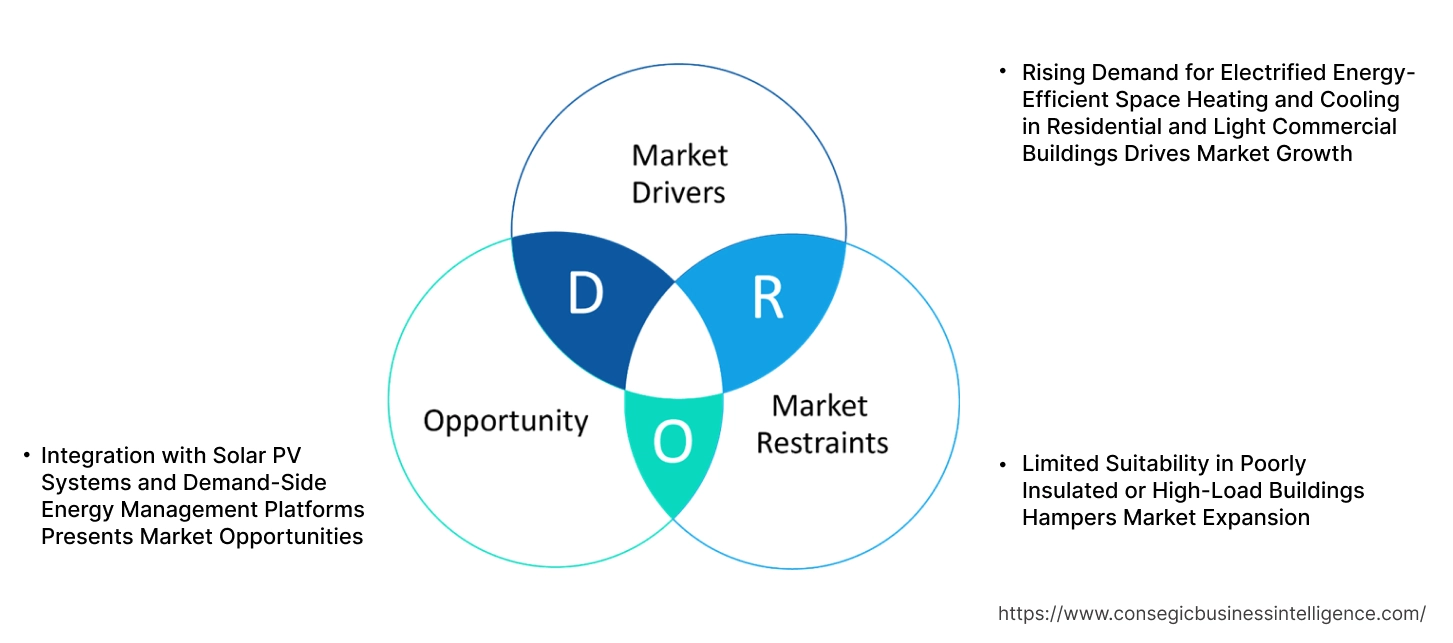
Rising Demand for Electrified Energy-Efficient Space Heating and Cooling in Residential and Light Commercial Buildings Drives Market Growth
Air to air heat pumps are increasingly being adopted in homes, apartments, and light commercial buildings as an energy-efficient solution for year-round climate control. These systems transfer heat between indoor and outdoor air, delivering both heating and cooling with significantly lower energy consumption than traditional systems. Their dual functionality, low maintenance requirements, and easy installation make them ideal for both new constructions and retrofits. North American, European, and Asian governments and regulatory authorities are encouraging electrified HVAC systems to displace fossil fuel-driven heating, which is further pushing adoption. As developers and consumers value energy efficiency, low carbon emissions, and lower operating costs, the technology is picking up robust market momentum.
- For instance, in February 2025, Viessmann Canada launched new heat pump products for residential and light commercial applications. The products, Vitocal 100-S single zone and Vitocal 200-S multi-zone in both duct and ductless formats, ensure reliable comfort with ultra-quiet operation and high efficiency.
The increased focus on sustainable building solutions and decarbonized heating infrastructure is fueling sustained air to air heat pump market expansion.
Key Restraints:
Limited Suitability in Poorly Insulated or High-Load Buildings Hampers Market Expansion
The performance of air to air heat pumps is greatly influenced by the thermal properties of the buildings on which they are installed. Buildings with poor insulation, air sealing, or contemporary glazing lose more heat, causing systems to be on longer cycles and less efficient. In high-load buildings or older envelopes, these systems tend to fall short of delivering consistent comfort, particularly in cold climates or summer months. Without concurrent investment in building upgrades, energy savings are limited. This diminishes system appeal to property owners interested in straightforward heating upgrades without extensive retrofits. Even with increasing demand for efficient HVAC systems, these performance constraints limit adoption in aging and poorly maintained infrastructure, eventually hindering air to air heat pump market growth in some applications.
Future Opportunities :
Integration with Solar PV Systems and Demand-Side Energy Management Platforms Presents Market Opportunities
Blending rooftop solar photovoltaic systems with air to air heat pumps and intelligent energy management systems is unleashing fresh energy efficiency savings in both homes and businesses. Through the utilization of solar electricity for driving heat pumps during sunny daytime hours, buildings decrease their dependence on the grid and operation costs. When combined with smart thermostats and demand-response-capable controllers, such systems dynamically adjust to time-of-use electricity rates and maximize comfort for occupancy. This integration advances net-zero building aspirations and cooperates with utility decarbonization efforts. Integrated HVAC and solar systems provide enticing operating and environmental advantages as clean energy and building electrification needs continue to rise. The intersection of solar generation, real-time load control, and electrified heating is driving scalable air to air heat pump market opportunities fueled by sustainability goals and smart building expansion.
Air to Air Heat Pump Market Segmental Analysis :
By Product Type:
Based on product type, the market is divided into ducted systems and ductless systems (mini-split).
The ductless systems (mini-split) segment accounted for the largest air to air heat pump market share in 2024.
- Ductless systems are widely adopted in residential and small commercial spaces due to their flexible installation, energy efficiency, and zoned temperature control.
- These systems eliminate the need for ductwork, making them ideal for retrofitting in older buildings or expanding HVAC in specific zones.
- They are increasingly equipped with smart controls and inverter technology, enhancing user comfort and energy savings.
- For instance, in February 2025, Lennox unveiled the 'Lennox Powered by Samsung' mini-split system. Utilizing a low global warming potential (GWP) refrigerant, the heat pumps provide homes with an environmentally friendly, energy-efficient heating and cooling solution. It also includes compatibility with the Samsung SmartThings app, enabling remote control of home temperature.
- As per air to air heat pump market analysis, ductless systems are preferred for their operational simplicity and lower energy consumption.
The ducted systems segment is projected to grow at the fastest CAGR during the forecast period.
- Ducted systems are commonly used in larger homes and commercial properties where centralized air distribution is required.
- They offer aesthetic benefits by concealing the HVAC infrastructure and ensuring uniform air distribution across multiple rooms.
- Builders and architects favor ducted heat pumps in new constructions for their seamless integration with architectural plans.
- According to the air to air heat pump market trends, the segment’s requirement is rising due to improved duct insulation technologies and enhanced building energy codes.
By Technology:
Based on technology, the market is segmented into inverter and non-inverter systems.
The inverter segment accounted for the largest revenue share in 2024.
- Inverter-based air-to-air heat pumps automatically adjust compressor speed, ensuring precise temperature regulation and energy efficiency.
- These systems offer quieter operation, extended equipment lifespan, and lower utility bills compared to non-inverter units.
- Their adoption is supported by energy-efficiency incentives in Europe, Japan, and North America.
- For instance, in March 2024, Goodman launched new inverter air conditioners and heat pumps. Their features include a compact design for limited installation options, high efficiency performance (17.2 SEER2 for Goodman SD air conditioners and 17.5 SEER2 and 8.5 HSPF2 for the heat pumps), and quiet operation. Furthermore, they are backed by 10 10-year Unit Replacement Limited Warranty and Lifetime Compressor Limited Warranty for compressor failures.
- According to air to air heat pump market trends, the inverter segment continues to gain traction due to its alignment with low-carbon building goals.
The non-inverter segment is expected to witness growth during the forecast period.
- Non-inverter systems operate at fixed speeds and are generally more affordable upfront, appealing to budget-conscious consumers.
- These units are commonly found in regions with moderate climate conditions and stable energy prices.
- Their simpler design results in easier maintenance and lower repair costs over time.
- Hence, non-inverter models fulfil the air to air heat pump market demand in developing economies with less stringent energy regulations.
By End-Use:
Based on end-use, the market is segmented into residential, commercial, and industrial.
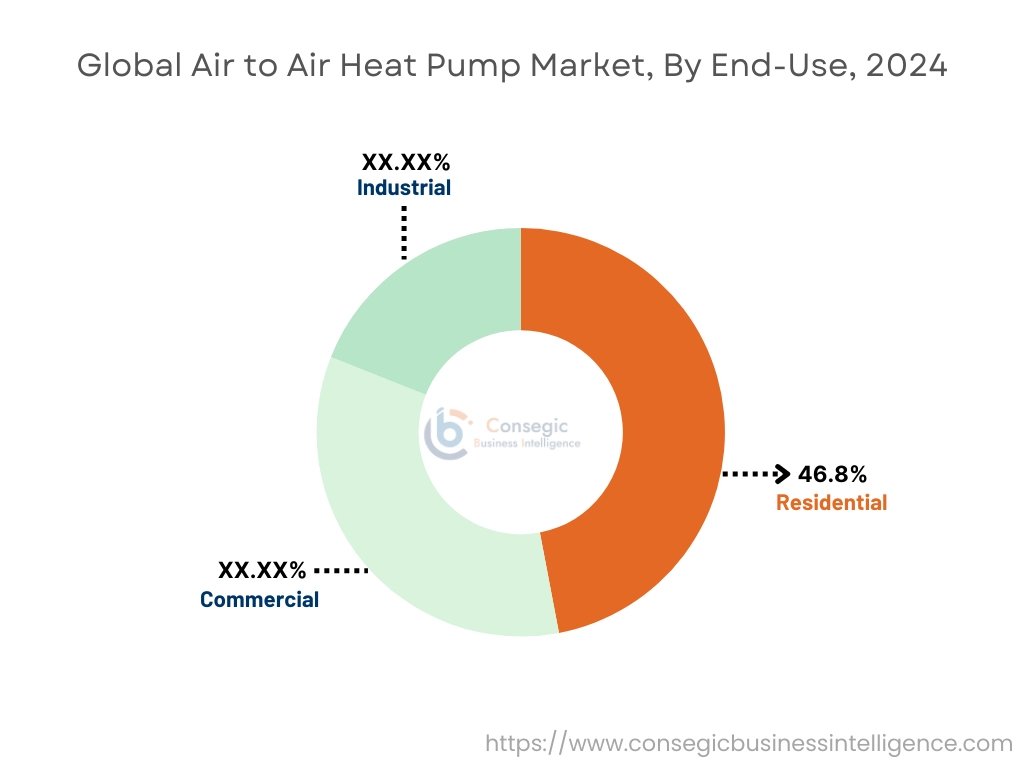
The residential segment held the largest air to air heat pump market share of 46.8% in 2024.
- Air-to-air heat pumps are increasingly used in single-family and multi-unit residences for space heating and cooling.
- Their integration with smart home systems enhances occupant control and energy optimization.
- Rising utility costs and stricter building efficiency standards are driving retrofits and new installations in the residential segment.
- As per air to air heat pump market analysis, residential deployment is reinforced by homeowner interest in sustainable and cost-effective HVAC alternatives.
The commercial segment is projected to register the fastest CAGR during the forecast period.
- Commercial properties like retail stores, offices, and small healthcare facilities are upgrading to heat pump solutions for reduced carbon emissions.
- Heat pumps support modular expansion and decentralized control, benefiting properties with variable occupancy levels.
- Government-led green building certifications encourage commercial adoption, especially in urban centers.
- Thus, commercial upgrades are a key driver of air to air heat pump market growth globally.
By Distribution Channel:
Based on distribution channel, the air to air heat pump market is segmented into online retail and offline retail (distributors, installers, OEMs).
The offline retail segment accounted for the largest revenue share in 2024.
- Offline retail remains the dominant channel due to the technical nature of system selection, installation, and post-sale support.
- Professional installers and OEMs guide system configuration based on building layout, capacity requirements, and local climate.
- Long-standing dealer networks ensure access to replacement parts and warranty services.
- Thus, offline channels offer confidence and reliability in complex HVAC installations, bolstering air to air heat pump market demand.
The online retail segment is anticipated to grow at the fastest CAGR during the forecast period.
- E-commerce platforms enable consumers to compare brands, access technical specifications, and read reviews before purchasing.
- Increasing digitalization and DIY-friendly mini-split kits are driving online purchases in residential applications.
- Manufacturers are strengthening their online presence with direct-to-consumer offerings, bundled with virtual support.
- Hence, the shift toward online channels is supported by evolving consumer preferences and wider internet accessibility, resulting in air to air heat pump market expansion.
Regional Analysis:
The regions covered are North America, Europe, Asia Pacific, the Middle East and Africa, and Latin America.
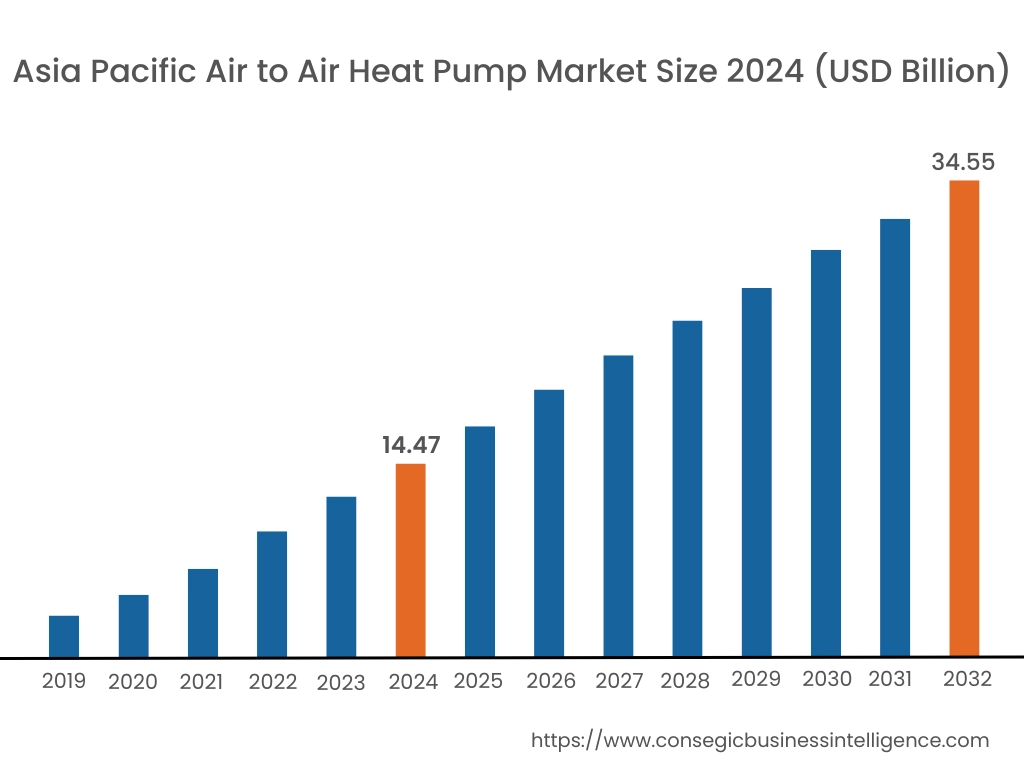
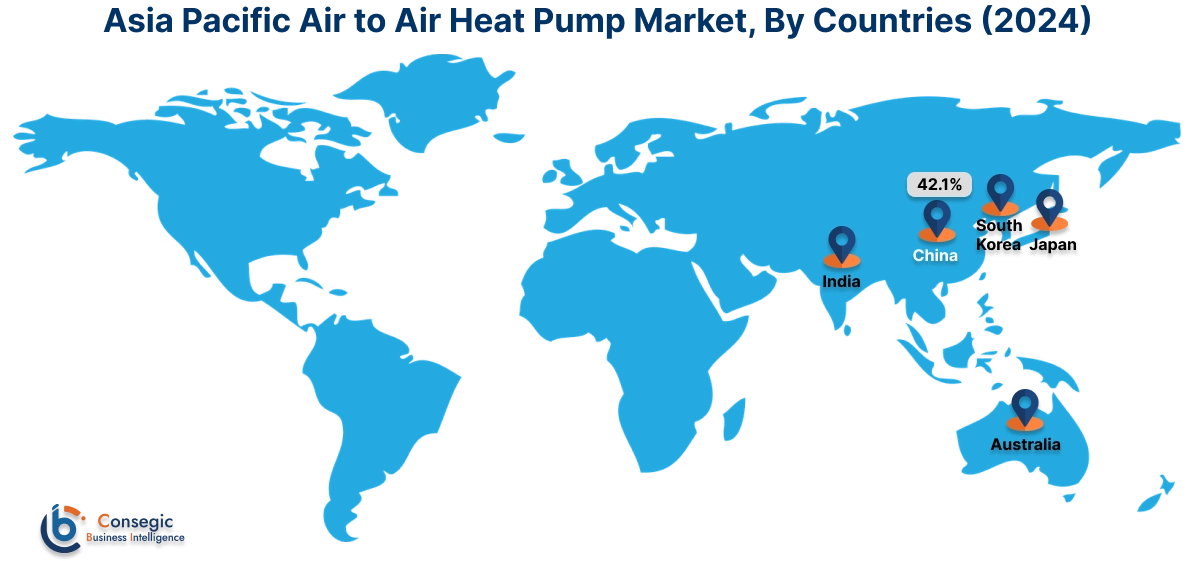
Asia Pacific region was valued at USD 14.47 Billion in 2024. Moreover, it is projected to grow by USD 15.87 Billion in 2025 and reach over USD 34.55 Billion by 2032. Out of this, China accounted for the maximum revenue share of 42.1%. The Asia-Pacific is experiencing strong growth in the air to air heat pump industry, fueled by climate volatility, growing urban populations, and heightened interest in electrified heating and cooling. Japan and South Korea are leaders in early adoption, with a well-established residential and commercial heat pump market underpinned by government initiatives and technology development. In China, widespread urbanization and policy requirements to enhance air quality are driving large-scale deployment in multifamily dwellings and public buildings. Market analysis indicates rising need in Australia and Southeast Asia, where reversible systems are used to meet year-round thermal comfort requirements. Manufacturing capacity in the region and increasing requirement for green building certifications for both domestic consumption and export opportunities support both.
North America is estimated to reach over USD 41.93 Billion by 2032 from a value of USD 17.77 Billion in 2024 and is projected to grow by USD 19.46 Billion in 2025. North America remains a key region for adoption, particularly in the United States and Canada, where pressure towards clean heating and cooling solutions is building. Market research shows that state-level mandates for energy efficiency, federal incentives for electrification, and increasing utility bills are driving the migration away from conventional HVAC systems toward heat pump substitutes. In colder climates, innovation in cold-climate heat pump technologies is further driving acceptance in residential and light commercial markets. Demand for ductless mini-split systems is also increasing due to the simplicity of retrofitting and zoning features. Growth continues to be spurred by the rise in low-emission heating solutions that are compatible with smart thermostats and grid-responsive platforms.
Europe dominates in total deployment, with high policy coordination and popular acceptance of decarbonizing building heating systems. Germany, France, Sweden, and the Netherlands are retiring fossil fuel-based boilers and ramping up the installation of air to air heat pumps through national renovation schemes and green building regulations. Market research indicates that carbon neutrality objectives and building energy directives are stimulating uptake in new builds and retrofitting. The trend is strong towards inverter-based, high-efficiency models that can seamlessly integrate with thermal storage and solar PV systems. The European air to air heat pump market opportunity is expanding as financial subsidies continue to roll out and regulatory influence pushes for an end to gas-based heating in domestic markets.
Latin America is exhibiting early but consistent adoption, particularly in Chile, Brazil, and Argentina. Market research shows that growing awareness of environmental advantages and the necessity for effective temperature control in mixed climates are driving need for heat pump systems. Demand is mainly concentrated in urban residential schemes and mid-scale commercial developments where electric heating options are becoming increasingly popular. Hurdles like upfront cost and low consumer awareness are being overcome through energy efficiency drives and phased infrastructure upgradation. Expansion is anticipated to be supported by local climate adaptation initiatives and growth of renewable electricity networks.
The Middle East and Africa offer a developing market with selective uptake, especially in nations with moderate seasonal temperature difference or mountainous regions. In South Africa, Turkey, and the UAE, the latest construction and high-end residential schemes are incorporating air to air heat pumps into designs as a means to enhance indoor climate control and mitigate energy consumption. Market research points to increasing knowledge of the dual heating and cooling functionality of the technology, particularly in green buildings and sustainable development areas. While penetration continues to be limited, the region's market opportunity is expanding due to greater investment in green infrastructure and electrified heating.
Top Key Players and Market Share Insights:
The air to air heat pump market is highly competitive with major players providing products and services to the national and international markets. Key players are adopting several strategies in research and development (R&D), product innovation, and end-user launches to hold a strong position in the global air to air heat pump market. Key players in the air to air heat pump industry include -
- Daikin Industries Ltd. (Japan)
- Mitsubishi Electric Corporation (Japan)
- Panasonic Holdings Corporation (Japan)
- Stiebel Eltron GmbH & Co. KG (Germany)
- Viessmann Group (Germany)
- LG Electronics Inc. (South Korea)
- Samsung Electronics Co., Ltd. (South Korea)
- Midea Group Co., Ltd. (China)
- Fujitsu General Limited (Japan)
- Bosch Thermotechnology GmbH (Germany)
Recent Industry Developments :
Acquisitions:
- In April 2025, the global air conditioning and climate control solution expert, Daikin acquired the Swedish residential heat pump service company Kylslaget. This move elevated Daikin’s service network in Sweden, increased the number of service technicians and expanded its training programs. This decision is part of a larger expansion strategy focused on Scandinavia, following the acquisition of BKF Klima in Denmark earlier in 2024. This is because the region has an advanced residential heat pump market due to strong environmental awareness.
Partnerships:
- In October 2023, E.S partnered with Daikin to launch its own Sustainable Home Centre (SHC). The centre showcased a range of low-carbon solutions, from heat pumps to fan convectors.
Air to Air Heat Pump Market Report Insights:
| Report Attributes | Report Details |
| Study Timeline | 2019-2032 |
| Market Size in 2032 | USD 125.86 Billion |
| CAGR (2025-2032) | 11.3% |
| By Product Type |
|
| By Technology |
|
| By End-Use |
|
| By Distribution Channel |
|
| By Region |
|
| Key Players |
|
| North America | U.S. Canada Mexico |
| Europe | U.K. Germany France Spain Italy Russia Benelux Rest of Europe |
| APAC | China South Korea Japan India Australia ASEAN Rest of Asia-Pacific |
| Middle East and Africa | GCC Turkey South Africa Rest of MEA |
| LATAM | Brazil Argentina Chile Rest of LATAM |
| Report Coverage |
|
Key Questions Answered in the Report
How big is the Air to Air Heat Pump Market? −
Air to Air Heat Pump Market size is estimated to reach over USD 125.86 Billion by 2032 from a value of USD 53.45 Billion in 2024 and is projected to grow by USD 58.54 Billion in 2025, growing at a CAGR of 11.3% from 2025 to 2032.
What specific segmentation details are covered in the Air to Air Heat Pump Market report? +
The Air to Air Heat Pump market report includes specific segmentation details for product type, technology, end-use and distribution channel.
What are the end-use of the Air to Air Heat Pump Market? +
The end-use of the Air to Air Heat Pump Market are residential, commercial, and industrial.
Who are the major players in the Air to Air Heat Pump Market? +
The key participants in the Air to Air Heat Pump market are Daikin Industries, Ltd. (Japan), Mitsubishi Electric Corporation (Japan), Panasonic Holdings Corporation (Japan), LG Electronics Inc. (South Korea), Samsung Electronics Co., Ltd. (South Korea), Midea Group Co., Ltd. (China), Fujitsu General Limited (Japan), Bosch Thermotechnology GmbH (Germany), Stiebel Eltron GmbH & Co. KG (Germany) and Viessmann Group (Germany).
Overview
Reputation & Certifications


Our Services
- Market Intelligence & Forecasting
- Custom Research Solutions
- Market Entry Strategy
- Competitive Intelligence
- Customer Insights
- Industry Innovation Analysis
- Investment Advisory