Jump to Content
Rotary Heat Pump Compressors Market - Size, Share, Industry Trends, and Forecasts (2025-2032)
Rotary Heat Pump Compressors Market Size:
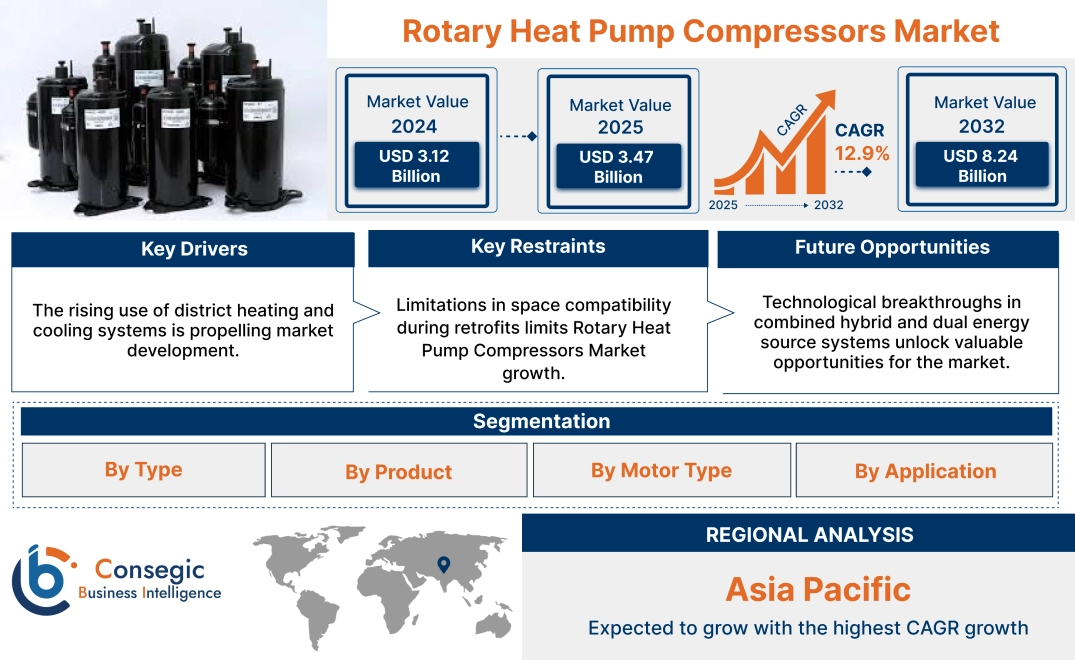
Rotary Heat Pump Compressors Market size is estimated to reach over USD 8.24 Billion by 2032 from a value of USD 3.12 Billion in 2024 and is projected to grow by USD 3.47 Billion in 2025, growing at a CAGR of 12.9% from 2025 to 2032.
Rotary Heat Pump Compressors Market Scope & Overview:
Rotary heat pump compressor are mechanical devices designed to circulate refrigerant within heat pump systems using a rotary motion to compress the gas. These compressors are valued for their small dimensions, quiet performance, and steady airflow, making them a good fit for systems where space is limited and low noise is important. They typically use either a rolling piston or a vane mechanism to carry out the compression process.
Their design usually includes a sealed casing, built-in suction and discharge ports, an oil system for lubrication, and an electric motor. The internal parts are made with close-fitting tolerances to reduce energy loss and improve thermal performance. These rotary compressors are compatible with various refrigerants and are often optimized for use in low to moderate capacity systems such as residential HVAC, domestic water heating, and compact commercial units.
These compressors play an essential role in ensuring operational stability and energy transfer within compact system designs. End-users include manufacturers of heating and cooling systems that require consistent thermodynamic performance in environments with frequent load cycling.
Rotary Heat Pump Compressors Market Dynamics - (DRO) :
Key Drivers:
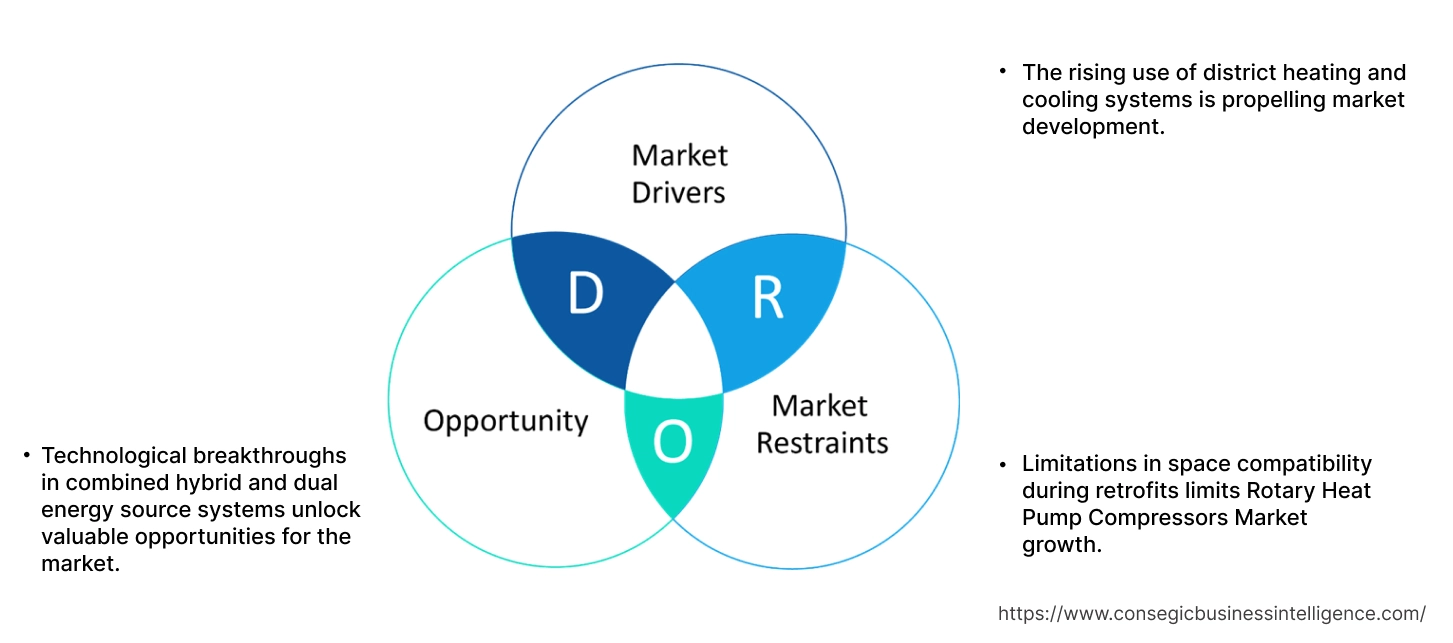
The rising use of district heating and cooling systems is propelling market development.
District heating and cooling systems are becoming increasingly popular in large urban areas due to their ability to provide efficient, centralized temperature control. These systems are designed to reduce energy consumption by using a shared source to heat or cool multiple buildings, helping to lower overall operational costs and carbon emissions. Rotary heat pump compressors are well-suited for district systems because they offer high-efficiency performance, ensuring consistent heating and cooling across large spaces. These advancements in sustainable infrastructure and energy efficiency encourage urban areas to adopt heat pump compressors in district heating and cooling systems. The integration of rotary compressors in these systems not only enhances their efficiency but also helps cities meet environmental targets. This rise toward centralized, energy-efficient climate control solutions presents a significant driver for the rotary heat pump compressor market growth.
Key Restraints:
Limitations in space compatibility during retrofits limits Rotary Heat Pump Compressors Market growth.
Retrofitting older HVAC systems, especially in commercial and residential buildings often create structural compatibility issues due to lack of space which is needed to accommodate new, advanced technologies. Retrofitting existing infrastructure requires careful planning and technical modifications, which can involve significant operational and handling costs and time. Many buildings, particularly older ones, may not be designed to support the advanced components of rotary heat pump systems, resulting in the need for extensive renovations. This can lead to higher installation costs, longer project timelines, and potential disruptions to daily operations. These hurdles often deter building owners from adopting new systems, particularly in retrofit projects. This results in, slowed market growth, significantly limiting the rotary heat pump compressors market expansion.
Future Opportunities :
Technological breakthroughs in combined hybrid and dual energy source systems unlock valuable opportunities for the market.
The increasing demand for hybrid and dual-source systems is steering market growth in both residential and commercial applications. These systems combine rotary compressors with other technologies such as geothermal or air-source heat pumps to optimize energy use depending on seasonal or environmental conditions, i.e., in colder months, the system may rely on geothermal energy, while in warmer months, the rotary compressor might be used for cooling, ensuring that energy consumption is always optimized. Additionally, as these hybrid systems become more refined and cost-effective, their potential for widespread adoption in regions with varying climates increases. This versatility makes hybrid and dual-source systems particularly attractive to both homeowners and businesses looking for year-round, energy-efficient solutions.
- For instance, in February 2025, LG Electronics presented their wide range of advanced HVAC solutions at the AHR Expo 2025. These models included a full pack of electrification solutions based on the company’s high-efficiency inverter heat pumps, including the LG Inverter Heat Pump Water Heater that uses DUAL Inverter Heat Pump technology, offering convenient smart control with integration of the ThinQ app.
As technological advancements continue to improve the performance and affordability of these systems, the adoption of these heat pump compressors in such solutions is expected to grow, driving rotary heat pump compressors market opportunities.
Rotary Heat Pump Compressors Market Segmental Analysis :
By Type:
Based on Type, the market is categorized into Single Rotary Compressors and Twin Rotary Compressors.
The Single Rotary Compressors segment holds the largest revenue of the overall Rotary Heat Pump Compressors Market share in the year 2024.
- Single rotary compressors operate with one rolling piston and a vane, offering compact design, low cost, and simplified construction.
- These compressors are commonly used in small-capacity residential heat pumps due to their balance of efficiency, reliability, and affordability.
- Manufacturers continue to improve noise insulation and sealing technology in single rotary models, extending their application in energy-efficient domestic heating.
- According to the rotary heat pump compressors market analysis, the low cost model, widespread compatibility, and ease of integration in wall-mounted and split systems make it the largest segment, significantly propelling the market growth.
The Twin Rotary Compressors segment is expected to grow at the fastest CAGR during the forecast period.
- Twin rotary compressors use two rotating pistons operating 180 degrees out of phase, reducing torque fluctuation and improving operational smoothness.
- These compressors are more energy-efficient and generate lower noise and vibration, making them ideal for high-end residential and light commercial
- Additionally, OEMs are increasingly integrating twin rotary compressors in inverter-driven systems for better partial-load performance and temperature stability.
- As per the market trends, rising demand for ultra-efficient, quiet, and long-life compressors in premium and low-GWP refrigerant heat pump applications have substantially driven the global rotary heat pump compressors market demand.
By Product:
Based on Product, the market is categorized into Air Source, Ground Source, and Water Source.
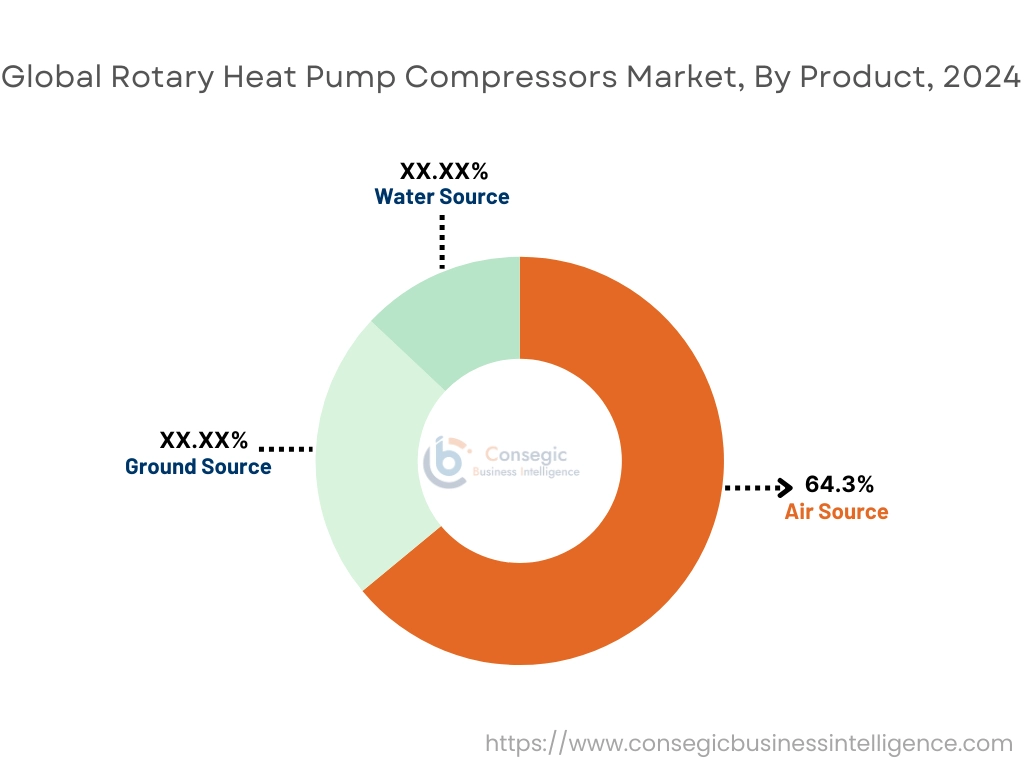
The Air Source segment holds the largest revenue of the overall Rotary Heat Pump Compressors Market share of 64.3% in the year 2024.
- Air source rotary heat pumps are cost-effectiveness, simpler installation, and broad employed in both residential and light-commercial buildings.
- These systems extract heat from ambient air, making them ideal for moderate climate zones where year-round temperature differentials support efficient heat exchange.
- Rotary compressors are particularly well-suited for compact air source units thanks to their low noise, stable part-load performance, and ability to cycle frequently without mechanical stress.
- According to the rotary heat pump compressors market analysis, the widespread applicability, regulatory support, and continued product optimization in the air-to-air segment make it the largest segment, significantly propelling the market growth.
The Water Source segment is expected to grow at the fastest CAGR during the forecast period.
- Water source heat pump systems are gaining traction in large buildings and district energy systems, where a consistent water loop or geothermal reservoir is available for stable thermal exchange.
- Rotary compressors used in these systems deliver high efficiency at both partial and peak loads, especially in closed-loop applications with controlled inlet temperatures.
- Additionally, their adoption is accelerating in commercial sectors such as hospitals, universities, and high-performance buildings that target LEED or BREEAM certification.
- As per the market analysis, the growing thermal infrastructure projects scale in urban districts and new construction focusing on lifecycle energy savings, fuel the global rotary heat pump compressors market opportunities.
By Motor Type:
Based on Motor Type, the market is categorized into Fixed Speed, Inverter (Variable Speed), Brushless DC (BLDC).
The Fixed Speed segment holds the largest revenue share of the overall Rotary Heat Pump Compressors Market in the year 2024.
- Fixed speed motors operate at a constant speed once turned on, making them simpler and more affordable to manufacture and maintain.
- Fixed speed rotary compressors are reliable for areas with steady heating or cooling demand, where speed adjustments are not necessary.
- Additionally, many original equipment manufacturers (OEMs) still offer fixed speed models as part of their entry-level product lines due to long-standing market familiarity.
- Thus, the market analysis shows that affordability and strong presence in legacy equipment, significantly drives the rotary heat pump compressors market trends.
The Inverter (Variable Speed) segment is expected to grow at the fastest CAGR during the forecast period.
- Inverter motors adjust their speed based on real-time heating or cooling needs, which helps reduce energy usage and improves indoor temperature control.
- Variable speed operation allows rotary compressors to run smoothly, reduce wear and tear, and deliver quieter performance compared to fixed speed systems.
- Additionally, major OEMs are actively shifting toward inverter-driven rotary compressors as building standards emphasize seasonal energy efficiency and carbon reduction.
- For instance, in November 2024, Daikin and Copeland announced a joint venture to bring energy and cost savings and enhanced reliability to the US market. This venture focuses on bringing inverter swing rotary compressors and accelerate the shifting trend towards energy-efficient heat pumps.
- According to the market analysis, the shifting trend towards seek high-efficiency and low-noise solutions is significantly fueling the global rotary heat pump compressors market progress.
By Application:
Based on Application, the market is categorized into Residential, Commercial, and Industrial.
The Residential segment holds the largest revenue share of the overall Rotary Heat Pump Compressors Market in the year 2024.
- Rotary compressors are highly favored in residential heat pumps due to their compact size, affordability, and compatibility with low-to-medium capacity systems.
- Single-family homes, apartments, and multifamily dwellings adopt rotary-based heat pumps for space heating, water heating, and hybrid climate systems.
- The growing regulatory incentives, subsidy programs, and building energy efficiency mandates in various countries is boosting the adoption of these heat pump compressors.
- For instance, in June 2023, Danfoss and Highly collaborated to offer rotary technology to the residential heat pump market. This partnership strengthened Danfoss as a reliable partner to accelerate the decarbonization of the heating sector.
- Thus, the large installation base, growing replacement demand, and consistent volume sales in residential areas, significantly drives the rotary heat pump compressors market trends.
The Commercial segment is expected to grow at the fastest CAGR during the forecast period.
- Commercial buildings, including hotels, offices, hospitals, and retail centers are increasingly adopting rotary heat pump compressors in variable refrigerant flow (VRF) and modular multi-zone systems.
- Twin rotary compressors are preferred in commercial units due to their enhanced energy performance, reduced acoustic output, and better load management.
- Commercial projects gain cost advantages by upgrading older systems and adding rotary-based heat pumps into hybrid or multi-unit configurations.
- According to the market analysis, the shifting trend of sustainable HVAC solutions and the increasing adoption of energy-as-a-service (EaaS) models is significantly fueling the global rotary heat pump compressors market expansion.
Regional Analysis:
The regions covered are North America, Europe, Asia Pacific, Middle East and Africa, and Latin America.
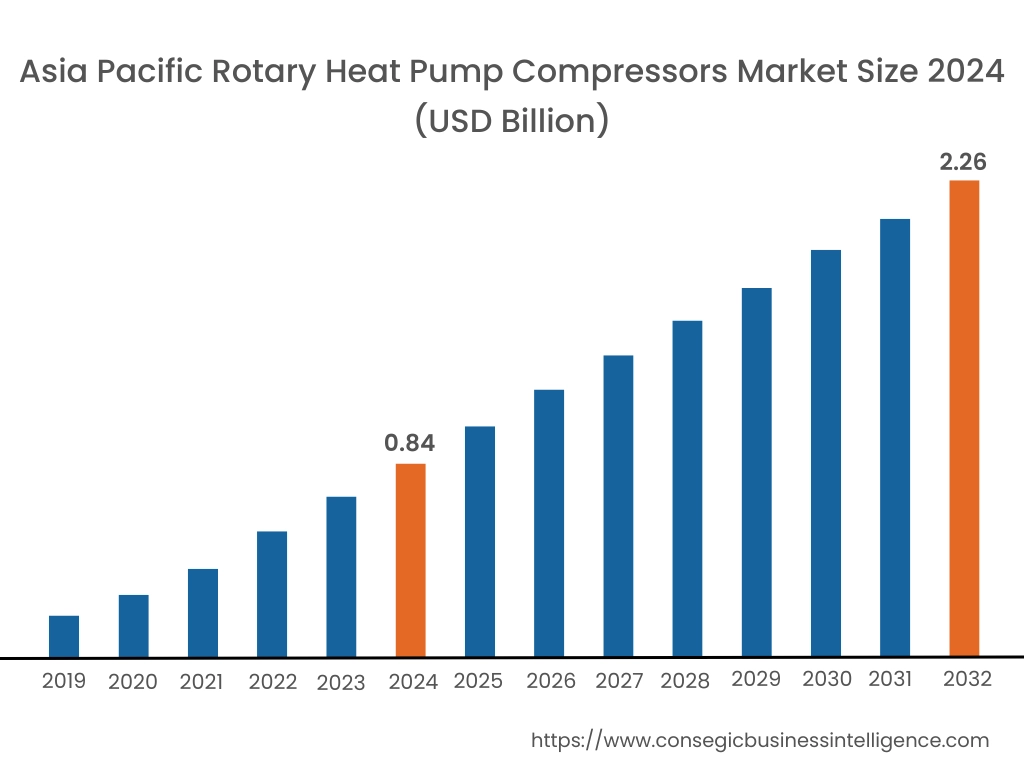
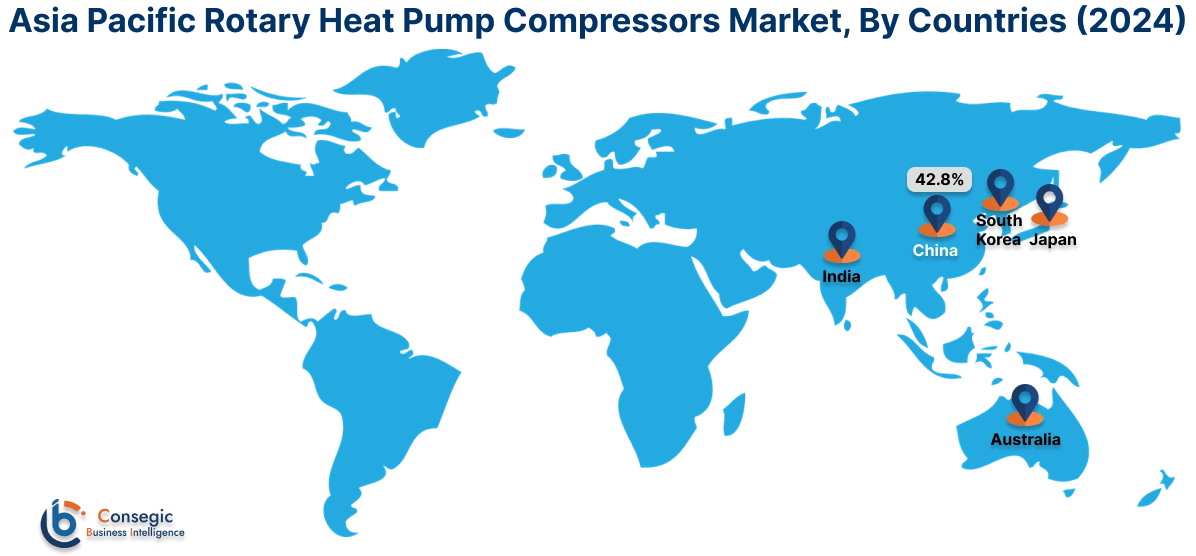
Asia Pacific region was valued at USD 0.84 Billion in 2024. Moreover, it is projected to grow by USD 0.94 Billion in 2025 and reach over USD 2.26 Billion by 2032. Out of this, China accounted for the maximum revenue share of 42.8%.
In the Asia-Pacific region countries such as China, Japan, India, and South Korea are redefining the rotary heat pump compressor market with a strong emphasis on modernizing power solutions for rapidly developing urban centers and industrial applications. Additionally, integrating digital control technologies that enable real-time performance monitoring and precise energy management fuels market development.
- For instance, in December 2024, Daikin Airconditioning India Pvt. Ltd. and Rechi Precision Co., Ltd. announced a partnership to establish a joint venture in India with an aim to manufacture, design, and sell compressors to Indian HVAC industry. This partnership will deliver business foundation of Daikin and the manufacturing capabilities of Rechi for low-cost, high-quality compressors in the Indian market.
Analysis of the market showed that government-led initiatives and local innovation play a crucial role, and strategic partnerships between domestic technology providers and international experts are essential for tailoring solutions to local industrial needs, significantly driving the rotary heat pump compressors market demand.
North America is estimated to reach over USD 2.74 Billion by 2032 from a value of USD 1.04 Billion in 2024 and is projected to grow by USD 1.15 Billion in 2025.
- For instance, in December 2024, Mitsubishi Electric Corporation announced that it will invest U.S. $143.5 million to renovate a US-based factory to make variable speed compressors used in high-efficiency heat pumps. Based in Kentucky, the factory currently manufactures and sells automotive electrical equipment, will now also start with the production of compressors.
Furthermore, the supportive regulatory policies and strategic investments in research and development have significantly driven the Rotary Heat Pump Compressors industry in this region.
European countries such as Germany, France, Italy, and the United Kingdom are at the forefront of adopting rotary compressor technology, particularly within the context of the region’s commitment to reducing carbon emissions and promoting renewable energy. The shifting trend toward incorporating advanced control systems in compressors to improve efficiency and ensure precise temperature regulation highlights market potential. Moreover, focus on developing robust products that withstand diverse weather conditions common in various European climates have significantly boosted the rotary heat pump compressors market in this region.
The Rotary Heat Pump Compressor Market in the Middle East and Africa experiences steady growth mainly due to the development of rugged compressor designs that can operate reliably under extreme temperatures while minimizing energy use. Furthermore, the rising trend towards the customization of smart control systems to adapt to both hot, arid environments and regions with significant temperature variations has significantly boosted the market progress. Analysis of the market showed that efforts to modernize infrastructure and align with stringent environmental goals, have fueled the rotary heat pump compressors market in this region.
In Latin America, the market is witnessing a shift towards innovative energy solutions as agricultural and industrial sectors modernize their operations. One trends is the increasing use of compressors integrated with smart sensor technology to achieve optimal thermal management in diverse environmental conditions. Additionally, the rising focus on the development of flexible system architectures that can be easily adapted to regional climatic differences and application requirements is propelling the market demand, significantly driving the rotary heat pump compressors market growth in this region.
Top Key Players and Market Share Insights:
The Rotary Heat Pump Compressors Market is highly competitive with major players providing products and services to the national and international markets. Key players are adopting several strategies in research and development (R&D), product innovation, and end-user launches to hold a strong position in the global Rotary Heat Pump Compressors Market. Key players in the Rotary Heat Pump Compressors industry include -
- Panasonic Industry Co., Ltd. (Japan)
- LG Electronics Inc. (South Korea)
- Midea Group Co., Ltd. (China)
- Samsung Electronics Co., Ltd. (South Korea)
- Rechi Precision Co., Ltd. (Taiwan)
- GMCC (Guangdong Meizhi Compressor Co., Ltd.) (China)
- Boyard Compressor Co., Ltd. (China)
- Danfoss A/S (Denmark)
- Johnson Controls International plc (Ireland)
- Emerson Electric Co. (Copeland) (United States)
Recent Industry Developments :
Product Launches:
- In January 2024, Tecumseh Products Company LLC introduced new product range optimized for low-GWP refrigerants. One of the products unveiled was the A2L ready rotary compressors for hot water heat pump applications equipped with A2L refrigerants, offered in both horizontal and vertical orientations and can cater to a wide range of manufacturing needs.
Rotary Heat Pump Compressors Market Report Insights:
| Report Attributes | Report Details |
| Study Timeline | 2019-2032 |
| Market Size in 2032 | USD 8.24 Billion |
| CAGR (2025-2032) | 12.9% |
| By Type |
|
| By Product |
|
| By Motor Type |
|
| By Application |
|
| By Region |
|
| Key Players |
|
| North America | U.S. Canada Mexico |
| Europe | U.K. Germany France Spain Italy Russia Benelux Rest of Europe |
| APAC | China South Korea Japan India Australia ASEAN Rest of Asia-Pacific |
| Middle East and Africa | GCC Turkey South Africa Rest of MEA |
| LATAM | Brazil Argentina Chile Rest of LATAM |
| Report Coverage |
|
Key Questions Answered in the Report
How big is the Rotary Heat Pump Compressors Market? −
Rotary Heat Pump Compressors Market size is estimated to reach over USD 8.24 Billion by 2032 from a value of USD 3.12 Billion in 2024 and is projected to grow by USD 3.47 Billion in 2025, growing at a CAGR of 12.9% from 2025 to 2032.
What specific segments are covered in the Rotary Heat Pump Compressors Market? +
The Rotary Heat Pump Compressors Market specific segments for Type, Product, Motor Type, Application, and Region.
Which is the fastest-growing region in the Rotary Heat Pump Compressors Market? +
Asia pacific is the fastest growing region in the Rotary Heat Pump Compressors Market.
What are the major players in the Rotary Heat Pump Compressors Market? +
The key players in the Rotary Heat Pump Compressors Market are Panasonic Industry Co., Ltd. (Japan), LG Electronics Inc. (South Korea), Midea Group Co., Ltd. (China), Samsung Electronics Co., Ltd. (South Korea), GMCC (Guangdong Meizhi Compressor Co., Ltd.) (China), Boyard Compressor Co., Ltd. (China), Danfoss A/S (Denmark), Johnson Controls International plc (Ireland), Emerson Electric Co. (Copeland) (United States), Rechi Precision Co., Ltd. (Taiwan), and others.
Overview
Reputation & Certifications


Our Services
- Market Intelligence & Forecasting
- Custom Research Solutions
- Market Entry Strategy
- Competitive Intelligence
- Customer Insights
- Industry Innovation Analysis
- Investment Advisory