Jump to Content
Commercial Water Heater Market - Size, Share, Industry Trends, and Forecasts (2025-2032)
Commercial Water Heater Market Size:
Commercial Water Heater Market size is estimated to reach over USD 14.55 Billion by 2032 from a value of USD 8.35 Billion in 2024 and is projected to grow by USD 8.80 Billion in 2025, growing at a CAGR of 7.2% from 2025 to 2032.
Commercial Water Heater Market Scope & Overview:
Commercial water heaters are essential systems used in various industries to produce and supply hot water in large volumes for multiple commercial applications. These units are designed to cater to larger needs compared to residential water heaters. They come in various types, including tankless, storage tank, and heat pump models, each designed for efficiency and capacity to meet commercial needs. These water heaters function through different heating methods, such as electric, gas, or solar, increasing versatility for various commercial enterprises. They offer an array of benefits such as energy efficiency, reduced operational costs, and reliable hot water supply, crucial for various businesses. They find application across a wide array of industries, including healthcare facilities, hospitality (hotels, motels), commercial laundries, offices, and buildings with industrial processes, as well as high-density housing.

Commercial Water Heater Market Dynamics - (DRO) :
Key Drivers:
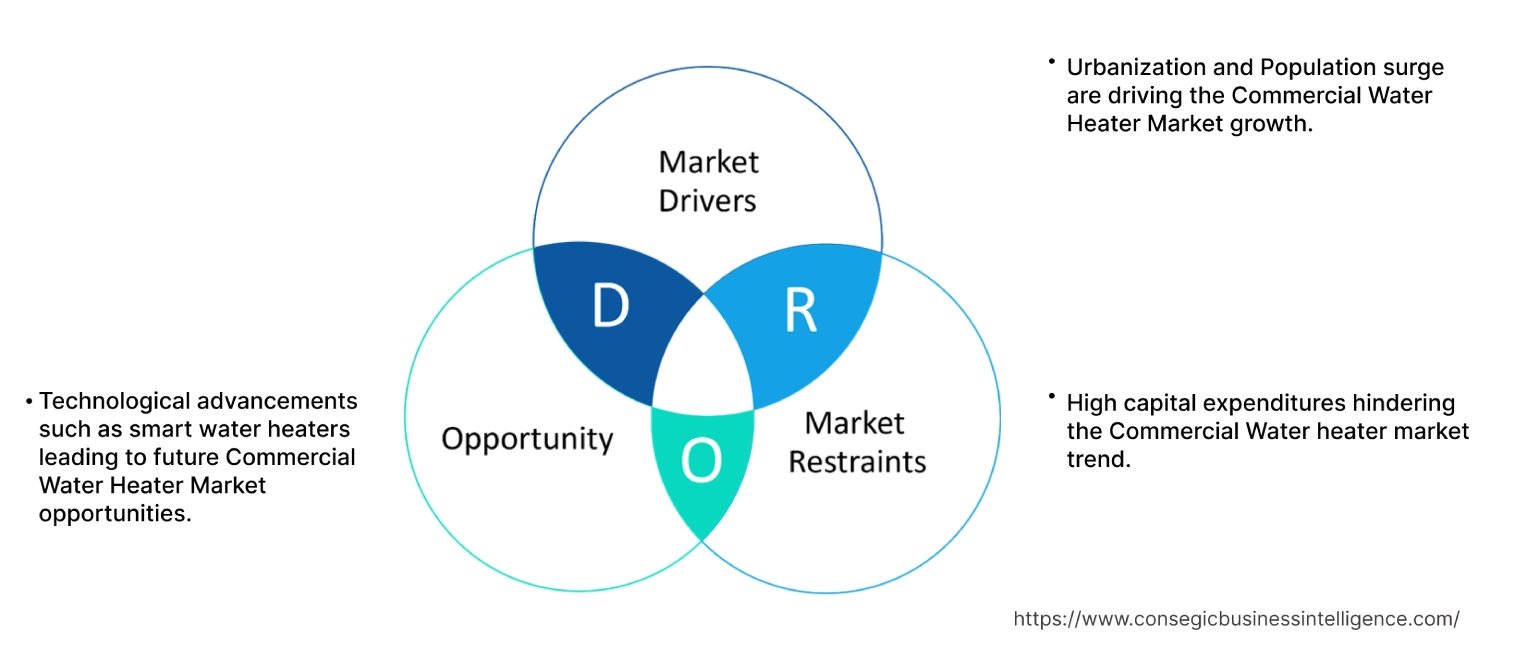
Urbanization and Population surge are driving the Commercial Water Heater Market growth.
Urbanization leads to a surge in the need of commercial water heaters due to increased population density, infrastructure development, and the need for hot water in commercial establishments like hotels, hospitals, and restaurants. As cities grow, the number of people living and working in urban areas increases, leading to a higher interest for infrastructure, housing, and commercial spaces.Urbanization fuels the surge of commercial establishments which require reliable and efficient hot water solutions.More people means more daily activities that require hot water, such as cleaning, cooking, and bathing, both in residential and commercial settings.
- For instance, in July 2024, O. Smith, a leader in water heating and water treatment, announces the addition of the Voltex MAX hybrid electric heat pump water heater (HPWH) to its growing family of sustainable products. The Voltex MAX HPWH uses a new smart valve to deliver maximum hot water while the heat pump technology provides maximum savings. Using newly available advanced operating modes, the Voltex MAX provides more hot water than previous iterations of heat pump water heaters.
Thus, the population surge and rapid urbanization which fuels the commercial establishment increment is driving the Commercial water heater market demand.
Key Restraints:
High capital expenditures hindering the Commercial Water heater market trend.
Commercial water heaters are designed to handle significantly higher water heating needs compared to residential heaters, requiring larger tanks, more powerful heating elements, and robust construction to withstand continuous use, which translates to higher upfront costs. They have high capital expenditure due to factors like the need for robust, high-capacity systems, specialized fuel infrastructure (for oil or gas), and the complexity of installation and maintenance, which leads to higher initial costs and ongoing expenses.Oil and gas-fired commercial water heaters necessitate the installation of specialized fuel pipelines and exhaust systems, adding to the complexity and cost of the installation process. Their constant operation leads to accelerated wear and tear, requiring more frequent maintenance and repairs, further increasing the overall cost of ownership.
Thus, their high capital expenditures, including development, installation, and maintenance, are a significant factor affecting the commercial water heater market expansion.
Future Opportunities :
Technological advancements such as smart water heaters leading to future Commercial Water Heater Market opportunities.
Smart technology in commercial water heaters offers advancements like remote monitoring, energy optimization, and integration with building management systems, leading to improved efficiency and cost savings. Smart water heaters allow for remote access and control, enabling facility managers to monitor energy consumption, adjust temperatures, and even turn the system on or off remotely.Smart features like scheduling and demand response capabilities allow for optimizing energy usage by heating water only when needed, reducing energy waste and lowering operational costs.Smart water heaters tracks usage patterns and provide data insights to help optimize water heating systems and identify areas for improvement.They provide alerts for potential issues, such as leaks or low water pressure, allowing for timely maintenance and preventing costly repairs.Some smart water heaters are hybrid systems, combining electric resistance heating with heat pump technology to extract heat from the air, leading to significant energy savings.
- For instance, in March 2025, Xiaomi Launched Mijia Gas Water Heater S10 with Smart Temperature Control. It provides precision ±0.3℃ temperature control and smart dual-drive water servo tech and is compatible with other Xiaomi home products. With its intelligent dual-drive water servo, S10 dynamically adjusts pipeline water flow and maintains a safe and stable temperature even with unstable water pressure or flow.
Thus, the technological advancements such as smart water heaters provides potential Commercial Water Heater market opportunities.
Commercial Water Heater Market Segmental Analysis :
By Product type:
Based on product type, the market is segmented into tankless, storage tank, and heat pump model.
The tankless segment accounted for the largest revenue in the Commercial water heater market share in 2024 and are anticipated to register the highest CAGR during the forecast period.
- A tankless water heater, also known as an on-demand water heater, heats water only when it's needed and does not store hot water.
- Tankless heaters use electric elements or gas burners to heat water instantly when required. Since they only activate when there’s a need for hot water, they are more energy-efficient, avoiding the constant heating and reheating of water.
- Tankless models don't have a storage tank to hold heated water, which means they don't lose heat through standby losses.
- These units provide a continuous supply of hot water, which is particularly beneficial for businesses with varying peak interests.
- Tankless water heaters provide instant heated water, avoiding standby losses and thus, driving the commercial water heater market growth.
By Power:
Based on power, the market is segmented into electric, solar and gas.
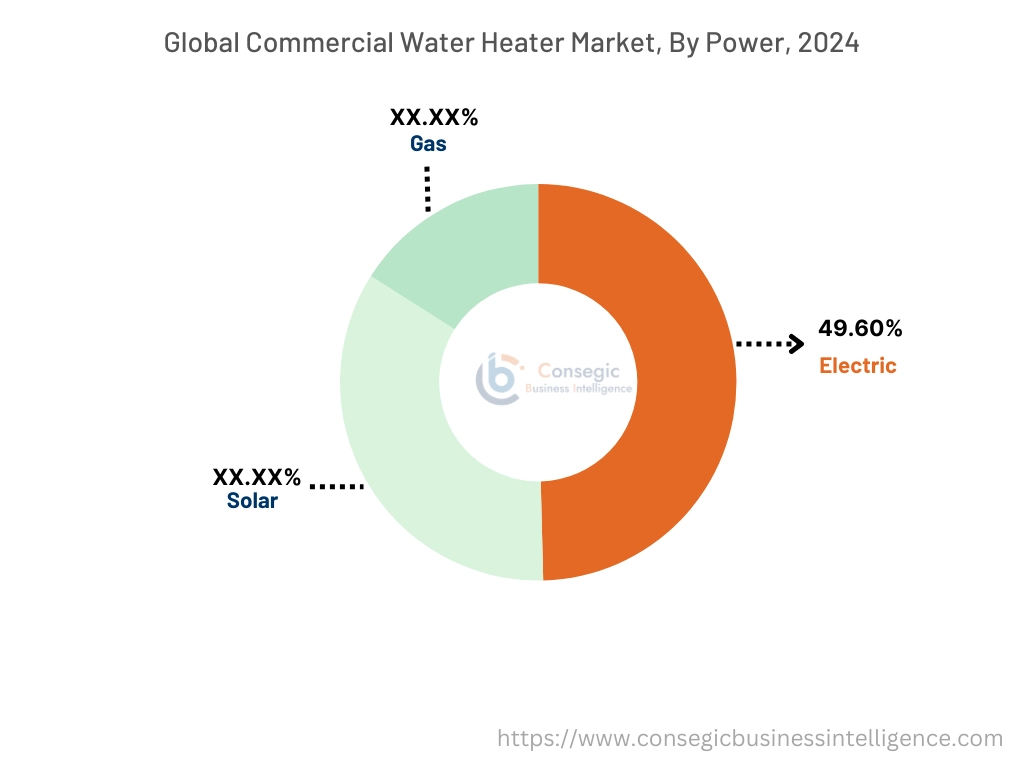
The electric segment accounted for the largest Commercial Water Heater Market share of 49.6% in 2024.
- Electric water heaters are devices that use electricity to heat water for various uses such as bathing, cooking, and cleaning. They typically consist of a heating element, a thermostat, and a storage tank or a heat exchanger.
- Electric water heaters convert electrical energy into heat, which then heats the water stored in the tank or as it flows through the device.
- They offer benefits such as safety due to the absence of combustion, lower initial costs, and energy efficiency as they convert most energy into heat.
- Electric water heaters, especially those with insulated designs, have the capability to maintain heat for longer duration, reducing heat loss.
- Thus, the trend of electric water heaters are driving the market.
The solar segment is anticipated to have the fastest CAGR during the forecast period.
- Solar-based water heaters use the sun's energy to heat water, offering a cost-effective and environmentally friendly alternative to conventional water heaters.
- Solar water heaters significantly reduces electricity or gas bills, as they use a free and renewable energy source.
- While the initial investment may be higher, solar water heaters offer long-term savings and a reduced environmental impact.
- Improvements in solar technology, including higher efficiency solar collectors and storage tanks, enhances the performance and reliability of solar water heaters making them more useful for commercial applications where consistent hot water is needed.
- For instance, in January 2024, The Renewable Energy and Energy Efficiency Encouragement Fund, affiliated with the Ministry of Energy and Mineral Resources, announced the activation of the preliminary inclusion platform for inquiring about the subsidy program for installing PV systems and solar water heating systems for the residential sector subscribers.
- Thus, according to segmental analysis, the solar water heater is experiencing rapid increase in its market trend due to its high efficiency collectors and storage tanks are driving the market.
By Applications:
Based on applications, the market is segmented into healthcare, restaurants, institutes, offices, and others.
The healthcare segment accounted for the largest revenue share in the commercial water heater market in 2024 and is anticipated to have the highest CAGR during the forecast period.
- In the healthcare sector, they are crucial for various functions, including patient care, hygiene, and facility operations, requiring efficient and reliable hot water supply.
- They are used for various tasks, including sanitation, sterilization, cleaning, and powering medical equipment.
- Hospitals and healthcare facilities have a high and constant need for hot water, requiring robust and reliable water heating systems.
- Hot water is essential for bathing, cleaning, and hygiene procedures, directly impacting patient comfort and well-being.
- Hospitals ensures the safety and quality of their water supply, including hot water, to prevent the spread of infections.
- Therefore, the requirement of supply of water heaters for sanitation and sterilization to ensure cleanliness and prevent the spread of infections is a massive trend in the healthcare industry and is driving the market.
Regional Analysis:
The regions covered are North America, Europe, Asia Pacific, the Middle East and Africa, and Latin America.
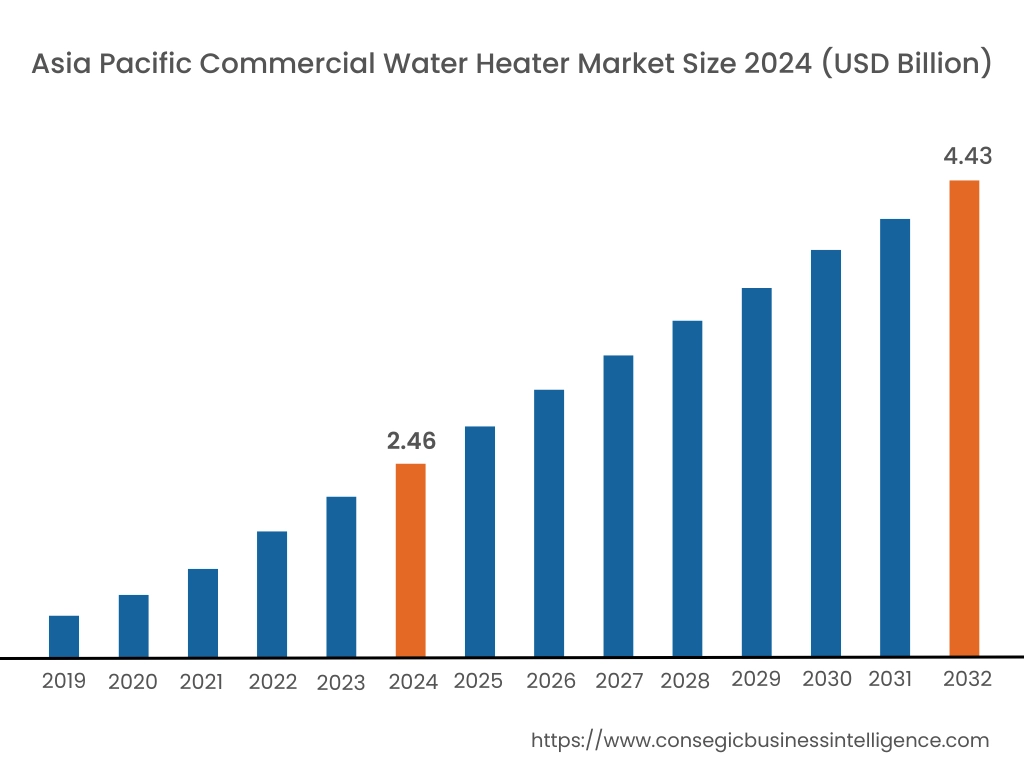
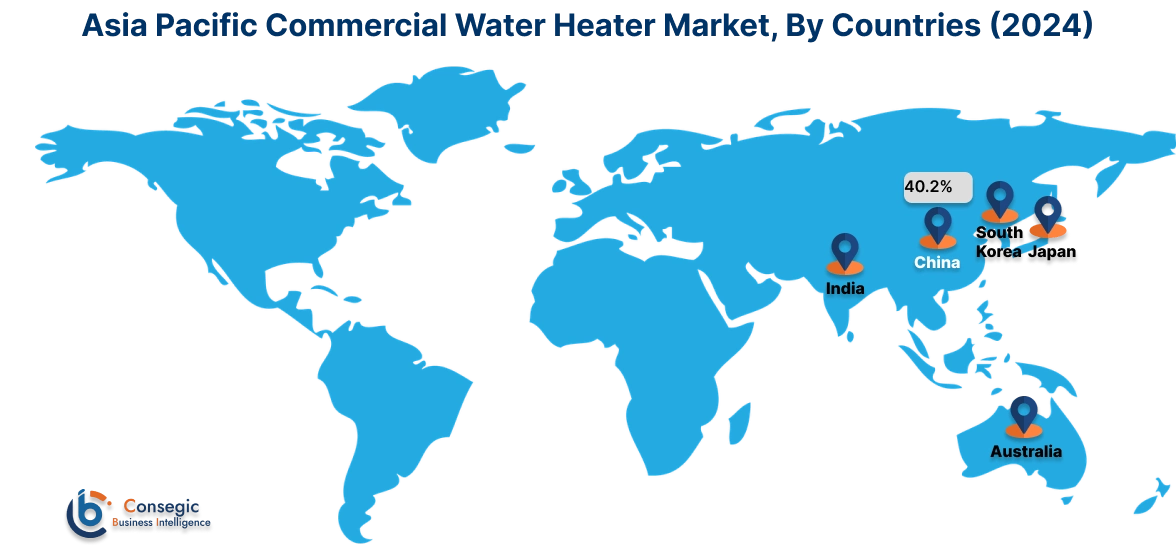
Asia Pacific region was valued at USD 2.46 Billion in 2024. Moreover, it is projected to grow by USD 2.60 Billion in 2025 and reach over USD 4.43 Billion by 2032. Out of this, China accounted for the maximum revenue share of 40.2%.
The Asia Pacific region holds a significant share in the global commercial water heater market. In this region, commercial water heaters are used across various sectors, including hospitality (hotels, motels), corporate settings, industries, and institutions, for applications like bathing, laundry, cleaning, and food preparation, with growing interest for energy-efficient and smart solutions. The demand in Asia is driven by rapid urbanization, rising disposable incomes, increasing investments in commercial sectors, and a growing focus on energy-efficient and sustainable solutions. Asia-Pacific's fast urbanization and strong economic growth, particularly in countries like China and India, are fueling requirement for both residential and commercial water heaters.
Growing awareness of energy consumption and the environmental impact of traditional water heaters is responsible for more energy-efficient and sustainable solutions, including tankless and solar water heaters. Asia-Pacific is a popular tourist destination, and the hospitality sector relies heavily on water heaters to provide hot water to guests. Government mandates related to greenhouse gas emissions and energy efficiency are also playing a role in promoting the adoption of water heaters that meet these standards.
Thus, the commercial water heater market analysis highlights the dominance of Asia Pacific region due to the massive population in China and India leading to the increased trend of water heaters.
North America is estimated to reach over USD 4.72 Billion by 2032 from a value of USD 2.77 Billion in 2024 and is projected to grow by USD 2.91 Billion in 2025.
The commercial water heater market in North America is experiencing a rising trend, driven by factors like increased investment in commercial sector development, growing energy efficiency awareness, and the adoption of advanced, energy-saving technologies like tankless water heaters. They are used to provide hot water for various businesses, industrial facilities, and other commercial settings, including restaurants, hotels, hospitals, laundromats, schools, and industrial facilities, where consistent hot water supply is crucial for various processes and operations.
Government policies encouraging energy-efficient appliances (like ENERGY STAR ratings) and growing consumer/business awareness of energy conservation are major drivers. Rising investments in green building infrastructure and the emphasis on sustainable practices are pushing the adoption of energy-efficient water heating technologies. The move towards smart water heaters and the increasing acceptance of tankless and solar-powered systems reflect a focus on long-term cost savings and sustainability.
Thus, the commercial water heater market analysis shows the emergence of water heaters in the North American region due to government policies and increasing consumer awareness of energy conservation.
The commercial water heater market in Europe is experiencing growth, driven by factors like increasing requirement from the hospitality sector and a rising focus on energy efficiency in commercial buildings. Hot water is also used for cleaning facilities and machinery, heating solutions in the chemical industry, and food processing applications like fermentation and blanching. Water heaters in Europe are designed to meet specific energy efficiency standards, such as the EU's ErP Directive and Energy Labeling Directive. The European Union is promoting energy-efficient water heaters to reduce energy consumption and CO2 emissions.Some commercial applications are using hybrid-heat systems that can switch between different fuel sources based on price and availability, further promoting energy efficiency.
- For instance, in September 2023, Navien, Inc., the number one brand in high efficiency condensing tankless water heaters, announced the NHW-A non-condensing tankless water heater, featuring the ComfortFlow circulation pump and buffer tank, which helps resolve the issue of low flow rates found in other tankless heaters. It also reduces the wait time for hot water by allowing internal or external recirculation without the need for external parts or controls.
Thus, the market analysis shows the surge in utilization of water heater across the European countries driving the market.
There is a rising trend of commercial water heaters in the Middle East and African region, driven by increasing need for energy-efficient solutions.The MEA region is experiencing rapid population surge and urbanization, leading to a higher requirement for residential and commercial water heating solutions.As living standards improve, there's a greater requirement for amenities like hot water, which fuels the growth of the water heater market.There is a growing emphasis on energy efficiency and sustainability, leading to an increase in energy-efficient water heaters such as heat pumps.The Middle East and Africa market for heat pump water heaters is in the early stages but shows potential increment, with countries like Saudi Arabia, the UAE, and South Africa gradually adopting these systems.
Therefore, the market analysis shows the rising need of water heater in the middle east and developing countries of Africa driving the commercial water heater market.
In Latin America, the commercial water heater market is experiencing a surge in trend due to rapid infrastructural development, smart city initiatives, and the surge in tourism and hotel construction, along with rising demand for hot water in commercial sectors.Ongoing infrastructure projects and smart city development initiatives are fueling demand for water heaters, particularly in commercial buildings and hotels.Economic growth and rising living standards in Latin American countries are contributing to increased investment in infrastructure and commercial buildings, further driving water heater need.The expansion of the restaurant and hospitality sectors in South America has fueled the need for commercial water heaters, especially those that quickly heats large volumes of water, like those used in commercial kitchens.Brazil is a key market for water heaters, with a growing demand for tankless water heaters and heat pump systems.Chile is also experiencing a rise in need of energy-efficient water heaters.
Thus, the market analysis shows the emergence of water heaters in the Latin American region due to infrastructural development and improvement in economy.
Top Key Players and Market Share Insights:
The Commercial Water Heater market is highly competitive with major players providing products and services to the national and international markets. Key players are adopting several strategies in research and development (R&D), product innovation, and end-user launches to hold a strong position in the global Commercial Water Heater market. Key players in the Commercial Water Heater industry include –
Recent Industry Developments :
Acquisition:
- In July 2024, Bosch, the supplier of technology and services, acquired the global HVAC solutions business for residential and light commercial buildings from Johnson Controls, to continue its development. With this acquisition, Bosch aims to achieve the leading position in the HVAC market.
Commercial Water Heater Market Report Insights :
| Report Attributes | Report Details |
| Study Timeline | 2019-2032 |
| Market Size in 2032 | USD 14.55 Billion |
| CAGR (2025-2032) | 7.2% |
| By Product Type |
|
| By Power |
|
| By Applications |
|
| By Region |
|
| Key Players |
|
| North America | U.S. Canada Mexico |
| Europe | U.K. Germany France Spain Italy Russia Benelux Rest of Europe |
| APAC | China South Korea Japan India Australia ASEAN Rest of Asia-Pacific |
| Middle East and Africa | GCC Turkey South Africa Rest of MEA |
| LATAM | Brazil Argentina Chile Rest of LATAM |
| Report Coverage |
|
Key Questions Answered in the Report
What are Commercial Water Heaters? −
Commercial water heaters are essential systems used in industrial applications to produce and supply hot water in large volumes for the commercial sector. They fulfil larger needs as compared to residential sectors. They provide benefits such as energy efficiency, operational cost reduction, and a reliable hot water supply throughout the need.
What are the future opportunities of the Commercial Water Heaters? +
The improvements in technology such as smart water heaters provides potential future opportunities for Commercial water heaters. Smart technology, such as smart water heaters, opens up numerous benefits such as remote monitoring, energy optimization, leading to improved efficiency and cost savings. Its scheduling and demand feature allows energy usage optimization, and the alerts feature warns about leakage or low water pressure, allowing on-time maintenance and costly repair prevention.
What specific segmentation details are covered in the Commercial Water Heater market report, and how is the fastest segment anticipated to impact market growth? +
The market is segmented on the basis of product type, power, and applications. The solar segment, for instance, is anticipated to have the highest CAGR during the forecast period because they offer a cost-effective and environmentally friendly alternative to conventional water heaters. Solar water heaters reduce electricity or gas bills and offer long term savings and reduce environmental impact.
Who are the major key players in the Commercial Water Heaters market? +
Rheem (US), Rinnai (Japan), Viessmann (Germany), American water heaters (US), NIBE Energy Systems Limited (UK), Solahart Industries (Australia), Danfoss (Denmark), Mitsubishi Electric (Japan), Ariston Thermo (Italy), A.O. Smith (India).
Overview
Reputation & Certifications


Our Services
- Market Intelligence & Forecasting
- Custom Research Solutions
- Market Entry Strategy
- Competitive Intelligence
- Customer Insights
- Industry Innovation Analysis
- Investment Advisory