Jump to Content
Electric Sports Utility Vehicle Market Size & Industry Share - Growth Trends & Forecasts (2026 - 2034)
The Electric Sports Utility Vehicle Market is expected to expand from 427.87 (US$B) in 2025 to 496.76 (US$B) in 2026, and is forecast to surpass 1,639.84 (US$B) by 2034, growing at a CAGR of 16.1% between 2026 and 2034, according to a recent report from Consegic Business Intelligence.
Electric Sports Utility Vehicle Market Scope & Overview:
AI is fundamentally reinventing the electric sports utility vehicle sector by shifting the focus from mechanical hardware to software-defined vehicles. Advanced AI-driven Battery Management Systems (BMS) now utilize machine learning to predict thermal issues and optimize charging cycles in real-time, effectively extending battery lifespan and range. Inside the cabin, Generative AI assistants such as Google Gemini are used for providing conversations for navigation and vehicle control. Furthermore, AI enhances safety through perception-based ADAS, where sensor fusion allows SUVs to navigate complex urban environments autonomously, making the vehicle a proactive, intelligent partner.
How is AI Transforming the Electric Sports Utility Vehicle Market?
AI is fundamentally reinventing the electric sports utility vehicle sector by shifting the focus from mechanical hardware to software-defined vehicles. Advanced AI-driven Battery Management Systems (BMS) now utilize machine learning to predict thermal issues and optimize charging cycles in real-time, effectively extending battery lifespan and range. Inside the cabin, Generative AI assistants such as Google Gemini are used for providing conversations for navigation and vehicle control. Furthermore, AI enhances safety through perception-based ADAS, where sensor fusion allows SUVs to navigate complex urban environments autonomously, making the vehicle a proactive, intelligent partner.

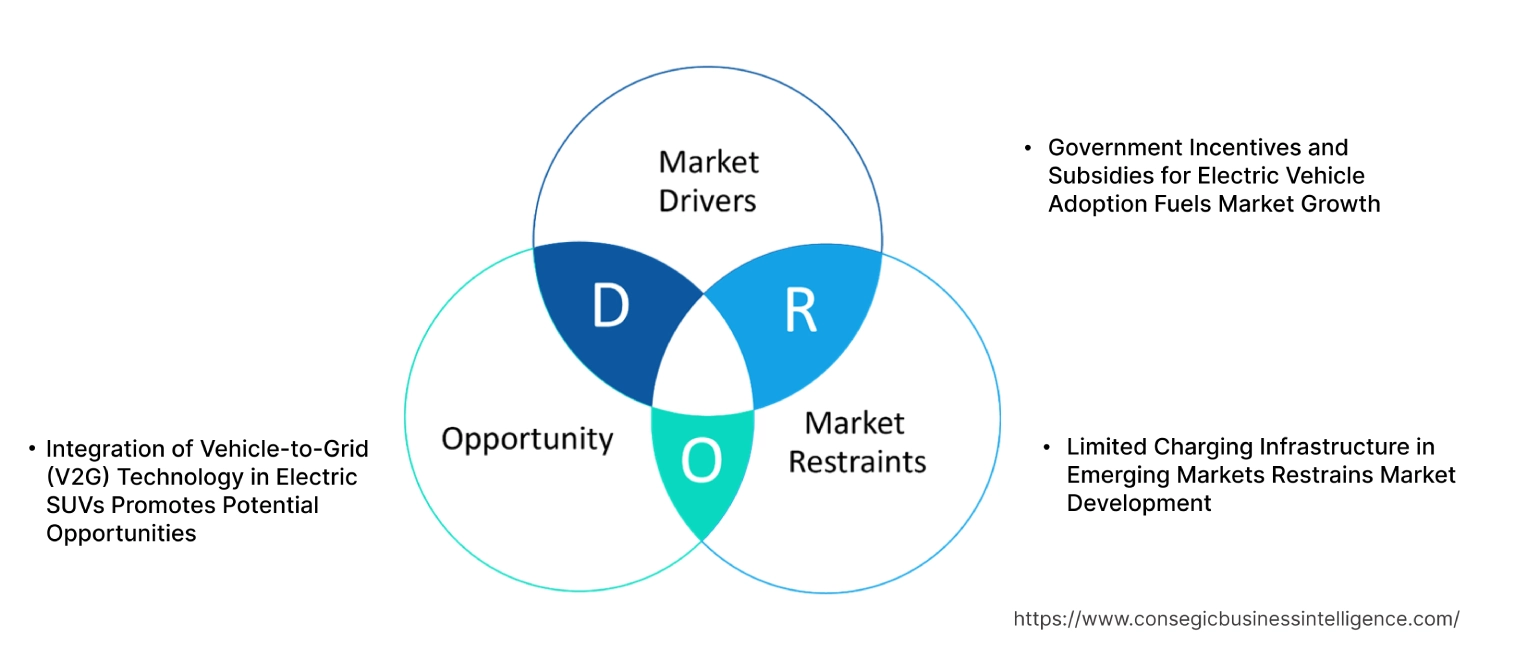
Electric Sports Utility Vehicle Market Dynamics - (DRO):
Key Drivers:
The growth of the electric SUV is fundamentally propelled by the intersection of rigid regulatory frameworks and a profound shift in consumer values toward environmental stewardship. Governments worldwide are enforcing ambitious decarbonization targets that compel automakers to accelerate electrification or face massive financial penalties, effectively making the production of zero-emission SUVs a strategic necessity. Moreover, rising public awareness regarding climate change and urban air quality has transformed the E-SUV into a symbol of sustainable status.
- For instance, according to the European Commission, Zero- and Low-Emission Vehicle (ZLEV) incentive mechanism is a voluntary crediting system designed to accelerate the adoption of vehicles emitting less than 50g CO2/km between 2025 and 2029. Under this system, manufacturers that exceed specific sales benchmarks are rewarded with a relaxation of their overall fleet-wide CO2 emission targets by up to 5%.
Thus, rigid regulatory frameworks, decarbonization targets, and rising public awareness contribute significantly to the electric sports utility vehicle market size.
Key Restraints :
High Initial Purchase Price and Limited Charging Infrastructure in Emerging Economies are Limiting the Market Growth
In emerging economies, the growth of the electric vehicle is significantly hampered by high upfront purchase prices that often exceed the financial reach of the average consumer, particularly when compared to more affordable internal combustion alternatives. This economic barrier is intensified by a fragmented and limited charging infrastructure, which restricts these large-format vehicles to urban centers. Furthermore, the substantial capital investment required for grid upgrades in these regions often lags behind vehicle adoption, leaving potential buyers hesitant to commit to a technology that lacks a reliable, widespread support network.
Future Opportunities :
Increasing Focus on Solid-State & Sodium-Ion Batteries Drives Electric Sports Utility Vehicle Market Opportunities
The increasing focus on solid-state and sodium-ion batteries presents a transformative opportunity for the electric SUV market by addressing the critical limitations of current lithium-ion technology. Solid-state batteries offer significantly higher energy density and enhanced safety, enabling luxury E-SUVs to achieve ranges exceeding 1,000 km while drastically reducing charging times. Simultaneously, sodium-ion batteries provide a cost-effective, cobalt-free alternative with superior cold-weather performance, making entry-level E-SUVs more accessible and reliable in diverse climates. By diversifying battery chemistries, manufacturers can stabilize supply chains against lithium price volatility and cater to both high-performance and budget-conscious consumer segments globally.
- For instance, Nissan, through its "Ambition 2030" vision, aims to revolutionize the electric vehicle market by launching in-house developed all-solid-state batteries (ASSBs) by fiscal year 2028. This game-changing technology is expected to double energy density compared to current lithium-ion cells, slash charging times by two-thirds, and significantly reduce production costs.
Thus, diversification of battery chemistries, higher energy density, and enhanced safety drive the electric sports utility vehicle market opportunities.
Electric Sports Utility Vehicle Market Segmental Analysis :
By Type:
Based on the type, the market is segmented into compact E-SUVs, mid-size E-SUVs, and full-size E-SUVs.
Trends in the Type:
- Brands are focusing on bold, youthful styling and customizable interiors to attract the growing demographic of Gen Z and Millennial which is driving the electric sports utility vehicle market trends.
- Full-size E-SUVs are rapidly moving toward 800V electrical systems to enable ultra-fast charging, which in turn drives the electric sports utility vehicle market size.
Compact E-SUVs accounted for the major revenue share in the year 2024 and is anticipated to register a significant CAGR during the forecast period.
- Increasing demand for the integration of Advanced Driver Assistance Systems in this segment is driving the electric sports utility vehicle market share.
- Further, mid-size models are incorporating Vehicle-to-Load (V2L) technology, allowing the car to power home appliances or camping gear.
- Furthermore, there is an increasing trend of incorporating interiors that are made using vegan leathers, recycled ocean plastics, and flax-based composites to appeal to eco-conscious buyers, which in turn drives the electric sports utility vehicle market trends.
- Thus, as per the electric sports utility vehicle market analysis, sustainable materials, ADAS Integration, and other factors are driving the market.
By Propulsion:
Based on the propulsion, the market is segmented into Battery Electric Vehicles (BEV) and Plug-in Hybrid Electric Vehicle (PHEV).
Trends in the Propulsion:
- Extended Range Electric Vehicles (EREVs), where the engine only acts as a generator, are surging in popularity, particularly in China and North America, which in turn drives the electric sports utility vehicle market demand.
- Growing demand for advanced AI to automatically manage battery usage, ensuring the vehicle stays in electric mode during city traffic and saves fuel for highways, in turn driving the sports utility vehicle market
Battery Electric Vehicles (BEV) accounted for the largest revenue share in the year 2024 and is anticipated to register a significant CAGR during the forecast period.
- New SUV architectures are increasingly integrating battery cells directly into the vehicle frame to reduce weight and increase structural rigidity, which in turn drives electric sports utility vehicle market growth.
- Further, manufacturers are shifting focus from simply bigger batteries to system efficiency, utilizing heat pumps and silicon carbide inverters to extend range, in turn driving the electric sports utility vehicle industry.
- Furthermore, rise of solid-state batteries and standardization of 800V architecture drives the electric sports utility vehicle market expansion..
- For instance, according to IEA, global electric vehicle sales spiked in 2024, with more than 17 Million units sold worldwide.
- Thus, as per the electric sports utility vehicle market analysis, the aforementioned factors are driving the market.
By Range:
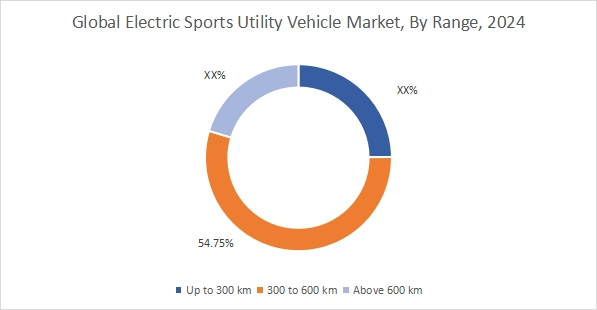
Based on the range, the market is segmented into up to 300 km, 300 to 600 km, and above 600 km.
Trends in the Range:
- Entry-level SUVs are adopting sodium-ion batteries to provide a low-cost, cobalt-free alternative that performs exceptionally well in cold weather, which in turn drives the electric sports utility vehicle market expansion.
- Up to 300 km range vehicles are shedding excess weight through simplified interiors and smaller motors to maximize efficiency, which propels the electric sports utility vehicle market.
300 to 600 km accounted for the largest revenue share of 54.75% in the year 2024.
- A 500 km range has become the benchmark for mainstream buyers to feel comfortable switching from gasoline, which is driving the market.
- Further, mid-range SUVs are adopting active grille shutters and flush door handles to reduce drag, extending range without increasing battery size.
- Furthermore, standardized integration of advanced heat pumps is ensuring that the real-world range remains stable even during extreme winter conditions, which in turn drives electric sports utility vehicle market growth.
- Thus, based on analysis, improved efficiency, advanced heat pump adoption vehicles, and other trends are driving the market.
Above 600 km is anticipated to register the fastest CAGR during the forecast period.
- High-end flagship SUVs are beginning to use semi-solid-state batteries that offer massive energy density in a smaller, lighter footprint, which in turn drives the electric sports utility vehicle market share.
- Further, segment exclusively uses 800V architectures to enable 350kW charging, adding 400+ km of range in under 15 minutes, which in turn drives the electric sports utility vehicle market demand.
- Furthermore, the use of SiC power electronicsis becoming standard to reduce energy loss during high-speed highway cruising.
- Therefore, based on analysis, silicon carbide inverters, adoption of solid-state batteries, and ultra-fast 800V support are anticipated to boost the market during the forecast period.
By Drive Type:
Based on drive type, the market is segmented into 2WD, 4WD, and AWD.
The AWD segment dominated the market in 2024.
- AWD systems are critical for providing stability, traction, and control across various terrains and weather conditions, making them a preferred option in electric SUVs.
- Automakers are incorporating intelligent AWD systems with torque vectoring capabilities to optimize performance, delivering superior handling and a refined driving experience in premium and mid-range SUVs.
- The dominance of this segment is driven by the growing consumer preference for SUVs that combine off-road capabilities with enhanced safety features, catering to both urban and adventure-oriented users creating significant electric sports utility vehicle market opportunities.
The 4WD segment is expected to register the fastest CAGR during the forecast period.
- 4WD (Four-Wheel Drive) systems are widely used in rugged electric SUVs designed for off-road applications and challenging environments.
- Growth in adventure tourism and outdoor activities is driving the adoption of 4WD electric SUVs among enthusiasts and commercial operators.
- As per electric sports utility vehicle market analysis, the rapid progress of the 4WD segment is supported by its focus on durability and adaptability to extreme driving conditions.
Regional Analysis:
The regions covered are North America, Europe, Asia Pacific, the Middle East and Africa, and Latin America.
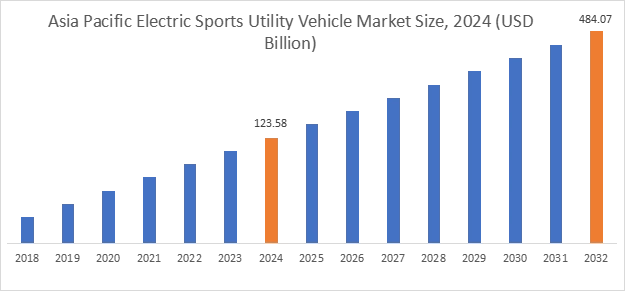
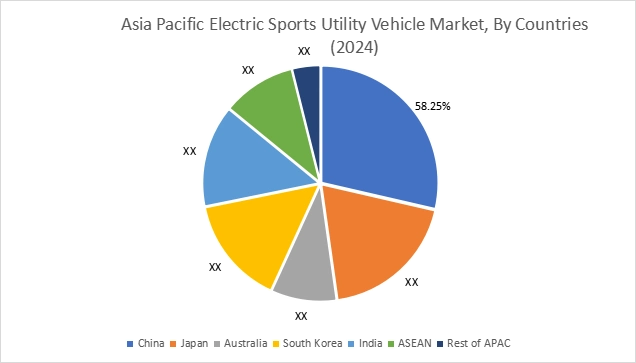
Asia Pacific region was valued at USD 123.58 Billion in 2024. Moreover, it is projected to grow by USD 145.06 Billion in 2025 and reach over USD 484.07 Billion by 2032. Out of this, China accounted for the maximum revenue share of 58.25%. The market growth for electric sports utility vehicles is mainly driven by aggressive government incentives & subsidies and the rapid expansion of local battery manufacturing hubs in China, India, and Southeast Asia. Additionally, the surge in demand is fueled by a rising middle-class preference for spacious, high-clearance vehicles that offer a lower total cost of ownership compared to traditional internal combustion engine SUVs.
- For instance, according to the IEA, China solidified its global dominance in the EV industry during 2024, with electric vehicles capturing nearly 50% of the nation's total automotive market.
North America is estimated to reach over USD 309.62 Billion by 2032 from a value of USD 79.90 Billion in 2024 and is projected to grow by USD 93.70 Billion in 2025. The North American market is primarily driven by technological advancement in batteries, and a strong cultural preference for versatile, large-format vehicles drives the market growth in the region.
- For instance, Ford and Volkswagen strengthened their strategic e-mobility alliance, with Ford set to produce a second electric vehicle for the European market using Volkswagen’s MEB platform. By leveraging this open architecture, Ford plans to double its production volume to 1.2 Million units over six years, enabling a faster and more cost-effective transition to a fully electric portfolio.
The regional trends analysis depicts stringent emission targets, and a rapid rise of a public charging network in Europe is driving the market. Additionally, the factors driving the market in the Middle East and African region are heavy investments in high-speed charging corridors and the localization of EV manufacturing. Further, favorable fiscal policies, cost effectiveness, and investment in improving the charging infrastructure is paving the way for the progress of market trends in Latin America region.
Top Key Players & Market Share Insights:
The Electric Sports Utility Vehicle market is highly competitive with major players providing products and services to the national and international markets. Key players are adopting several strategies in research and development (R&D), product innovation, and end-user launches to hold a strong position in the global Electric Sports Utility Vehicle market. Key players in the Electric Sports Utility Vehicle industry include –
- Tesla(U.S.)
- BYD Company Limited(China)
- BMW Group (Germany)
- Volvo Car Corporation (Sweden)
- Volkswagen AG (Germany)
- Kia Corporation (South Korea)
- Tata Motors (India)
- Mahindra & Mahindra (India)
- Mercedes-Benz Group AG (Germany)
- Ford Motor Company (U.S.)
Recent Industry Developments :
Product Launch
- In April 2025, Teslalaunched the redesigned Model Y, a comprehensive update to the bestselling vehicle featuring a premium exterior aesthetic and a modernized interior. This new version incorporates significant engineering enhancements designed to maximize energy efficiency and passenger comfort, marking the first major overhaul nearly five years after the model's initial debut.
- In November 2024, Suzuki Motor Corporationintroduced e VITARA as its first mass-production battery electric vehicle, marking a significant milestone in the brand's global electrification strategy. Scheduled for production at the Suzuki Motor Gujarat plant in India starting in spring 2025, the model is expected to launch across key markets including Europe, India, and Japan.
Electric Sports Utility Vehicle Market Report Insights :
| Report Attributes | Report Details |
| Study Timeline | 2021-2034 |
| Market Size in 2034 | USD 1,639.84 Billion |
| CAGR (2026-2034) | 16.10% |
| Base Year | 2025 |
| By Type |
|
| By Propulsion |
|
| By Range |
|
| By Region |
|
| Key Players |
|
| North America | U.S. Canada Mexico |
| Europe | U.K. Germany France Spain Italy Russia Benelux Rest of Europe |
| APAC | China South Korea Japan India Australia ASEAN Rest of Asia-Pacific |
| Middle East and Africa | GCC Turkey South Africa Rest of MEA |
| LATAM | Brazil Argentina Chile Rest of LATAM |
| Report Coverage |
|
Key Questions Answered in the Report
How big is the electric sports utility vehicle market? −
The electric sports utility vehicle market is estimated to reach over USD 1,216.57 Billion by 2032 from a value of USD 314.78 Billion in 2024 and is projected to grow by USD 369.07 Billion in 2025, growing at a CAGR of 16.1% from 2025 to 2032.
What specific segmentation details are covered in the Electric Sports Utility Vehicle report? +
The electric sports utility vehicle report includes specific segmentation details for type, propulsion, range, and regions.
Which is the fastest segment anticipated to impact the market growth? +
In the electric sports utility vehicle market, above 600 km range is the fastest-growing segment during the forecast period.
What are the key trends in the electric sports utility vehicle market? +
The electric sports utility vehicle market is being shaped by several key trends including adoption of 800-volt ultra-fast charging architectures, shift toward software-defined vehicles, technological advancement in battery chemistry, and stringent regulations.
Who are the major players in the electric sports utility vehicle market? +
The key participants in the electric sports utility vehicle market are BMW Group (Germany), Tesla (U.S.), BYD Company Limited (China), Volvo Car Corporation (Sweden), Volkswagen AG (Germany), Kia Corporation (South Korea), Tata Motors (India), Mahindra & Mahindra (India), Mercedes-Benz Group AG (Germany), Ford Motor Company (U.S.), and others.
Overview
Reputation & Certifications


Our Services
- Market Intelligence & Forecasting
- Custom Research Solutions
- Market Entry Strategy
- Competitive Intelligence
- Customer Insights
- Industry Innovation Analysis
- Investment Advisory