Jump to Content
Asia Pacific Coatings Equipment Market - Size, Share, Industry Trends, and Forecasts (2025-2034)
Executive Summary
Asia Pacific powder coating equipment market is a niche and a fast-growing sector of industrial finishing equipment industry, which comprises electrostatic spray guns, powder coating booths, curing ovens, material handling units, powder recovery units, and full body automated coating lines, designed to apply dry powder coating to metal substrates and other materials. The market has diverse industrial applications such as automotive production, decoration of architectural aluminum, appliance product, furniture finishing, general industrial equipment production and new markets that need finishing solutions that are environmentally friendly in all their manufacturing facilities in the region.
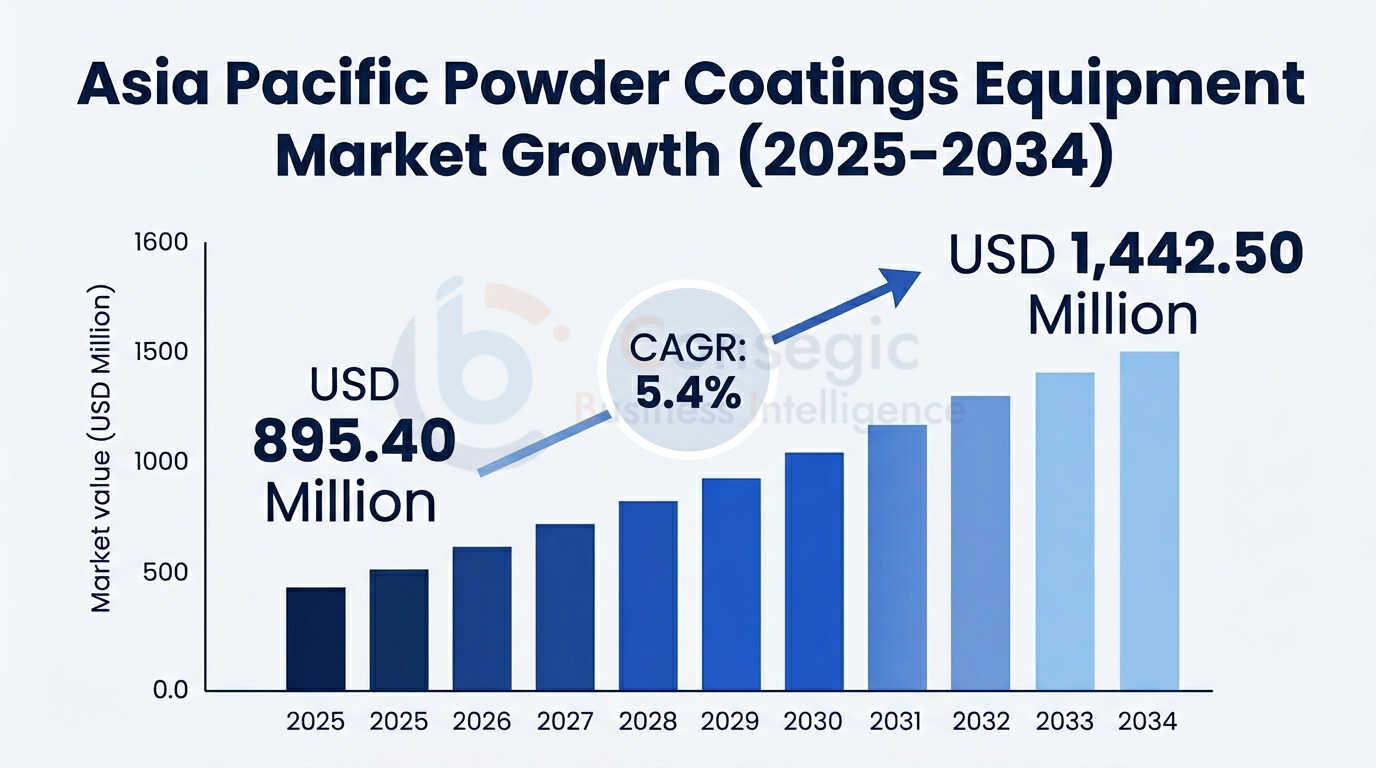
The market exhibits significant scale, with USD 845.20 million and USD 895.40 million considered as base-year values to make analytical projections. Market projections show the strong growth trend to reach USD 1,442.50 Million in 2034, representing a compound annual growth rate (CAGR) of 5.4 percent over the period 2026–2034. This positive growth trend is driven by several overlapping dynamics such as strict environmental standards limiting the release of volatile organic compounds, evolving trends in the manufacture of automobiles, especially electric vehicles, infrastructure building that tends to generate architectural coating requirements, automation of the manufacturing process which necessitates combined coating systems, and the high performance attributes of powder coating compared to liquid alternatives.
Regional Trends and Insights
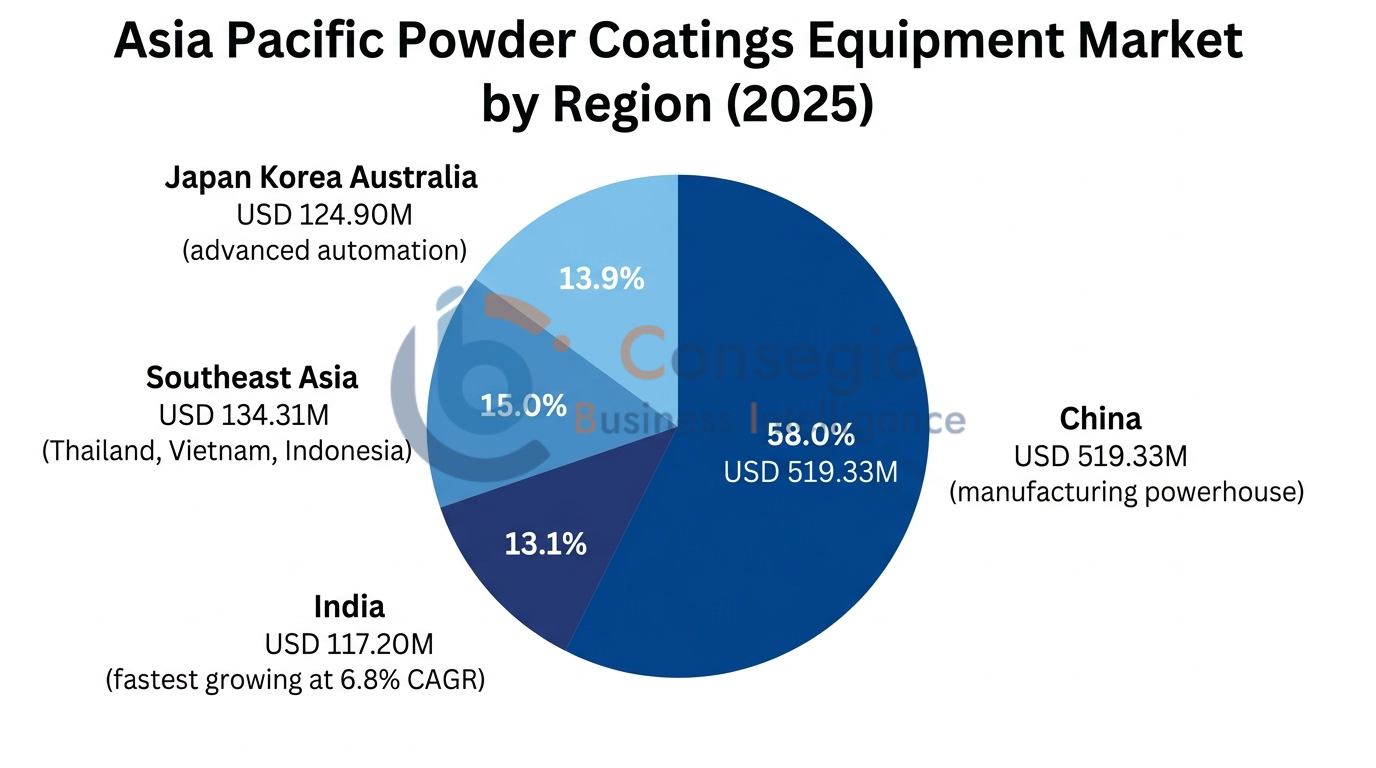
- China: Market leader with USD 519.33 Million (2025) → USD 836.65 Million (2034); 58.0% share, driven by strong manufacturing base and environmental regulations
- India: USD 117.20M (2025) → USD 216.38M (2034); fastest CAGR of 6.8%, driven by automotive growth, PLI schemes, and infrastructure development
- Japan, South Korea & Australia: USD 124.90M; mature markets with focus on automation and advanced technologies
Key Market Characteristics:
Asia Pacific region is the manufacturing hub of the world and the output of the industry is approximated to 18.5 trillion USD in the year 2024 showing 52 percent of the global manufacturing activity. China alone provides USD 5.8 trillion to the regional manufacturing output, which generates unprecedented demand in the high-tech finishing equipment. The powder coating process has some strong points such as zero level of volatile organic compounds, 95 percent use of material through powder recovery system, single coating that would produce required film thickness, increased durability and corrosion resistance, and cost-efficiency with a reduced level of wasting material and no solvent disposal.
Powder coating consumption in the region was about 1.85 million metric tons in 2024 with China consuming 58 percent of the total consumption, India consuming 13 percent, Southeast Asia consuming 15 percent, and the developed markets, like Japan, South Korea, and Australia consuming 14 percent. The equipment market is closely linked to powder coating consumption trends, as the manufacturers need special purpose equipment to apply powder coating, curing equipment, and the infrastructure to support the use of powder coating.
Market Scope & Overview:
The Asia Pacific powder coatings equipment market operates across a variety of industrial setups involving high volume automotive assembly lines of 45–60 units per hour to minor job shops to custom fabrication jobs. The market includes detailed equipment lines that meet specific operation needs such as manual spray guns of USD 800-3,500 to satisfy small-scale demands, semi-automated systems of USD 25,000-150,000 to meet the medium production volumes, and fully automated lines costing around USD 2 million to meet the high volume production facilities with throughput of 500–1,200 parts per hour.
Modern powder coating systems are technologically integrated with electrostatic spray guns with transfer efficiency of 65–85 percent compared to 40–60 percent in liquid coating systems, superior powder recovery system with 95-99 percent overspray material reusability, computerized programmable logic controllers allowing precise control of application parameters, and automated color change systems with quick product changeover of 5-8 minutes to reduce production downtime. Better automated devices include robotic application with six axis articulation that ensures consistent quality of coating, built-in quality control systems based on infrared thickness measurements, and data analytics systems that track the performance of equipment and coating parameters.
The manufacturing ecosystem shows an overall assimilation to the major companies possessing control of design, component production, assembly processes and distribution channels. Regional supply chains involve special component production that is focused in Germany, Switzerland, and the United States for premium technologies and China, India and Southeast Asia serve as major assembly and integration centers and takes advantage of cost and market proximity.
Key Market Driver
Environmental standards and Volatile Organic Compounds Emission regulations.
The most influential market factor is the introduction of increasingly stringent environmental policies that limit the release of volatile organic compounds and that facilitate the adoption of sustainable production methods across all economies of the Asia Pacific. Powder coatings contain no volatile organic compounds, unlike conventional liquid finishes that have 400-650 grams per liter VOC content and contain hazardous air contaminants, and expose the worker to toxic ETCs.
This was done in China where effective VOC emission control policies were introduced as the Air Pollution Prevention and Control Action Plan and the later “Blue Sky Defense” initiative that set out strict emission limits of the industrial coating operations. The major industrial provinces such as Guangdong, Jiangsu, Zhejiang, and Shandong introduced VOC emission levels of 50-80 grams per square meter of industrial coating processes, which effectively required the use of powder coating or prohibited liquid coating processes without costly emission control devices. The national standards such as GB 24409 which stipulates a limit of 35 grams per square meter of automotive coating VOC emissions and GB 38507 which stipulates a limit of 35 grams per square meter of industrial protective coating VOC emissions provide regulatory impetus towards the use of powder coating equipment.
The National Clean Air Programme of India that aims at the reduction of 20-30 percent of the particulate matter and recommended VOC levels of 1,000 to 1,500 ppm of industrial coating operations create a favorable regulatory environment for the adoption of powder coating. Stricter emission limits were introduced by state pollution control boards in Maharashtra, Gujarat, Tamil Nadu and Karnataka that obliged coating operations to prove compliance by monitoring their emissions or switching to zero-VOCs such as powder coating.
The Southeast Asian countries such as Thailand, Vietnam, Malaysia and Indonesia are increasingly enforcing environmental protection policies in accordance with the international standards, which establish regulatory pressure to the sustainable coating technologies. Government programs that encourage green production and adherence to the environment influence demand of powder coating equipment in sectors of export based production that cater to foreign markets with high level of environmental standards.
Key Market Restraint
High Initial Capital Requirements and technical complexity requirements.
Powder coating equipment entails a high beginning capital outlay that poses a significant barrier to the small and medium enterprises and inhibits market penetration especially in the emerging markets that are price-sensitive. Full-scale automated powder coating systems with application equipment, curing ovens, and material management system, powder collection devices, and supporting infrastructure cost USD 500,000 to USD 5-8 million dollars apiece, depending on the size, scale, and end-user requirements.
The advanced technical nature of contemporary powder coating systems creates operational challenges that need special skills in installation, use, and maintenance. High level electrostatic generation, accurate powder delivery, finely tuned curing profiles and automated systems demand trained staff who are often unavailable in developing markets. Although automated systems have enhanced color changeover operation, manual operations take 15–35 minutes and 5-8 minutes on automated operations compared to 2-5 minutes on liquid coating, which may not be suitable for operations with a high frequency of color changeover or small batch production.
The economic sensitivity influences equipment buying choices where the industrial capital equipment spending has shown a high relationship with manufacturing industry confidence and the economy. The indicators of regional manufacturing PMI were highly volatile in the period of 2023-2024, creating uncertainty in capital investment decisions. Depreciation of currency in some emerging markets affects equipment affordability where imported components and finished systems that are priced in USD or EUR will have their prices effectively increased by 8–15 percent of the local currency in 2024.
Key Market Opportunity
Smart Manufacturing Systems: automation Integration and Industry 4.0.
The integration of automation technologies with powder coating equipment is offering unprecedented opportunities in the market as manufacturers aim to reduce reliance on labor, enhancing coating uniformity and creating operational efficiency. The increasing labor expenses in the region and especially in China where the wage rates of manufacturing workers have doubled in the last ten years provide strong economic justification to automated coating devices using robots to apply the coating, intelligent powder handling and in-built quality checks.
The latest automation systems have six axis robots to spray with uniform gun-to-part distance and spray angle, automated feed centers with multiple colors and the ability to change between colors quickly, real time monitoring systems to track coating parameters and material use, and predictive analytics algorithms to optimize equipment utilization. These advanced systems help manufacturers to attain high quality of coating and less labor needs and wastage of materials.
The integration of Industry 4.0 enables an in-depth data analytics and multi-site production management with remotely controlled coating lines linked to enterprise resource planning systems, as well as cloud-based recipe management archiving thousands of part profiles with automatic parameter intervention. Leading manufacturers report that automation investments yield 15-25 percent productivity and 20-35 percent reduction in coating flaws, which make a strong economic case for return on investment despite increased start-up capital demands.
Automobiles especially the production of electric vehicles is a source of demand of specialization automation that can paint finely the difficult-to-paint battery cases, motor casings, and body parts with controlled thickness and electrical insulating values. The processing of architectural aluminum needs high speed automated systems that process long profiles with consistent quality that is internationally required in the use of buildings.
Market Segmentation Analysis
By GasifiBy Equipment Type: Comprehensive Technology Portfolioer Type
Application Equipment Dominates Market Value
Application equipment such as electrostatic spray guns, automatic reciprocators, and robotic application systems accounts for USD 376.67 million which constitutes 42.1 percent of overall market value in 2025 and is expected to grow to USD 607.17 Million in the year 2034. This group includes manual electrostatic spray guns that cost USD 800-3,500 that meet small-scale operations, touch-up work, automatic reciprocators that cost USD 18,000-65,000, and robotic application systems that cost USD 85,000-350,000 that are used to provide precise coating application to complex geometries.
High application equipment uses high-tech electrostatic generation systems that have reached charging voltages of 60-100 kilovolts, accurate control of powder flow that keeps delivery rates within +-3 percent, and intelligent optimization of powder clouds that has cut overspray by 25-35 percent of the conventional systems. High-end robotic systems have six-axis articulation to accommodate intricate motions, in-built part recognition and placement vision systems, and automatic part geometry and coating spray settings.
Curing Ovens Represent Substantial Investment Category
Curing ovens in the form of convection, infrared, and hybrid models take USD 313.39 Million which is 35.0 percent of the market value as of 2025 to USD 504.88 Million as of 2034. This group includes batch ovens with price USD 25,000-150,000 used in small to medium volume production, continuous conveyor ovens with price USD 180,000-800,000 in volume operations of medium to high scale and large automotive coating ovens with price USD 2 million or above in integration of high production volume assembly lines.
Powder Handling and Recovery Systems
Powder handling devices such as feed hoppers, delivery systems, and recovery units take USD 152.22 Million which translates to 17.0 percent of the market value in 2025 to USD 245.23 Million in 2034. High-end recovery systems have 95-99 percent powder capture efficiency which makes it possible to optimize the cost of materials and comply with the environment.
By End-Use Industry: Application Sector Dynamics
Automotive Manufacturing Leads Market Demand
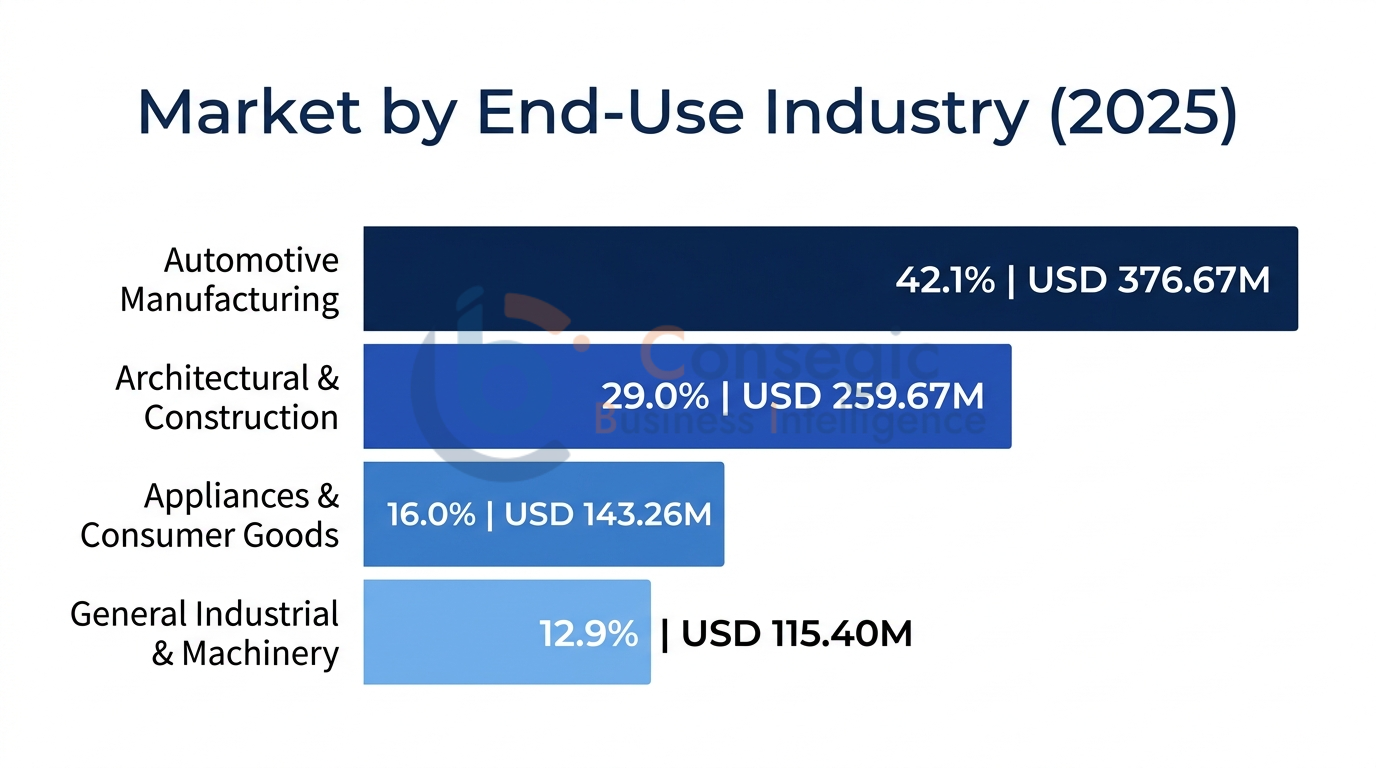
The largest applications are in the automotive of USD 376.67 Million 42.1 percent of total market value in 2025, which will increase to USD 607.17 Million in 2034. This category also includes the businesses of assembling passenger vehicles, commercial vehicles, automotive parts, and the electric vehicle segment that is rapidly developing and needs to be coated with special solutions to battery systems, motor housings, and structural elements.
Architectural and Construction Applications
The largest applications are in the automotive of USD 376.67 Million 42.1 percent of total market value in 2025, which will increase to USD 607.17 Million in 2034. This category also includes the businesses of assembling passenger vehicles, commercial vehicles, automotive parts, and the electric vehicle segment that is rapidly developing and needs to be coated with special solutions to battery systems, motor housings, and structural elements.
Regional Market Analysis
China: The powerhouse of manufacturing and the market leader.
China is already a market leader with USD 519.33 Million with 58.0 percent of the total market value in 2025 and projected to USD 836.65 Million in 2034. This leadership in the market indicates the role of China as the global manufacturing hub whose industrial production stands at USD 5.8 trillion in 2024, 28.5 million vehicles of auto-manufacturing, and holistic environmental laws that require sustainable coating technologies.
The policies promoted by the government on manufacturing upgrading via Made in China 2025 initiative and green manufacturing programs provide an opportune atmosphere in the adoption of advanced coating equipment. The environmental laws such as the National Emission Standards of Air Pollutants that establish the limit of VOC emissions basically stipulate the use of powder coating or the use of costly emission control mechanisms.
India: Rapidly Emerging Big Market.
India is USD 117.20 Million in 2025 (13.1 percent of market value) that is expected to grow to USD 216.38 Million in 2034 which is the highest rate of major market growth at 6.8 percent CAGR. This outstanding expansion is based on fast growth of automotive production, diversification of the manufacturing sector through Production Linked Incentive schemes in which there are large investments, and development of infrastructure which spurs demand of architectural coating.
Other Markets Southeast Asia.
The southeast Asia (USD 134.31 Million) comprises 15.0 percent of the market value, and the combination of Japan, South Korea and Australia (USD 124.90 Million) constitutes mature market with interest in high automation and technological improvement.
Recent Developments and Industry Dynamics
Technology Advancement (2024-2025) Automation.
Large machinery producers launched new-generation automated systems with the optimization of artificial intelligence, integration of modern robotics, and the ability to process all data. Nordson Corporation introduced higher-performance robotic powder coating systems with AI-controlled spray pattern optimization that save 18-25 percent of powder and Gema Switzerland unveiled electrostatic spray guns with 30 percent higher transfer efficiency that uses advanced technology to generate electrostatic.
Capacity Expansion (2024-2025) in manufacturing.
Renowned manufacturers spent heavily on regional manufacturing capacity with Nordson reported USD 45 million investment to expand Suzhou plant, Gema reported USD 18 million manufacturing plant, India, and other companies all stocking up their regional production power to meet the emerging Asian demand, and they also cut on lead times, and increased their customer support services.
Strategic Alliances and Buy outs.
The consolidation of the industry was further accelerated with the acquisition of Chinese manufacturer Hangzhou color by Italian Finishing Group at a cost of USD 85 million with a combination of European technology know-how and Chinese manufacturing and accessibility to the market. Several strategic alliances between global technology vendors and local system integrators that formed market specific solutions developed.
Asia Pacific Powder Coatings Equipment Market Report Insights
| Report Attributes | Report Details |
|---|---|
| Study Timeline | 2022–2034 |
| Base Year | 2025 |
| Forecast Period | 2026–2034 |
| Market Size in 2024 | USD 845.20 Million |
| Market Size in 2025 | USD 895.40 Million |
| Market Size in 2034 | USD 1,442.50 Million |
| CAGR (2026–2034) | 5.4% |
| By Equipment Type | Application Equipment (42.1%), Curing Ovens (35.0%), Powder Handling (17.0%), Others (5.9%) |
| By End-Use Industry | Automotive (42.1%), Architectural (29.0%), Appliances (16.0%), General Industrial (12.9%) |
| By Automation Level | Semi-Automated (46.0%), Fully Automated (38.0%), Manual (16.0%) |
| By Region | China (58.0%), India (13.1%), Southeast Asia (15.0%), Japan/Korea/Australia (13.9%) |
| Key Players | Nordson Corporation, Gema Switzerland, Wagner Systems, Graco Inc., Sames Kremlin, ITW Finishing |
| Report Coverage |
|
Key Questions Answered in the Report
What would be the size and forecasted growth of the Asia Pacific powder coatings equipment market? −
Asia Pacific powder coating equipment market boasts of high commercial magnitude of up to USD 895.40 Million year 2025 acting as base year of all market analysis. The market also has a healthy growth pattern with its projections showing that the market will grow to USD 1,442.50 Million in 2034, which translates to a compound annual growth rate of 5.4 percent over the 2026-2034 forecast period. This continuous growth trend can be attributed to various converging factors such as strict environmental laws that limit VOC emissions, rapid pace of automobile manufacturing especially electric cars, infrastructural development that fuels the architectural coating market and the automation trend of manufacturing that necessitates the creation of integrated coating systems to provide a consistent quality and operational efficiency.
What are the equipment types and end-use applications that make the markets demand? +
Applied equipment that comprises the electrostatic spray guns, reciprocators and robots occupies the biggest market segment of USD 376.67 Million of 42.1 percent of the total market value in 2025 due to importance of quality coating and constant development of technology. The second largest category is the curing ovens with USD 313.39 Million covering 35.0 percent of the market value. End-use applications are dominated by automotive manufacturing with 42.1 percent market value due to the growth in vehicle production, the demanding vehicles quality standards, and the rapid growth of electric vehicle production. Architectural applications account 29.0 percent market value which is backed by infrastructure development and construction of buildings in the emerging markets
What are the key growth forces and the issues that impact the market? +
Environmental regulations are the largest driver of growth as the governments in Asia Pacific have set high VOC emission standards of between 35-80 grams per square meter in regards to industrial coating process, which is a mandate to adopt powder coating. The development of the automotive industry and, in particular, the production of electric cars (up to 14.8 million vehicles in Asia Pacific) generates a niche in the equipment in battery systems and components. The major challenge is the large initial capital investment needs, which implies that full automated systems entail USD 500,000 to USD 5-8 million investment, which is an obstacle to adopting by small and medium enterprises. Market penetration is also limited by technical complexity that demands specialized expertise to operate and maintain the technical products, in emerging economies.
What are the areas with most market performance and growth opportunities? +
China is dominating the market position with USD 519.33 Million and accounting 58.0 percent of the total market value in 2025 as the world manufacture center with USD 5.8 trillion industrial output and with the extensive scope of environmental regulations ensuring the adoption of sustainable technologies. India has the highest growth rate among major markets at 6.8 percent CAGR that grows between USD 117.20 Million in 2025 to USD 216.38 Million by the year 2034 and this increase is a result of the increasing automotive production, Production Linked Incentive schemes attracting manufacturing investments and structural enhancement. Southeast Asia has a market value of 15.0 percent and is experiencing a high growth impetus due to growth in manufacturing, foreign direct investment, and export production factories.
What is the impact of technological innovations to the competitive environment? +
The automation and the introduction of Industry 4.0 essentially change equipment capabilities as manufacturers implemented AI-driven spray optimization of equipment that will use less powder by 18-25 percent, a robotic application system that achieves uniform quality, and full data analytics to increase predictive maintenance and performance optimization. Major manufacturers allocate a lot of money to automation technology featuring six-axis robots, on-board vision systems to recognize parts and adaptive spray settings that automatically modify to the geometry of parts. Smart manufacturing solutions based on cloud-based recipe management, real-time monitoring, and integration of an enterprise system can provide 15-25 percent productivity gains and a 20-35 percent cut in coating defects.
What are the new trends that are influencing the market? +
Recent changes focus on capacity growth and technology improvement whereby Nordson USD 45 million Asian manufacturing capacity growth, Gema USD 18 million India manufacturing plant, and various firms consolidating their regional positions. Industrial consolidation with a combination of European technology and Asian manufacturing power comes in the form of strategic acquisition such as the acquisition of Chinese manufacturer Hangzhou Color by Italian Finishing Group to the tune of USD 85 million. Technology releases are aimed at efficiency of energy use, improvement of automation and environmental compliance and manufacturers are coming up with next generation systems that have better transfer efficiency, lower consumption of energy and improved automation capabilities to suit the needs of regional market.
Overview
Reputation & Certifications


Our Services
- Market Intelligence & Forecasting
- Custom Research Solutions
- Market Entry Strategy
- Competitive Intelligence
- Customer Insights
- Industry Innovation Analysis
- Investment Advisory