Jump to Content
Alpha-Amylase Baking Enzyme Market - Size, Share, Industry Trends, and Forecasts (2025 - 2032)
Alpha-Amylase Baking Enzyme Market Size:
Alpha-Amylase Baking Enzyme Market size is growing with a CAGR of 3.3% during the forecast period (2025-2032), and the market is projected to be valued at USD 532.84 Million by 2032 from USD 414.99 Million in 2024.
Alpha-Amylase Baking Enzyme Market Scope & Overview:
Alpha-amylase is an enzyme that breaks down complex starch molecules into simpler sugars like maltose and glucose. This breakdown accelerates fermentation by providing yeast with readily available food, leading to faster dough rise and improved flavor development. Alpha-amylase enzymes, sourced from fungi, bacteria, and plants, play a vital role in the baking sector. Fungal-based alpha-amylases are known for their thermostability and pH tolerance, making them suitable for various baking applications. Bacterial-based alpha-amylases are also thermostable and pH-tolerant, often produced in large quantities at lower costs. Plant-based alpha-amylases, while less stable than fungal and bacterial counterparts, are considered more natural. They are used in various baking applications, including bread, buns, cookies, and cakes among others, to improve dough handling, fermentation, and crumb texture. Overall, alpha-amylase enzymes contribute to the quality, texture, and shelf life of a wide range of baked goods.

Alpha-Amylase Baking Enzyme Market Dynamics - (DRO) :
Key Drivers:
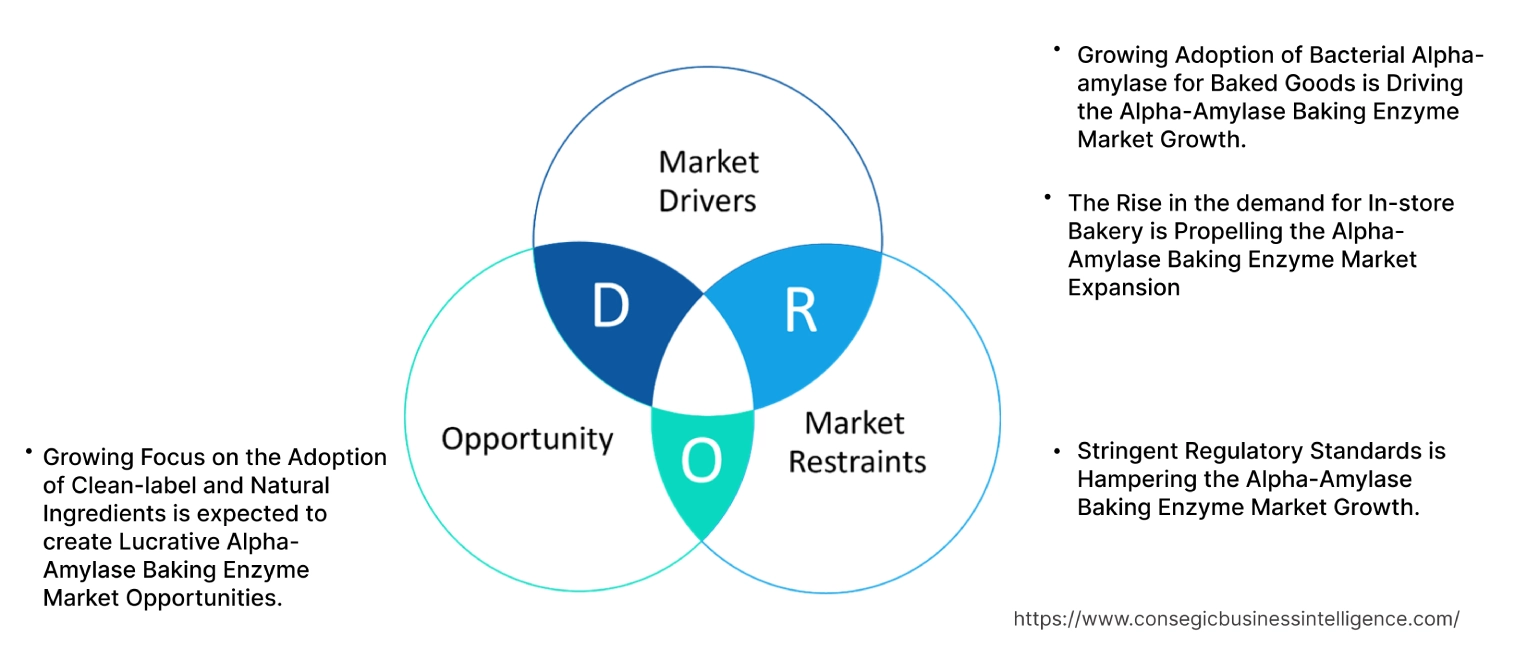
Growing Adoption of Bacterial Alpha-amylase for Baked Goods is Driving the Alpha-Amylase Baking Enzyme Market Growth.
The global alpha-amylase baking enzyme industry is experiencing significant growth, driven by the increasing adoption of bacterial alpha-amylase. Bacterial-derived enzymes offer several advantages including higher thermostability, pH tolerance, and cost-effectiveness. This makes them ideal for baking applications, such as bread, buns, cookies, and cakes among others. Additionally, alpha-amylase derived through bacteria such as Bacillus subtilis is approved in various regions for the preparation of bread.
- In April 2023, Health Canada approved the use of alpha-amylase derived from Bacillus subtilis AR-651 in various baked goods, including bread, flour, whole wheat flour, and unstandardized bakery products. This development signifies a positive step towards expanding the use of food enzymes to enhance the quality, texture, and shelf life of baked goods.
Thus, as consumers demand high-quality, consistent, and affordable baked goods, the utilization of bacterial alpha-amylase is poised to propel the alpha-amylase baking enzyme market expansion.
The Rise in the demand for In-store Bakery is Propelling the Alpha-Amylase Baking Enzyme Market Expansion
The increasing preference for fresh, artisanal bread and pastries has led to a surge in in-store bakeries. In-store bakeries are bakery sections within supermarkets or grocery stores. They offer freshly baked bread, pastries, cakes, and other baked goods. These bakeries mainly consist of a variety of products, from classic loaves to artisan bread. These bakeries mainly produce a wide range of products, from classic loaves to gourmet pastries, requiring efficient and reliable production processes.
Alpha-amylase baking enzymes play a crucial role in meeting these requirements. By accelerating fermentation, improving dough handling, and enhancing the final product's texture and flavor, alpha-amylase helps in-store bakeries maintain consistent quality and increase production efficiency. Additionally, there is a rise in the requirement for in-store bakeries to purchase functional bakery items, such as bread, buns, and rolls among others.
- According to the FMI –The Food Industry Association, in its Power of In-Store Bakery 2022 report, states that consumer engagement with in-store bakery items remains high, with nearly all shoppers (95%) consuming them occasionally and 63% doing so on a weekly basis.
Overall, based on the market analysis, the rise in the popularity of in-store bakeries is influencing the use of alpha-amylase in various bakery items, thus driving the growth of the market.
Key Restraints:
Stringent Regulatory Standards is Hampering the Alpha-Amylase Baking Enzyme Market Growth.
The Alpha-Amylase Baking Enzyme market faces significant hurdles due to stringent regulatory standards set forth by government bodies across the globe. These regulations are primarily aimed at safeguarding both public health and the environment, but they also come with substantial implications for the sector.
To comply with these regulatory frameworks, companies navigate a complex landscape of guidelines governing food additives, including enzymes. This entails a rigorous process of testing, which includes safety assessments, efficacy evaluations, and toxicological studies. The necessary documentation to prove compliance is exhaustive, requiring considerable resources in terms of both time and money. As a result, production costs inevitably rise, leading to longer timelines for product development and market introduction. These cumulative factors hinder the swift adoption of alpha-amylase which stifles potential growth within the market.
Future Opportunities :
Growing Focus on the Adoption of Clean-label and Natural Ingredients is expected to create Lucrative Alpha-Amylase Baking Enzyme Market Opportunities.
The rising consumer preference for clean-label and natural ingredients is driving significant growth in the market. As consumers seek products with minimal artificial additives, enzymes like alpha-amylase, derived from natural sources such as bacteria, fungi, or plants, are gaining traction. These enzymes offer a range of benefits, including improved dough handling, fermentation, and product quality. By aligning with the clean-label trend, alpha-amylase is poised to become an indispensable ingredient in the baking sector, contributing to the production of healthier and more appealing baked goods. This makes it an ideal choice for manufacturers aiming to meet the increasing consumer preference for clean-label and natural products.
- According to the data provided by Asia Food Journal in April 2024, it is stated Ingredion's latest ATLAS research confirms that clean label continues to be a major purchase driver, with up to 55% of European consumers willing to pay more for products with natural ingredients, such as those made with enzymes like alpha-amylase.
Thus, the growing preference for clean labels and natural ingredients is influencing the alpha-amylase baking enzyme market opportunities.
Alpha-Amylase Baking Enzyme Market Segmental Analysis :
By Source:
Based on source, the market is categorized into fungi, bacteria, and plant
Trends in the Source:
- The trends in producing Bacillus alpha-amylase through fermentation methods is driving the segment growth.
- Consumers and bakers are increasingly seeking enzymes that come from plant sources, driven by the requirement for natural ingredients.
The bacteria segment accounted for the largest market share in 2024.
- Bacteria-based alpha-amylase is a type of enzyme produced by specific bacterial strains, primarily Bacillus species.
- It is widely used in the baking industry due to its ability to break down complex starch molecules into simpler sugars.
- This enzymatic activity accelerates fermentation, leading to faster dough rise and improved bread quality.
- Additionally, bacterial alpha-amylase enhances dough handling properties, making it more bendable and easier to shape.
- It also contributes to the development of a softer crumb and better moisture retention in the final baked product.
- Bacterial alpha-amylase exhibits higher thermostability and pH tolerance, making it suitable for various baking processes.
- Manufacturers are developing novel alpha-amylase products derived from bacterial sources for baked goods applications.
- For instance, Enzyme Development Corporation developed FRESH-N, which is a heat-resistant alpha-amylase enzyme derived from Bacillus liquifaciens. This enzyme is specifically designed to improve the quality and shelf life of various baked goods.
- Thus, based on the market analysis, by optimizing the use of bacterial alpha-amylase, bakers achieve consistent product quality, reduce production time, and meet the growing consumer requirement for high-quality, natural, and delicious baked goods, thus driving the alpha-amylase baking enzyme market trends.
The plant segment is expected to grow at the fastest CAGR over the forecast period.
- Plant-based alpha-amylase enzymes are derived from plant sources and are gaining popularity in the baking sector due to their natural origin and potential health benefits.
- These enzymes, often extracted from plants like barley or wheat, offer a sustainable and clean-label alternative to microbial-derived alpha-amylases.
- Plant-based enzymes effectively break down complex starches into simpler sugars, improving dough fermentation, texture, and overall product quality.
- They enhance the crumb softness, moisture retention, and flavor development of baked goods.
- Additionally, plant-based alpha-amylases are often perceived as more natural and appeal to consumers seeking products with minimal processing and artificial additives.
- Nevertheless, as per the market analysis, advancements in enzyme technology are continually expanding the applications, thus driving the market expansion.
By Application:
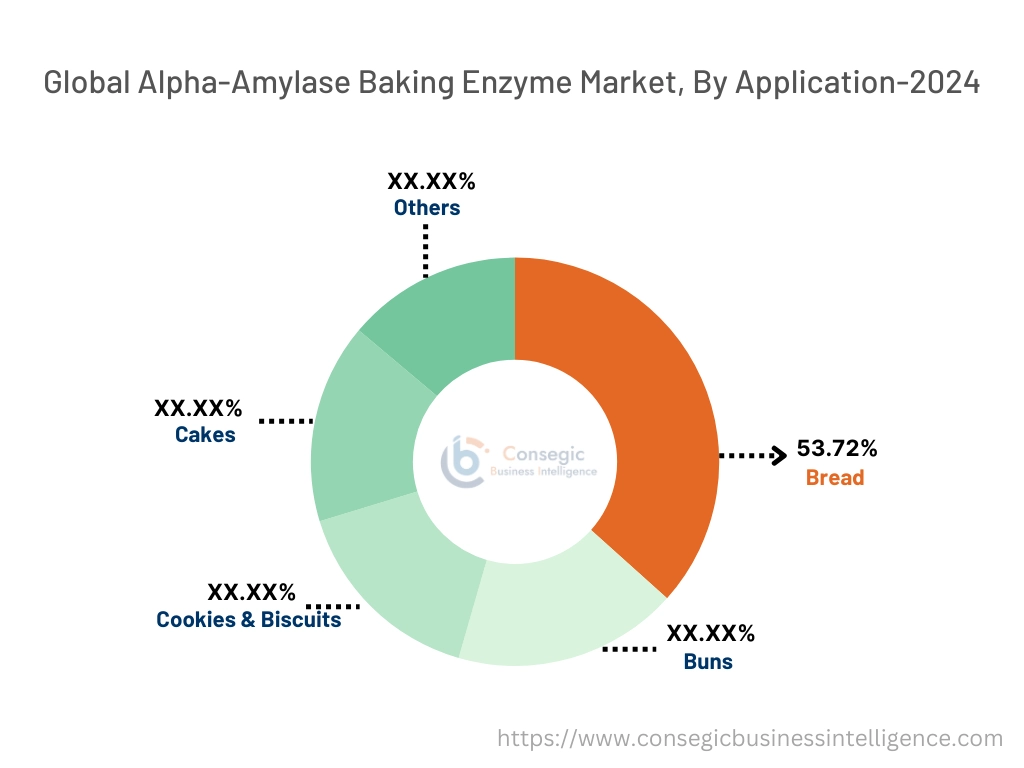
Based on applications, the market is categorized into bread, buns, cookies & biscuits, cakes, and others.
Trends in Application:
- The increasing trend for enhanced dough handling and texture is influencing the segment.
- The rising popularity of developing tailored alpha-amylase enzymes for specific applications, such as bread, cakes, and cookies, is driving the market,
The bread segment accounted for the largest market share of 53.72% in the year 2024.
- Alpha-amylase, a potent enzyme derived from various sources like bacteria, fungi, and plants, plays a pivotal role in enhancing bread quality.
- When added to bread dough, it catalyzes the breakdown of complex starch molecules into simpler sugars, primarily maltose.
- This enzymatic action accelerates fermentation by providing readily available food for yeast, leading to faster dough rise and improved volume.
- Additionally, alpha-amylase contributes to a softer crumb by breaking down starch granules, resulting in a more tender texture.
- It also helps retain moisture, preventing the bread from drying out prematurely and extending its shelf life.
- The rise in the consumption of bread influences the use of alpha-amylase in bread to enhance the properties of bread.
- For instance, according to the data published by the UK Flour Millers, bread is purchased by 99.8% of households in Britain, with nearly 11 million loaves sold each day. Approximately 60-70% of the bread consumed is white, and sandwiches are believed to account for 50% of total bread consumption. Alpha-amylase, a natural enzyme, plays a crucial role in enhancing the quality and consistency of bread.
- Thus, by optimizing the use of alpha-amylase, bakers produce high-quality bread with improved flavor, aroma, and overall consumer appeal, thus driving the alpha-amylase baking enzyme market demand.
The cookies & biscuits segment is expected to grow at the fastest CAGR over the forecast period.
- Alpha-amylase plays a significant role in enhancing the quality of cookies and biscuits.
- By breaking down complex starch molecules into simpler sugars, it influences dough viscosity and spread, contributing to the desired shape and texture of these baked goods.
- Additionally, the breakdown of starch during baking enhances the Maillard reaction, leading to the development of the characteristic golden-brown color and rich flavor of cookies and biscuits.
- Alpha-amylase also improves the crumb structure, making it more tender and crumblier.
- By optimizing the use of alpha-amylase, manufacturers are able to produce high-quality cookies and biscuits with consistent texture, flavor, and appearance.
- Thus, the use of alpha-amylase in cookies & biscuits is enhancing the alpha-amylase baking enzyme market demand in coming years.
Regional Analysis:
The regional segment includes North America, Europe, Asia Pacific, the Middle East and Africa, and Latin America.
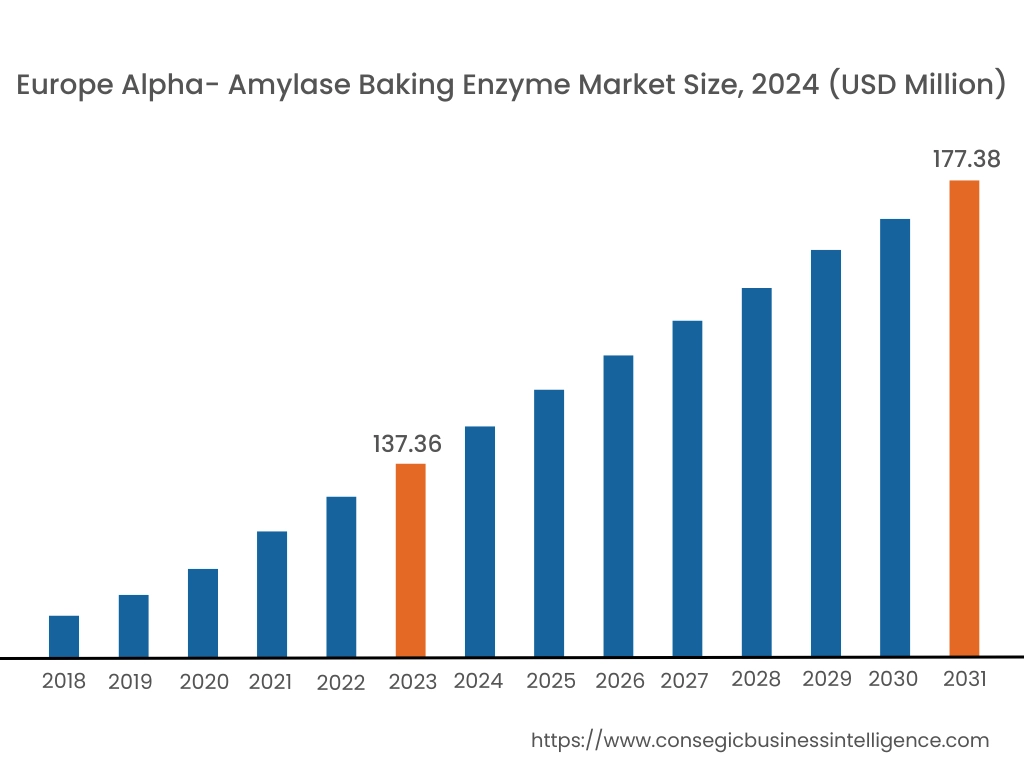
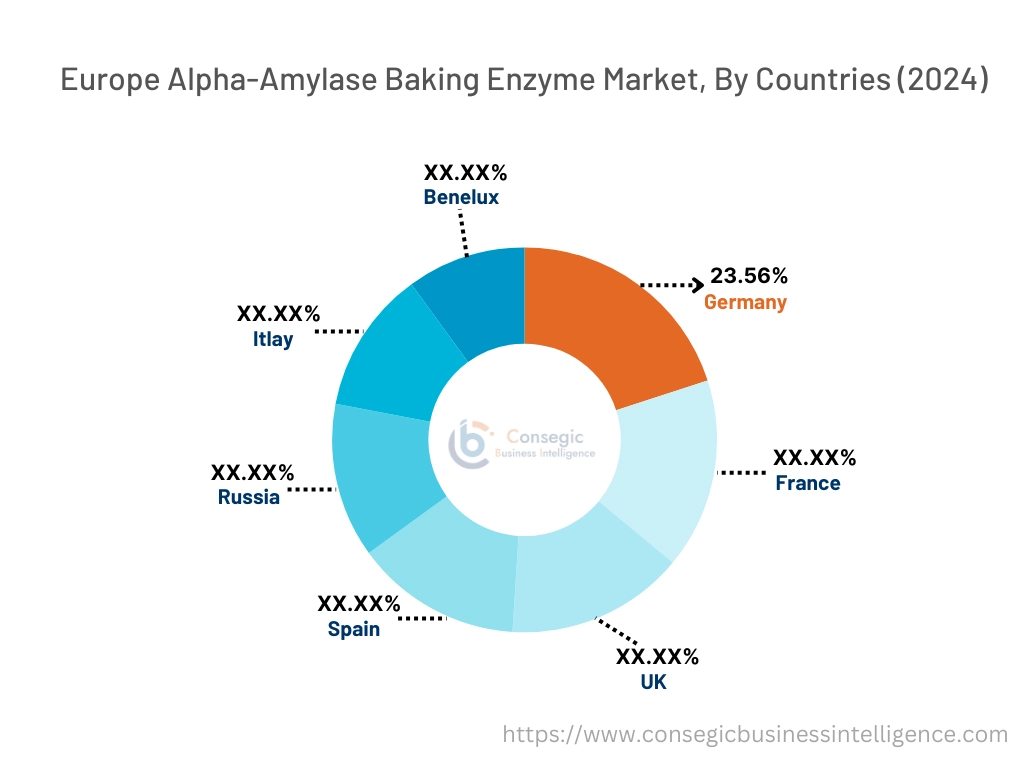
In 2024, Europe accounted for the highest alpha-amylase baking enzyme market share at 33.10% and was valued at USD 137.36 Million and is expected to reach USD 177.38 Million in 2032. In Europe, Germany accounted for the highest alpha-amylase baking enzyme market share of 23.56% during the base year of 2024. Europe is a significant market for alpha-amylase baking enzymes, driven by the region's strong requirement for high-quality, innovative, and natural food products. The growing consumer preference for clean-label and organic products has led to increased requirements for natural enzymes such as alpha-amylase. These enzymes help improve dough handling, fermentation, and product texture, resulting in superior-quality baked goods.
Additionally, European consumers are increasingly health-conscious, and alpha-amylases contribute to the production of healthier bread and baked goods by improving nutrient absorption and reducing the glycemic index. Based on the alpha-amylase baking enzyme market analysis, the European market continues to evolve, with a focus on sustainability, natural ingredients, and innovative product development, alpha-amylase enzymes are poised to play a crucial role in shaping the future of the baking sector, thus influencing the market share in this region.
Asia Pacific is experiencing the fastest growth with a CAGR of 3.9% over the forecast period. The Asia-Pacific region is a significant market for alpha-amylase baking enzymes, driven by the growing demand for bakery products, particularly in countries like China, India, and Japan. The increasing urbanization and rising disposable incomes in these countries have led to a shift towards Western-style diets, including bread and pastries. Alpha-amylase enzymes play a crucial role in enhancing the quality and production efficiency of these products. They improve dough handling, fermentation, and crumb texture, resulting in softer, more flavorful, and longer-lasting baked goods. Additionally, the growing requirement for ready-to-eat bakery products is making alpha-amylase enzymes a choice for many manufacturers.
- According to the data published by the India Brand Equity Foundation, in March 2024, states that the ready-to-eat market in India is expected to surge by approximately 45% over the next five years. Alpha-amylase enzymes play a crucial role in meeting this development by improving the quality and production efficiency of ready-to-eat baked goods.
Thus, as per the alpha-amylase baking enzyme market analysis, as the Asia-Pacific region continues to experience rapid economic development and changing consumer preferences, the alpha-amylase baking enzyme market trend is expected to remain strong.
North America is a significant market for alpha-amylase baking enzymes, driven by the region's consumption of bread and bakery products. The requirement for high-quality, consistent, and innovative baked goods has fueled the adoption of alpha-amylase enzymes to enhance product quality and production efficiency. Bacterial-based alpha-amylases, particularly those derived from Bacillus subtilis, are widely used in the region due to their thermostability, pH tolerance, and cost-effectiveness. These enzymes help improve dough handling, fermentation, and crumb texture, resulting in softer, more flavorful, and longer-lasting bread. Additionally, the growing trend towards clean-label and natural ingredients has further boosted the requirement for alpha-amylase enzymes, as they are derived from natural sources and do not leave any residues in the final product.
The Middle East and Africa (MEA) region is experiencing rapid urbanization and a growing middle class, leading to increased requirements for convenience foods, including baked goods. Alpha-amylase baking enzymes play a crucial role in meeting this requirement by enhancing the quality and production efficiency of various baked products. They improve dough handling, fermentation, and crumb texture, resulting in softer, more flavorful, and longer-lasting bread, pastries, and cakes. Additionally, the rising health and wellness trend in the region has led to increased demand for natural and clean-label ingredients, making alpha-amylase enzymes a preferred choice for many manufacturers. Based on the market analysis, as the MEA region continues to modernize and its population grows, the requirement for alpha-amylase is expected to increase significantly.
Latin America is a dynamic market for alpha-amylase baking enzymes, driven by the growing middle class and changing consumer preferences. The region has witnessed a significant shift towards Western-style diets, including bread and pastries. To meet this increasing demand, local manufacturers are adopting advanced technologies and innovative ingredients, such as alpha-amylase enzymes. These enzymes help improve dough handling, fermentation, and product quality, leading to softer, more flavorful, and longer-lasting baked goods. Additionally, the growing emphasis on food safety and quality standards has led to increased adoption of food enzymes like alpha-amylase. As the Latin American market continues to evolve, alpha-amylase enzymes are poised to play a crucial role in driving the development of the baking sector.
Top Key Players and Market Share Insights:
The global Alpha-Amylase Baking Enzyme market is highly competitive with major players providing precise products to the national and international markets. Key players are adopting several strategies in research and development (R&D) and product innovation to hold a strong position in the global Alpha-Amylase Baking Enzyme market. Key players in the Alpha-Amylase Baking Enzyme industry include-
- Novozymes A/S (Denmark)
- International Flavors & Fragrances Inc. IFF (United States)
- Infinita Biotech Private Limited. (India)
- Kerry Inc. (Ireland)
- Enzyme Development Corporation (United States)
- Biolaxi Corporation. (India)
- Antozyme Biotech Pvt Ltd (India)
- AB Enzymes (Germany)
- Jiangsu Yiming Biological Technology Co., Ltd.,(China)
Recent Industry Developments:
Approval:
- In April 2023, Health Canada approved the use of alpha-amylase derived from Bacillus subtilis AR-651 in various baked goods, including bread, flour, whole wheat flour, and unstandardized bakery products. This development signifies a positive step towards expanding the use of food enzymes to enhance the quality, texture, and shelf life of baked goods.
Alpha-Amylase Baking Enzyme Market Report Insights :
| Report Attributes | Report Details |
| Study Timeline | 2019-2032 |
| Market Size in 2032 | USD 532.84 Million |
| CAGR (2025-2032) | 3.3% |
| By Source |
|
| By Application |
|
| By Region |
|
| Key Players |
|
| North America | U.S. Canada Mexico |
| Europe | U.K. Germany France Spain Italy Russia Benelux Rest of Europe |
| APAC | China South Korea Japan India Australia ASEAN Rest of Asia-Pacific |
| Middle East and Africa | GCC Turkey South Africa Rest of MEA |
| LATAM | Brazil Argentina Chile Rest of LATAM |
| Report Coverage |
|
Key Questions Answered in the Report
How big is the Alpha-Amylase Baking Enzyme market? −
In 2024, the Alpha-Amylase Baking Enzyme market is USD 414.99 Million.
Which is the fastest-growing region in the Alpha-Amylase Baking Enzyme market? +
Asia Pacific is the fastest-growing region in the Alpha-Amylase Baking Enzyme market.
What specific segmentation details are covered in the Alpha-Amylase Baking Enzyme market? +
Source and application segmentation details are covered in the Alpha-Amylase Baking Enzyme market.
Who are the major players in the Alpha-Amylase Baking Enzyme market? +
Novozymes A/S (Denmark), International Flavors & Fragrances Inc. IFF (United States), Biolaxi Corporation. (India) are some of the major players in the market.
Overview
Reputation & Certifications


Our Services
- Market Intelligence & Forecasting
- Custom Research Solutions
- Market Entry Strategy
- Competitive Intelligence
- Customer Insights
- Industry Innovation Analysis
- Investment Advisory