Jump to Content
Aluminum Die Casting Market - Size, Share, Industry Trends, and Forecasts (2025-2032)
Aluminum Die Casting Market Size:
Aluminum Die Casting Market size is estimated to reach over USD 171.58 Billion by 2032 from a value of USD 82.41 Billion in 2024 and is projected to grow by USD 88.85 Billion in 2025, growing at a CAGR of 9.6% from 2025 to 2032.
Key Market Trends & Insights
- North America was valued at USD 27.34 Billion and is expected to reach USD 55.61 Billion in 2032. North America, the U.S. accounted for the highest share of 73.10% during the base year of 2024.
- Asia Pacific, the market is experiencing the fastest growth with a CAGR of 10.1% over the forecast period. Asia-Pacific is the largest and most dynamic aluminum die casting industry. The region is home to major manufacturing hubs, including China, India, and Japan
Aluminum Die Casting Market Scope & Overview:
Aluminum die casting is a manufacturing process that involves injecting molten aluminum under high pressure into a mold cavity to create intricate and precise metal components. This process ensures superior dimensional accuracy, excellent surface quality, and cost-efficient production for large-scale operations. The method is renowned for producing lightweight and corrosion-resistant components with enhanced strength and durability. Aluminum die castings also exhibit excellent thermal conductivity and resistance to extreme temperatures, making them suitable for high-performance applications. The process allows for complex designs and minimizes material wastage, ensuring cost efficiency and sustainability. Applications of it span various industries, including automotive, aerospace, electronics, and industrial machinery. In the automotive sector, it is used for engine parts, transmission housings, and structural components, contributing to improved fuel efficiency and reduced emissions. In aerospace, it enables the creation of lightweight yet robust parts critical for aircraft performance. Electronics benefit from it through the production of enclosures and heat sinks, ensuring better heat dissipation and product reliability. End-use industries prioritize it for its ability to deliver durable, versatile, and precision-engineered components, addressing the growing trend for high-quality and efficient manufacturing solutions.

Aluminum Die Casting Market Dynamics - (DRO) :
Key Drivers:
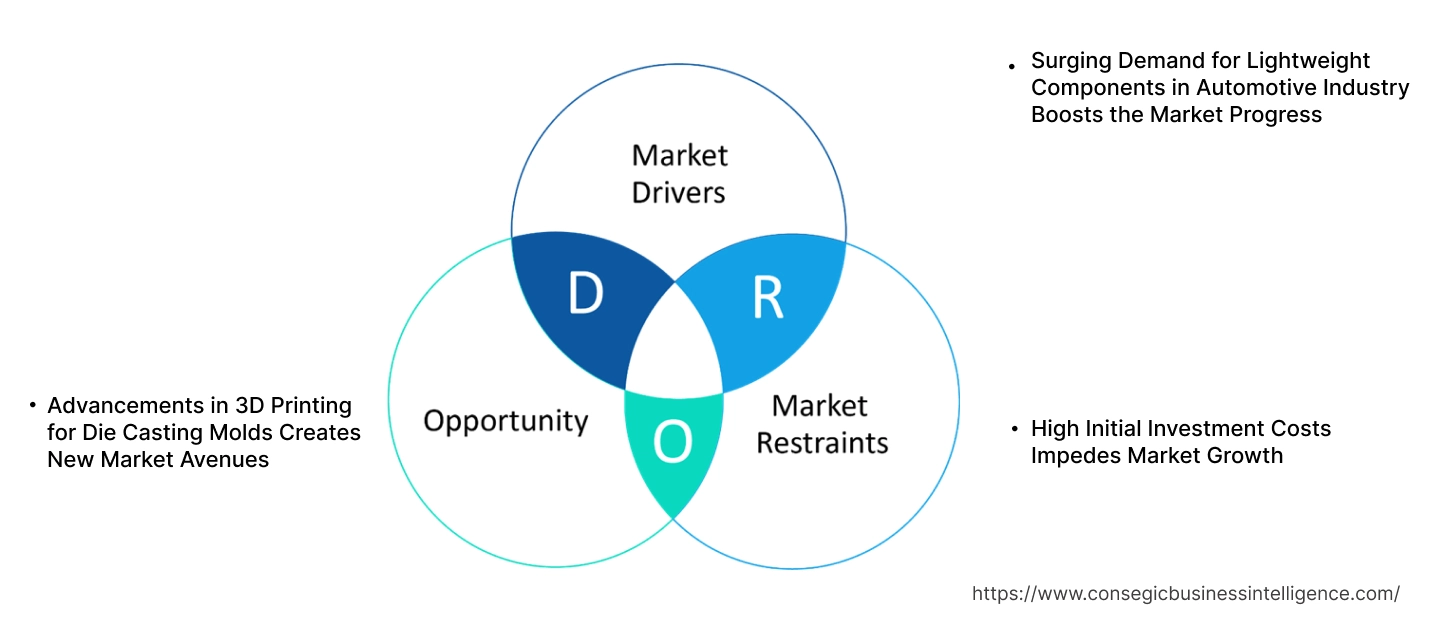
Surging Demand for Lightweight Components in Automotive Industry Boosts the Market Progress
The automotive industry is increasingly focused on reducing vehicle weight to enhance fuel efficiency, improve performance, and lower carbon emissions. Aluminum die casting plays a crucial role in this trend by enabling the production of lightweight yet durable components, such as engine blocks, transmission housings, and structural parts. By using this process, manufacturers can create parts that meet the stringent performance and safety requirements of modern vehicles while keeping weight at a minimum. For instance, aluminum die-cast engine components are lightweight, strong, and resistant to wear and corrosion, making them ideal for enhancing fuel efficiency. As governments implement stricter fuel efficiency regulations and manufacturers look for ways to reduce the environmental impact of their vehicles, the trend in the automotive sector is expected to rise.
Therefore, the growing requirement for lightweight components in the automotive industry is expected to significantly boost the aluminum die casting market.
Key Restraints:
High Initial Investment Costs Impedes Market Growth
One of the primary challenges in the aluminum die casting market is the high initial investment required for the technology. The process involves substantial upfront costs for purchasing specialized die casting equipment, molds, and tooling. These expenses can pose significant barriers for small and medium-sized enterprises (SMEs) or businesses with limited capital. The initial costs, combined with ongoing maintenance and energy consumption, increase the financial burden on manufacturers. Furthermore, creating high-quality aluminum die-cast products requires skilled labor and precise production methods, which adds to the overall cost structure. While the long-term benefits of die casting, such as increased production efficiency and reduced material waste, are substantial, the significant initial capital investment remains a major hurdle, particularly in emerging markets or industries with smaller production volumes.
Thus, the substantial capital investment required for aluminum die casting technology can limit its adoption, especially in price-sensitive sectors or by companies with constrained budgets.
Future Opportunities :
Advancements in 3D Printing for Die Casting Molds Creates New Market Avenues
Recent advancements in 3D printing technology present a significant opportunity for the aluminum die casting market. The use of 3D printing in mold creation allows manufacturers to produce complex mold geometries that would otherwise be difficult, time-consuming, or costly to create with traditional manufacturing methods. 3D-printed molds can improve the precision of the die-casting process, reduce production times, and lower material waste. Moreover, 3D printing allows for the creation of custom molds and rapid prototyping, making it easier for manufacturers to innovate and experiment with new designs. This capability is particularly valuable in industries where design flexibility and fast turnarounds are essential, such as the automotive and aerospace industries. The ability to produce cost-effective, highly detailed molds and reduce lead times will likely attract more companies to adopt die casting as a preferred manufacturing method. As 3D printing continues to evolve and become more affordable, it is expected to play a key role in shaping the future of aluminum die casting.
Therefore, the integration of 3D printing technology into die casting processes presents a promising aluminum die casting market opportunity by enhancing flexibility, reducing costs, and improving efficiency.
Rising Demand from Aerospace and Consumer Electronics Sectors Opens New Doors
The aerospace and consumer electronics industries are increasingly relying on aluminum die casting to meet their needs for lightweight, durable, and high-performance components. In aerospace, aluminum die-cast parts are critical in producing intricate components for aircraft and satellites, where weight reduction and strength are paramount. Similarly, in consumer electronics, the need for thin yet strong enclosures for devices like smartphones, laptops, and gaming consoles is pushing need for aluminum die casting. The ability to produce complex, high-precision parts makes aluminum die casting a preferred choice in these industries. As these sectors continue to expand and innovate, the aluminum die casting market demand is expected to increase.
Thus, the rising demand for aluminum die-cast components in aerospace and consumer electronics is an important opportunity for aluminum die casting market expansion.
Aluminum Die Casting Market Segmental Analysis :
By Type:
Based on type, the market is segmented into high pressure die casting, low pressure die casting, vacuum die casting, gravity die casting, and squeeze die casting.
The high pressure die casting segment accounted for the largest revenue share in 2024.
- High pressure die casting is the most widely used method due to its efficiency in producing complex and high-precision components at a large scale. It involves injecting molten metal into a steel mold (die) at high pressure, which solidifies quickly to form parts with excellent dimensional accuracy.
- This method is highly suitable for automotive, aerospace, and consumer electronics industries, where lightweight, durable components are required. Parts such as engine blocks, transmission housings, and chassis are commonly produced using high pressure die casting.
- The key advantages of high pressure die casting include faster cycle times, superior finish, and the ability to cast intricate shapes. These characteristics lead to its dominance in industries that require large volumes of precision parts, especially automotive and electronics.
- Additionally, advancements in automation and integration with smart technologies in casting systems are further enhancing the capabilities and attractiveness of high pressure die casting.
- Thus, high pressure die casting is expected to continue leading the market in both revenue and demand, especially as industries seek more cost-effective and sustainable manufacturing solutions.
- Therefore, according to aluminum die casting market analysis, the high pressure die casting sector dominates the market due to its efficiency, ability to produce high-precision and lightweight components, and continued advancements in casting technology.
The vacuum die casting segment is anticipated to register the fastest CAGR during the forecast period.
- Vacuum die casting involves creating a vacuum around the molten metal inside the die, which helps to eliminate air bubbles and defects, resulting in a smoother, denser, and stronger cast.
- This method is especially beneficial for aerospace and automotive industries, where parts must meet strict standards for strength and durability.
- As vacuum die casting technology improves, it is becoming more affordable and accessible to manufacturers, which is driving its adoption in high-performance applications.
- Vacuum die casting is increasingly being used to create complex parts, including thin-walled and high-strength components. These include turbine blades, structural parts, and heat-resistant components.
- The need for high-quality, defect-free parts is pushing the growth of this segment, with aerospace and high-performance automotive sectors being the main drivers.
- Thus, according to aluminum die casting market analysis, vacuum die casting is expected to experience the fastest growth due to its ability to produce high-quality, defect-free components for critical applications, particularly in aerospace and automotive sectors.
By Production Process:
The market is segmented based on production process into die casting machines (Cold Chamber Die Casting Machines, Hot Chamber Die Casting Machines) and Tooling (Steel Tooling, Aluminum Tooling).
The die casting machines segment accounted for the largest revenue share in 2024.
- Die casting machines are central to the die casting process, as they are responsible for injecting molten metal into the die cavity. These machines are divided into two main types: cold chamber and hot chamber.
- Cold chamber die casting machines are the most widely used for aluminum die casting due to the higher melting point of aluminum. These machines are designed to handle the temperature extremes associated with molten aluminum.
- In addition to the primary machine types, advancements in automation and robotics are transforming die casting machines, enabling faster, more precise, and more energy-efficient operations. Integration with IoT allows for better monitoring and control of the production process, further improving efficiency.
- Die casting machines are widely used in sectors such as automotive, industrial machinery, and electronics, where the need for precision and high-volume production is high.
- Therefore, according to market analysis, die casting machines remain the dominant segment due to their critical role in the die casting process, with the trend for automation and precision driving continued market expansion.
The tooling segment is expected to register the fastest CAGR during the forecast period.
- Tooling refers to the molds and dies used to shape the molten aluminum during the casting process. Steel tooling is favored for its durability and ability to withstand the high pressure and temperatures involved in die casting.
- Steel tooling provides exceptional precision and longevity, making it ideal for high-volume production runs, particularly in automotive and aerospace industries.
- As more industries require high-quality, durable components with precise dimensional accuracy, the look for steel tooling is expected to rise rapidly.
- The aluminum die casting market trend towards customized tooling for specific applications in sectors such as automotive and aerospace will further drive the need for steel tooling, making it a high-growth area.
- Thus, according to market analysis, steel tooling is projected to grow the fastest due to its durability, precision, and high demand in industries requiring customized, high-performance aluminum die cast components.
By Sales Channel:
The market is segmented into OEMs (Original Equipment Manufacturers) and aftermarket.
The OEM segment accounted for the largest revenue share in 2024.
- OEMs are the primary purchasers of aluminum die cast parts, as they use them in the assembly of end products, including vehicles, electronics, and industrial machinery.
- OEMs typically require high volumes of aluminum die cast parts with specific designs and precision to meet their production needs.
- The growing aluminum die casting market trend of outsourcing manufacturing to OEM suppliers, as well as long-term contracts between OEMs and die casting manufacturers, is driving the growth of this segment.
- The automotive sector, which is heavily reliant on aluminum die castings for vehicle production, is one of the largest contributors to the OEM segment.
- Therefore, according to market analysis, the OEM segment holds the largest revenue share due to its large-scale, long-term demand for high-quality aluminum die cast components used in the manufacturing of end products.
The aftermarket segment is expected to register the fastest CAGR during the forecast period.
- The aftermarket segment involves the sale of replacement parts for maintenance and repair purposes. As industries such as automotive and industrial machinery expand, the need for spare parts and replacement components increases.
- Aluminum die cast parts used in vehicles, machinery, and equipment often need replacement due to wear and tear, which is driving the growth of the aftermarket segment.
- Additionally, as more industries shift to more sustainable manufacturing methods, the trend for aftermarket aluminum parts that are durable, high-quality, and cost-effective is expected to increase.
- Thus, according to market analysis, the aftermarket segment is projected to grow the fastest due to the rising demand for replacement parts across industries such as automotive and industrial machinery.
By End User Industry:
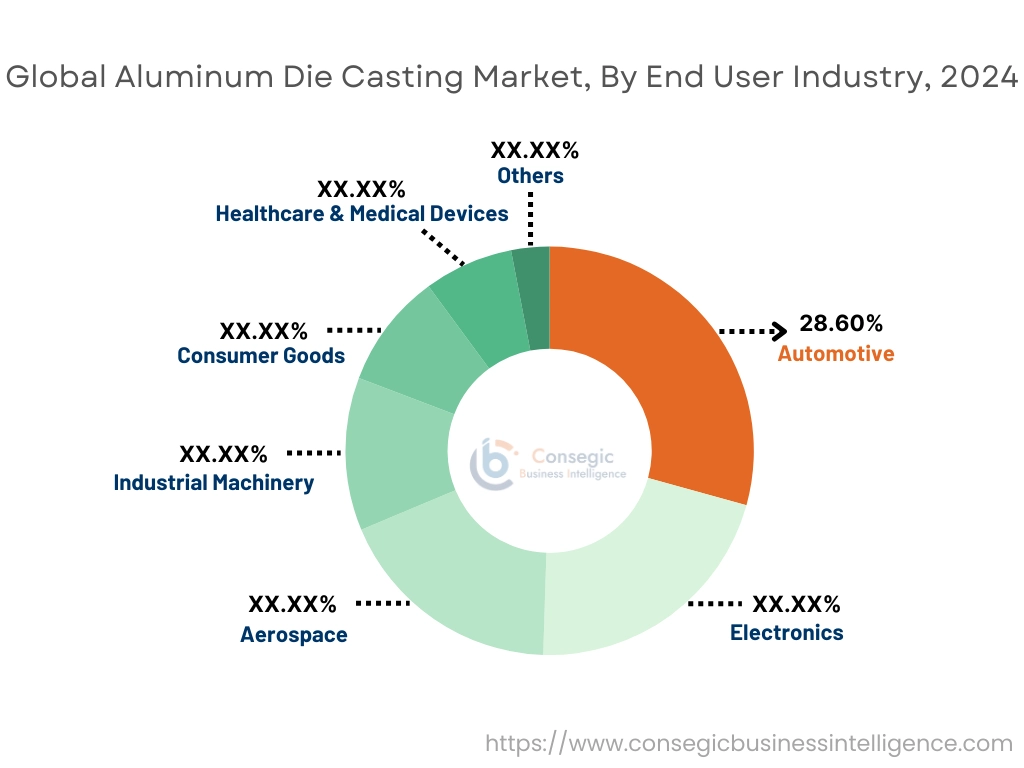
Based on end-user industry, the market is segmented into automotive, electronics, aerospace, industrial machinery, consumer goods, healthcare & medical devices, and others.
The automotive segment accounted for the largest revenue share by 28.60% in 2024.
- The automotive industry is the largest consumer of aluminum die castings due to the growing need for lightweight materials that improve fuel efficiency and reduce emissions. Aluminum die castings are used extensively for engine blocks, transmission housings, cylinder heads, and structural components in vehicles.
- The shift towards electric vehicles (EVs) is also contributing to the growing trend for lightweight aluminum components, as they help reduce the overall weight of the vehicle and enhance energy efficiency.
- Additionally, as vehicles become more technologically advanced, the demand for more intricate and complex parts, such as sensors, housings, and structural elements, is driving the aluminum die casting market within the automotive sector.
- With ongoing innovations in the automotive industry and the increasing emphasis on sustainability, the automotive sector is expected to continue to dominate the aluminum die casting market.
- Therefore, according to market analysis, the automotive industry leads the market due to its high demand for aluminum die cast parts, driven by the need for lightweight, energy-efficient, and high-performance components in modern vehicles.
The aerospace segment is expected to register the fastest CAGR during the forecast period.
- The aerospace sector relies on aluminum die casting for lightweight, high-strength parts that are critical for aircraft performance and safety. Parts like structural components, landing gears, and turbine blades are often made from aluminum die castings.
- As the aerospace industry grows, particularly in commercial aviation and space exploration, the demand for aluminum die casting is expected to increase.
- Additionally, advancements in casting technologies are enabling the production of more complex parts that meet the stringent requirements for strength, weight, and durability.
- The rising focus on fuel efficiency and reducing carbon emissions in the aerospace industry will further contribute to the aluminum die casting market growth of the in this sector.
- Thus, according to market analysis, the aerospace sector is anticipated to see the fastest growth due to the increasing demand for lightweight, high-performance aluminum components in aerospace applications.
Regional Analysis:
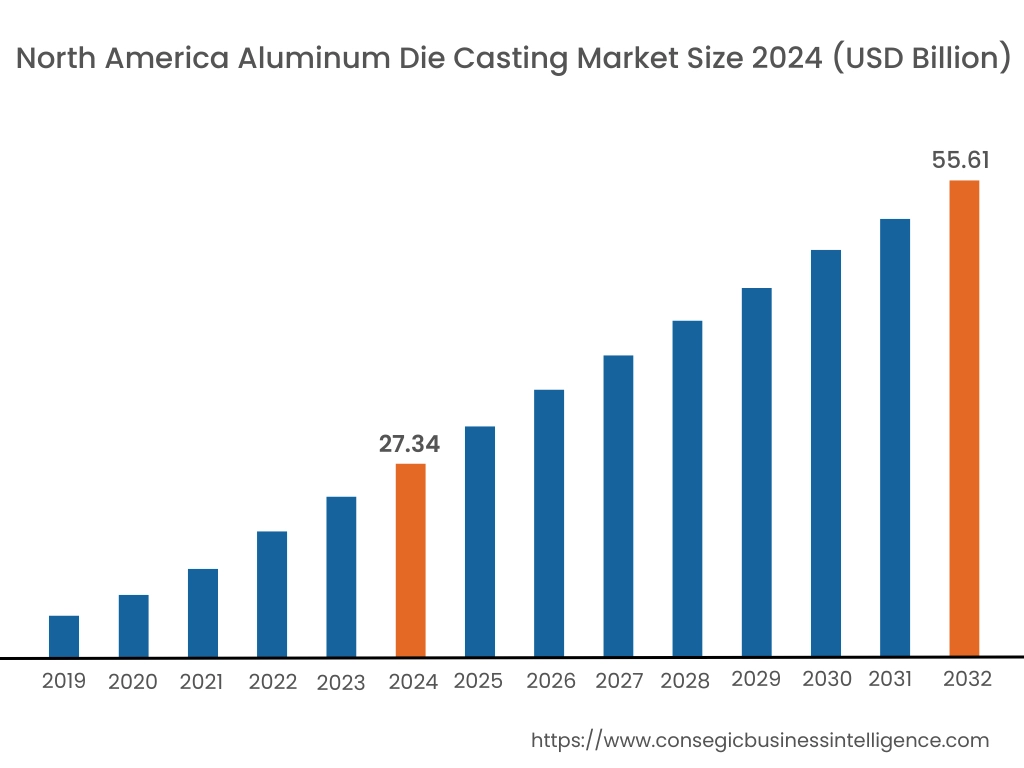
In 2024, North America was valued at USD 27.34 Billion and is expected to reach USD 55.61 Billion in 2032. In North America, the U.S. accounted for the highest share of 73.10% during the base year of 2024. North America holds a significant aluminum die casting market share. The automotive industry in the U.S. and Canada remains a key sector demanding lightweight and durable components. Technological advancements in casting processes and the increasing use of aluminum in electric vehicles further support market expansion. Strict environmental regulations and a focus on sustainability also influence market dynamics.

In 2024, North America was valued at USD 27.34 Billion and is expected to reach USD 55.61 Billion in 2032. In North America, the U.S. accounted for the highest share of 73.10% during the base year of 2024. North America holds a significant aluminum die casting market share. The automotive industry in the U.S. and Canada remains a key sector demanding lightweight and durable components. Technological advancements in casting processes and the increasing use of aluminum in electric vehicles further support market expansion. Strict environmental regulations and a focus on sustainability also influence market dynamics.
In Asia Pacific, the market is experiencing the fastest growth with a CAGR of 10.1% over the forecast period. Asia-Pacific is the largest and most dynamic aluminum die casting industry. The region is home to major manufacturing hubs, including China, India, and Japan. High demand from the automotive, construction, and electronics industries drives market performance. In addition, rising industrialization, infrastructure development, and the adoption of aluminum for weight reduction in vehicles play vital roles in market development.Europe remains a strong player in the aluminum die casting industry, driven by a robust automotive industry in countries like Germany, France, and Italy. Manufacturers in Europe focus on sustainable production methods, energy efficiency, and lightweight automotive components. Regulatory frameworks encouraging reduced carbon emissions further impact the demand for aluminum die casting in the automotive and industrial sectors.
The Middle East and Africa show moderate progress in the aluminum die casting market. Increasing investments in infrastructure, construction, and automotive industries contribute to market potential. However, the market is constrained by economic challenges, limited industrial capacity, and reliance on imports for advanced die casting technologies. Efforts to enhance manufacturing capabilities are underway, especially in countries like the UAE and South Africa.
In Latin America, the aluminum die casting market is emerging, with Brazil and Mexico leading in demand from the automotive and industrial sectors. The market benefits from the region's developing infrastructure and investments in manufacturing. However, economic volatility and political uncertainties create challenges for consistent market growth. There is also an ongoing push toward adopting more efficient casting technologies to boost production.
Top Key Players & Market Share Insights:
The Global Aluminum Die Casting Market is highly competitive with major players providing FWA to the national and international markets. Key players are adopting several strategies in research and development (R&D), product innovation, and end-user launches to hold a strong position in the Global Aluminum Die Casting Market. Key players in the Aluminum Die Casting Market industry include-
- Nemak, S.A.B. de C.V. (Mexico)
- Ryobi Limited (Japan)
- Finkl Steel (United States)
- KumKang Kind (South Korea)
- Rautaruukki Oyj (Finland)
- Gibbs Die Casting Corporation (United States)
- Die Casting Corporation of Florida, Inc. (United States)
- Pace Industries, LLC (United States)
- Handtmann Group (Germany)
- Bühler Group (Switzerland)
Recent Industry Developments :
Product launches:
- In January 2024, LK Technology introduced a new aluminum die casting machine that enhances production speed and minimizes material waste by utilizing advanced automation and precise control.
Aluminum Die Casting Market Report Insights:
| Report Attributes | Report Details |
| Study Timeline | 2019-2032 |
| Market Size in 2032 | USD 171.58 Million |
| CAGR (2025-2032) | 9.6% |
| By Type |
|
| By Production Process |
|
| By Sales Channel |
|
| By End-Use Industry |
|
| By Region |
|
| Key Players |
|
| North America | U.S. Canada Mexico |
| Europe | U.K. Germany France Spain Italy Russia Benelux Rest of Europe |
| APAC | China South Korea Japan India Australia ASEAN Rest of Asia-Pacific |
| Middle East and Africa | GCC Turkey South Africa Rest of MEA |
| LATAM | Brazil Argentina Chile Rest of LATAM |
| Report Coverage |
|
Key Questions Answered in the Report
How big is the Aluminum Die Casting Market? −
In 2024, the Aluminum Die Casting Market was USD 82.41 billion.
What will be the potential market valuation for the Aluminum Die Casting Market by 2032? +
In 2032, the market size of Aluminum Die Casting Market is expected to reach USD 171.58 Billion.
What are the segments covered in the Aluminum Die Casting Market report? +
The types, production processes, sales channels, and end-user industry are the segments covered in this report.
Who are the major players in the Aluminum Die Casting Market? +
Nemak, S.A.B. de C.V. (Mexico), Ryobi Limited (Japan), Gibbs Die Casting Corporation (United States), Die Casting Corporation of Florida, Inc. (United States), Pace Industries, LLC (United States), Handtmann Group (Germany), Bühler Group (Switzerland), Finkl Steel (United States), KumKang Kind (South Korea), Rautaruukki Oyj (Finland) are the major players in the Aluminum Die Casting market.
Overview
Reputation & Certifications


Our Services
- Market Intelligence & Forecasting
- Custom Research Solutions
- Market Entry Strategy
- Competitive Intelligence
- Customer Insights
- Industry Innovation Analysis
- Investment Advisory