Jump to Content
Amorphous Polyethylene Terephthalate Market - Size, Share, Industry Trends, and Forecasts (2025 - 2035)
Amorphous Polyethylene Terephthalate Market Scope & Overview
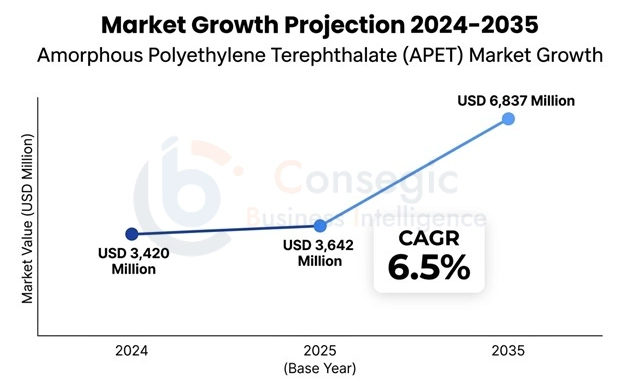
The amorphous polyethylene terephthalate (APET) market of the world is a niche or specialized market of the rigid plastic packaging and thermoforming industry which is a versatile transparent polymer material that is incredibly clear, offers great barrier properties, high formability, as well as recyclability to be used with various applications in food packaging, pharmaceutical containers, electronic energy housings, and consumer products. The market size is projected to be USD 3,420 Million in 2024 and USD 3,642.30 Million in 2025 (base year) and expected to grow by vast amounts to USD 6,837.10 Million in 2035. This growth trend is a compound annual growth rate (CAGR) of 6.5% over the forecast period 2026 to 2035 that will be driven by the growing rate of demand of sustainable packaging solutions, the growing ready-to-eat food markets, the growth in the pharmaceutical industry and by the shift in regulations favoring a non-use of PVC in food-contact applications.
Regional Trends and Insights
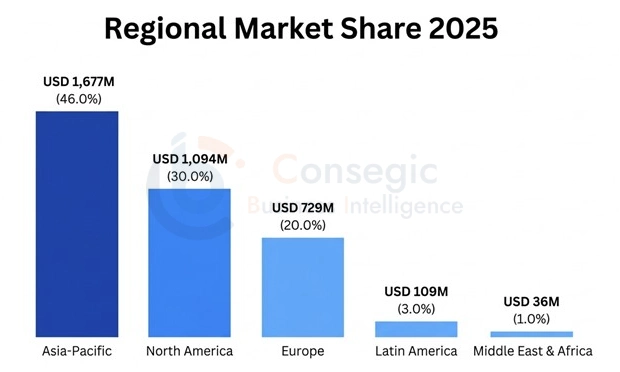
- By 2025, the Asia-Pacific Amorphous PET market is valued at USD 1,677 million, accounting for 46% of the global market, and is projected to grow to USD 3,240 million by 2035 at a 6.8% CAGR.
- In 2025, the North American APET market is valued at USD 1,094 million, accounting for 30% of the regional market, and is projected to reach USD 2,025 million by 2035 at a 6.3% CAGR.
Amorphous PET is a modification of crystalline PET using rapid cooling during the manufacturing process to produce non-crystalline molecular structure of materials which are exceptionally transparent with almost 90% light transmission, with high impact strength, and thermoformable at lower processing temperatures. In 2024 the world APET usage was more than 2.85 million metric tons, packaging uses took about 78 percent of total consumption and annual processing value in finished products in food service, retail packaging, medical devices, and consumer electronics markets was estimated to be over USD 18,400 Million.
Market Channel Distribution Analysis:
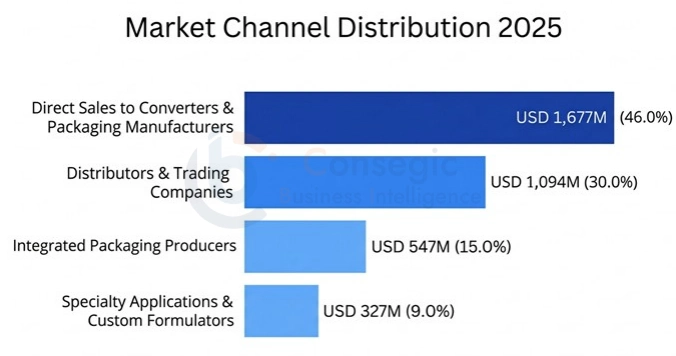
The amorphous PET market operates through four distinct sales and delivery channels, each serving specific customer segments with differentiated value propositions and supply chain models. The total market revenue distribution demonstrates significant variation by customer type, order volume, and regional factors:
- Direct Sales to Converters & Packaging Manufacturers:USD 1,677 Million (46.0% of total market value)
- Distributors & Trading Companies:USD 1,094 Million (30.0% of market revenue)
- Integrated Packaging Producers:USD 547 Million (15.0% of market share)
- Specialty Applications & Custom Formulators:USD 327 Million (9.0% of total market value)
In 2024, investment in recycling infrastructure and chemical recycling technologies across the world exceeded USD 2,850 Million, and the key resin producers devoted about 7.8% of their income to the creation of recycled grades of APET, to the enhancement of mechanical recycling, and to the further commercialization of new depolymerization technologies. The fundamental transformation of the industry towards the models of the circular economy with the compulsory demand of recycled content makes the significant breakthrough that leads to the massive innovation in the collection systems, sorting technologies, and closed-loop recycling utilization.
Amorphous Polyethylene Terephthalate Market Dynamics (DRO)
Key Drivers:
Sustainable Packaging Transition and PVC Replacement
The greatest market force is the growing shift to sustainable packaging material across the world that is highly recyclable as opposed to other plastics such as polystyrene, PVC and multi-material laminates. In the world, it is estimated that about 68 percent of people are very active when it comes to consumers thinking of environmental sustainability when buying products, and recyclable transparent packaging is commanding 15-25 % price premiums in the high-end food and beverage markets. Sustainable packaging market is projected to hit USD 285,000 Million in 2024, and its rate of increase is 7.5 percent per annum with APET being a preferred material adopted by companies that would want to show their environmental concerns, besides showing product visibility and protection.
APET has superior recyclability via well-established PET collection and sorting systems with a mechanical recycling rate of 58-65 in mature markets of 9-14 % with polystyrene and zero percent with PVC in food packaging uses. Large food retailers such as Walmart, Tesco, and Carrefour have set targets that 100% of their packaging to be recyclable, reusable or compostable with packaging by 2025, which has put strong pressure on APET as a drop-in solution to less sustainable packaging.
Ready-to-Eat Food Market Expansion and Convenience Trends
The unprecedented expansion of pre-cooked meals, pre-packaged fresh fruits and vegetables, premade snacks and meal kit delivery services is putting pressure on more transparent yet protective packaging that helps to keep products visible and extends shelf life. The worldwide ready-to-eat food sector reached USD 186,500 Million in 2024 and is growing at 8.2% per year, with the rigid plastic packaging consuming about 42% of all the volume of the packaging.
The thermoformed containers made of APET are excellent packaging materials in fresh salads, cutting fruits, prepared meals, and bakery products with the highest moisture barrier property of 5-8 grams per square meters per day, an oxygen barrier property of 50-120 cubic centimeters per square meter per day and excellent grease resistance. The transparency of the material allows the consumers to physically examine the quality and freshness of the products and make purchase decisions at point-of-sale in the retail outlet.
Key Restraints:
Raw Material Cost Volatility and Crude Oil Price Dependency
The economics of APET production is still closely attached to the prices of crude oil and natural gas due to the use of the petrochemical value chain of crude oil to paraxylene (PX), purified terephthalic acid (PTA), and monoethylene glycol (MEG) as main feedstocks in the production of APET. The volatility of the crude oil price directly reflects on the cost of producing APET and the proportion of raw materials is 72-78% of the total manufacturing cost. The price of a barrel of the brent crude oil was between USD 71-95 per barrel in 2024, which put a lot of margin pressure on the producers of the APET on fixed-price supply contracts.
PTA prices had volatility 32% in 2024, between USD 685-905 per metric ton whereas MEG prices had a volatility of 28% between USD 520-665 per metric ton. These fluctuations in the cost of raw materials squeeze the margins of the manufacturer and introduce pricing uncertainties that complicate the closing of long-term supply agreements with the converters of packaging.
Competition on Alternative Materials and Technical Limitations
The competition that APET is experiencing in its alternative packaging material is increasing based on the recycled PET (rPET) bioplastics, polylactic acid (PLA) bioplastics, cellulose-based materials, and fiber-based packaging solutions with differentiated sustainability profiles. As of 2024, the recycled PET market is USD 8,450 Million large, growing at 9.5% per year with food-grade rPET having the same performance as virgin APET and attracting 8-15% price differentials in sustainability-oriented use.
Moreover, APET has thermal constraints that have a glass transition temperature of around 70-80°C that is not suitable in microwaveable or oven ready applications where crystalline PET or polypropylene prevails.
Future Opportunities:
Advanced Recycling Technologies and Circular Economy Integration
The combination of chemical recycling, enzyme depolymerization and sophisticated mechanical recycling introduces transformational opportunities of closed loop APET systems that can transform post consumable packaging into virgin quality resin with no performance loss. The high-end plastics recycling market will have reached USD 4,250 Million in 2024 with an annual growth rate of 18.5% with PET as the most commercially viable polymer in chemical recycling because it has a rather simple molecular structure.
Technologies of chemical recycling such as glycolysis, methanolysis, and enzymatic hydrolysis can be used to break down PET polymer chains into monomers (TPA and MEG) that can be re-polymerized again into virgin-quality APET, without the color, contamination, and mechanical property limitations inherent to conventional techniques of mechanical recycling.
High-Barrier and Functional APET Applications
Advancements in multi-layer co-extrusion technologies and barrier coatings are allowing APET to insert itself into more premium applications that need a longer shelf life, oxygen sensitivity protection, and specialty performance features. The fresh food shelf life is demonstrated to be extended by 5-10 days with advanced barrier APET structures, in which EVOH layers or oxygen-scavenging additives are embedded as compared to conventional packaging.
Market Segmentation Analysis
By Type: Product Grade Analysis
Sheet Grade APET: Market Leadership
Sheet grade APET continues its industry dominance with USD 2,187 Million or 60.0% share market value in 2025 where it is estimated to reach USD 4,050 Million by means of CAGR at a rate up to 6.3% until year 2035. This segment includes APET sheet products with thickness range of 0.18-2.0 millimeters for thermoforming applications including food packaging, electronics trays, blister packaging and point-of-purchase displays.
Film Grade APET: Specialty Applications
Film grade APET accounts for USD 1,094 Million (30.0%) of total market value, serving flexible packaging applications, lamination substrates, and specialty films requiring exceptional clarity and barrier properties. This segment demonstrates accelerated growth at 6.8% CAGR driven by pharmaceutical blister films and high-barrier food packaging applications.
Other Grades: Specialized Applications
Specialty grades including medical-grade APET, high-barrier formulations, and custom compounds represent USD 364 Million (10.0% of market value), serving niche applications with specific performance requirements.
By Application: End-Use Industry Analysis
Food Packaging: Largest Application Segment
Food packaging is the area worth USD1,677 million in 2025. It makes up 46.0% of the market. This is expected to grow to USD3,105 million by 2035 at a rate of 6.3% per year. Food packaging includes things like containers, bakery packaging, deli containers, prepared meal trays, and grab-and-go food service packaging.
Pharmaceutical and Medical Packaging
The pharmaceutical and medical packaging segment is worth USD1,094 million. This is 30.0% of the market. Pharmaceutical and medical packaging is growing fast at 7.2% per year. This is because people are taking pharmaceuticals. There is also a need for packaging for biologics and for sterilizing devices.
Electronics and Consumer Goods
Electronics packaging is worth USD547 Million. This is 15.0% of the market. Other applications, like cosmetics packaging, packaging and specialty uses are worth USD 327 Million. This is 9.0% of the market.
By Thickness: Material Specification Analysis
0.2 to 0.5 mm: High Volume Standard
The 0.2 to 0.5 mm thickness range dominates the market at USD 1,641 Million (45.0%), serving most standard food containers and blister packs.
Greater than 0.8 mm: Heavy Duty Applications
Thicknesses greater than 0.8 mm account for USD 1,094 Million (30.0%), used for heavy-duty trays and industrial transport packaging.
Other Thickness Ranges
Remaining thickness categories collectively account for USD 910 Million (25.0%).
Regional Market Analysis
Asia-Pacific: Dominant Market Leader
By 2025, the Asia Pacific Amorphous PET market, valued at USD 1,677 million, holds 46.0% of the global market share. Annual growth of USD 3,240 million by 2035 at 6.8% CAGR is the most significant of any market in the world. China leads the region with 52.5% of the market, followed by Japan with 18.5%, India 12.0%, and Other Southeast Asian countries at 17.0% as a collective.
With a market value of USD 880 million in 2025, China holds the greatest share of the APET market. Growth in the food packaging industry, e-commerce, food delivery services, and food delivery services have fueled the market. China's annual production capacity is greater than 1.45 million metric tons and the country operate 38 APET sheet manufacturing facilities. Leading producers are Jiangsu Jinghui, Shinkong Synthetic Fibers, and Nan Ya Plastics, and they are therefore the largest domestic suppliers.
North America: Mature High-Value Market
In 2025, the North American APET market will reach USD 1,094 Million, capturing 30.0% of the North American APET market. The North American APET market is projected to increase to USD 2,025 Million by 2035 with a growth rate of 6.3% CAGR. The largest market in the region is the United States, with food service packaging, retail pack clamshells, and pharmaceutical end use packaging dominating the market.
Europe: Sustainability Leadership
In 2025, the European APET market will reach USD 729 million or 20% of APET market. The European APET market is projected to grow to USD 1,350 million by 2035 at a growth rate of 6.3% CAGR. Germany, UK, France, and Italy have Tight recycling laws with extended producer responsibility resulting in a high demand for the use of recyclables in packaging as compared to other countries.
Other Regions
The Latin America and Middle East and Africa market is also thought to be growing. Latin America is 109 million USD (3.0%) of global packaging and Middle East and Africa is 36 million (1.0%) The driver for this is retail evolution and increase for packaged food.
Competitive Landscape and Key Market Players
Market Leadership and Strategic Positioning
Indorama Ventures Public Company Limited (Thailand) - Global Market Leader
Indorama Ventures maintains market leadership with estimated 2024 APET revenue of USD 485 Million, representing 13.3% global market share. The company operates 8 PET production facilities with combined APET capacity exceeding 420,000 metric tons annually across Asia, Europe, and North America.
Eastman Chemical Company (United States) - Innovation Leader
Eastman Chemical captures approximately 11.5% global market share with APET revenue estimated at USD 420 Million in 2024, emphasizing specialty grades and recycling technology leadership through its molecular recycling platform.
SK Chemicals Co., Ltd. (South Korea) - Technology Focus
SK Chemicals holds approximately 9.8% global market share with APET revenue estimated at USD 355 Million in 2024, focusing on high-clarity grades and sustainable product development.
Additional Key Market Participants:
- Nan Ya Plastics Corporation- 8.5% market share
- Polyplex Corporation Limited- 7.2% market share
- Klöckner Pentaplast Group- 6.5% market share
- Jiangsu Jinghui Synthetic Material Co., Ltd.- 5.8% market share
- Shinkong Synthetic Fibers Corporation- 4.5% market share
Recent Industry Developments
Indorama Ventures - Recycling Capacity Expansion
Indorama Ventures announced USD 185 Million investment in advanced PET recycling facilities across Europe and North America in early 2025, adding 150,000 metric tons of food-grade recycled PET capacity utilizing both mechanical and chemical recycling technologies to produce virgin-quality APET resin.
Eastman Chemical - Molecular Recycling Commercialization
Eastman Chemical achieved full commercial operation of its USD 250 Million molecular recycling facility in Tennessee, processing 110,000 metric tons of mixed plastic waste annually to produce virgin-quality APET through methanolysis depolymerization, achieving 72% lower carbon footprint compared to fossil-derived resin.
SK Chemicals - Bio-Based APET Development
SK Chemicals launched its ECOZEN Bio partially bio-based APET grade incorporating 30% bio-derived content from renewable feedstocks, targeting premium sustainable packaging applications with 18% carbon footprint reduction while maintaining identical performance characteristics to conventional APET.
Amorphous Polyethylene Terephthalate Market Report Insights
| Report Attributes | Report Details |
|---|---|
| Study Timeline | 2022-2035 |
| Base Year | 2025 |
| Forecast Period | 2026-2035 |
| Market Size in 2025 | USD 3,642.30 Million |
| Market Size in 2035 | USD 6,837.10 Million |
| CAGR (2026–2035) | 6.5% |
| By Type | Sheet Grade, Film Grade, Other Specialty Grades |
| By Application | Food Packaging, Pharmaceutical & Medical, Electronics, Consumer Goods, Others |
| By End-User | Food & Beverage, Healthcare & Pharmaceutical, Consumer Goods, Industrial, Others |
| By Thickness | Below 0.2mm, 0.2-0.5mm, 0.5-0.8mm, Above 0.8mm |
| By Region | Asia-Pacific, Europe, North America, Latin America, Middle East & Africa |
| Key Players | Indorama Ventures, Eastman Chemical, SK Chemicals, Nan Ya Plastics, Polyplex Corporation, Klöckner Pentaplast, Jiangsu Jinghui, Shinkong Synthetic Fibers, Plastipak Packaging |
| Report Coverage |
|
Key Questions Answered in the Report
How big is the Amorphous Polyethylene Terephthalate market? −
The global amorphous polyethylene terephthalate market demonstrates strong financial performance, valued at USD 3,642.30 Million in 2025 and projected to reach USD 6,837.10 Million by 2035, reflecting sustained growth driven by sustainable packaging adoption, ready-to-eat food market expansion, pharmaceutical industry growth, and regulatory shifts favoring recyclable materials.
Which is the fastest-growing region in the Amorphous Polyethylene Terephthalate market? +
Asia-Pacific represents both the largest and fastest-growing regional market at 6.8% CAGR, driven by rapid urbanization, expanding middle-class consumption, food delivery service growth, pharmaceutical industry expansion, and domestic manufacturing capacity development across China, India, and Southeast Asian nations.
What specific segmentation details are covered in the Amorphous Polyethylene Terephthalate report? +
The report provides comprehensive segmentation analysis by Type (Sheet Grade, Film Grade, Specialty Grades), Application (Food Packaging, Pharmaceutical & Medical, Electronics, Consumer Goods), End-User (Food & Beverage, Healthcare, Consumer Goods, Industrial), Thickness (Below 0.2mm, 0.2-0.5mm, 0.5-0.8mm, Above 0.8mm), and Regional markets with detailed subsegment analysis.
Who are the major players in the Amorphous Polyethylene Terephthalate market? +
The competitive landscape is led by Indorama Ventures (13.3% market share), Eastman Chemical Company (11.5% market share), SK Chemicals Co., Ltd. (9.8% market share), Nan Ya Plastics Corporation (8.5% market share), Polyplex Corporation Limited (7.2% market share), Klöckner Pentaplast Group (6.5% market share), and numerous regional producers serving specialized applications and geographic markets.
What are the key technology trends shaping the market through 2035? +
Major technological trends include advanced chemical recycling and depolymerization technologies enabling true circular economy models, bio-based APET formulations incorporating renewable feedstocks to reduce carbon footprint by 18-30%, high-barrier APET grades with enhanced oxygen and moisture resistance for extended shelf-life applications, ultra-thin gauge sheet development reducing material usage by 15-25% while maintaining performance, and smart packaging integration incorporating sensors and indicators for food freshness monitoring.
Overview
Reputation & Certifications


Our Services
- Market Intelligence & Forecasting
- Custom Research Solutions
- Market Entry Strategy
- Competitive Intelligence
- Customer Insights
- Industry Innovation Analysis
- Investment Advisory