Jump to Content
Anesthesia Devices Market - Size, Share, Industry Trends, and Forecasts (2025 - 2035)
Anesthesia Devices Market Size:
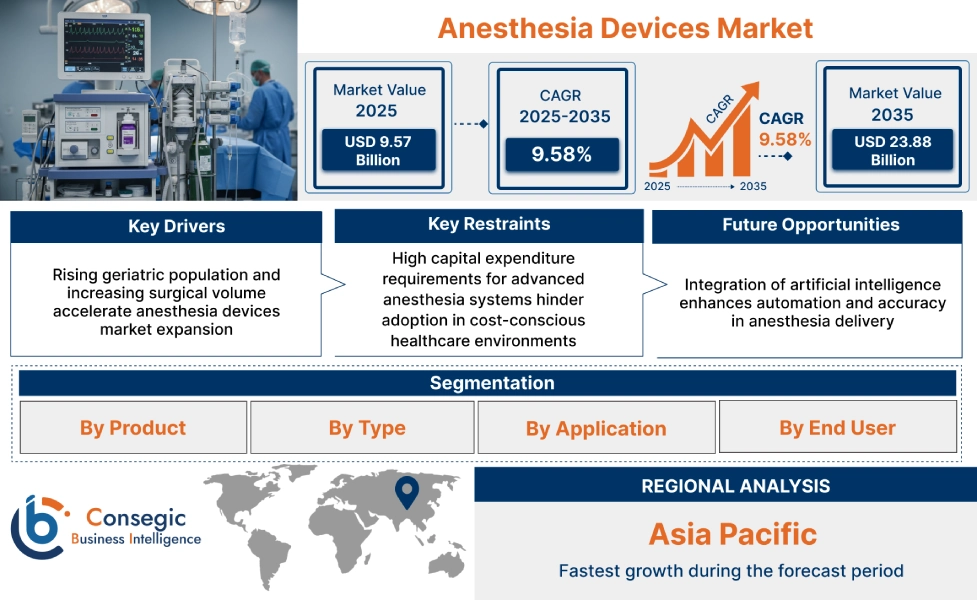
Anesthesia Devices Market size is estimated to reach over USD 23.88 Billion by 2035 from a value of USD 8.73 Billion in 2024 and is projected to grow by USD 9.57 Billion in 2025, growing at a CAGR of 9.58% from 2025 to 2035
Anesthesia devices Market Scope & Overview:
Anesthesia devices are medical systems designed to administer anesthetic agents, monitor patient vital parameters, and support controlled ventilation during surgical and diagnostic procedures. The anesthesia devices market includes anesthesia workstations, vaporizers, ventilators, patient monitoring systems, and other consumables that ensure the accurate delivery of inhalational and intravenous anesthetics. These devices combine sophisticated hardware components with digital interfaces and software-based monitoring modules to control oxygen flow rates, anesthetic concentrations, airway pressures, and hemodynamic variables. Anesthesia devices are used by healthcare facilities in hospitals, ambulatory surgical facilities, specialty clinics, and emergency departments to ensure patient safety, procedural efficiency, and accuracy in perioperative care.
The major driving factors for the anesthesia devices market are the growing number of surgical procedures, the rising number of cases of chronic diseases that require surgical procedures, and technological advancements in anesthesia delivery systems. Additionally, anesthesia devices improve the accuracy of clinical procedures, patient monitoring, and perioperative safety, thus fueling the anesthesia devices market in developed and developing healthcare settings.
How is the Anesthesia devices Market Affected by AI?
AI employs machine learning algorithms and predictive models for precise processing of patient-specific physiological data, thus enhancing the accuracy of anesthetic dosing and preventing the possibility of under/over-sedation. AI-based systems continuously monitor real-time vital signs such as heart rate, blood pressure, oxygen saturation, and respiratory patterns, thus making it easier to dynamically adjust drug delivery and enhance intraoperative stability during changing surgical conditions.
Moreover, AI facilitates automated ventilation management and closed-loop anesthesia delivery using predictive modeling and risk stratification, thus enhancing patient safety protocols in operating rooms and critical care environments. Furthermore, AI facilitates proactive complication detection by identifying subtle changes in physiological patterns and potential adverse events, thus allowing healthcare professionals to transition from manual monitoring to intelligent and data-driven anesthesia management systems.
Anesthesia devices Market Dynamics - (DRO):
Key Drivers:
Rising geriatric population and increasing surgical volume accelerate anesthesia devices market expansion
The growing number of older people in developed and developing countries is leading to an increase in the number of cases of chronic diseases such as cardiovascular diseases, cancer, musculoskeletal disorders, and neurological disorders. Elderly patients frequently require surgical interventions for disease management, joint replacements, tumor resections, and minimally invasive corrective procedures. This demographic change is also contributing to the growing use of anesthesia devices in hospitals, ambulatory surgical centers, and specialty clinics.
- According to the World Health Organization (WHO), the total number of people aged 60 years and above is expected to increase to 2.1 billion in 2050. Moreover, the number of people aged 80 years and above is also expected to increase, tripling from 2020 to 2050 to 426 million.
Therefore, the anesthesia devices market is witnessing steady growth driven by increasing surgical procedures associated with the expanding geriatric population.
Key Restraints:
High capital expenditure requirements for advanced anesthesia systems hinder adoption in cost-conscious healthcare environments
The procurement of advanced anesthesia workstations and patient monitoring systems involves high capital investment. Advanced systems include gas delivery modules, ventilators, real-time monitoring interfaces, and safety alarm systems, which are responsible for the high cost of purchase. Small to mid-scale healthcare environments, particularly in developing nations, face cost constraints that impede upgrading.
In addition to initial cost of acquisition, healthcare organizations also experience periodic expenses in terms of maintenance, calibration, software updates, and training. Adherence to regulatory requirements and safety standards further increases the overall cost. These costs are barriers to the replacement of conventional systems with technologically advanced anesthesia systems.
Therefore, high capital investment is a restraining factor for the adoption of advanced anesthesia systems in cost-sensitive healthcare settings.
Future Opportunities:
Integration of artificial intelligence enhances automation and accuracy in anesthesia delivery
The integration of artificial intelligence with anesthesia devices is expected to create significant growth opportunities for the market. Artificial intelligence solutions are designed to increase the accuracy of automation in anesthesia delivery, such as drug delivery, predictive analysis, and real-time analysis of anesthesia depth.
These solutions are designed on the basis of patient-specific information such as age, weight, comorbidities, and intraoperative variables to enhance the accuracy of drug dosing and reduce the risk of complications. AI solutions also improve intraoperative decision-making through continuous analysis of vital signs and early warning of physiological instability.
- For example, in January 2026, GE HealthCareand NXP Semiconductors announced a collaboration to develop new edge AI innovations in acute care, including the introduction of new concepts that apply AI directly to devices to help clinicians in operating rooms and neonatal intensive care units.
Therefore, the integration of artificial intelligence with anesthesia devices is expected to create significant growth opportunities for the market.
Anesthesia devices Market Segmental Analysis:
By Product:
On the basis of product, the anesthesia devices market is segmented into anesthesia devices (Anesthesia Workstation, Anesthesia Delivery Machines, Anesthesia Ventilators, Anesthesia Monitors, and Other Devices) and anesthesia disposables (Anesthesia Circuits (Breathing Circuits), Anesthesia Masks, Endotracheal Tubes (ETTS), Laryngeal Mask Airways (LMAS), and Other Accessories)
Trends in the Product:
- The rising volume of surgical procedures across multi-specialty hospitals is increasing the demand for advanced anesthesia workstations and monitoring systems.
- The growing emphasis on infection prevention and single-use components is supporting the adoption of anesthesia disposables.
Anesthesia Devices was responsible for the highest revenue share in 2024.
- Anesthesia devices include anesthesia machines, vaporizers, ventilators, and integrated monitoring systems that enable precise delivery of anesthetic gases.
- The increasing shift toward technologically advanced anesthesia workstations with integrated patient monitoring is supporting segment dominance.
- The growing demand for automated gas delivery systems and real-time respiratory monitoring is also driving the adoption of products in operating rooms.
- In addition, the development of surgical infrastructure in emerging countries is also driving the steady installation of anesthesia equipment.
- Therefore, the anesthesia devices market continues to lead because of its importance in managing patients in the perioperative setting.
Anesthesia Disposables are anticipated to register the highest compound annual growth rate (CAGR) during the forecast period.
- Anesthesia disposables include breathing circuits, masks, endotracheal tubes, laryngeal mask airways, and filters used during surgical procedures.
- Also, the increasing focus on minimizing cross-contamination risks is supporting the use of single-use anesthesia consumables.
- Moreover, the rising number of day-care surgeries and short-duration procedures is strengthening demand for disposable products.
- Further, regulatory emphasis on hygiene standards in healthcare facilities is accelerating the transition toward sterile and pre-packaged anesthesia components.
- Therefore, expanding surgical volumes and infection control protocols are expected to drive rapid growth of the anesthesia disposables segment.
By Type:
On the basis of type, the market is divided into general anesthesia and local anesthesia.
Trends in the type:
- The increasing prevalence of chronic diseases requiring surgical intervention is supporting the use of general anesthesia across complex procedures.
- The growing preference for minimally invasive and outpatient surgeries is increasing adoption of local anesthesia techniques.
General Anesthesia represented the highest revenue share in 2024.
- General anesthesia is widely used in major surgical procedures, including cardiovascular, neurological, and orthopedic surgeries.
- Moreover, the growing number of high-risk and long-duration surgeries is strengthening demand for controlled anesthetic delivery systems.
- In addition, the integration of advanced monitoring technologies in anesthesia machines is improving patient safety during general anesthesia administration.
- Furthermore, increasing hospital admissions for trauma and emergency procedures are supporting segment adoption.
- Thus, expanding surgical complexity and infrastructure development are driving the dominance of general anesthesia.
Local Anesthesia is anticipated to exhibit the most rapid compound annual growth rate (CAGR) throughout the forecast period.
- Local anesthesia finds application in dental, ophthalmic, dermatologic, and minor surgical procedures.
- In addition, the growing number of outpatient procedures and ambulatory surgical centers is adding to the strength of segment growth.
- Further, the growing geriatric population undergoing minimally invasive procedures is adding to the strength of higher usage of local anesthetic procedures.
- Moreover, the reduced recovery time and lower hospitalization costs of local anesthesia are adding to its adoption in healthcare facilities.
- Therefore, the growing shift toward cost-effective and minimally invasive care pathways is expected to accelerate growth of the local anesthesia segment.
By Application:
On the basis of application, the anesthesia devices market is segmented into cardiology, neurology, urology, orthopedics, dental, ophthalmology, and others.
Trends in the Application:
- The rising burden of cardiovascular and neurological disorders is increasing surgical intervention rates across specialized departments.
- The expansion of minimally invasive procedures across orthopedic and urology specialties is strengthening anesthesia device demand.
Cardiology accounted for the largest revenue share in the year 2024.
- Cardiac surgeries require precise anesthetic control and continuous hemodynamic monitoring.
- In addition, the increasing incidence of coronary artery disease and heart valve disorders is supporting surgical procedure volumes.
- Further, the demand for advanced anesthesia workstations in hybrid operating rooms is contributing to segment growth.
- Furthermore, the growing number of complex cardiovascular interventions is strengthening equipment installation across tertiary hospitals.
- Thus, high surgical complexity and critical care requirements are supporting the leadership of the cardiology segment.
Orthopedics is anticipated to register the fastest CAGR during the forecast period.
- The rising number of joint replacement and spinal surgeries is increasing anesthesia utilization.
- Moreover, the growing elderly population is contributing to higher orthopedic procedure volumes.
- In addition, expansion of sports injury treatments and trauma care services is supporting device adoption.
- Further, advancements in regional anesthesia techniques for orthopedic surgeries are improving procedural efficiency.
- Therefore, increasing musculoskeletal disorder prevalence is expected to accelerate growth within the orthopedics segment.
By End User:
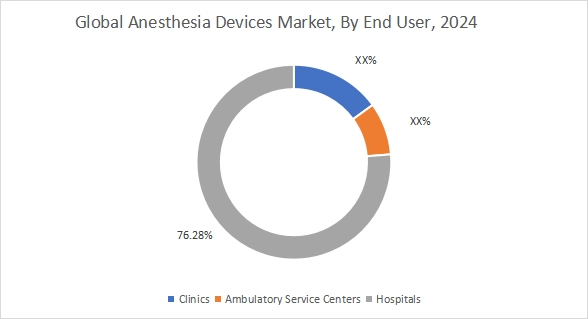
On the basis of end user, the anesthesia devices market is divided into clinics, ambulatory service centers, and hospitals.
Trends in the End User:
- The increasing number of surgical admissions across multi-specialty hospitals is strengthening equipment procurement.
- The rise in day-care procedures and same-day discharge processes is fueling demand at ambulatory service centers.
The hospital segment accounted for the largest revenue share of 76.28% in 2024.
- Hospitals perform a large number of complex and emergency surgeries, which require sophisticated anesthesia systems.
- Additionally, the availability of specialized operation theaters and intensive care units is boosting the deployment of large equipment.
- Further, the integration of anesthesia systems with electronic medical records and patient monitoring systems is enhancing usage in the hospital segment.
- Furthermore, capital expenditures in surgical infrastructure are also boosting upgrades in the product.
- Thus, the availability of surgical capabilities and infrastructure is fueling the dominance of the hospital segment.
Ambulatory Service Centers are expected to witness the fastest CAGR during the forecast period.
- Ambulatory centers perform minimally invasive and short-duration procedures that require efficient anesthesia management.
- Moreover, the rising preference for cost-effective outpatient surgical care is strengthening segment expansion.
- In addition, the shorter patient turnaround time and optimized operating costs are supporting anesthesia equipment adoption in these facilities.
- Further, healthcare policy shifts favoring outpatient procedures are encouraging infrastructure development.
- Thus, the transition toward decentralized surgical care delivery is expected to drive rapid growth in ambulatory service centers.
Regional Analysis:
North America, Europe, Asia Pacific, the Middle East and Africa, and Latin America are the regions of coverage.
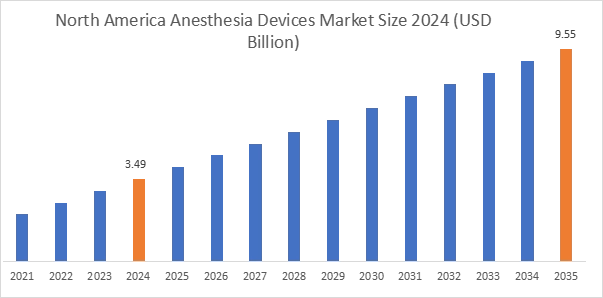
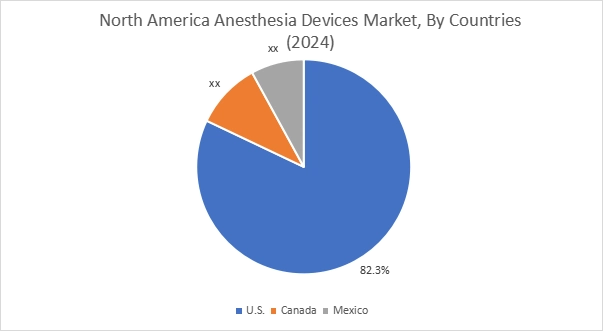
North America region was valued at USD 3.49 billion in 2024. Furthermore, it is expected to increase by USD 3.83 billion in 2025 and exceed USD 9.55 billion by 2035. The US accounted for the highest revenue share of 82.3% during the base year of 2024. Market growth is fueled by the increasing incidence of chronic diseases that require surgical procedures, such as cardiovascular diseases, cancer, orthopedic disorders, and gastrointestinal disorders. The increasing number of surgical procedures in hospitals and ambulatory surgical centers is also fueling the demand for advanced anesthesia devices, such as anesthesia workstations, monitoring devices, and consumables.
Strong clinical emphasis on patient safety, perioperative monitoring practices, and the adoption of digital anesthesia workstations is also a factor in the region’s leadership position. The encouraging environment for reimbursements and the existing infrastructure in hospitals are also adding to the demand for technology upgrades.
- For example, according to data from the NIHCM Foundation, close to 60% of adults in the US have at least one chronic disease, and many of these patients have multiple comorbidities. This is resulting in an increase in the number of elective and emergency surgeries, thus contributing to the demand for anesthesia devices in the healthcare sector.
In Asia Pacific, the anesthesia devices market is experiencing the fastest growth with a CAGR of 13.73% over the forecast period. This is due to huge government expenditures in public hospital renovation projects, development of critical care units, and rising expenditure on healthcare. Urbanization and accessibility to tertiary care units are also factors for the rise in surgical procedures.
- According to the International Trade Administration, China is the second-largest healthcare market in the world, estimated to be valued at nearly USD 1 trillion in 2024 and is projected to surpass USD 1.5 trillion by 2029. Approximately 60% of the total healthcare spending in the country is supported by the government.
Europe anesthesia devices market is fueled by the aging population trend, high procedural volume, and standardized perioperative care guidelines in Germany, France, Italy, and the UK. The hospitals are upgrading their anesthesia devices and patient monitoring systems to meet the safety compliance standards and digital integration requirements, thus fueling the market growth.
Latin America anesthesia devices market is fueled by the expansion of hospital infrastructure and public investment in healthcare in Brazil, Argentina, and Chile. The governments are enhancing perioperative care capabilities in public hospitals, thus fueling the demand for anesthesia devices and respiratory monitoring systems.
Middle East & Africa anesthesia devices market growth is supported by hospital expansion projects and rising healthcare infrastructure investment in Saudi Arabia, UAE, and South Africa. National health transformation strategies are increasing focus on emergency care and surgical service quality, thereby driving demand for modern anesthesia systems.
Top Key Players & Market Share Insights:
The global market for anesthesia devices is moderately consolidated, with key manufacturers providing end-to-end solutions for anesthesia workstations, monitoring, and airway management solutions to developed and emerging healthcare markets. Players are enhancing their position in the market by innovation, regulatory approvals, collaborations, geographic expansion, and acquisitions. Technological developments in anesthesia delivery systems, patient monitoring systems, and increasing demand from surgical centers and hospitals are also influencing the market dynamics. Key players in the anesthesia devices market are:
- Ambu A/S- Denmark
- Braun Melsungen AG - Germany
- BD (Becton, Dickinson and Company) - US
- Drägerwerk AG & Co. KGaA - Germany
- Fisher & Paykel Healthcare - New Zealand
- GE Healthcare- US
- Hamilton Medical AG - Switzerland
- Heyer Medical AG - Germany
- Intersurgical Ltd.- UK
- Medtronic plc - Ireland
Recent Industry Developments:
- In April 2025, Dräger launched the Atlan A100 anesthesia workstation in the Indian market, which included advanced lung-protective ventilation and low-flow anesthesia. This move helped improve patient safety and operating room efficiency. The integrated functionality and monitoring of the product enhanced the company’s offerings in the Anesthesia Devices market by providing support for efficient perioperative care.
- In January 2025, GE HealthCare Korea launched the Carestation 600 Series V2, a compact anesthesia workstation designed for operating rooms with limited space. The product included automatic patient-based ventilation support and a focus on safety. This product launch enhanced the company’s offerings in the Anesthesia Devices market by providing efficient and ergonomic technology designed for various operating room settings.
- In November 2024, Mindray launched an update to its A-Series anesthesia workstation to enhance safety and workflow efficiency during surgical procedures. This product update enhanced the company’s offerings in the Anesthesia Devices market by providing more reliable performance and improved user-centric operational efficiency.
Anesthesia devices Market Report Insights:
| Report Attributes | Report Details |
|---|---|
| Study Timeline | 2019-2035 |
| Market Size in 2035 (USD Billion) | USD 23.88 Billion |
| CAGR (2025-2035) | 9.58% |
| By Product |
|
| By Type |
|
| By Application |
|
| By End User |
|
| By Region |
|
| Key Players |
|
| Report Coverage |
|
Key Questions Answered in the Report
How big is the anesthesia devices market? −
The anesthesia devices market sizeis estimated to reach over USD 23.88 Billion by 2035 from a value of USD 8.73 Billion in 2024 and is projected to grow by USD 9.57 Billion in 2025, growing at a CAGR of 9.58% from 2025 to 2035.
Which segmentation details are covered in the anesthesia devices report? +
The anesthesia devices report includes specific segmentation details for product, type, application, end user, and regions.
Which is the fastest segment anticipated to impact the market growth? +
In the anesthesia devices market, the Ambulatory Service Centers segment is the fastest-growing segment during the forecast period, due to the rising preference for cost-effective outpatient surgical care.
Who are the major players in the anesthesia devices market? +
The key participants in the anesthesia devices market are Ambu A/S (Denmark), B. Braun Melsungen AG (Germany), BD (Becton, Dickinson and Company) (US), Drägerwerk AG & Co. KGaA (Germany), Fisher & Paykel Healthcare (New Zealand), GE Healthcare (US), Hamilton Medical AG (Switzerland), Heyer Medical AG (Germany), Intersurgical Ltd. (UK), Medtronic plc (Ireland), and others.
What are the key trends in the anesthesia devices market? +
The anesthesia devices market is shaped by key trends including rising geriatric population and increasing surgical volume and other are the key trends driving the market.
Overview
Reputation & Certifications


Our Services
- Market Intelligence & Forecasting
- Custom Research Solutions
- Market Entry Strategy
- Competitive Intelligence
- Customer Insights
- Industry Innovation Analysis
- Investment Advisory