Jump to Content
Anhydrite Market - Size, Share, Industry Trends, and Forecasts (2025 - 2032)
Anhydrite Market Size:
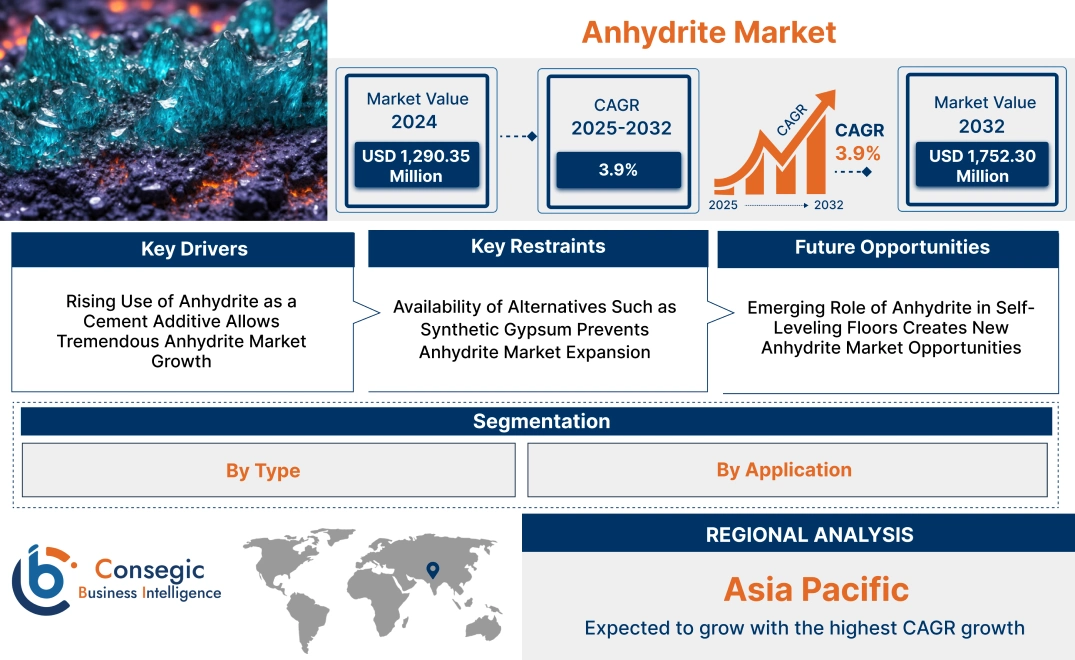
Anhydrite Market size is estimated to reach over USD 1,752.30 Million by 2032 from a value of USD 1,290.35 Million in 2024 and is projected to grow by USD 1,317.68 Million in 2025, growing at a CAGR of 3.9 % from 2025 to 2032.
Anhydrite Market Scope & Overview:
Anhydrite is a naturally occurring mineral composed of calcium sulfate without water content. It is recognized for its hardness, stability, and versatile applications across industries. This mineral features excellent compressive strength, heat resistance, and low solubility, making it suitable for various construction and industrial processes. Anhydrite offers several benefits, including its ability to improve soil quality, enhance construction materials, and serve as a filler in numerous industrial applications. Its properties contribute to better durability, efficiency, and performance in end-use products. Additionally, it is valued for its lightweight nature and ease of application in construction and manufacturing.
Applications of anhydrite span construction, agriculture, and industrial sectors. In construction, it is used in flooring compounds, plasters, and as a drying agent. In agriculture, anhydrite is utilized as a soil conditioner and fertilizer additive. The end-use industries for anhydrite include construction, agriculture, cement manufacturing, and the chemical sector, highlighting its diverse functionality and utility.
Anhydrite Market Dynamics - (DRO) :
Key Drivers:
Rising Use of Anhydrite as a Cement Additive Allows Tremendous Anhydrite Market Growth
Anhydrite is increasingly used as an additive in cement production due to its efficiency in enhancing setting time and mechanical strength. The material's capacity to act as a substitute for gypsum helps improve cement's properties, making it suitable for a variety of construction applications. For instance, the addition of anhydrite allows for better control over hydration in cement, improving performance in demanding construction environments.
This expanding application of anhydrite in the cement industry plays a pivotal role in advancing the global anhydrite market.
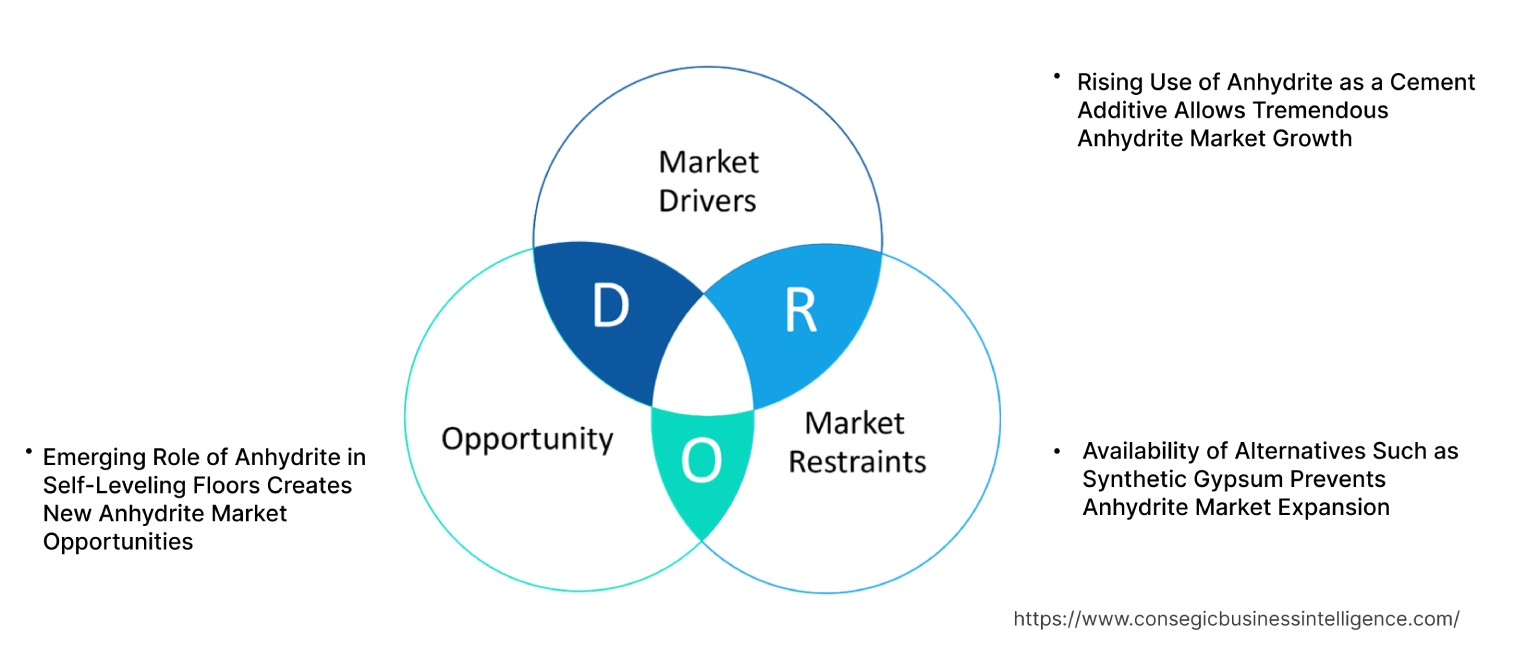
Key Restraints:
Availability of Alternatives Such as Synthetic Gypsum Prevents Anhydrite Market Expansion
Synthetic gypsum, derived from industrial by-products, offers similar functionality to anhydrite in cement production at a lower cost. Its widespread availability, coupled with its eco-friendly sourcing, makes it an attractive alternative for industries looking to optimize production expenses. For instance, many cement manufacturers prefer synthetic gypsum due to its consistent quality and reduced environmental impact.
The competition posed by synthetic gypsum challenges the adoption of anhydrite, restraining its market expansion in cost-sensitive sectors.
Future Opportunities :
Emerging Role of Anhydrite in Self-Leveling Floors Creates New Anhydrite Market Opportunities
The trend for self-leveling flooring solutions in commercial and industrial construction projects is expected to create opportunities for anhydrite. Anhydrite's superior flowability and minimal shrinkage properties make it ideal for self-leveling floor screeds, ensuring smooth and durable surfaces. With the increasing adoption of these floors in modern architecture and interior design, anhydrite is anticipated to gain prominence. For example, its use in large-scale projects, such as shopping malls and office complexes, is projected to rise significantly.
This growing application of anhydrite in self-leveling flooring solutions is expected to drive new opportunities for the market in the coming years.
Anhydrite Market Segmental Analysis :
By Type:
Based on type, the anhydrite market is segmented into natural and synthetic.
Natural anhydrite accounted for the largest revenue in the anhydrite market share in 2024.
- It is predominantly used in cement and concrete production, where it acts as a key component in regulating the setting time.
- Natural anhydrite offers high calcium sulfate content, making it an efficient additive for soil conditioning and agricultural applications.
- Its availability in natural deposits and cost-effectiveness compared to synthetic alternatives further bolster the anhydrite market trend in various industries.
- The growing construction sector in developing regions, fueled by infrastructure expansion and urbanization, has significantly boosted its consumption.
- Additionally, the easy extraction and processing of natural anhydrite reduce manufacturing costs, making it a preferred choice for large-scale industrial applications.
- Therefore, according to anhydrite market analysis, the extensive use of natural anhydrite in construction and agricultural industries drives its dominance in the anhydrite market.
Synthetic anhydrite is anticipated to register the fastest CAGR during the forecast period.
- It is a by-product of chemical processes such as phosphoric acid and hydrofluoric acid production, ensuring a steady and controlled supply.
- Synthetic anhydrite has consistent purity and chemical composition, making it highly desirable for applications in plaster and paint manufacturing.
- The increasing focus on sustainable practices has further amplified its adoption in industries seeking environmentally friendly materials.
- Its adaptability to customized applications, such as specialty coatings and industrial fillers, has created niche opportunities in advanced manufacturing sectors.
- Moreover, synthetic anhydrite helps reduce reliance on natural deposits, contributing to resource conservation and sustainable development goals.
- Thus, according to anhydrite market analysis, the advantages of controlled quality and eco-friendly sourcing propel the synthetic anhydrite market growth.
By Application:
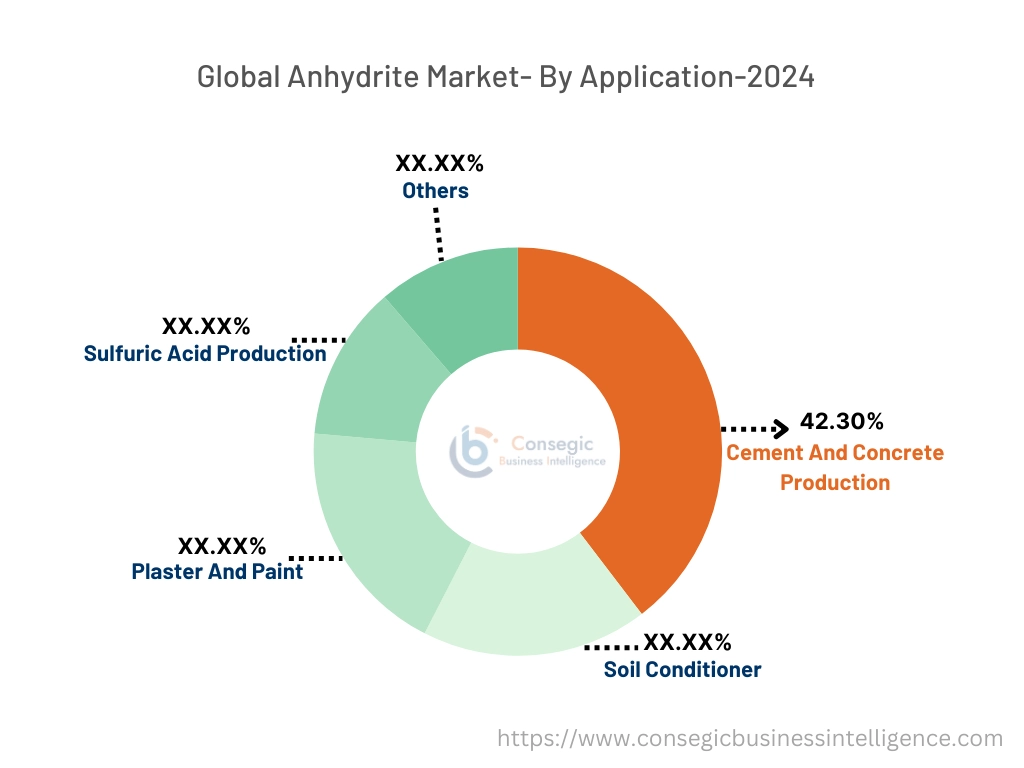
Based on application, the anhydrite market is segmented into cement and concrete production, soil conditioner, plaster and paint, sulfuric acid production, and others.
The cement and concrete production segment accounted for the largest revenue in the anhydrite market share by 42.30% in 2024.
- Anhydrite is widely used as a key additive in cement manufacturing to improve the workability and durability of concrete.
- It helps control the setting time, ensuring the efficient handling of cement-based mixtures in construction projects.
- The increasing trend for infrastructure development and urbanization has further strengthened the role of anhydrite in this application.
- Its incorporation in modern construction techniques enhances the thermal and chemical resistance of concrete structures, extending their lifespan.
- Innovations in pre-mixed concrete formulations often leverage anhydrite to achieve superior consistency and reliability in construction outcomes.
- Therefore, according to market analysis, the pivotal role of anhydrite in enhancing construction material properties establishes its dominance in the cement and concrete production segment.
The plaster and paint segment is anticipated to register the fastest CAGR during the forecast period.
- Anhydrite serves as a vital component in the formulation of plasters, providing smooth surfaces and reducing shrinkage during application.
- It enhances the performance of paints by improving opacity and adhesion while minimizing the environmental impact compared to traditional fillers.
- The rising trend for interior decoration and the construction of residential and commercial buildings support the growth of this application.
- The lightweight and easy-to-apply properties of anhydrite-based plasters contribute to faster construction timelines and reduced labor costs.
- Its growing use in eco-friendly building solutions and low-VOC paints aligns with the increasing preference for sustainable and energy-efficient construction materials.
- Thus, according to market analysis, the increasing adoption of anhydrite for improved performance and sustainable solutions accelerates the growth of the plaster and paint segment.
Regional Analysis:
The regional segment includes North America, Europe, Asia Pacific, the Middle East and Africa, and Latin America.
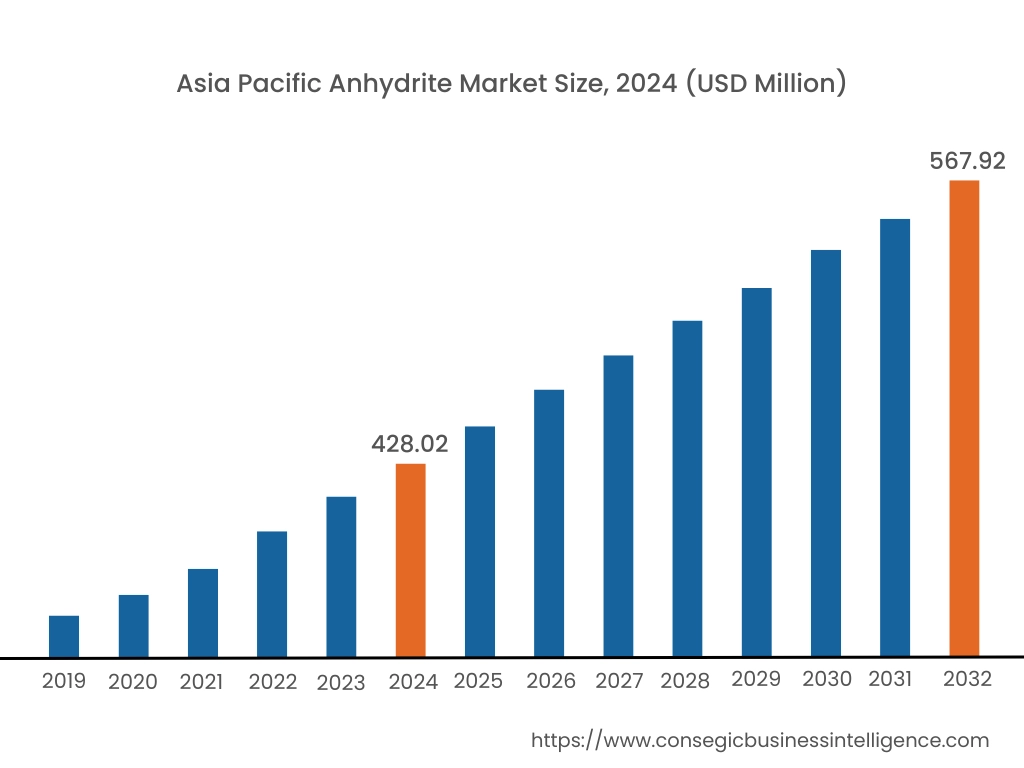
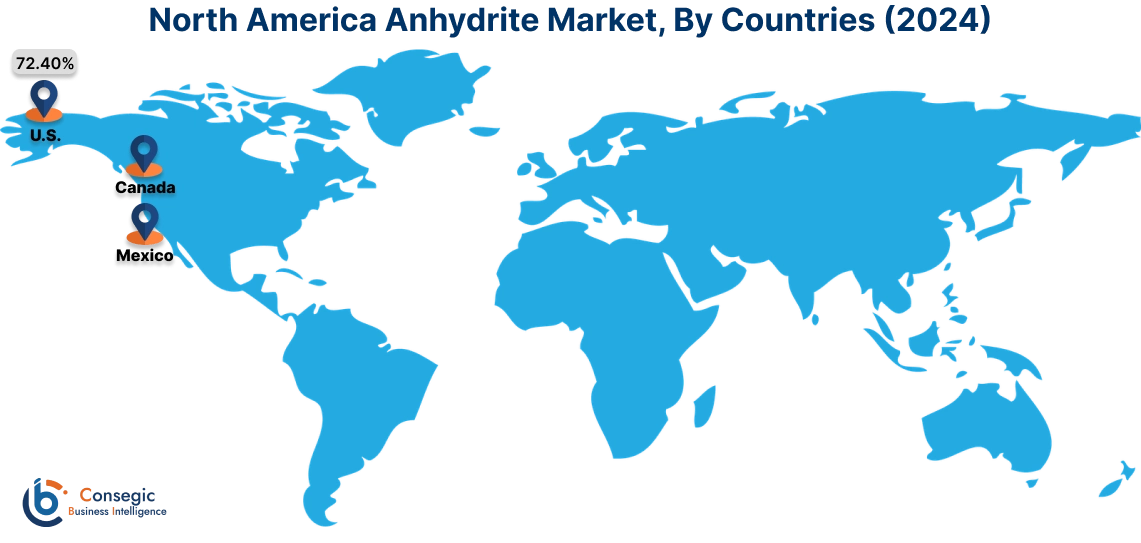
In 2024, North America was valued at USD 428.02 Million and is expected to reach USD 567.92 Million in 2032. In North America, the U.S. accounted for the highest share of 72.40% during the base year of 2024. In North America, the anhydrite market shows a stable trend, especially in the United States and Canada. The anhydrite market trend is primarily driven by its use in construction as a soil conditioner, cement production, and as an industrial chemical. The increasing trend for infrastructure development and the need for quality construction materials in these regions support the market. Additionally, the growing focus on sustainable building practices, which promote the use of anhydrite-based products, further supports market performance in North America.
In Asia Pacific, the market is experiencing the fastest growth with a CAGR of 4.3% over the forecast period. Asia-Pacific holds the largest share of the global anhydrite market, with China, India, and Japan being the leading contributors. The construction industry is a key consumer of anhydrite, used in the production of cement and as a soil conditioner in agriculture. China and India’s expanding urbanization and infrastructure projects significantly boost the anhydrite market trend. Furthermore, the region's expanding agricultural sector increases the usage of anhydrite for soil improvement. The growing focus on green technologies and sustainable construction practices also positively impacts market dynamics.
Europe represents a significant portion of the anhydrite market, with countries like Germany, France, and the UK being major players. The anhydrite market growth is largely driven by the construction and agriculture industries. The use of anhydrite in cement production, as well as in agricultural applications for improving soil quality, plays a crucial role in market expansion. Additionally, the European Union’s stringent environmental regulations have led to the adoption of eco-friendly alternatives, which is expected to further support the use of anhydrite in construction and agriculture. The region’s focus on sustainable building materials also contributes to increased growth.
In the Middle East and Africa, the anhydrite market is emerging, with significant demand in countries like Saudi Arabia, UAE, and South Africa. The anhydrite market demand is primarily influenced by the growing construction industry, driven by rapid urbanization and infrastructure development in these regions. The region's demand for cement and other building materials is expected to increase, further boosting the anhydrite market. Additionally, the agricultural sector in the region is expanding, leading to higher consumption of anhydrite as a soil conditioner. The lack of sufficient local production, however, results in some reliance on imports to meet demand.
Latin America shows moderate demand for anhydrite, with Brazil and Mexico being the largest markets. The construction sector, particularly in Brazil, is the main contributor to the market, where anhydrite is used in cement production. The expanding infrastructure and real estate projects in the region stimulate anhydrite market growth. Additionally, the agricultural industry in Latin America also uses anhydrite to enhance soil quality, particularly in regions with arid or less fertile soils. However, the market is hindered by economic fluctuations and dependency on imports for supply.
Top Key Players and Market Share Insights:
The Global Anhydrite Market is highly competitive with major players providing products to the national and international markets. Key players are adopting several strategies in research and development (R&D), product innovation, and end-user launches to hold a strong position in the Global Anhydrite Market. Key players in the Anhydrite industry include-
- American Rock Salt Company LLC (United States)
- Shaanxi Coal and Chemical Industry Co., Ltd. (China)
- Agriminerals Ltd. (United Kingdom)
- Imerys S.A. (France)
- National Gypsum Company (United States)
- The Mosaic Company (United States)
- Yunnan Tin Company Limited (China)
- K+S AG (Germany)
- OCP Group (Morocco)
- Salzdetfurth GmbH (Germany)
Anhydrite Market Report Insights :
| Report Attributes | Report Details |
| Study Timeline | 2019-2032 |
| Market Size in 2032 | USD 1,752.30 Million |
| CAGR (2025-2032) | 3.9% |
| By Type |
|
| By Application |
|
| By Region |
|
| Key Players |
|
| North America | U.S. Canada Mexico |
| Europe | U.K. Germany France Spain Italy Russia Benelux Rest of Europe |
| APAC | China South Korea Japan India Australia ASEAN Rest of Asia-Pacific |
| Middle East and Africa | GCC Turkey South Africa Rest of MEA |
| LATAM | Brazil Argentina Chile Rest of LATAM |
| Report Coverage |
|
Key Questions Answered in the Report
How big is the Anhydrite Market? −
In 2024, the Anhydrite Market was USD 1,290.35 million.
What will be the potential market valuation for the Anhydrite Market by 2032? +
In 2032, the market size of Anhydrite Market is expected to reach USD 1,752.30 million.
What are the segments covered in the Anhydrite Market report? +
The diagnosis and end-user industry are the segments covered in this report.
Who are the major players in the Anhydrite Market? +
American Rock Salt Company LLC (United States), Shaanxi Coal and Chemical Industry Co., Ltd. (China), Agriminerals Ltd. (United Kingdom), The Mosaic Company (United States), Yunnan Tin Company Limited (China), K+S AG (Germany), OCP Group (Morocco), Salzdetfurth GmbH (Germany), Imerys S.A. (France), National Gypsum Company (United States), are the major players in the Anhydrite market.
Overview
Reputation & Certifications


Our Services
- Market Intelligence & Forecasting
- Custom Research Solutions
- Market Entry Strategy
- Competitive Intelligence
- Customer Insights
- Industry Innovation Analysis
- Investment Advisory