Jump to Content
Apheresis Market - Size, Share, Industry Trends, and Forecasts (2025-2032)
Apheresis Market Size:
The Apheresis Market size is growing with a CAGR of 8.5% during the forecast period (2025-2032), and the market is projected to be valued at USD 6,119.86 Million by 2032 from USD 3,190.58 Million in 2024. Additionally, the market value for 2025 attributed to USD 3,451.33 Million.
Apheresis Market Scope & Overview:
Apheresis is a non-surgical medical procedure that involves separating the different components of blood. In this procedure blood of a patient is passed through a device that separates blood into different components such as red blood cells, white blood cells, platelets, and plasma and then returns the remaining blood components back to the individual. Several types of this procedure are plasmapheresis, plateletpheresis, erythrocytapheresis, and others. Apheresis serves various purposes, including collecting blood components, treating medical conditions, and collecting stem cells for transplantation. The procedure includes use of several devices and consumables such as machines, kits, filters, tubing sets, blood bags, and more. The procedure is widely used across several medical facilities including hospitals, specialty clinics, diagnostic laboratories, and blood donation centers among others.

Apheresis Market Dynamics - (DRO) :
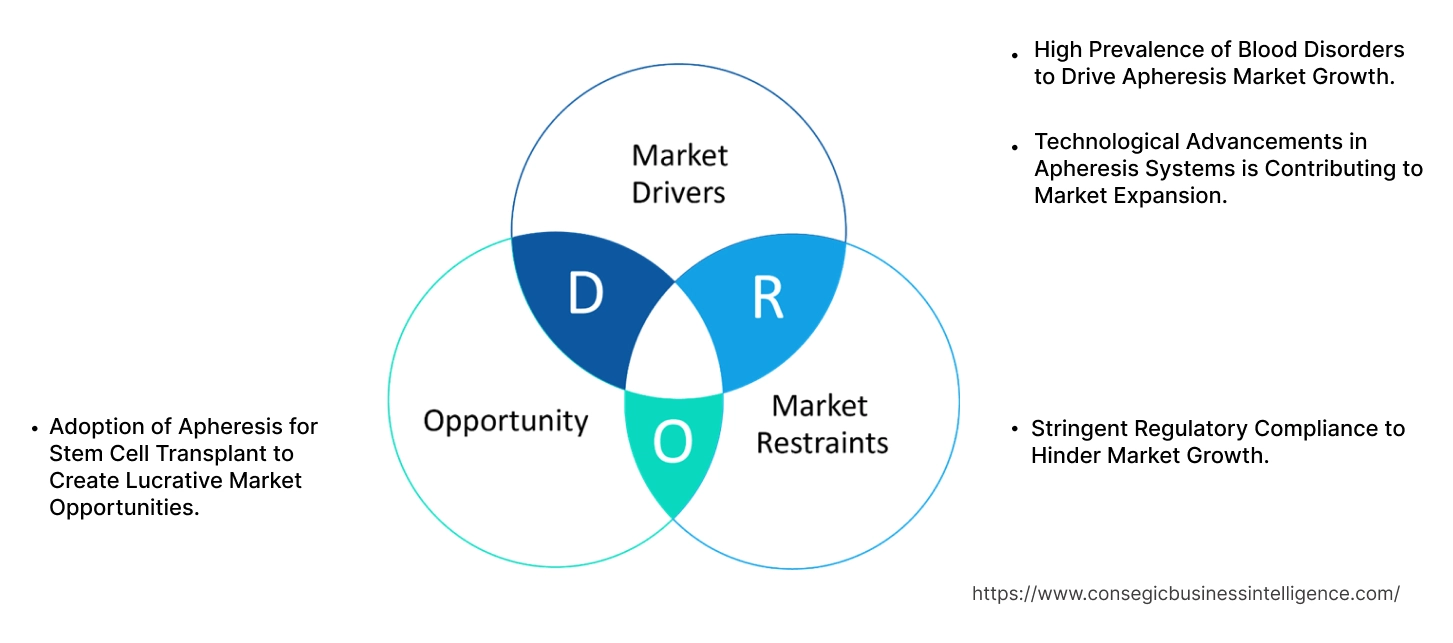
Key Drivers:
High Prevalence of Blood Disorders to Drive Apheresis Market Growth.
Apheresis is a core treatment for a wide range of blood disorders, playing a crucial role in managing them. It's essential for collecting stem cells for transplants in leukemia and lymphoma patients, removing excess white blood cells in certain leukemias, exchanging red blood cells in sickle cell anemia, and collecting platelets for transfusion in cases of thrombocytopenia. The incidence of many blood disorders is rising, consequently increasing the demand for this procedure.
- For instance, as per the data provided by Centers for Disease Control and Prevention, Sickle cell disease affects around 100,000 people in the United States every year.
Apheresis is being integrated into treatment protocols for an expanding range of blood disorders further propelling the upward market trajectory.
Technological Advancements in Apheresis Systems is Contributing to Market Expansion.
Technological advancements are making apheresis procedures more efficient, safer, more precise, and more accessible. Newer systems offer improved efficiency, processing blood faster and collecting target components more quickly. Real-time monitoring and automated checks reduce complications. Greater precision and targeting allow for efficient collection of specific blood components. Additionally, user-friendly interfaces and automation simplify the process and reduce the need for specialized personnel. These improvements are boosting the adoption of this procedure across various healthcare settings.
- For instance, in June 2022, NHS England approved Terumo Blood and Cell Technologies' Spectra Optia apheresis system for wider use in treating sickle cell disease. This decision, supported by the NHS MedTech Funding Mandate, improved access to automated red blood cell exchange for sickle cell patients across English hospitals.
Thus, due to the above-mentioned factors, the adoption of technologically advanced systems is contributing to upward market trajectory.
Key Restraints:
Stringent Regulatory Compliance to Hinder Market Growth.
Stringent regulatory standards imposed by government agencies and international organizations worldwide cause barriers in the market. Regulatory bodies such as Food and Drug Administration and European Medicines Agency among others impose long process for approvals for devices and systems. It includes lengthy documentation, product safety assessment, and rigorous quality control procedures. It leads to increase production costs and slow down product development. Additionally, regulatory authorities and regulatory standards differ by country and region. This creates limitations for researchers and companies operating in multiple jurisdictions. Thus, the impact of these stringent regulations on the apheresis market expansion is multifaceted.
Future Opportunities :
Adoption of Apheresis for Stem Cell Transplant to Create Lucrative Market Opportunities.
A stem cell transplant is a procedure that replaces damaged or diseased stem cells with healthy ones. The rise in adoption of apheresis for stem cell transplant is creating market growth over the forecast period. Stem cell transplants are being used for treating cancers, solid tumors, and autoimmune diseases. Compared to bone marrow harvest, this procedure is less invasive, performed outpatient, and yields more stem cells. This rising demand for stem cells fuels apheresis market opportunities. As a result, manufacturers are increasingly focusing on developing platforms specifically supporting stem cell transplant via apheresis.
- For instance, in September 2024, BioLineRx launched Mobilization Matters, a digital platform designed to support patients preparing for stem cell collection via apheresis for autologous stem cell transplant. BioLineRx is also partnering with the HealthTree Foundation to conduct a patient experience survey regarding stem cell collection and apheresis.
Thus, developments towards apheresis specifically stem cell transplant are creating market trajectory over the upcoming period.
Apheresis Market Segmental Analysis :
By Product Type:
Based on product type, the market is bifurcated into devices and consumables.
Trends in the Product Type:
- Trend of advancements in automation, real-time monitoring, and AI integration to improve the precision and efficiency of apheresis procedures.
- Development of biocompatible and durable tubing sets to minimize the risk of adverse reactions.
The consumables segment accounted for the largest market share in 2024.
- Apheresis consumables encompass a range of essential disposable items used in the procedure. The consumables segment is categorized into apheresis kits, filters, tubing sets, blood bags, and others.
- Kits are pre-assembled for specific procedures containing all the necessary.
- Filters play a crucial role in separating and collecting specific blood components, such as platelets, plasma, or white blood cells.
- Sterile tubing sets connect the patient to the machine, facilitating the flow of blood and separate components.
- Specialized blood bags are used to collect and store the separate blood components.
- The single-use nature of most consumables creates a continuous need for replacements. Additionally, increasing number of therapeutic procedures and blood component donations directly fuels demand.
- Collectively, as per analysis, aforementioned factors support segment trajectory in the overall market.
The devices segment is expected to grow at the fastest CAGR in the forecast period.
- Apheresis devices encompass a range of technologies, with machines representing the core technology for separating blood components.
- Centrifugation-based machines is well-established technology that spins blood at high speeds to separate components based on density.
- Membrane-based machines utilize filters with tiny pores to separate components by size and other properties.
- Plasma separators, including centrifugation-based or membrane-based, are specifically designed to isolate plasma from the blood
- The advancements in device technologies is a key pointer supporting the segment trajectory in future years.
- For instance, in 2023, Fresenius Medical Care announced the launch of APRED, a new, advanced apheresis system designed to be fast, efficient, and user-friendly. It utilizes Fresenius's existing line of adsorbers and filters and offers a range of features to support healthcare professionals.
- Thus, considering this analysis, the devices segment is expected to experience greater CAGR in the forecast years.
By Application:
The application segment is categorized into blood disorders, cardiovascular disorders, renal disorders, autoimmune disorders, and others.
Trends in the Application:
- There's a growing trend towards personalized medicine with apheresis serving a crucial role in collecting specific cell types.
The blood disorders segment accounted for the largest apheresis market share in 2024.
- Apheresis plays a crucial role in managing a wide range of blood disorders, offering targeted treatments and improving patient outcomes.
- In leukemia and lymphoma, this procedure is essential for harvesting hematopoietic stem cells from the blood for transplantation and is also used for leukoreduction, removing excess white blood cells.
- For sickle cell anemia it helps remove sickle-shaped red blood cells and replaces them with healthy ones.
- Additionally, the procedure is also utilized in the treatment of thrombotic thrombocytopenic purpura hemolytic uremic syndrome, and paraproteinemia.
- Blood disorders segment is dominating the market due to the growing prevalence of these disorders.
- For instance, as per data published in Jornal Elsevier in August 2023, the global prevalence of sickle cell disease has significantly increased, with the number of people living with the condition rising by 41.4% between 2000 and 2021.
- Owing to the above-mentioned factors, the blood disorders segment is dominating in the overall apheresis market demand.
The autoimmune disorders segment is expected to grow at the fastest CAGR over the forecast period.
- Apheresis is increasingly used to treat autoimmune conditions by removing harmful antibodies and immune cells from the blood.
- Specific application of autoimmune diseases where this procedure is used include multiple sclerosis, where it helps reduce the severity of attacks
- In myasthenia gravis it improves muscle strength and in rheumatoid arthritis, it helps reduce inflammation.
- The rising prevalence of autoimmune diseases, coupled with the growing understanding and acceptance of this procedure as a valuable treatment modality, are key factors driving the rapid rise in this segment.
- Thus, due to the above-mentioned factors, the autoimmune disorders segment is expected to register the fastest CAGR in the overall apheresis market demand.
By End Use:
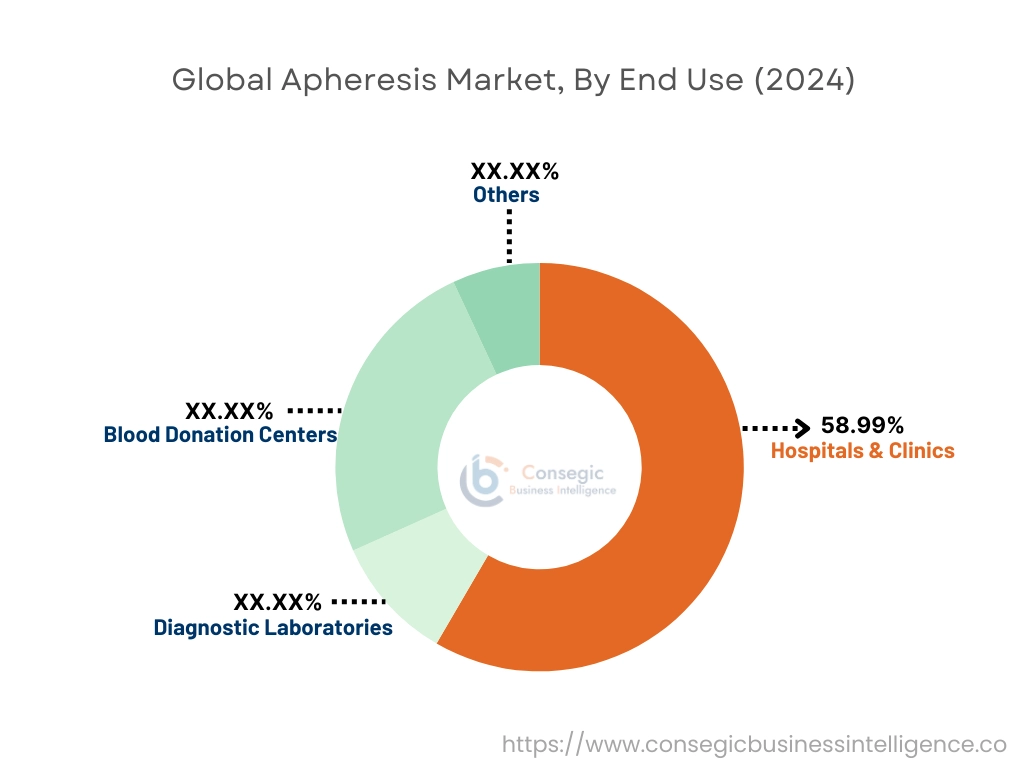
Based on end use, the market is categorized into hospitals & clinics, diagnostic laboratories, blood donation centers, and others.
Trends in the End Use:
- The implementation of advanced apheresis technologies in hospitals to enhance component quality.
- There is growing trend in the automation and digitalization of laboratory processes to improve efficiency and accuracy in apheresis-related testing.
The hospitals & clinics segment accounted for the largest market share of 58.99% in 2024.
- Hospitals and clinics are the primary providers of apheresis procedures due to their established infrastructure, specialized equipment, and trained medical personnel.
- They address a wide range of needs, including blood disorders, cardiovascular disorders, renal disorders, autoimmune disorder.
- Hospitals and clinics also collect blood components including platelets, plasma, and stem cells for transfusions and therapies.
- These procedures and conditions also necessitate teams that include highly skilled specialists. Hospitals are well equipped to provide these teams.
- Furthermore, hospitals and clinics are also involved in adopting advanced solutions for patient care.
- This analysis positions the hospitals & clinics as a key end user segment within the dynamic apheresis market expansion.
The blood donation centers segment is expected to grow at the fastest CAGR in forecast years.
- Blood donation centers are the primary source of blood components used in transfusions and therapies.
- They play a vital role in collecting blood through apheresis, which allows them to efficiently obtain specific blood components.
- Several factors drive their growth, including increased need for blood components due to advanced medical treatments, the efficiency of this procedure compared to whole blood donation, and the growing reliance on plasma-derived therapies.
- As a result, blood centers are investing in equipment and collaborating with pharmaceutical companies to ensure adequate blood component supplies.
- For instance, in September 2023, Sanguine Biosciences launched a blood donor center in Los Angeles. The center specializes in collecting concentrated white blood cell biospecimens through apheresis.
- Thus, based on the apheresis market analysis, the aforementioned factors contribute to blood donation centers as prominent end-users.
Regional Analysis:
The regional segment includes North America, Europe, Asia Pacific, the Middle East and Africa, and Latin America.
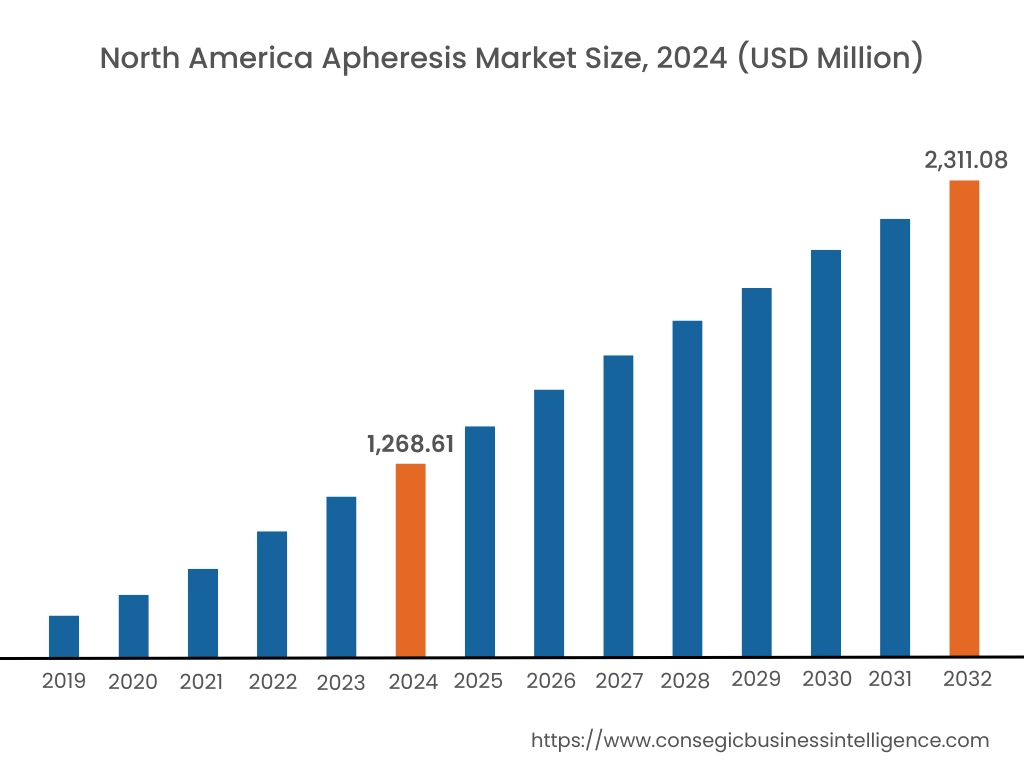
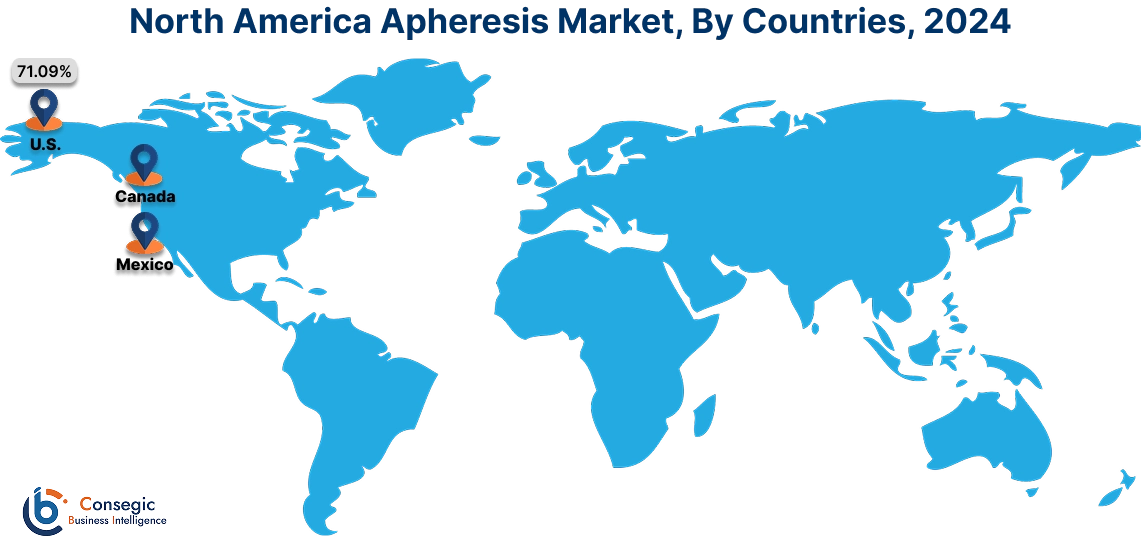
In 2024, North America accounted for the highest Apheresis market share at 39.77% and was valued at USD 1,268.61 Million and is expected to reach USD 2,311.08 Million in 2032. In North America, the U.S. accounted for the largest share of 71.09% during the base year of 2024.
The rising incidences of chronic disorders such as autoimmune disorders and blood cancers is the key factor that is leading to the market trajectory in North America. The region also present a well-established healthcare infrastructure equipped with advanced medical facilities, further supporting the growth of apheresis procedures. The increasing demand for both plasma-derived therapies and blood components, coupled with the early adoption of advanced technologies, strengthens North America's position. In addition to this, the availability of advanced treatment solutions for chronic diseases is increasing across the region. This is boosting the adoption of this procedure in North America.
- For instance, as per survey data published by the America's Blood Centers, in 2021, the United States saw the collection of 11,784,000 units of whole blood and apheresis red blood cells, a 1.7% increase from 2019. A total of 2,528,000 platelet units were distributed. Of the distributed platelet units, 2,422,000 were apheresis platelets, demonstrating a 2.7% increase from 2019 levels.
Therefore, confluence of aforementioned factor results in apheresis market trend in North America region.
In Asia Pacific the apheresis market analysis is experiencing the fastest growth with a CAGR of 9.9% over the forecast period. Shift towards development of novel treatment solutions such as stem cell transplant serves a prominent role apheresis market growth in Asia Pacific. As stem cell transplants become a more established treatment option for various conditions, the demand for this procedure to collect the necessary stem cells is also rising. Additionally, increased healthcare expenditure and improving healthcare infrastructure are enabling greater access to advanced medical technologies. Growing awareness of this procedure and its diverse applications, coupled with the rising demand for blood components and plasma-derived therapies further support apheresis market opportunities in Asia Pacific.
The increasing focus on adoption of advanced apheresis systems is one of the primary factors creating market demand across Europe. European countries present some of the most advanced healthcare systems with patient-centric approaches. As healthcare providers seek to improve efficiency, safety, and patient outcomes, they are increasingly investing in and implementing these advanced technologies. This focus on upgrading capabilities is contributing significantly to market growth in the region. It is promoting European companies to invest in research and development to produce devices with advanced functionalities. Collectively, these factors create market demand across Europe.
The increasing demand for blood components is a prominent factor that drives the apheresis market trend in Latin America. As healthcare systems in the region improve and access to advanced medical treatments expands, the need for blood transfusions and plasma-derived therapies is also growing. This rising demand for blood components directly fuels the upward trajectory of the market. Moreover, improving healthcare infrastructure and increased access to healthcare services are making these procedures more readily available to patients. Consequently, this analysis supports the industry in Latin America.
The Middle East and African industry is led by the growing healthcare expenditure, coupled with improving healthcare infrastructure. Government bodies across the region are increasingly investing in the development of hospitals, clinics, diagnostic laboratories, and blood donation centers with provision of advanced equipment. Owing to these factors, the market in the Middle East and Africa is growing at a considerate rate.
Top Key Players & Market Share Insights:
The global Apheresis Market is highly competitive with major players providing products to the national and international markets. Key players are adopting several strategies in research and development (R&D) and product innovation to hold a strong position in the global Apheresis market. Key players in the Apheresis industry include-
- Terumo BCT, Inc. (U.S.)
- Haemonetics (U.S.)
- Fresenius Kabi (Germany)
- Medica SPA (Italy)
- Baxter (U.S.)
- Asahi Kasei Corporation (Japan)
- Miltenyi Biotec (Germany)
- Braun (Germany)
- Haier Biomedical (China)
- Heinz Meise GmbH (Germany)
Recent Industry Developments :
Expansion:
- In November 2024, Terumo Blood and Cell Technologies announced a strategic manufacturing partnership with Terumo Medical Products (Hangzhou) Co., Ltd to launch facility in Hangzhou, China. This agreement establishes local manufacturing of Terumo BCT products at TMPH's Hangzhou facility
Product Launch:
- In 2023, Fresenius Medical Care announced the launch of APRED, a new, advanced apheresis system designed to be fast, efficient, and user-friendly. It utilizes Fresenius's existing line of adsorbers and filters and offers a range of features to support healthcare professionals.
Apheresis Market Report Insights:
| Report Attributes | Report Details |
| Study Timeline | 2019-2032 |
| Market Size in 2032 | USD 6,119.86 Million |
| CAGR (2025-2032) | 8.5% |
| By Product Type |
|
| By Application |
|
| By End-Use |
|
| By Region |
|
| Key Players |
|
| North America | U.S. Canada Mexico |
| Europe | U.K. Germany France Spain Italy Russia Benelux Rest of Europe |
| APAC | China South Korea Japan India Australia ASEAN Rest of Asia-Pacific |
| Middle East and Africa | GCC Turkey South Africa Rest of MEA |
| LATAM | Brazil Argentina Chile Rest of LATAM |
| Report Coverage |
|
Key Questions Answered in the Report
How big is the Apheresis market? −
In 2024, the Apheresis market is USD 3,190.58 Million.
Which is the fastest-growing region in the Apheresis market? +
Europe is the fastest-growing region in the Apheresis market.
What specific segmentation details are covered in the Apheresis market? +
By Product Type, Application, and End Use segmentation details are covered in the Apheresis market.
Who are the major players in the Apheresis market? +
Terumo BCT, Inc. (U.S.), Haemonetics (U.S.), Fresenius Kabi (Germany) are some of the major players in the market.
Overview
Reputation & Certifications


Our Services
- Market Intelligence & Forecasting
- Custom Research Solutions
- Market Entry Strategy
- Competitive Intelligence
- Customer Insights
- Industry Innovation Analysis
- Investment Advisory