Jump to Content
Appendiceal Cancer Treatment Market - Size, Share, Industry Trends, and Forecasts (2025-2032)
Appendiceal Cancer Treatment Market Size:
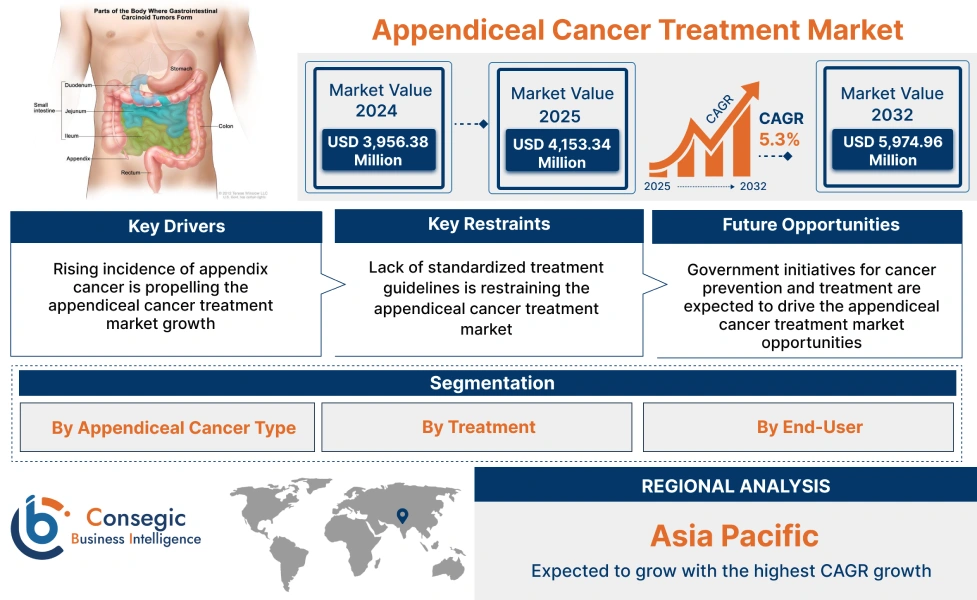
The appendiceal cancer treatment market size is growing with a CAGR of 5.3% during the forecast period (2025-2032), and the market is projected to be valued at USD 5,974.96 Million by 2032 from USD 3,956.38 Million in 2024. Additionally, the market value for 2025 attributes to USD 4,153.34 Million.
Appendiceal Cancer Treatment Market Scope & Overview:
Appendiceal cancer treatment is a medical approach that is used for managing and curing appendiceal cancer. It is primarily used for treating different types of appendix cancers, such as epithelial appendiceal cancer and neuroendocrine appendiceal cancer. Moreover, primary treatment options for appendix cancer include chemotherapy, surgery, and others. Additionally, hospitals and cancer research institutes are offering advanced diagnostic methods such as computed tomography to facilitate early diagnosis of appendix cancers. Further, several government and cancer research foundations worldwide are collaborating to spread awareness regarding cancer and its treatment options, thereby driving the market.
How is AI Transforming the Appendiceal Cancer Treatment Market?
AI is increasingly being integrated into appendiceal cancer treatment sector, particularly across various stages, ranging from diagnosis to treatment planning and drug discovery. AI-powered systems can analyze complex data such as imaging, genomics, and patient records to improve early detection, predict treatment response, and personalize treatment plans.
Additionally, AI-powered solutions can also accelerate the drug discovery process by predicting drug-target interactions and optimizing drug formulations for appendix cancer treatment. Consequently, the above factors are projected to boost the market growth in upcoming years.
Appendiceal Cancer Treatment Market Dynamics - (DRO) :
Key Drivers:
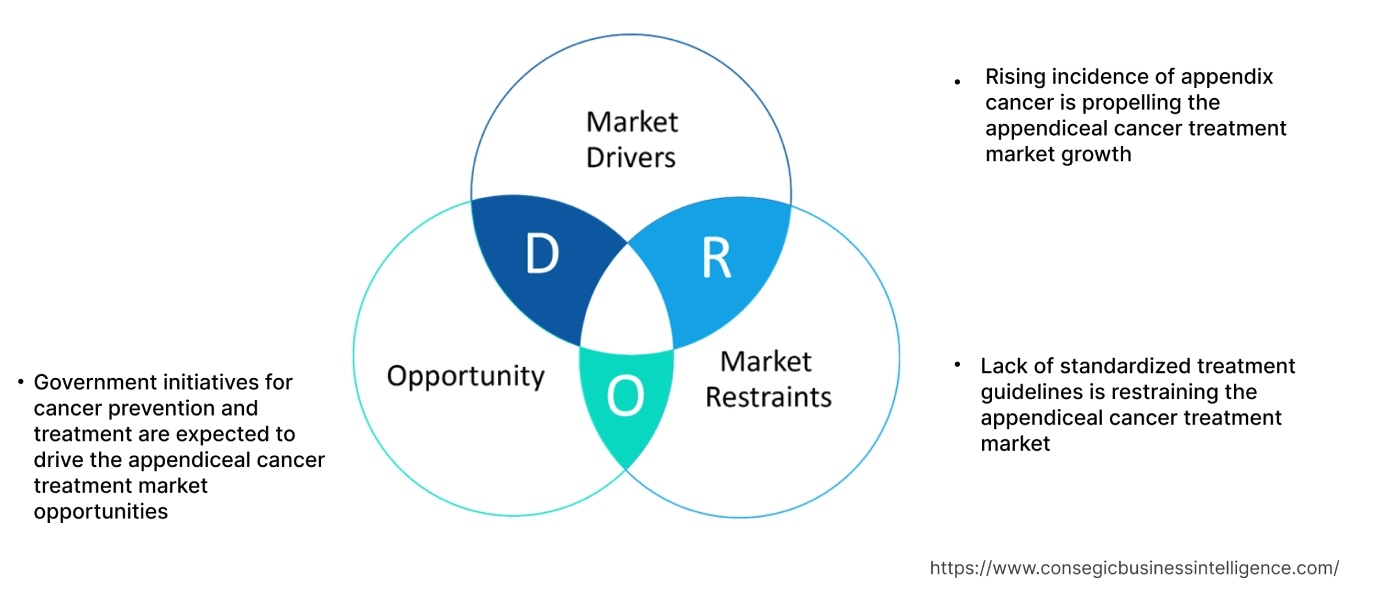
Rising incidence of appendix cancer is propelling the appendiceal cancer treatment market growth
Appendix cancer, also known as appendiceal cancer, refers to a type of cancer that grows from cells that form the appendix. Moreover, there are several causes of appendix cancers, including age, smoking or tobacco product usage, family history of cancer, and certain health conditions, such as atrophic gastritis, Zollinger-Ellison syndrome, pernicious anemia, and others. Smaller tumors on the appendix are less likely to spread, while larger tumors typically require aggressive treatments. As a result, the rising incidence of appendix cancer is driving the adoption of appendiceal cancer treatment.
- For instance, according to the National Center for Biotechnology Information, the incidence of appendiceal tumors has increased from 0.47 to 1.72 per 100,000 individuals annually over the past 20 years.
Therefore, the rising incidence of appendix cancer is driving the adoption of appendiceal cancer treatment, in turn proliferating the appendiceal cancer treatment market size.
Key Restraints:
Lack of standardized treatment guidelines is restraining the appendiceal cancer treatment market
The lack of standardized treatment guidelines due to the rarity and diverse subtypes of appendiceal cancer is among the primary factors limiting the market growth. Appendiceal cancers can vary significantly, ranging from signet ring cell carcinoma, and mucinous adenocarcinomas to neuroendocrine tumors, each requiring distinctive treatment approaches. Moreover, the absence of universally accepted protocols often leads to delays in clinical decision-making, which further affects the treatment across hospitals and regions.
Additionally, the lack of extensive clinical trials and research collaboration is a significant factor affecting patient treatment. Similarly, the lack of standardized treatment guidelines also affects drug development, patient outcomes, and treatment accessibility. Therefore, the lack of standardized treatment guidelines, absence of universally accepted protocols, and insufficient treatment accessibility are hindering the appendiceal cancer treatment market expansion.
Future Opportunities :
Government initiatives for cancer prevention and treatment are expected to drive the appendiceal cancer treatment market opportunities
The prevalence of several government initiatives regarding cancer prevention and treatment is expected to provide lucrative opportunities for market development. The governments in multiple regions are providing funding to cancer research foundations to facilitate research & development (R&D) and treatment of several types of cancers, including appendiceal cancer. Moreover, the investment in targeted therapies for appendiceal cancer is also improving the treatment options. Additionally, government cancer treatment and research centers often invest in cancer prevention programs, in turn driving the market.
- For instance, City of Hope, an organization specializing in cancer care, launched its first mobile cancer prevention program in February 2024. This program provides personalized screening recommendations for several types of cancer beyond the hospital settings through mobile clinics.
Hence, according to the analysis, the prevalence of several government initiatives regarding cancer prevention and treatment is expected to boost the appendiceal cancer treatment market opportunities during the forecast period.
Appendiceal Cancer Treatment Market Segmental Analysis :
By Appendiceal Cancer Type:
Based on appendiceal cancer type, the market is segmented into epithelial appendiceal cancer and neuroendocrine appendiceal cancer.
Trends in the appendiceal cancer type:
- Increasing trend in the diagnosis of neuroendocrine appendiceal cancer due to appendectomy.
- Rising advancements in cytoreductive surgery and systemic chemotherapy are improving the treatment options for epithelial appendiceal cancer, which is further driving the market.
The neuroendocrine appendiceal cancer segment accounted for the largest revenue in the total appendiceal cancer treatment market share in 2024.
- Neuroendocrine appendiceal cancer refers to a type of cancer that arises from neuroendocrine cells in the appendix.
- Neuroendocrine appendiceal tumors are typically slow-growing and usually detected incidentally during appendectomy.
- For instance, according to a research article published in the National Centre for Biotechnology Information in 2022, over 80% of appendiceal neuroendocrine cancers are diagnosed incidentally in appendectomy specimens. Additionally, the research study also states that they are mostly found in approximately 0.5% to 1% of all appendectomies.
- Further, neuroendocrine appendiceal cancer is usually treated through surgery to remove the appendix to prevent the spread of cancer to other parts.
- According to the analysis, the aforementioned factors are driving the market demand.
The epithelial appendiceal cancer segment is anticipated to register the fastest CAGR growth during the forecast period.
- Epithelial appendiceal cancer refers to a type of malignant tumor that originates from the epithelial lining of the appendix. This cancer mainly affects cells that produce a jelly-like substance called mucin.
- Moreover, epithelial appendiceal cancer primarily includes low-grade and high-grade mucinous neoplasms, adenocarcinomas, and goblet-cell adenocarcinomas.
- Additionally, epithelial appendiceal cancer usually spreads within the abdominal cavity instead of the bloodstream or lymph nodes.
- Further, the rising advancements in epithelial appendiceal cancer treatment options, such as cytoreductive surgery and systemic chemotherapy, are driving the market demand.
- Hence, the aforementioned factors are anticipated to drive the market during the forecast period.
By Treatment:
Based on treatment, the market is segmented into surgery, chemotherapy, and others.
Trends in the treatment:
- Rising trend in adoption of surgical removal options for appendiceal cancer to reduce tumor burden and associated symptoms.
- Increasing trend in the adoption of hyperthermic intra-peritoneal chemotherapy treatment, due to its lower complication rates and faster patient recovery, among others.
Surgery segment accounted for the largest revenue share in the overall appendiceal cancer treatment market share in 2024.
- Surgery is commonly used in the treatment of appendiceal cancer, which typically serves as the primary and most effective form of treatment.
- The type of surgery for appendiceal cancer mainly depends on the tumor grade, size, and spread.
- Moreover, a simple appendectomy is sufficient for localized tumors, specifically for low-grade appendiceal mucinous neoplasms.
- Meanwhile, in more advanced cases of appendiceal cancer, including mucinous adenocarcinoma or signet ring cell carcinoma, right hemicolectomy surgery is usually performed.
- Additionally, opting for surgery not only helps in curative treatment but also decreases tumor burden and associated symptoms.
- Therefore, the increasing adoption of surgical removal options for appendiceal cancer is driving the appendiceal cancer treatment market trends.
The chemotherapy segment is anticipated to register the fastest CAGR growth during the forecast period.
- Chemotherapy refers to a type of cancer treatment that utilizes powerful chemicals to destroy cancer cells and prevent tumor growth.
- The adoption of chemotherapy as a mode of treatment for appendiceal cancer is growing, particularly for high-grade appendiceal cancers.
- Moreover, hyperthermic intra-peritoneal chemotherapy is generally recommended in patients, wherein heated chemotherapy drugs are applied directly inside the appendix.
- Additionally, several cancer centers are widely adopting this chemotherapy to eliminate the remaining cancerous cells.
- For instance, in 2024, HCG Cancer Centre performed hyperthermic intra-peritoneal chemotherapy on a 40-year-old patient suffering from mucinous adenocarcinoma of the appendix.
- Thus, the rising adoption of hyperthermic intra-peritoneal chemotherapy for the treatment of appendiceal cancer is anticipated to boost the appendiceal cancer treatment market growth during the forecast period.
By End-User:
Based on the end-user, the market is segmented into hospitals, cancer research institutes, and others.
Trends in the end-user:
- Hospitals are increasingly adopting advanced diagnostic and specialized treatment options for offering comprehensive care to appendiceal cancer patients, which is further driving the market.
- Rising research & development activities in cancer research institutes for providing effective cancer treatment options, such as novel therapies and personalized medicines.
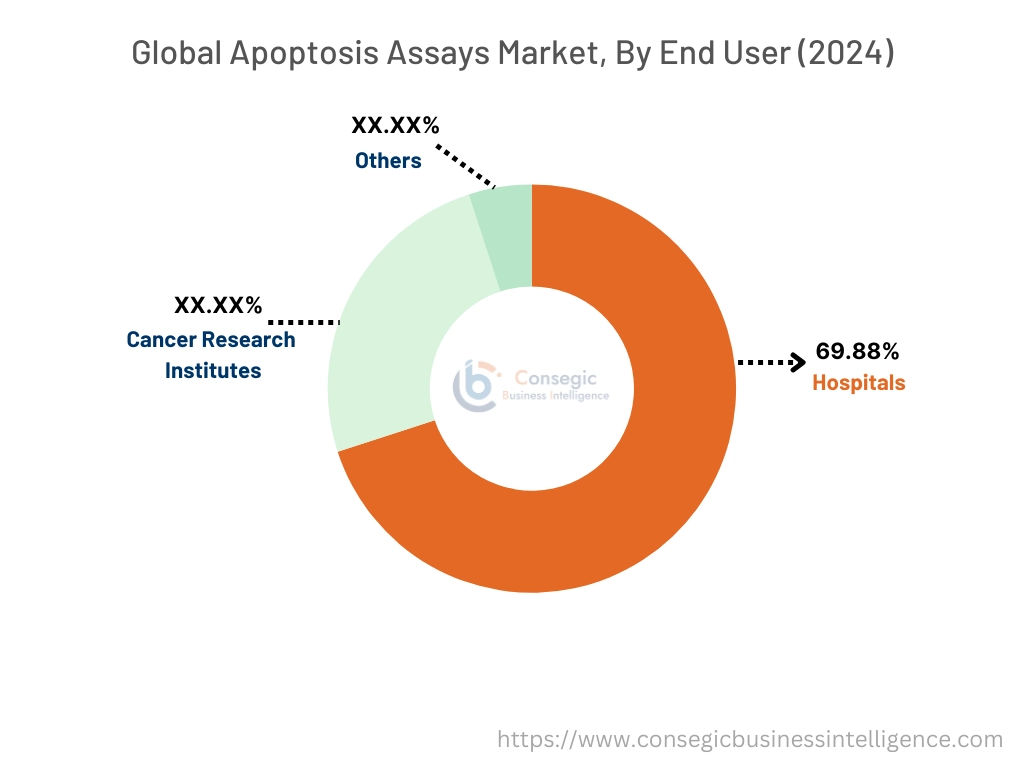
Hospitals segment accounted for the largest revenue share of 69.88% in the total market in 2024, and it is anticipated to register a substantial growth CAGR during the forecast period.
- Hospitals play a vital role in appendix cancer treatment by providing several advanced diagnostic methods and treatment options.
- Hospitals are widely preferred by patients for treatment of appendiceal cancer, due to the prevalence of well-developed infrastructure, advanced technology, and skilled healthcare professionals.
- Further, hospitals are also incorporating the utilization of robotic-assisted surgeries in the treatment of cancer to facilitate enhanced processes and enable faster recovery and improved quality of life.
- For instance, in May 2024, Apollo Hospital, located in Chennai, India, performed a robotic cytoreductive surgery for the treatment of appendiceal cancer.
- According to the analysis, the above factors are driving the appendiceal cancer treatment market size.
Regional Analysis:
The regions covered are North America, Europe, Asia Pacific, the Middle East and Africa, and Latin America.
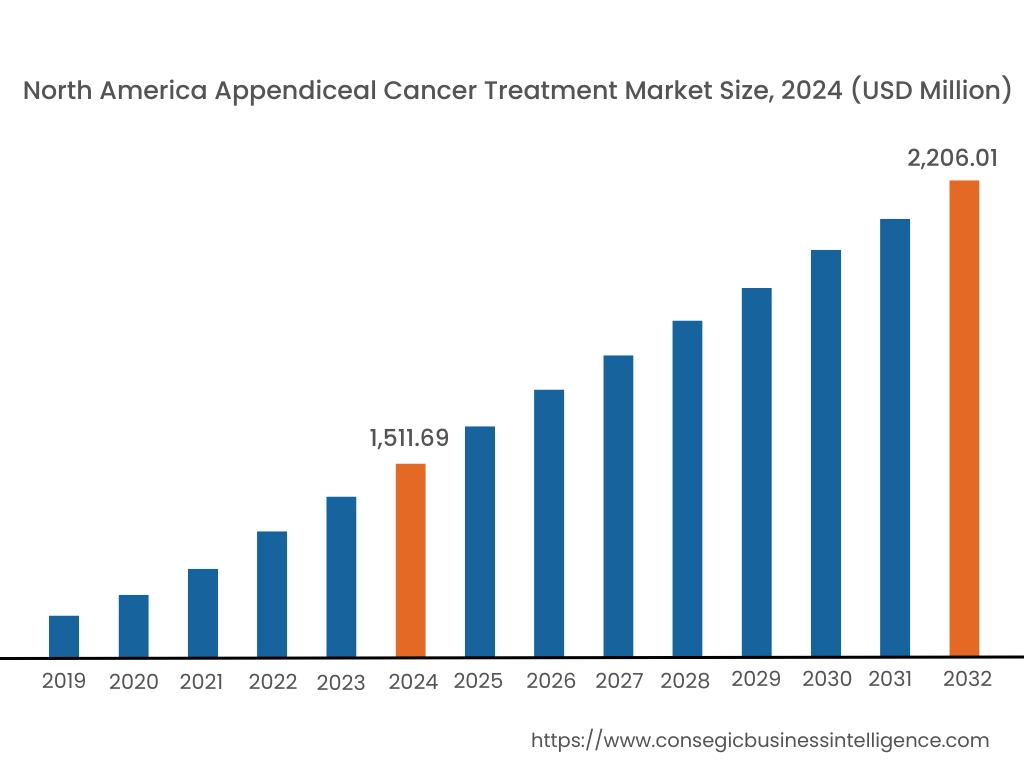
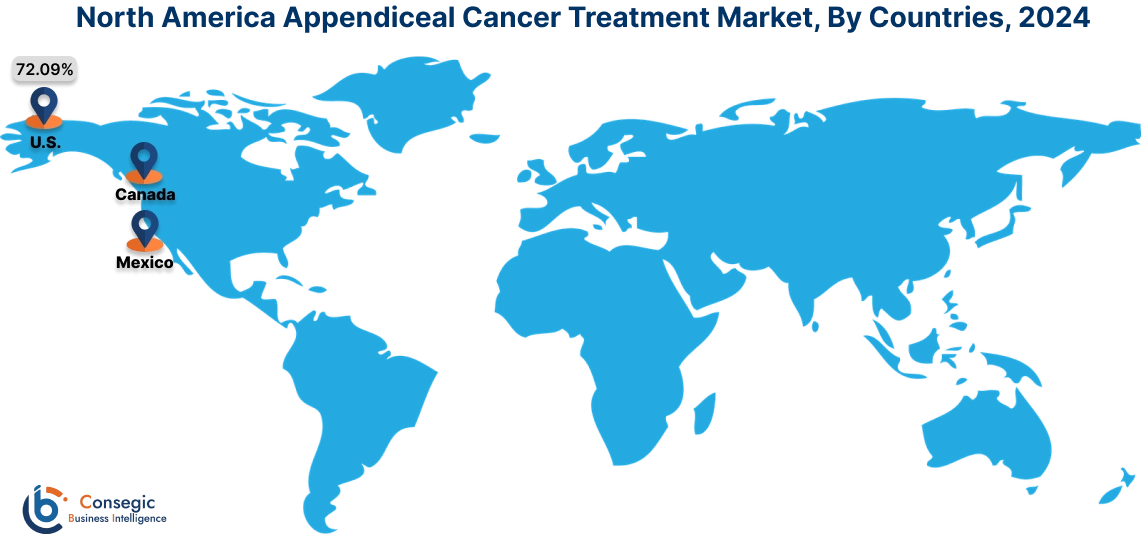
In 2024, North America accounted for the highest market share at 38.21% and was valued at USD 1,511.69 Million and it is expected to reach USD 2,206.01 Million in 2032. In North America, the United States accounted for the highest market share of 72.09% during the year 2024. In North America, the growth of the appendiceal cancer treatment industry is driven by favorable government initiatives for cancer prevention and treatment. The governments in the North American region are collaborating with research institutes to facilitate effective research & development activities for deriving efficient treatment options for appendiceal cancer. Moreover, rising investments in R&D activities associated with cancer therapy and increasing awareness programs related to appendiceal cancer are contributing to the appendiceal cancer treatment market demand.
- For instance, in August 2024, the Appendix Cancer Pseudomyxoma Peritonei (ACPMP) Research Foundation launched Appendix Cancer Awareness Month in the United States, with the aim of raising awareness among individuals regarding the risks and symptoms related to appendiceal cancer to promote early detection and treatment. The above factors are expected to boost the appendiceal cancer treatment market trends in North America during the forecast period.
Asia-Pacific is expected to witness the fastest CAGR of 6% over the forecast period (2025-2032). As per the appendiceal cancer treatment market analysis, the adoption of appendix cancer treatment in the Asia-Pacific region is primarily driven by the growing healthcare industry, the increasing prevalence of appendectomy, along the rising development of cancer hospitals and treatment centers in the region. Moreover, the increasing development of hospitals and cancer centers is further driving the adoption of surgery and chemotherapy for the treatment of appendiceal cancer.
- For instance, in February 2023, Mount Alvernia Hospital, in collaboration with Icon Cancer Centre launched the first integrated private cancer treatment center in Singapore. The collaboration and the launch of the new center aimed at advancing the development of an ecosystem for healthcare professionals, institutions, and patients by adopting a personalized approach to patient care while offering individuals various cancer treatment options. Thus, the above factors are accelerating the appendiceal cancer treatment market expansion in the Asia-Pacific region.
In addition, the regional analysis depicts that factors, including rising investments in R&D activities for cancer treatment, along with the prevalence of advanced cancer treatment hospitals & centers, equipped with modern diagnostic technology and skilled healthcare professionals, are driving the appendiceal cancer treatment market demand in Europe.
Furthermore, as per the appendiceal cancer treatment market analysis, the market demand in Latin America, Middle East, and African regions is expected to grow at a considerable rate due to factors such as growing healthcare industry, development of healthcare facilities including hospitals and cancer treatment centers, along with government measures for providing access to advanced treatments for cancer, including appendiceal cancer, among others.
Top Key Players and Market Share Insights:
The global appendiceal cancer treatment market is highly competitive with major players providing services to the national and international markets. Key players are adopting several strategies in research and development (R&D), product innovation, and end-user launches to hold a strong position in the appendiceal cancer treatment market. Key players in the appendiceal cancer treatment industry include-
- Pfizer Inc. (United States)
- Merck & Co., Inc. (United States)
- Siemens Healthineers (Germany)
- Johnson & Johnson (United States)
- GE Healthcare (United States)
- Bayer AG (Germany)
- Roche Holding AG (Switzerland)
- AbbVie Inc. (United States)
- Novartis AG (Switzerland)
- Sanofi S.A (France)
Appendiceal Cancer Treatment Market Report Insights :
| Report Attributes | Report Details |
| Study Timeline | 2018-2032 |
| Market Size in 2032 | USD 5,974.96 Million |
| CAGR (2025-2032) | 5.3% |
| By Appendiceal Cancer Type |
|
| By Treatment |
|
| By End-User |
|
| By Region |
|
| Key Players |
|
| North America | U.S. Canada Mexico |
| Europe | U.K. Germany France Spain Italy Russia Benelux Rest of Europe |
| APAC | China South Korea Japan India Australia ASEAN Rest of Asia-Pacific |
| Middle East and Africa | GCC Turkey South Africa Rest of MEA |
| LATAM | Brazil Argentina Chile Rest of LATAM |
| Report Coverage |
|
Key Questions Answered in the Report
How big is the appendiceal cancer treatment market? −
In 2024, the appendiceal cancer treatment market is USD 3,956.38 million.
Which is the fastest-growing region in the appendiceal cancer treatment market? +
Asia Pacific is the fastest-growing region in the appendiceal cancer treatment market.
What specific segmentation details are covered in the appendiceal cancer treatment market? +
Appendiceal Cancer Type, Treatment and End-User are covered in the appendiceal cancer treatment market.
Who are the major players in the appendiceal cancer treatment market? +
Pfizer Inc. (United States), Merck & Co., Inc. (United States), and Bayer AG (Germany) are some of the major players in the market.
Overview
Reputation & Certifications


Our Services
- Market Intelligence & Forecasting
- Custom Research Solutions
- Market Entry Strategy
- Competitive Intelligence
- Customer Insights
- Industry Innovation Analysis
- Investment Advisory