Jump to Content
Application Container Market - Size, Share, Industry Trends, and Forecasts (2025-2032)
Application Container Market Size:
Application Container Market size is estimated to reach over USD 37,452.44 Million by 2032 from a value of USD 5,538.84 Million in 2024 and is projected to grow by USD 6,937.18 Million in 2025, growing at a CAGR of 31.6% from 2025 to 2032.
Application Container Market Scope & Overview:
Application containers are lightweight, portable software units that package applications and dependencies for seamless deployment across various environments. They ensure consistency, efficiency, and scalability in software development and deployment. These containers provide isolation, allowing multiple applications to run independently on a shared operating system.
Key features include rapid deployment, resource optimization, and compatibility across cloud and on-premise infrastructures. They enhance operational flexibility, reduce overhead costs, and simplify software updates. Security features include access control, encryption, and vulnerability management.
Application containers are widely used in IT, banking, healthcare, retail, and telecommunications. They support microservices architecture, DevOps automation, and cloud-native development. Common applications include software testing, web services, and enterprise application deployment, ensuring reliability and streamlined management.
How is AI Transforming the Application Container Market?
There is a rising adoption of AI in the application container market, specifically for enhancing its management, optimizing resource allocation, and streamlining deployment processes. Moreover, AI algorithms can analyze data to predict container demand, optimize resource allocation, and ensure efficient utilization of infrastructure resources such as CPU, memory, and storage.
In addition, AI solutions can automate various stages of the DevOps pipeline, ranging from code commit to deployment, which further helps in accelerating the delivery of containerized applications and reducing manual effort. Consequently, the above factors are expected to propel the market growth during the forecast period.

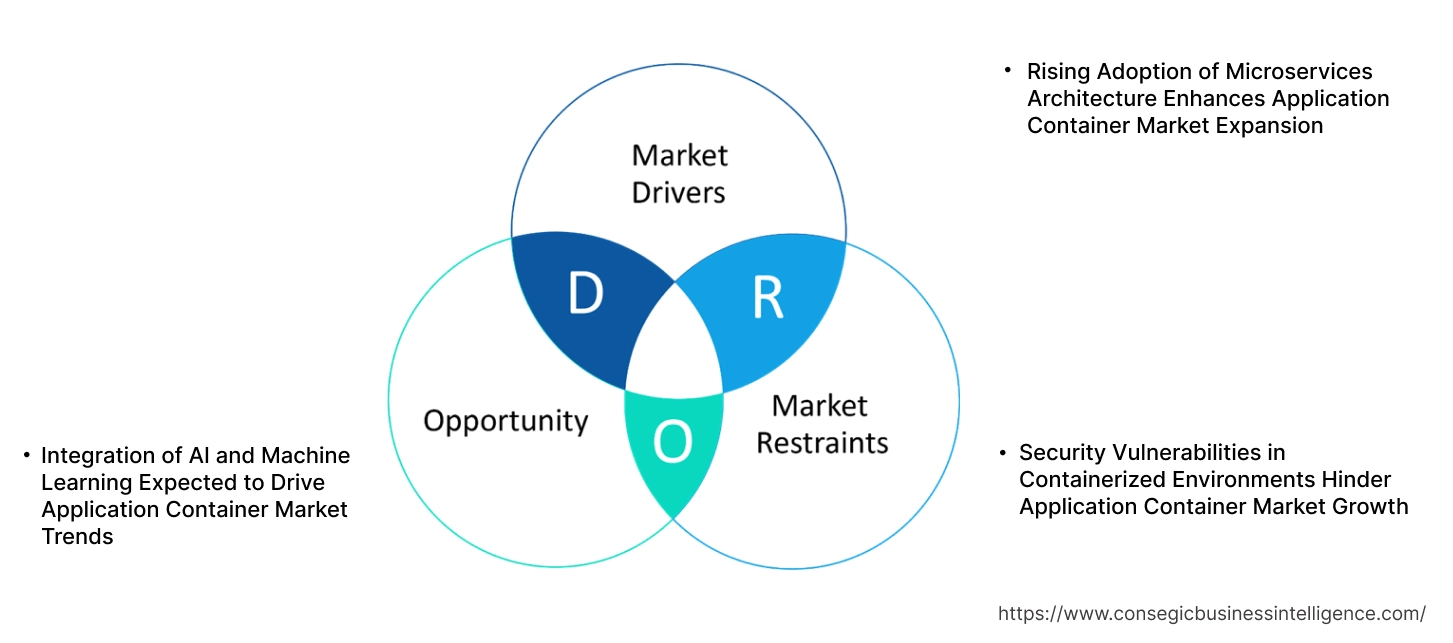
Application Container Market Dynamics - (DRO):
Key Drivers:
Rising Adoption of Microservices Architecture Enhances Application Container Market Expansion
Microservices architecture is increasingly replacing monolithic applications due to its scalability, flexibility, and efficient resource utilization. Application containers provide a lightweight and portable solution for deploying microservices, ensuring faster development and deployment cycles. These containers allow enterprises to break down applications into smaller, independent services, improving fault isolation and system resilience. For instance, organizations in the e-commerce sector utilize application containers to enable seamless updates to individual microservices without disrupting the entire system. Therefore, the growing adoption of microservices architecture is fueling the trend for application containers across industries.
Key Restraints:
Security Vulnerabilities in Containerized Environments Hinder Application Container Market Growth
Application containers introduce security challenges, including risks related to container escapes, unpatched vulnerabilities, and misconfigurations. Unlike traditional virtual machines, containers share the host operating system kernel, making them more susceptible to security threats. The lack of robust isolation mechanisms increases the risk of unauthorized access and data breaches. Additionally, containerized applications require continuous monitoring and security updates to prevent exploitation. Organizations deploying containers in highly regulated industries, such as finance and healthcare, face compliance challenges due to these security concerns. These security vulnerabilities in containerized environments are limiting the widespread adoption of application containers.
Future Opportunities:
Integration of AI and Machine Learning Expected to Drive Application Container Market Trends
The integration of artificial intelligence (AI) and machine learning (ML) with application containers is anticipated to create new application container market opportunities. Containers provide an efficient and scalable environment for deploying AI models, enabling faster inference and streamlined model updates. Organizations leveraging AI-driven applications benefit from containerized environments that support real-time data processing and model retraining. For instance, enterprises in the autonomous vehicle sector are expected to use containers to deploy and update AI models efficiently. Thus, the integration of AI and ML with application containers is projected to open new avenues for application container market expansion in the coming years.
Application Container Market Segmental Analysis :
By Component:
Based on components, the application container market is segmented into platforms and services.
The platform segment accounted for the largest revenue application container market share in 2024.
- The platform includes container runtime environments and container orchestration tools that facilitate the efficient deployment and management of containerized applications.
- Organizations are increasingly adopting container platforms to enhance software development, enable seamless scaling, and optimize IT operations.
- These platforms offer benefits such as improved agility, portability, and resource efficiency, driving adoption across enterprises.
- Additionally, platforms streamline DevOps practices by integrating with CI/CD pipelines, enabling faster and more reliable software delivery.
- Therefore, according to application container market analysis, these factors contribute to the high revenue share of the platform segment.
The services segment is anticipated to register the fastest CAGR during the forecast period.
- The services segment includes consulting, integration, support, and managed services that help enterprises deploy and manage containerized applications effectively.
- The trend for container-related services is increasing due to the complexity of implementing and securing container environments.
- Organizations seek expert guidance to optimize their containerized infrastructure, ensure security compliance, and maintain operational efficiency.
- The growing trend of cloud-native application development is also fuelling trend for managed container services.
- Thus, according to application container market analysis, these factors contribute to the anticipated rapid application container market growth of the services segment.
By Deployment Mode:
Based on deployment mode, the market is segmented into on-premises, cloud, and hybrid.
The cloud segment accounted for the largest revenue application container market share in 2024.
- Cloud-based application containers offer scalability, flexibility, and cost-effectiveness, making them the preferred choice for enterprises.
- Cloud platforms provide seamless integration with DevOps tools, enabling automated deployment and continuous delivery.
- Organizations leverage cloud-based containers to reduce infrastructure costs, enhance application performance, and enable remote accessibility.
- Major cloud service providers offer container services that simplify deployment and management, driving adoption across industries.
- Therefore, according to the market analysis, these advantages contribute to the significant revenue share of the cloud segment.
The hybrid segment is anticipated to register the fastest CAGR during the forecast period.
- Hybrid deployment combines the benefits of on-premises infrastructure with cloud scalability, allowing enterprises to balance performance, security, and cost.
- Organizations adopt hybrid container environments to meet compliance requirements while leveraging cloud resources for workload optimization.
- The increasing need for multi-cloud and edge computing solutions is driving the adoption of hybrid containers.
- Enterprises use hybrid models to maintain data sovereignty, enhance security, and optimize application performance across distributed environments.
- Thus, according to the market probe, these factors contribute to the expected rapid growth of the hybrid segment.
By Organization Size:
Based on organization size, the market is segmented into small and medium enterprises (SMEs) and large enterprises.
The large enterprises segment accounted for the largest revenue in application container market share in 2024.
- Large enterprises invest heavily in application containers to streamline software development, improve operational efficiency, and reduce infrastructure costs.
- Containers enable large organizations to modernize legacy applications and transition to cloud-native architectures.
- The need for scalable, high-performance computing environments drives container adoption in industries such as finance, healthcare, and IT.
- Enterprises also leverage container security solutions to mitigate risks and ensure compliance with industry regulations.
- Therefore, according to the market exploration, these factors contribute to the dominance of the large enterprises segment.
The small and medium enterprises (SMEs) segment is anticipated to register the fastest CAGR during the forecast period.
- SMEs increasingly adopt container technology to enhance agility, accelerate application deployment, and minimize IT expenses.
- The availability of cost-effective container platforms and managed services enables SMEs to leverage enterprise-grade infrastructure.
- Cloud-native development practices and open-source container solutions support SME adoption.
- The growing application container market demand for digital transformation among SMEs further accelerates the adoption of application containers.
- Thus, according to the market probe, these factors contribute to the anticipated rapid growth of the SME segment.
By Service:
Based on service, the market is segmented into consulting, container monitoring, container security, container data management, container networking, container orchestration, and support and maintenance.
The container security segment accounted for the largest revenue share in 2024.
- Security solutions protect containerized applications from cyber threats, vulnerabilities, and unauthorized access.
- Enterprises prioritize container security to comply with industry regulations and safeguard sensitive data.
- Security solutions offer runtime protection, vulnerability scanning, and access control mechanisms.
- The rise in container adoption has led to increased investment in security solutions to prevent breaches and ensure compliance.
- Therefore, according to the market study, these factors contribute to the high revenue share of the container security segment.
The container orchestration segment is anticipated to register the fastest CAGR during the forecast period.
- Container orchestration automates the deployment, scaling, and management of containerized applications across distributed environments.
- Kubernetes and other orchestration tools enable enterprises to manage complex container ecosystems efficiently.
- The adoption of microservices architecture and cloud-native applications accelerates trend for orchestration solutions.
- Enterprises leverage orchestration to optimize resource utilization, improve reliability, and enhance scalability.
- Thus, according to the market study, these factors contribute to the expected rapid growth of the container orchestration segment.
By Application:
Based on application, the market is segmented into BFSI, healthcare and life sciences, telecommunication and IT, retail and e-commerce, education, and media and entertainment.
The telecommunication and IT segment accounted for the largest revenue share of 28.97% in 2024.
- IT and telecom enterprises utilize containers to enhance application performance, optimize network infrastructure, and streamline service delivery.
- Containers support cloud-native development, enabling faster deployment and scaling of IT services.
- Telecom operators leverage containerized solutions for network functions virtualization (NFV) and 5G infrastructure deployment.
- The increasing application container market trend for high-performance, resilient IT infrastructure drives the adoption of application containers in this segment.
- Therefore, according to the market analysis, these factors contribute to the high revenue share of the telecommunication and IT segment.
The healthcare and life sciences segment is anticipated to register the fastest CAGR during the forecast period.
- Healthcare organizations adopt containers for secure, scalable, and compliant application deployment.
- Containers enable interoperability in healthcare systems, supporting electronic health records (EHR), telemedicine, and patient data management.
- Life sciences companies use containerized applications for research, drug discovery, and genomic data analysis.
- The increasing adoption of cloud-based healthcare solutions and regulatory compliance requirements drive container usage in this segment.
- Thus, according to the market analysis, these factors contribute to the anticipated rapid growth of the healthcare and life sciences segment.

Regional Analysis:
The regional segment includes North America, Europe, Asia Pacific, Middle East and Africa, and Latin America.

In 2024, Asia-Pacific was valued at USD 1,430.56 Million and is expected to reach USD 9,924.90 Million in 2032. In Asia-Pacific, China accounted for the highest share of 30.51% during the base year of 2024. Asia-Pacific is experiencing rapid adoption of application containers due to digital transformation initiatives across industries. Countries like China, India, and Japan are investing in cloud computing and container orchestration technologies. The presence of emerging startups and growing demand for agile software development influence market performance. Government policies supporting cloud infrastructure development enhance adoption rates.

North America region was valued at USD 1,935.61 Million in 2024. Moreover, it is projected to grow by USD 2,423.54 Million in 2025 and reach over USD 13,040.94 Million by 2032. North America holds a significant share of the application container market due to the strong presence of cloud service providers and technology firms. The United States leads in adoption, driven by enterprises implementing containerization for scalable application deployment. The application container market demand for microservices architecture and DevOps practices contributes to application container market opportunities. Increasing investment in hybrid cloud solutions further supports the market.
Europe has a well-established market for application containers, supported by enterprises prioritizing cloud-native technologies. The United Kingdom, Germany, and France are key markets due to increasing investment in automation and Kubernetes-based solutions. Data privacy regulations, including GDPR, impact market strategies and drive demand for secure containerized environments. The adoption of multi-cloud strategies also strengthens the market.
The Middle East and Africa are witnessing steady adoption of application containers as organizations modernize their IT infrastructure. Countries like the UAE and Saudi Arabia are investing in digital transformation and cloud services. The expansion of data centers and rising interest in AI-driven applications contribute to market performance. Government-led initiatives supporting cloud computing further influence adoption.
Latin America is emerging as a potential market for application containers due to increasing cloud adoption in Brazil, Mexico, and Argentina. Enterprises in the region are focusing on modernizing legacy applications using containerization. The demand for cost-effective IT solutions and investments in DevOps practices contribute to market growth. Public cloud expansion by global providers also supports adoption.
Top Key Players & Market Share Insights:
The global application container market is highly competitive with major players providing products and services to the national and international markets. Key players are adopting several strategies in research and development (r&d), product innovation, and end-user launches to hold a strong position in the global application container market. Key players in the application container industry include-
- Amazon Web Services, Inc. (United States)
- Google LLC (United States)
- SAP SE (Germany)
- Broadcom Inc. (CA Technologies) (United States)
- SUSE SE (Germany)
- IBM Corporation (United States)
- Microsoft Corporation (United States)
- Docker, Inc. (United States)
- Red Hat, Inc. (United States)
- VMware, Inc. (United States)
Recent Industry Developments :
Mergers and Acquisitions:
- In November 2024, Amcor, an Australian packaging leader, announced a scrip merger deal valued at $8.4 billion to acquire Berry Global Group, a prominent manufacturer of plastic consumer containers and closures. This strategic move positions Amcor as the world's largest plastic packaging company, expanding its market reach and capabilities with annual sales projected to reach $23.9 billion.
- In September 20204, CMA CGM, the world's third-largest shipping group, invested $1.1 billion to acquire a 48% stake in Santos Brasil, a Brazilian port terminal operator, with intentions for a full takeover. This acquisition grants CMA CGM access to three container port terminals in Brazil, enhancing its operational footprint in South America.
Application Container Market Report Insights:
| Report Attributes | Report Details |
| Study Timeline | 2019-2032 |
| Market Size in 2032 | USD 37,452.44 Million |
| CAGR (2025-2032) | 31.6% |
| By Component |
|
| By Deployment Mode |
|
| By Organization Size |
|
| By Service |
|
| By Application |
|
| By Region |
|
| Key Players |
|
| North America | U.S. Canada Mexico |
| Europe | U.K. Germany France Spain Italy Russia Benelux Rest of Europe |
| APAC | China South Korea Japan India Australia ASEAN Rest of Asia-Pacific |
| Middle East and Africa | GCC Turkey South Africa Rest of MEA |
| LATAM | Brazil Argentina Chile Rest of LATAM |
| Report Coverage |
|
Key Questions Answered in the Report
How big is the Application Container Market? −
In 2024, the Application Container Market was USD 5,538.84 million.
What will be the potential market valuation for the Application Container Market by 2032? +
In 2032, the market size of Application Container Market is expected to reach USD 37,452.44 million.
What are the segments covered in the Application Container Market report? +
The component, deployment mode, organization size, service, and application are the segments covered in this report.
Who are the major players in the Application Container Market? +
Amazon Web Services, Inc. (United States), Google LLC (United States), IBM Corporation (United States), Microsoft Corporation (United States), Docker, Inc. (United States), Red Hat, Inc. (United States), VMware, Inc. (United States), SAP SE (Germany), Broadcom Inc. (CA Technologies) (United States), SUSE SE (Germany) are the major players in the Application Container market.
Overview
Reputation & Certifications


Our Services
- Market Intelligence & Forecasting
- Custom Research Solutions
- Market Entry Strategy
- Competitive Intelligence
- Customer Insights
- Industry Innovation Analysis
- Investment Advisory