Jump to Content
Aseptic Sampling Market - Size, Share, Industry Trends, and Forecasts (2025-2032)
Aseptic Sampling Market Size:
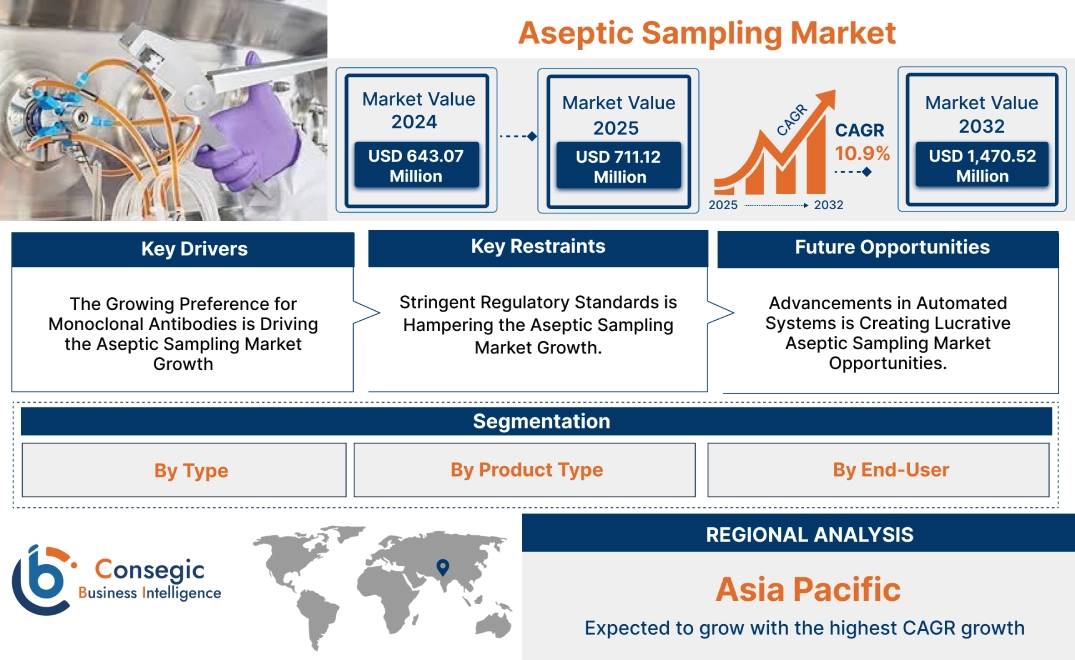
Aseptic Sampling Market size is growing with a CAGR of 10.9% during the forecast period (2025-2032), and the market is projected to be valued at USD 1,470.52 Million by 2032 from USD 643.07 Million in 2024. Additionally, the market value for the 2025 attributes to USD 711.12 Million.
Aseptic Sampling Market Scope & Overview:
Aseptic sampling refers to the process of collecting a representative sample from a sterile or controlled environment. The sample is collected in a manner that prevents contamination from microorganisms or other unwanted substances. Aseptic sampling procedures are designed to preserve the original state of the sample, ensuring its validity analysis or processing. The sampling ensures the quality and safety of products, prevents contamination that could compromise research or manufacturing processes, and provides reliable data for analysis and decision-making. The types generally consist of manual sampling and automated sampling. The product type of this sampling method includes bags & bottles, syringes and needles, sampling valves, filters and membranes, and others. The end-user consists of pharmaceutical & biotechnology companies, food & beverage manufacturers, research laboratories, contract manufacturing organizations, and others.
How is AI Impacting the Aseptic Sampling Market?
AI is transforming the aseptic sampling market by significantly enhancing quality control and automation. AI-based systems utilize advanced data analytics to monitor manufacturing processes in real-time, detecting subtle patterns that indicate potential contamination risks with greater accuracy than traditional methods. These intelligent systems help to predict sterility problems before they occur, allowing manufacturers to take proactive measures. By integrating with automated sampling equipment, AI reduces the need for human intervention, thereby minimizing the primary source of contamination risk and ensuring superior sterility performance. This technological advancement is crucial for industries like biopharmaceuticals, where maintaining product integrity and meeting stringent regulatory standards are paramount.
Aseptic Sampling Market Dynamics - (DRO) :
Key Drivers:
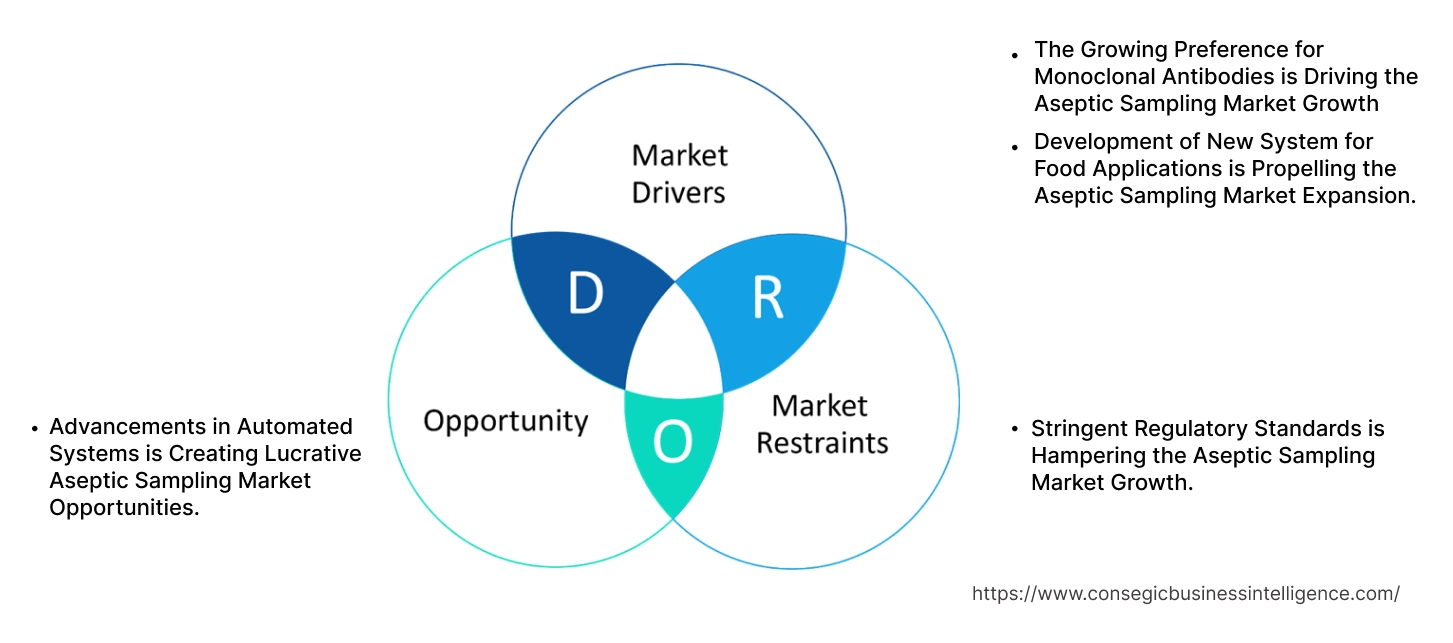
The Growing Preference for Monoclonal Antibodies is Driving the Aseptic Sampling Market Growth
Monoclonal Antibody (mAbs) is a complex protein used in therapies for various diseases, require stringent manufacturing processes to maintain sterility and ensure product quality. Aseptic sampling is important throughout the mAb production lifecycle, from upstream cell culture to downstream purification and formulation. The rising demand for mAbs requires increased production volumes, which amplifies the need for robust and reliable sampling techniques that are aseptic. Additionally, novel services are being introduced that require sampling techniques that are aseptic in nature for the development of mAbs.
For instance,
- In January 2022, Avantor, launched its OmniTop Sample Tubes Adjustable Volume Sampling System (AVSS), designed to lower contamination risk and reduce volume loss in bioprocessing operations. The system is designed for high-integrity product sampling applications such as monoclonal antibodies (mAbs) and cell and gene therapy processes, as well as final fill operations.
Thus, the rise in the preference for monoclonal antibodies is driving the growth of the market.
Development of New System for Food Applications is Propelling the Aseptic Sampling Market Expansion.
Food production involves complex and diverse processes, requiring sampling methods that effectively maintain sterility and prevent contamination. New systems are being designed to address these parameters, incorporating features like specialized sampling tools, automated procedures, and integration with food processing lines. These advancements enable more efficient and reliable sampling, ensuring food safety and quality throughout the production chain.
For instance,
- In March 2023, QualiTru Sampling Systems introduced a new TruStream7 Septum EU, which is designed specifically to serve dairy and liquid food processing companies. It enables dairy and liquid food processors, and dairy farmers, to enhance food safety and quality processes by performing aseptic inline process monitoring simply, and cost-efficiently.
Thus, the development of new systems for food applications is propelling the aseptic sampling market demand.
Key Restraints:
Stringent Regulatory Standards is Hampering the Aseptic Sampling Market Growth.
Stringent regulatory standards imposed by government bodies worldwide pose significant constraints in the market. These regulations, designed to protect the environment and public health. They mandate strict adherence to aseptic procedures and require extensive validation and documentation of sampling processes. This leads to increased costs for manufacturers, as they need to invest in specialized equipment, trained personnel, and robust quality control systems to meet these requirements. Furthermore, the complexity of these regulations and the need for thorough compliance slow down the adoption of new technologies and innovative sampling solutions. Companies are hesitant to implement new systems until they are thoroughly examined and proven to meet stringent standards. Thus, this stifles innovation and limits the market penetration of potentially beneficial sampling technologies.
Future Opportunities :
Advancements in Automated Systems is Creating Lucrative Aseptic Sampling Market Opportunities.
Automated systems are technologies that use automated machinery and processes to collect and fill samples from various environments or processes, minimizing human intervention and improving efficiency, accuracy, and sterility. Technological innovations address critical needs in various industries, particularly pharmaceuticals and biotechnology, where maintaining sterility and sample integrity is important. Advanced systems collect and monitor samples more rapidly and consistently than manual methods, significantly increasing efficiency and throughput, especially in large-scale operations. They are integrated with process monitoring and control systems, enabling real-time feedback and enhanced process optimization.
For instance,
- In June 2024, Syntegon introduced Settle Plate Changer (SPC) for automated viable monitoring in the aseptic filling process. This system provides consistent sampling for aseptic filling process.
Thus, advancements in automated systems are creating lucrative aseptic sampling market opportunities.
Aseptic Sampling Market Segmental Analysis :
By Type:
Based on type, the market is categorized into manual sampling and automated sampling.
Trends in the Type:
- There is a rise in the trend for automated systems to reduce contamination caused by manual interventions.
The manual sampling segment accounted for the largest market share in 2024.
- Manual aseptic sampling involves the collection of samples from a sterile or controlled environment using traditional techniques and equipment, performed by trained personnel.
- This method relies heavily on the skill and adherence to strict protocols of the individuals conducting the sampling to maintain sterility and prevent contamination.
- The process typically involves using sterile tools, such as pipettes, needles, or sampling valves, and sterile containers, like vials or bags, to collect the sample.
- Manual sampling is mainly employed in situations where the sampling location is easily accessible or when the sample volume is relatively small.
- Thus, as per the market analysis, the use of manual sampling for small sample volumes is driving the aseptic sampling market trends.
The automated sampling segment is expected to grow at the fastest CAGR over the forecast period.
- The automating sampling utilizes automated machinery, involving robotic arms or precisely controlled mechanisms, to manipulate sterile sampling tools and containers within a closed or contained environment like a cleanroom, isolator, or directly from a production line.
- The key function is to minimize human intervention, thereby reducing the risk of contamination and ensuring the sample's purity.
- Automated aseptic sampling systems are programmable, allowing for consistent and repeatable sample collection at specific intervals or under pre-defined process conditions.
- For instance, in 2022, Tema Sinergie introduced a new pharmaceutical isolator for sampling sterile powders (API) under aseptic conditions. The Aseptic Sampling Isolator (AP-IS Series) is developed in response to the need for aseptic sampling of large quantities of sterile active ingredients and for handling large containers.
- Thus, these aforementioned factors are influencing the growth of the segment.
By Product Type:
Based on product type, the market is categorized into bags & bottles, syringes and needles, sampling valves, filters and membranes, and others.
Trends in Product Type:
- There is a growing trend for valves designed to minimize contamination risks and streamline processes.
- Development of smart sampling tools (bags, bottles with embedded sensors) captures data about the sample such as temperature, pH and transmit it wirelessly for analysis.
The bags & bottles segment accounted for the largest market share in the year 2024.
- Bags and bottles are widely utilized components of aseptic sampling procedures, serving as essential vessels for collecting, storing, and transporting samples while maintaining sterility.
- Aseptic sampling bags are typically made from sterile, biocompatible materials like polymers, and designed for single use to minimize contamination risks and simplify workflows.
- They are available in various sizes and configurations, including those with integrated filters or sampling ports for added convenience.
- Sampling bottles are usually made from glass or plastic and are reusable (after sterilization) or disposable.
- They also come in various sizes features specialized closures or connections to maintain sterility during sample collection and transfer, thus driving the segment.
The sampling valves segment is expected to grow at the fastest CAGR over the forecast period.
- Sampling valves are critical components within aseptic sampling systems, designed to enable the controlled and sterile extraction of samples from a process stream or container.
- These valves are engineered to maintain the sample and the process, preventing contamination and ensuring representative sampling.
- Sampling valves are typically constructed from biocompatible materials, such as stainless steel, and are designed to be easily sterilized, mainly through autoclaving or chemical treatment.
- They are available in various configurations, including two-way, three-way, and multi-port valves, allowing for different sampling strategies and integration with various process equipment.
- A key feature of aseptic sampling valves is their ability to create a tight seal, preventing leakage and maintaining sterility during sample collection.
- For instance, in 2022, GEA group introduced a aseptic single-seat sampling valve that is used for the safe sampling in UltraClean and Aseptic processing plants. Aseptomag is mainly used for dairy, beverage and food applications.
- Thus, as per the market analysis, these factors are influencing the segment.
By End User:
Based on end user, the market is categorized into pharmaceutical & biotechnology companies, food & beverage manufacturers, research laboratories, contract manufacturing organizations, and others.
Trends in the End User:
- The growing trend of government and public funding for aseptic sample systems use in contract manufacturing organizations is propelling the segment.
- Pharmaceutical companies are using sampling systems with advanced data capture capabilities to enhance efficiency, sterility assurance, and process control.
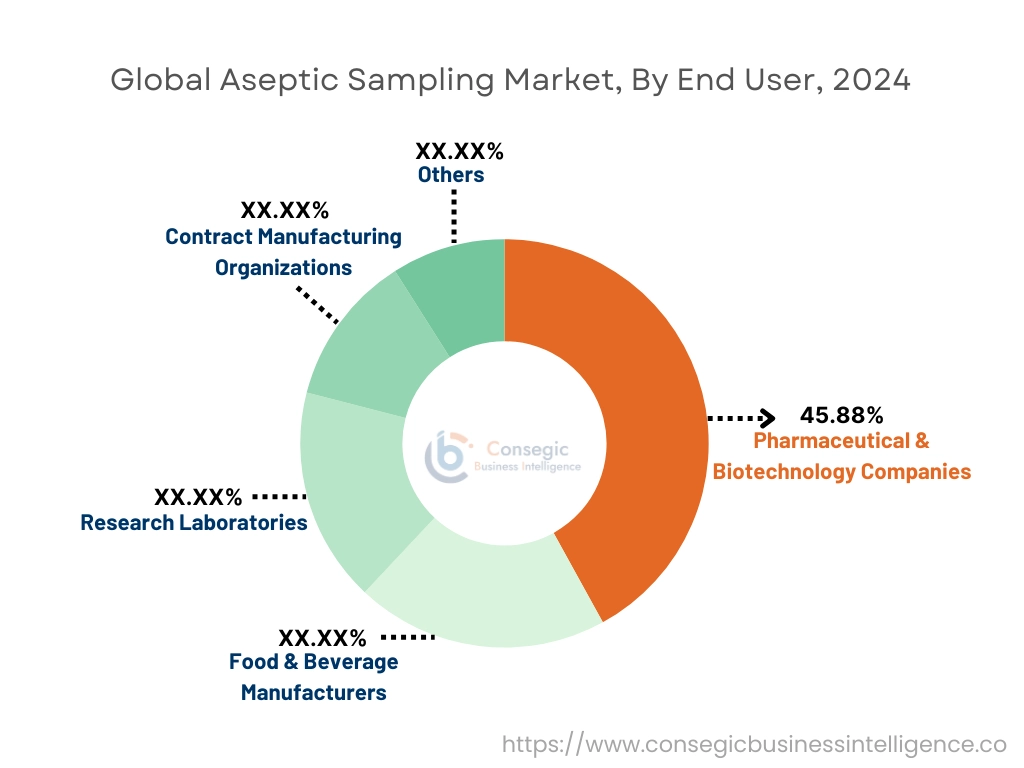
The pharmaceutical & biotechnology companies segment accounted for the largest aseptic sampling market share of 45.88% in the year 2024.
- Aseptic sampling is absolutely crucial for pharmaceutical and biotechnology companies, forming a cornerstone of their quality control and manufacturing processes.
- These companies deal with sterile products, injectable medications, cell therapies, and other biologics where contamination has disturbing consequences.
- This sampling is implemented throughout the entire product lifecycle, from early-stage research and development to large-scale manufacturing and final product release.
- During filling and packaging, sampling ensures the final product meets stringent quality standards.
- The rise in the development of new biotechnology companies enhances the use of these sampling systems for various research and development applications.
- For instance, according to the data published by IBEF, states that the surge in biotechnology startups in India, with approximately 1,128 new entrants in 2021 alone, has created a dynamic environment for innovation. that are custom made.
- Thus, these factors are influencing the growth of the segment.
The contract manufacturing organization’s segment is expected to grow at the fastest CAGR over the forecast period.
- Aseptic sampling plays a crucial role in Contract manufacturing organization (CMOs) due to the nature of their work, which generally involves handling materials, manufacturing products and conducting clinical trials.
- CMOs are assigned to perform research and testing on behalf of pharmaceutical and biotechnology companies, requiring them to adhere to stringent quality control and regulatory standards.
- Aseptic sampling is essential at various stages, from receiving and storing biological samples to conducting laboratory analyses and manufacturing clinical trial materials.
- Maintaining sterility and preventing contamination during sampling is important to ensure the integrity of research data, the validity of clinical trial results, and the safety of any manufactured products.
- Thus, these factors are influencing the growth of the segment.
Regional Analysis:
The regional segment includes North America, Europe, Asia Pacific, the Middle East and Africa, and Latin America.
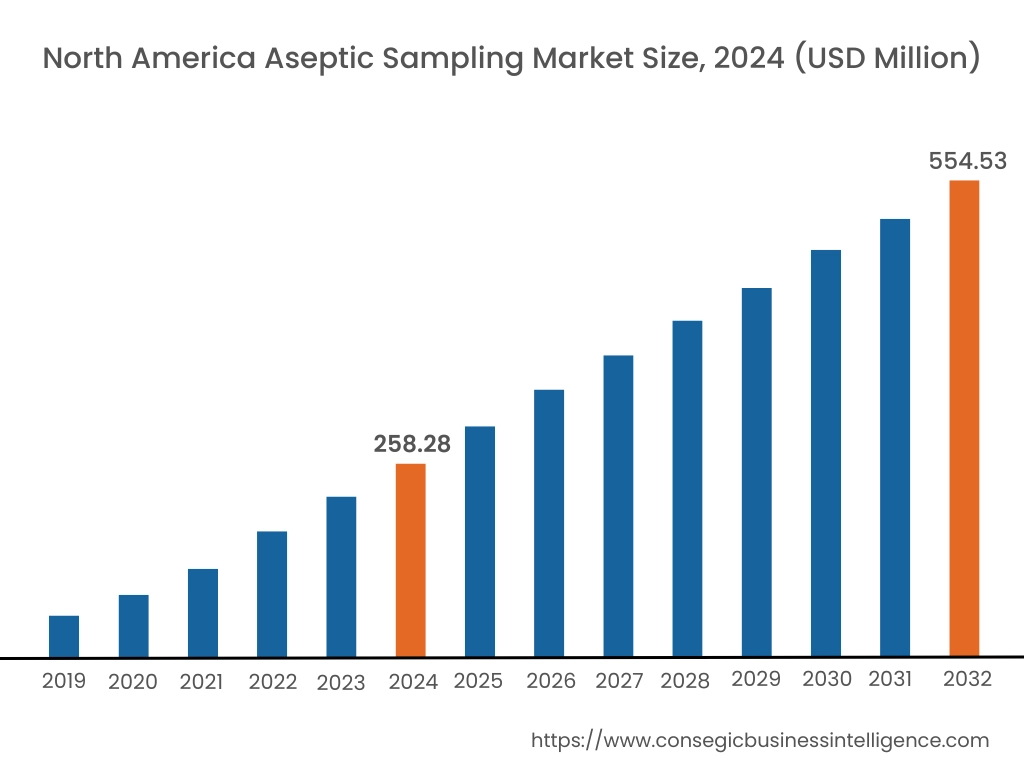
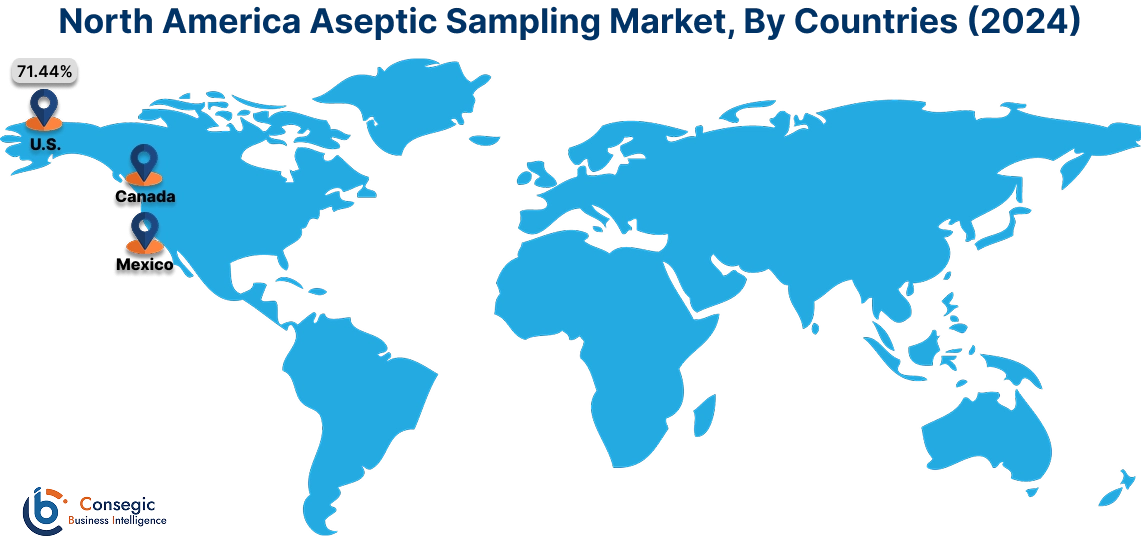
In 2024, North America accounted for the highest market share at 40.17% and was valued at USD 258.28 Million and is expected to reach USD 554.53 Million in 2032. In North America, U.S. accounted for the highest market share of 71.44% during the base year of 2024. North America dominates the global aseptic sampling industry, driven by factors such as significant government funding for research and development, a strong presence of leading pharmaceutical and biotechnology companies, and a well-established infrastructure for research and development. The region boasts a high concentration of renowned academic institutions and research centers, fostering a dynamic environment for research and development. They use aseptic sampling systems to maintain sterile conditions while manufacturing and processing of the product. Novel manufacturing sites are being introduced in the region. These bioprocessing sites generally require aseptic system in them.
For instance,
- In October 2023, Sino Biological announced the opening of its new US-based Center for Bioprocessing (C4B) in Houston, Texas. This development signifies a crucial step for the company, enhancing its ability to serve the North American market with expedited access to high-quality bioprocessing services.
Thus, as per the aseptic sampling market analysis, the rise in the use of aseptic systems is influencing the market in this region.
Asia Pacific is experiencing the fastest growth with a CAGR of 12.7% over the forecast period. As consumer demand for safe, high-quality food and beverage products increases, manufacturers are under pressure to implement stringent quality control measures throughout their production processes. Aseptic sampling plays a crucial role in ensuring product safety and preventing contamination, particularly for ready-to-drink beverages, dairy products, and other food items that require a high degree of sterility. The rising middle class in Asia Pacific, coupled with increasing disposable incomes, is fueling the demand for packaged and processed foods, further driving the need for aseptic sampling to maintain product quality and extend shelf life.
Europe presents a significant contribution to the aseptic sampling market analysis. European pharmaceutical and biotechnology companies, known for their focus on advanced technologies and high-quality manufacturing, are increasingly investing in automated solutions to improve efficiency, reduce contamination risks, and enhance data integrity. Automation offers several key advantages in aseptic sampling, including increased throughput, reduced human error, and improved consistency, which are particularly valuable in Europe's highly regulated environment. Furthermore, the integration of automated sampling systems with other production and monitoring systems allows for real-time process control and enhanced data management, further contributing to their appeal.
The Middle East and Africa (MEA) region is witnessing notable Aseptic Sampling market demand characterized by significant potential. Contract manufacturing organizations (CMOs) provide manufacturing services to pharmaceutical and biotechnology companies, mainly handling the production of sterile and injectable drugs. These products require stringent aseptic processes throughout manufacturing, making sampling crucial for quality control and regulatory compliance. CMOs in MEA must adhere to international quality standards and regulatory guidelines, necessitating the implementation of advanced sampling techniques to ensure product safety and efficacy. Therefore, the growth of the CMO sector in MEA directly contributes to the aseptic sampling market expansion in the region.
Latin America is an emerging region in the Aseptic Sampling market share, with significant potential for innovation. The region faces unique environmental challenges, including diverse ecosystems, resource extraction, and varying levels of industrialization, all of which necessitate robust monitoring and analysis. Aseptic sampling plays a crucial role in collecting representative samples from water sources, soil, air, and other environmental matrices to assess pollution levels, identify contaminants, and ensure compliance with environmental regulations. As awareness of environmental issues increases and regulations become stricter, the need for sampling in Latin America is expected to grow, contributing significantly to the aseptic sampling market trend in the region.
Top Key Players & Market Share Insights:
The global Aseptic Sampling market is highly competitive with major players providing precise products to the national and international markets. Key players are adopting several strategies in research and development (R&D) and product innovation to hold a strong position in the global Aseptic Sampling market. Key players in the Aseptic Sampling industry include-
- Cobetter (China)
- QualiTru Sampling Systems (United States)
- Flownamics Analytical Instruments, Inc. (United States)
- Saint-Gobain (France)
- ALFA LAVAL (United States)
- Merck KGaA (Germany)
- Sartorius AG (Germany)
- Avantor, Inc (United States)
- GEA Group (Germany)
- Gemu Group (Germany)
Recent Industry Developments :
Product Launch:
- In March 2023, QualiTru Sampling Systems introduced a new TruStream7 Septum EU, which is designed specifically to serve dairy and liquid food processing companies. It enables dairy and liquid food processors, and dairy farmers, to enhance food safety and quality processes by performing aseptic inline process monitoring simply, and cost-efficiently.
Aseptic Sampling Market Report Insights :
| Report Attributes | Report Details |
| Study Timeline | 2019-2032 |
| Market Size in 2032 | USD 1,470.52 Million |
| CAGR (2025-2032) | 10.9% |
| By Type |
|
| By Product Type |
|
| By End-User |
|
| By Region |
|
| Key Players |
|
| North America | U.S. Canada Mexico |
| Europe | U.K. Germany France Spain Italy Russia Benelux Rest of Europe |
| APAC | China South Korea Japan India Australia ASEAN Rest of Asia-Pacific |
| Middle East and Africa | GCC Turkey South Africa Rest of MEA |
| LATAM | Brazil Argentina Chile Rest of LATAM |
| Report Coverage |
|
Key Questions Answered in the Report
How big is the Aseptic Sampling market? −
In 2024, the Aseptic Sampling market is USD 643.07 Million.
Which is the fastest-growing region in the Aseptic Sampling market? +
Asia Pacific is the fastest-growing region in the Aseptic Sampling market.
What specific segmentation details are covered in the Aseptic Sampling market? +
Type, Product Type, and End User segmentation details are covered in the Aseptic Sampling market.
Who are the major players in the Aseptic Sampling market? +
Cobetter (China), QualiTru Sampling Systems (United States), Merck KGaA (Germany) are some of the major players in the market.
Overview
Reputation & Certifications


Our Services
- Market Intelligence & Forecasting
- Custom Research Solutions
- Market Entry Strategy
- Competitive Intelligence
- Customer Insights
- Industry Innovation Analysis
- Investment Advisory