Jump to Content
Asia Pacific Carbon Fiber Prepreg Market - Size, Share, Industry Trends, and Forecasts (2025-2034)
Asia Pacific Carbon Fiber Prepreg Market Executive Summary
The carbon fiber prepreg market in the Asia Pacific is a complex intersection of sophisticated materials science and mass-volume industrial production, involving the impregnation of carbon fiber reinforcing materials in advance with regulated resins that provide superior strength to weight ratios, dimensional integrity and durability. This broad market has epoxy-based prepregs with tensile of 4,000-7,000 MPa and modulus of 230-640 Gpa that can be used in aerospace work, thermoplastic prepregs with 2-5 minutes processing times versus 2-4 hours in thermoset systems, phenolic prepregs with outstanding fire resistance in aircraft interiors, bismaleimide systems having 200-230 deg C maximum temperature capability in engine parts, and specialty formulations with toughened resin used in damage tolerance.
Asia Pacific Carbon Fiber Prepreg Market Key Takeaways
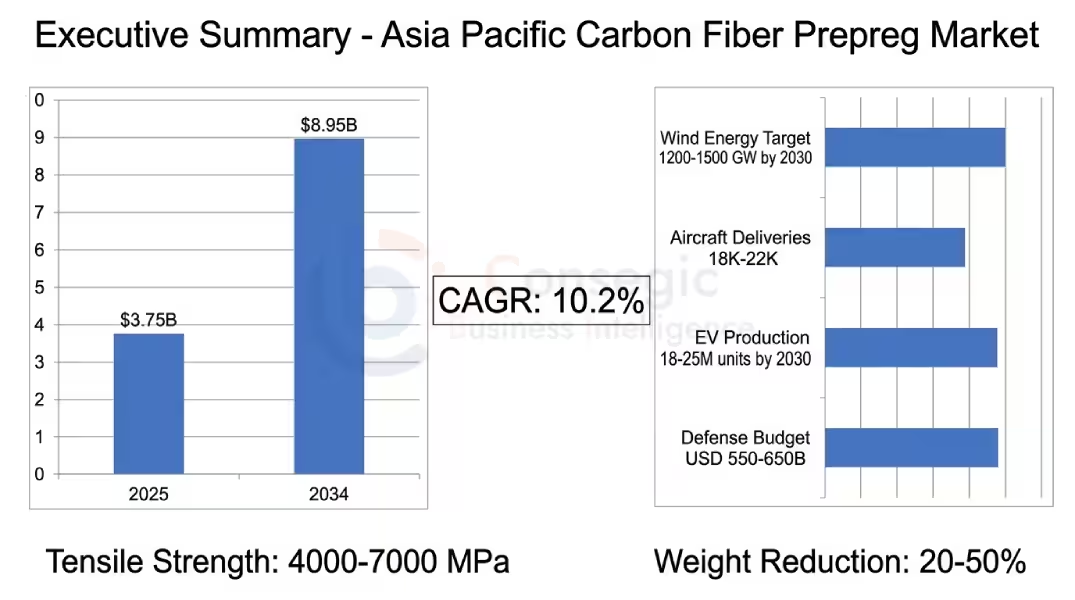
- Fast-growing market - The market is expected to grow from $3.75Bn in 2025 to $8.95Bn by 2034, at a 10.2% annual growth rate (CAGR).
- Key Market Driver - Wind energy expansion is a major driver, Aerospace industry is growing rapidly, Defense and military demand is rising
- Key Market Opportunity - Hydrogen vehicles creating new demand, Electric vehicle (EV) boom in Asia Pacific.
- Different types for different uses - Various prepregs are made for specific needs like airplanes, engines, and fire-safe interiors, all offering strong yet lightweight performance.
- Modern and precise manufacturing - Companies are using advanced machines and quality checks to produce highly accurate and reliable materials.
- Growth driven by planes and wind energy - More aircraft production and bigger wind turbines are increasing demand.
The modern Asia Pacific carbon fiber prepreg market has become an export-driven market with greater and greater dependence through the intensive level of domestic production capacity investment and technological capability building, to the strategic government efforts to support the high-level manufacturing industry. Recent prepreg manufacturing plants have installed automated fiber placement systems of up to 10-30 kg per hour, accurate resin impregnation technologies of within +-2 percent control, high quality control systems in ultrasonic inspection and computed tomography, and aerospace-grade cleanroom environments.
The base year is the year 2025 with the Asia Pacific carbon fiber prepreg market priced at USD 3.75 Billion and a strong growth is projected to reach USD 8.95 Billion in 2034. This growth trend would result in a compound growth rate of 10.2 percent per annum over the forecast period of 2026 to 2034 due to explosive growth in wind energy installations to 1,200-1,500 GW of cumulative capacity by 2030 with turbines over 100-120 meters in length, commercial aerospace expansion with 18,000-22,000 aircraft units forecasted over 20 years with the top two aircraft manufacturers, Boeing and Airbus
The competitive environment is characterized by an active ecosystem of established international material suppliers such as Toray Industries, Teijin Limited, and Mitsubishi Chemical that continue to take a technological lead, fast scale Chinese manufacturers such as Weihai Guangwei Composites, Jiangsu Hengshen and Zhongfu Shenying enabled by governmental support and specialized regional competitors serving automotive, hydrogen storage and sporting goods end-use. The market is evidenced to be vertically integrated with companies growing not only in production of carbon fibers but in prepreg to composite component fabrication with the help of massive government funding and domestic market protection policies.
Market Scope & Overview
The Asia Pacific carbon fiber prepreg market includes the entire value chain of pre-impregnated carbon fiber composite materials, including raw material production of carbon fiber making out of polyacrylonitrile (PAN) or pitch precursors, resin system formulation, resin synthesis, prepreg manufacturing by either the hot-melt impregnation process or solvent impregnation process with resulting resin contents of 30-45 percent by weight, distribution, and cold storage logistics of -18degC to -25degC to prevent premature curing and maintain material stability until end-use
Modern carbon fiber prepreg systems exhibit superior material performance such as specific tensile strength of 2,000-3,500 MPacm3/g being 400-500 times greater than aluminum alloys and 800-1,000 times greater than steel, specific modulus of 140-400 Gpm3/g offering better ratios of stiffness-to-weight ratios, fatigue performance of 10 million cycles at 60-70 percent ultimate strength and dimensional stability with coefficients of thermal expansion of ~(-0.5 to 1.0 × 10⁻⁶ /°C).These materials allow weight reductions of 20-50 percent over metallic in aerospace structures 30-40 percent reduction in the mass or weight in automotive parts and 15-25 percent reduction in weight in wind turbine blades equating to 5-8 percent increases in yearly power generation.
The technical architecture also includes several types of product formats such as unidirectional tapes with fiber volume of 60-65 percent with maximum mechanical properties in primary load direction, woven fabrics with plain, twill, and satin weaves with balanced properties and drapability in complex geometries, non-crimp fabrics, which do not have fiber crimp with maximum mechanical performances, and spread tow fabrics, which have flattened fiber bundles with areal weights of 50-200 g/m2 with ultra-lightweight structures. Hot-melt impregnation is also used in manufacturing processes with a pressure of 80-120degC to make sure there is accuracy in the controlling of the resin content, solvent impregnation is applied in complex fabric architecture, the consolidation is done using autoclave pressure of 5-7 bar and temperature of 120-180degC used in aerospace applications, and some upcoming out of autoclave systems undergoing atmospheric pressure curing is achieved at a capital equipment cost of 60-80 percent compared to traditional autoclave systems.
Quality assurance also involves non-destructive testing such as ultrasonic C-scanning that detects defects bigger than 3-5mm, thermography that detects delaminations and porosity, X-ray computed tomography that is used to give a three dimensional analysis of vacuity, and mechanical testing ensures tensile, compression, and interlaminar shear are within specification limits as per Boeing BMS 8-297 and Airbus AIMS specification.
Key Market Driver
Wind Power Growth and Aerospace Business Meeting.
The prevailing structural driver that is driving the market growth is the convergence of the mega wind energy infrastructure development with commercial aerospace manufacturing growth that is concentrated in the Asian Pacific generating unprecedented demand on high-performance composite materials. The wind energy industry in the region tops the world in terms of installations with China alone contributing more than 50 percent of the world installations with an average of 75-85 GW being installed each year and a target of 1,200-1,500 GW of cumulative capacity by 2030. With the turbine manufacturers coming up with larger offshore facilities of 8-15 MW and blade lengths of over 100-120 meters, carbon fiber prepreg is necessary to provide spar caps and structural reinforcements and, with such reinforcements, allow a reduction in weight by 25-35 percent of all-glass designs without compromising the structural integrity under severe loading conditions.
The second key growth driver is commercial aerospace expansion in which the aircraft industry is expected to deliver 18,000-22,000 new commercial aircraft with a market value of USD 3.1-3.8 trillion with the Asia Pacific projected to contribute 42-45 percent of all aircrafts delivered in the next 20 years. Boeing 787 Dreamliner uses 50 percent composite materials such as carbon fiber prepreg fuselage pieces and wings with Japanese suppliers such as Mitsubishi Heavy Industry, Kawasaki Heavy Industry, and Fuji Heavy Industry that manufactures 35 percent airframe structures and consumes 8000-12000 metric tons of carbon fiber prepreg a year. The COMAC C919 narrow-body aircraft program of China aims at producing 150-200 aircraft every year within the years 2028-2030 incorporating 12-15 percent of composite materials such as carbon fiber prepreg wing boxes, tail surfaces, and secondary structures.
The combined effect of these two drivers results in a sustained demand in the various segments of the market where industrial grade prepregs in 1500-2000mm width blades are used to make blades, and where the aerospace grade materials are used in the aerospace market to address the high mechanical property requirements and certification requirements. The regional manufacturing capacities assist both industries via the common infrastructures, development of skilled workforce, and optimization of the supply chain, with such companies as Toray Industries and Mitsubishi Chemical catering both to wind energy and to aerospace markets with specialized product lines and manufacturing plants.
The US defense forces in the Asian Pacific have military aerospace modernization programs that generate more sustainable demand with the annual military aviation programs of USD 85-110 billion and military aircraft procurement programs of 2,500-3,500 military aircraft in the next 15 years. Fifth-generation fighter aircraft designs such as the J-20 of China, the F-X program of Japan, the KF-21 Boramae of Korea, and the AMCA of India use 20-35 percent composite materials, by weight, and unmanned aerial vehicles are using all-composite airframes with endurance of 24-48 hours due to extreme optimization of weight reduction, which demands 3,500-5,500 metric tons of carbon fiber prepreg/year across defence applications.
Key Restraints:
Material High Costs and complexity in the manufacturing process.
The biggest obstacle to market growth is the high cost difference between carbon fiber prepreg materials and conventional ones that make it difficult to effectively adopt in price-sensitive markets and restrict market accessibility to aerospace and high-performance niches. Carbon fiber prepreg materials have a price of USD 35-120 per kilogram based on type of fiber, resin system, and quality grade as cost premiums, 800-2,000 percent versus glass fiber composites with USD 4-12 per kilogram, 1,500-4,000 percent versus steel with USD 0.80-2.50 per kilogram and 2,000-6,000 percent versus aluminum with USD 2.00-4.50 per kilogram This cost difference would pose significant economic obstacles to automotive uses where the material costs would have to be below USD 15-25 per kilogram to have a cost-effective performance crossover to steel and aluminum in a performance-adjusted basis.
The cost of production high capital intensity of carbon fiber and prepreg make it difficult to increase the capacity and competitive pressure on prices. Greenfield carbon fiber manufacturing with 5,000-10,000 metric ton per year capacity needs USD 250-500 million capital investment, prepreg manufacturing lines that can manufacture 2,000-4000 metric ton per year will need USD 30-60 million capital investment that includes impregnation equipment, slitting and winding system, cold storage facilities and quality control instrumentation. These capital requirements bring about economies of scale where established producers enjoy an advantage against those who are new entrants, and the capacity utilization rates should be at 70-85 percent in order to realize reasonable returns on investment.
It is too complex to be processed and has specialized manufacturing needs that restrict its adoption in industries that do not have knowledge of composite manufacturing. The continuous process of manual carbon fiber preparation needs temperature and humidity control environment at 18- 24 deg C and at 40-60 percent relative humidity, special tool materials with a cure temperature of 120-180 deg C and pressure of 5-7 bar, autoclave equipment worth USD 1-5 million in 2-10 meter diameter chambers, and qualified technicians trained in composite prepreg layup procedures, vacuum bagging, and quality control methods. These conditions pose a hindrance to the small and medium-sized manufacturers and industries that change to metal fabrication.
End-users are unsure with the availability of raw materials and the fluctuation of prices which restricts its use in cost-sensitive applications. Polyacrylonitrile (PAN) is a precursor that comprises 40-50 percent of carbon fiber manufacturing expenses and was priced at 25-40 percent in 2020-2024 as a result of supply risks, cost of energy changes and demand spikes. Added logistical difficulties are the out-time restrictions and shelf-life restrictions that carbon fiber prepregs have, where the out-time must be in -18degC to -25degC with the standard shelf life of 6-12 months and out-time of 5-30 days once removed, and these materials need to be stored in -18degC to -25degC, and the material waste rates are 5-15 per cent in aerospace and 15-30 per cent in lower-volume use.
Key Market Opportunity
Hydrogen Economy and Automotive Integration of Electrification.
The Asia Pacific carbon fiber prepreg market offers outstanding opportunities in the development of hydrogen economy and automotive electrification due to the popularization of the region of clean energy technologies and the creation of electric vehicles. In Asia Pacific, projects such as Japan (USD 3.4 billion hydrogen strategy), Korea (USD 2.3 billion hydrogen roadmap), and China (hydrogen development plans) aiming to make 6.2 million, 1 million fuel cell vehicles respectively propose hydrogen economy development initiatives. These programs establish great need of Type IV composite pressure vessel using carbon fiber towrapping that can store hydrogen at 350-700 bar pressure, where each passenger vehicle needs 15-25 kg of carbon fiber materials and commercial vehicles needs 80-150 kg of carbon fiber materials per unit.
The production of electric vehicles in Asia Pacific would be 10.5-12.5 million in 2024, or 65-70 percent of the global EV production, and is expected to rise to 18-25 million units per year by 2030 as China, Japan, Korea, and emerging Southeast Asian locations become trendsetters in electrifying their markets. The electric vehicles are confronted with severe weight issues since the battery packs contribute to mass increase of 200-400 kg over internal combustion based powertrains which present value propositions in the face of carbon fiber composite materials with a 30-40 percent decrease in mass of body structure, battery enclosure, and chassis components. Outdoor extension of between 8-12 percent in terms of vehicle weight reduction of between 150-250 kgs, faster acceleration and better handling features warrant high cost of material in performance and luxury car markets.
The market expansion is available through the development of cost-effective production processes that are optimized against production volumes of automotive production. High-pressure resin transfer molding (HP-RTM) with carbon fiber preforms and fast-curing resin systems uses cycle times of 3-8 minutes that can support production volumes of 10,000-50,000 components/year, compression molding of prepreg charge materials has cycle times of 2-5 minutes that can support production volumes of 50,000 units/year or more, and automated fiber placement is possible with thermoplastic prepreg materials that uses cycle times of 3-8 minutes reducing component costs to USD 15.
The highest growth rate of 15-18 percent per year in the thermoplastic prepreg systems category is the easiest opportunity segment due to the recyclability benefits to meet end-of-life vehicle requirements, quick processing speeds with consolidation times of 2-5 minutes in contrast to 2-4 hours in the thermoset systems, and high impact strength to meet crash worthiness models. These systems use polyetheretherketone (PEEK), polyphenylene sulfide (PPS) and polyamide matrices that have processing temperatures of 300-400degC, indefinite shelf life that does not need cold storage, as well as the potential to be welded and reformed and thus can be used in repair and recycling.
Market Segmentation Analysis
By Resin Type: Technology and Performance Analysis
Epoxy Prepregs: Leadership in Market and dominance in the aerospace.
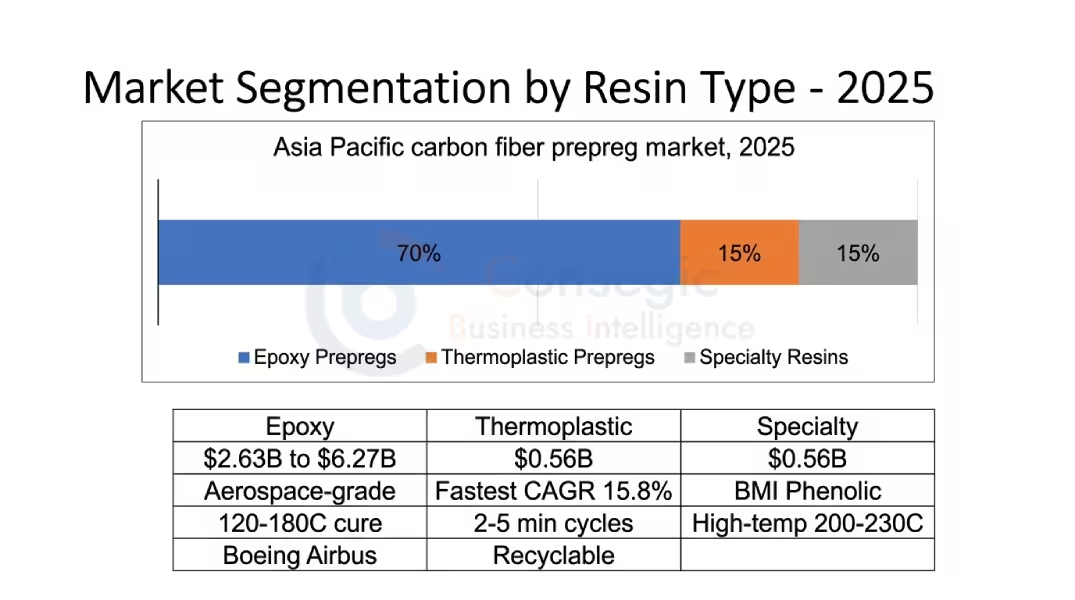
Prepregs of carbon fiber made of epoxy remain dominating the market with USD 2.63 Billion showing 70.0 percent of the total market value in 2025 and USD 6.27 Billion at 10.2 percent CAGR in 2034. These systems include epoxy resins that have curing temperatures of 120-180degC under standard aerospace applications and 177-232degC under high temperature applications, glass transition temperatures ranging between 180- 250degC, tensile strengths of 80-150 Mpa, and outstanding bonding with carbon fibers. It is used in commercial aerospace main structures such as fuselage sections, wing skins, and tail assemblies that need aerospace qualification to Boeing BMS 8-297 and Airbus AIMS, wind turbine blade spar caps and structural reinforcements and high-performance sporting goods such as bicycle frames and golf club shafts.
Variants of the product are toughened epoxy systems with thermoplastic interleaf layers to enhance damage tolerance by 40–60 percent and compression-after-impact strength by 30–50 percent, out-of-autoclave epoxies that cure under vacuum bag pressure alone rather than needing autoclaves, snap-cure formulations that fully cure in 30–90 minutes at temperatures of 120–150°C, and low-temperature cure systems that cure at 80–100°C, allowing the co-curing of temperature-sensitive core materials and substrates.
Fastest-Growing Segment: Thermoplastic Prepregs.
Thermoplastic carbon fiber prepregs USD 0.56 Billion equivalent to 15.0 percent of the market value with the highest growth rate of 15.8 percent CAGR because of the benefits of recyclability, ability to process quickly as well as the excellent toughness properties. These systems use polyetheretherketone (PEEK), polyetherketoneketone (PEKK), polyphenylene sulfide (PPS), and polyamide matrices, which have processing temperatures ranging between 300-400degC, indefinite shelf life and very high chemical resistance. Uses are aerospace and fittings that need high bearing strength, automobile structural components that need high bearing strength with advantages of high consolidation rates and hydrogen storage pressure vessels that need impact resistance and long life.
High-Performance Applications Specialty Resin Prepregs.
The USD 0.56 Billion represents 15.0 percent of market value made by phenolic, bismaleimide as well as cyanate ester prepreg systems. Phenolic prepregs offer outstanding fire, smoke, and toxicity of aircraft interior meeting FAR 25.853 requirements, bismaleimide systems offer high-temperature performance to 200-230degC of jet engine components and cyanate ester systems offer low dielectric constants of radome and satellite applications where RF transparency is needed.
Through Usage: End-Use Market Analysis.
Aerospace and Defense: Premium High Value High-End.
Aerospace and defense applications USD 1.69 Billion equivalent to 45.0 percent of the total market value in 2025 includes commercial aircraft primary and secondary structures, military fighter and transport aircraft, helicopters, unmanned aerial vehicles and space launch vehicles. Commercial aerospace is predominant with 25,000-35,000 metric tons of carbon fiber prepreg of Boeing 787, Airbus A350, and COMAC C919 programs consumed each year across global supply chains, of which 40-50 percent of composite structure is manufactured in Asia Pacific.
Fifth-generation fighter planes using 20-35 percent composite content, regional programmes such as the F-X of Japan, the KF-21 of Korea and the J-20 of China, and unmanned systems making use of all-composite airframes are all military applications. Applications Space applications include satellite systems that need dimensional stability, launch vehicles fairings and interstages, and reusable spacecraft systems that survive several thermal cycles.
Wind Energy: The Grower of Volumes.
Wind energy uses amount to USD 1.13 Billion equivalent to 30.0 percent market value with CAGR of 12.5 percent as the turbine size grows, which needs 75-115-meter-long blades to support 8-15 MW of the offshore systems. Carbon fiber prepreg spar caps offer primary structural support in blade roots and in the mid-span section to allow a 25-35 percent in weight reduction over all-glass designs and a 10-15 percent increase in length with differences in mass. The carbon fiber materials needed to meet the demand of 45,000-65,000 metric tons every year to produce wind capacity in Asia Pacific offshore of 250-350 GW.
Automotive and Transportation: New High-Growth Opportunity.
Automotive uses constitute USD 0.56 Billion that is equivalent to the 15.0 percent of market devoted and have the highest growth rate of 17.2 percent CAGR. One of the applications has been battery enclosures of electric vehicles that offer structural support but limit thermal bridging, body panels that save 40-50 percent weight, chassis components, and pressure vessels in hydrogen fuel cell vehicles. Premium manufacturers use carbon fiber content of 15-50 kg per vehicle with performance models using carbon fiber content of 100-200kg on body structures and chassis parts.
Sporting Goods and Industrial: Premium Segment.
Sporting goods and industrial use USD 0.38 Billion equivalent to 10.0 percent of market value, including bicycles of frame weights 800-1200 grams, golf club shafts with optimum weight, fishing rods, tennis rackets, robotics components of high stiffness and low inertia, medical imaging equipment, and semiconductor manufacturing equipment with dimensional stability.
Regional Market Analysis
China: Leadership in the Market and the Powerhouse in Manufacturing.
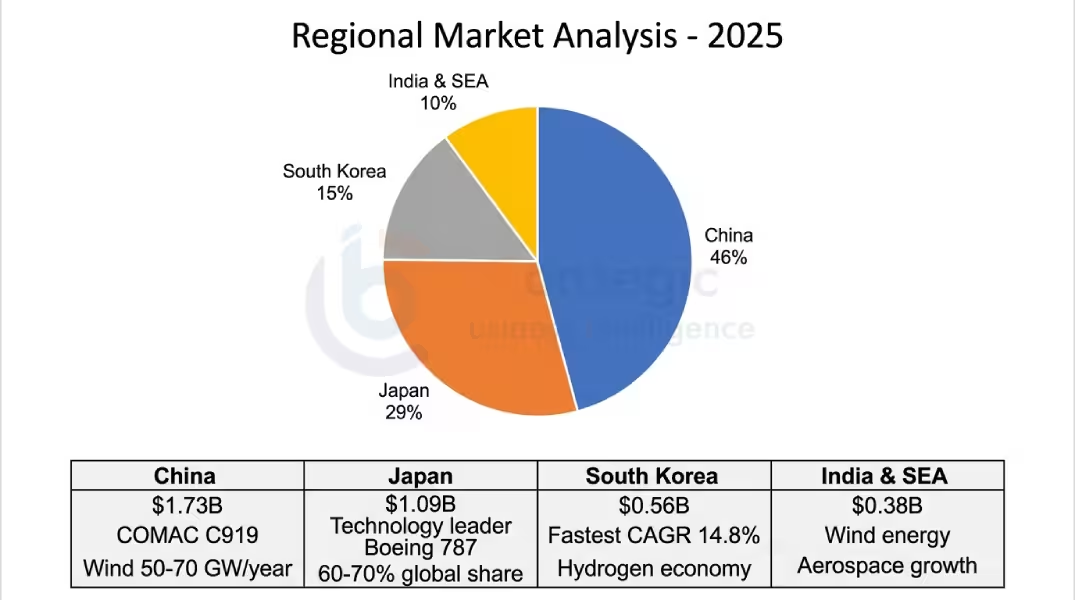
China depicts USD 1.73 Billion equivalent of total Asia Pacific market value of 46.0 percent in 2025 and 10.2 percent CAGR projected to USD 4.12 Billion in 2034. Market dominance can be demonstrated by the domestic production capacity of carbon fiber at 35,000-45,000 metric tons/year in 2024 and 80,000-120,000 metric tons/year in 2030, government incentives under Made in China 2025 and carbon neutrality programs as well as colossal domestic demand by wind energy, aerospace and automotive industries.
COMAC C919 program is aerospace based with the production rate of 150-200 airplanes per year in the year 2028-2030 with 12-15 percent of composite materials making 2 500-3500 kg per aircraft. Wind energy industry is the largest installations in the world with an average of 50-70 GW of annual capacity additions that consume 8000-12000-metric tonnes of carbon fiber materials to manufacture blades. Chinese giants like Weihai Guangwei Composites have a prepreg manufacturing capacity of between 8,000-12,000 metric tons/year, Jiangsu Hengshen 6,000-9,000 metric tons/year and Zhongfu Shenying Carbon Fiber 5,000-8,000 metric tons/year.
Japan: AI and Aerospace Leadership.
Japan is USD 1.09 Billion of equivalent market maturity, technology, and concentration of key material suppliers; Toray Industries, Teijin Limited, and Mitsubishi Chemical of 29.0 percent of the market value of the Asian Pacific market. Japanese companies lead the world in aerospace grade carbon fiber, prepregs system, and have 60-70 percent worldwide market share of commercial aerospace material and broad patent base in fiber manufacture, resin formulation as well as processing technology.
Boeing 787 supply chain Boeing 787 anchor Japanese aerospace composites industry with key suppliers supplying 35% airframe structures such as wing boxes, center fuselage sections and wing-to-body fairings. An annual prepreg carbon fiber consumption of 8,000-12,000 metric tons is needed to support domestic prepreg production capacity of 15,000-20,000 metric tons and vast infrastructure of composite manufacturing.
South Korea: New Production Powerhouse and Hydrogen Hero.
South Korea has USD 0.56 Billion equivalent to 15.0 percent of market value and the highest rate of regional growth of 14.8 percent CAGR, which is attributed to aerospace industry development, hydrogen economy projects, and automotive sector innovation. KF-21 Boramae fighter program aims at producing 120-180 airplanes by 2032 using 20-25 percent composite materials and developing local supply chain capacity.
Development of hydrogen fuel cell vehicles causes global commercialization as Hyundai Motor Group manufactures NEXO fuel cell SUV, and it is now moving into commercial vehicles use. The 15-25 kg of carbon fiber needed to manufacture a passenger vehicle type IV pressure vessels would demand a production level of 50,000-100,000 fuel cell vehicles per year will create a demand of 750-2,500 metric tons of carbon fiber material.
India and Southeast Asia: New Growth Markets.
India and southeast Asia are USD 0.38 Billion equivalent to 10.0 percent of market value which is characterized by wind energy installation, aerospace manufacturing growth, and development of the automotive sector. The aerospace sector in India involves both Boeing and Airbus supply chain involvement, Indian programs such as the Light Combat Aircraft Tejas and space programs through the Indian Space Research Organization.
The material demand in wind energy sector has been impetus as India aims to reach 140 GW offshore wind power by 2030 and in Southeast Asian countries with offshore wind power potentially reaching 25-40 GW of combined capacity needs 8,000-15,000 metric tons of carbon fiber materials per year. Automotive industry is looking at the adoption of electric vehicles where India is aiming to have 30 percent of the vehicles in the country being electric and the Southeast Asian countries are working towards the establishment of local production capacities.
Recent Industry Developments
Capacity Expansion and Manufacturing Investment (2024-2025)
In response to increased demand in aerospace, wind energy and automotive applications, major manufacturers of carbon fiber and prepreg announced significant capacity expansion plans in Asia Pacific in 2024-2025, valued at USD 2.5-3.5 billion. Toray industries invested USD 800 Million-1.0 Billion in increasing carbon fiber production 3,000-5,000 metric tons/year and prepreg manufacturing 5,000-8,000 metric tons, to be used in aerospace and industrial with completion by 2026-2027.
Chinese producers such as Weihai Guangwei Composites invested USD 400-600 Million in adding capacity of carbon fiber of 8,000-12,000 metric tons, prepreg capacity of 10,000-15,000 metric tons, with the aid of government subsidies and domestic market demand of transfers of the Weihai C919 program and wind energy market. Jiangsu Hengshen declared USD 300-450 Million investment setting aerospace quality prepreg production lines to Boeing and Airbus standards.
Development of Automotive Industry Partnerships and Technology (2024-2025).
The major auto makers formed strategic alliances with the suppliers of carbon fiber prepreg who were working on cost effective materials and production process that could be used to produce in high volume. BMW Group increased co-operation with SGL Carbon on thermoplastic prepreg to make batteries, body structure of an electric vehicle, where component costs of less than USD 50 per kilogram and cycle times of less than 5 minutes are aimed at through compression molding processes.
Chinese electric cars manufacturers such as NIO, Xpeng and Li Auto collaborated with local prepreg producers who are producing carbon fiber composite body parts, structural battery enclosures, and chassis parts. Such programs are aimed at material costs of USD 35-55/kg high-pressure resin transfer molding and compression molding processes with a target of 10,000 to 50,000 components per year.
The Development of Sustainability Initiatives and Recycling Technology (2024-2025).
Players in the industry initiated holistic sustainability initiatives on recycling of end-of-life composite, development of bio-resin, and optimization of the manufacturing process. Toray industries launched both carbon fiber and prepreg production carbon neutrality goals through the year 2050, and two intermediate goals of 30 percent carbon fiber and prepreg manufacturing emissions reduction by 2030 by adopting renewable energy sources, increasing process efficiency, and recovering solvents.
Mitsubishi Chemical came up with bio-based epoxy resin systems based on 30-50 percent of renewable content based on plant-based materials such as lignin and vegetable oils with aerospace qualification of 2026-2027 target and with a 20-35 percent carbon footprint reduction over petroleum-based epoxies. The Chinese manufacturers used closed-loop manufacturing methods that recovered solvents with 95-98 percent efficiency and recycling the prepreg production waste into low grade industrial use.
Competitive Landscape and Key Market Players
Strategic Positioning and Market Leadership
Toray Industries: World Market Leader.
Toray Industries is a dominant player in the world market with an estimated Asia Pacific revenues of USD 560-620 Million which is about 16-18 percent regional market share of technology leadership in carbon fiber manufacturing, extensive prepreg product line and long term contracts with Boeing, Airbus and other major aerospace OEMs. Some of the proprietary carbon fiber manufacturing technologies with tensile strengths of 6,500-7,000 Mpa in aerospace grade materials, large portfolio of patents covering fiber production as well as prepreg formulation and vertical integration of precursor production all the way up to composite component manufacturing are all competitive advantages.
Teijin Limited: Innovation and Diversification Leader.
Teijin limited has good Asia Pacific market presence with the estimated revenues of USD 420-480 Million of 12-14 percent market share with focus on thermoplastic prepreg technology, automotive uses, sustainable material development. Some of its competitive advantages are proprietary carbon fiber production using pitch feedstock with cost benefit, a leadership in thermoplastic composite using PEEK and PPS matrix systems, and mass production technology development with the automotive industry.
Mitsubishi Chemical: Materials Solutions Providers.
Mitsubishi Chemical possesses a substantial market share with estimated market share of 10-12 percent in the Asia Pacific with USD 340-400 Million revenue, through vertical integration in the manufacturing of carbon fiber prepreg making and composite component making. Strategic positioning concentrates on aerospace applications by involving itself in Boeing 787 supply chain, high-temperature prepreg systems development and bio-based resins formulations.
Other Major Market Competitors:
- Weihai Guangwei Composites - The largest Chinese manufacturer with projected revenues USD 300-360 Million.
- Jiangsu Hengshen - Chinese supplier of aerospace materials having approximate revenues of USD 200-260 Million.
- Zhongfu Shenying Carbon Fiber - Chinese manufacturer that is integrated and has estimated revenues between USD 180-240 Million.
- Hexcel Corporation - International Materials aerospace industry with USD 260-320 Million estimated revenues in Asia Pacific.
- Solvay - European materials specialist that has estimated revenues of USD 220-280 Million in Asia Pacific.
55 Market Report Insights
| Report Attributes | Report Details |
|---|---|
| Study Timeline | 2022–2034 |
| Base Year | 2025 |
| Forecast Period | 2026–2034 |
| Market Size in 2025 | USD 3.75 Billion |
| Market Size in 2034 | USD 8.95 Billion |
| CAGR (2026–2034) | 10.2% |
| By Resin Type | Epoxy Prepregs (70.0%), Thermoplastic Prepregs (15.0%), Specialty Resins (15.0%) |
| By Application | Aerospace & Defense (45.0%), Wind Energy (30.0%), Automotive & Transportation (15.0%), Sporting Goods & Industrial (10.0%) |
| By Manufacturing Process | Hot-Melt Impregnation (70.0%), Solvent Impregnation (30.0%) |
| By Region | China (46.0%), Japan (29.0%), South Korea (15.0%), India & Southeast Asia (10.0%) |
| Key Players | Toray Industries, Teijin Limited, Mitsubishi Chemical, Weihai Guangwei Composites, Jiangsu Hengshen, Zhongfu Shenying, Hexcel Corporation, Solvay |
| Report Coverage |
|
Key Questions Answered in the Report
What is the present size of the Asia Pacific market of carbon fiber prepreg and how rapidly growing? −
Asia Pacific carbon fiber prepreg market is estimated to reach USD 3.75 Billion in 2025 and is estimated to reach USD 8.95 Billion by 2034 with a CAGR of 10.2 within a forecast period of 2026-2034. Such expansion is centered on explosive growth in wind energy, with China potentially having over 75-85 GW deployed in the forthcoming years with a target of 1,200-1,500 GW of total capacity in 2030, the commercial aerospace, which has 18,000-22,000 aircraft deliveries per year over the next 20 years representing 42-45% of the world, electric vehicles that could be producing up to 18-25 million units of vehicles per year by 2030.
What segment shows the best growth in Asia Pacific carbon fiber prepreg market? +
The common market reaction to thermoplastic prepregs has shown the most promising growth rate of 15.8% CAGR, which is largely supported by the benefits of recyclability to meet environmental conservation policies, high processing rate with consolidation cycle of 2-5 minutes (unlike 2-4 hours cycle by thermoset prepregs), infinite shelf life that has removed cold storage needs, and high impact strength that provides crashworthiness application. Automobile and transportation have the highest growth of 17.2% CAGR due to adoption of electric vehicles necessitating 150-250 kg weight savings, hydrogen fuel cell vehicle pressure vessels necessitating 15-25 kg of carbon fiber per passenger vehicle, and high-end manufacturers integrating 15-50 kg content of carbon fiber per vehicle.
What are the main benefits of carbon fiber prepregs over other materials? +
Carbon fiber prepregs offer high specific strength of 2,000-3,500 MPacm3/g that is 400-500 times stronger than aluminum and 800-1,000 times stronger than steel, specific modulus of 140-400 GPa-cm3/g with higher stiffness-to-weight ratios and weight savings of 20-50 percent in aerospace structures, 30- 40 percent in automobile parts and 15- 25 percent in wind Other benefits are that it resists fatigue up to 10 million cycles at 60-70% ultimate strength, dimensional stability with thermal expansion coefficients of -0.5 to 1.0 x 10⁻⁶/degC, corrosion resistance, which avoids the use of protective coatings and design flexibility, allowing complex geometries and functional integration.
What are the main obstacles and financial factors that impact market adoption? +
The major challenge is the material costs in USD 35-120 per kilogram as the premiums of 800-2,000 percent compared with the glass fiber composites in comparison with steel and 2,000-6000 percent compared with aluminum. The capital intensity of carbon fiber plants with annual output of 5,000-10,000 metric tons and prepreg plants with annual output of 2,000-4,000 metric tons requires USD 250-500million and USD 30-60million respectively. Processing complexity would require USD 1-5 million of autoclave equipment, controlled and controlled environments of 18-24degC and 40-60 percent humidity, knowledgeable technicians, and storage conditions of -18degC to -25degC and shelf life in 6-12 months with out time of 5-30 days upon exiting cold storage.
Who are the competitors in the carbon fiber prepreg market in Asia Pacific? +
Examples of market leaders in the region with 16-18% market share with technological leadership on proprietary carbon fiber to 6,500-7,000 Mpa tensile strength and long-term aerospace supply contracts include Toray Industries and Teijin Limited with 12-14% market share with focus on thermoplastic prepregs and automotive uses, Mitsubishi Chemical with 10-12% market share with vertical integration focus and Boeing 787 supply chain involvement. Chinese firms such as Weihai Guangwei Composites, Jiangsu Hengshen, and Zhongfu Shenying are highly increasing capacity and capabilities with the government subsidies and domestic market protection support and international competitors Hexcel Corporation and Solvay are holding their own with technological innovation.
Overview
Reputation & Certifications


Our Services
- Market Intelligence & Forecasting
- Custom Research Solutions
- Market Entry Strategy
- Competitive Intelligence
- Customer Insights
- Industry Innovation Analysis
- Investment Advisory