Jump to Content
Asia Pacific Decaf Coffee Market - Size, Share, Industry Trends, and Forecasts (2025-2034)
Market Scope & Overview
Asia Pacific decaf coffee market is a niche and high growing market in the regional coffee industry, which involves the decaffeinated coffee products that are extracted in different ways such as Swiss Water Process, supercritical CO2 extraction and the use of solvents to extract at least 97 percent of caffeine content without altering taste attributes. The varied market targeted by this product is health conscious people who need caffeine in moderation, pregnant women and those advised against caffeine by their physicians, people with sensitivity to caffeine, aging populations who need to control the quality of their sleep and coffee lovers who want to have evening coffee consumption without affecting their sleep.
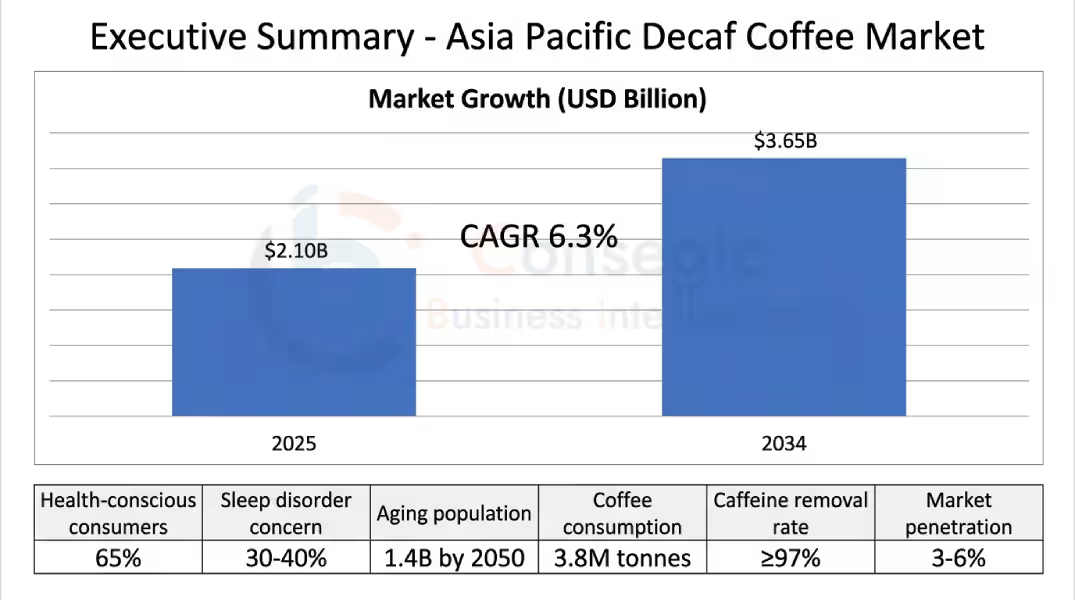
It showed a significant growth rate in the market with the valuation of USD 1.85 billion in 2024 and is predicted to grow to USD 2.10 billion in 2025 as the current research year to carry out a thorough analysis. The market forecasts are that the market will experience a strong growth to USD 3.65 billion by 2034 with a compound annual growth rate of 6.3 percent over the 2026-2034 period. This upward trend of growth is due to the growing health awareness of the Asian consumer with 65 percent reported to be concerned about excessive caffeine intake, urbanization that is fast and leads to sleep deprived populations seeking wellness beverages, penetrating the coffee culture in traditionally tea dominated markets, aging populations that demand moderation of caffeine and rising trends of premiumization dictating specialty coffee drinking including quality decaffeinated coffee.
Key Market Insights
- Market expected to expand from USD 1.85 billion (2024) to USD 3.65 billion by 2034 (CAGR 6.3%)
- Asia Pacific decaf coffee market is growing strongly, driven by health-conscious and caffeine-sensitive consumers
- Japan leads the market, while China is the fastest-growing
- Premium demand rising in Australia & New Zealand, while India & Southeast Asia are emerging markets
- Growth driven by urbanization, rising coffee adoption, e-commerce, and increasing focus on health and wellness
Processing Innovation and Technological Evolution.
Modern decaffeination technology has come a long way out of the old chemical-heavy decaffeination methods, towards what is now known as clean label decaffeination which maintains the sensory profiles that are very important in identifying the Asian palates. The Swiss Water Process, which applies the water filtration and activated carbon filters, has 99.9 percent caffeine removal but retains volatile flavor compounds and can fetch a high wholesale price USD 8-12 per kilogram, as compared to the traditional methods USD 5-7 per kilogram. Supercritical CO2 extraction uses selective caffeine extraction with a high level of accuracy of temperature and pressure that reduce flavor effects and environmental benefits through the ability to recycle solvents. These innovated products tackle the issue of chemical residues as consumers express concern towards, and provide similar taste experiences as the caffeinated products.
The Asia Pacific coffee market that is worth USD 32 billion every year with consumption volumes of more than 3.8 million metric tons is facing transformative forces such as urbanization where 58 percent of the populations of the regions live in cities with the highest rate of coffee consumption, increase in disposable incomes at an average of 6.2 percent/year across developing economies, change in generational preferences with millennials moving towards coffee culture and changing health consciousness which demand the use of some functional drink that can address particular wellness goals. These forces of the market present the decaf producers with a big opportunity to produce products that match the health concerns of consumers without compromising the quality of the product to be of the same standard as the ordinary coffee.
Executive Summary
Asia Pacific decaf coffee market is undergoing a paradigm shift of niche health product to mainstream lifestyle choice that is being precipitated by wellness consciousness brought about by urbanization and demographic changes being experienced in the region. Early stage development as indicated by USD 2.10 billion market valuation in 2025 compared to mature western markets where decaf is 10-15 percent of total coffee 3-6 percent penetration in most countries in the Asia Pacific region. Due to the projected growth of USD 3.65 billion by 2034, it has a large potential of expanding as more consumers become aware of the product, the quality of the product is enhanced by the use of more advanced processing technologies and the distribution channels are expanded by modernization of retail and e-commerce development.
The strength of the market expansion is supported by the persuasive demographic pressures such as the rapidly aging population where projected numbers of 1.4 billion aged 60 years and above (across the Asia Pacific) will form consumer groups that are highly sensitive to reduced-caffeine drinks due to health factors and drug interactions. The growth of urban middle classes, which have a population of estimated 3.5 billion people by the year 2030, is a huge source of addressable markets because consumption of coffee is closely linked to urbanization and the level of income. The boom of the sleep economy, which deals with sleep disorders of 30-40 percent of urban residents in large metropolitan areas, causes the consistent demand of evening coffee substitutes that allow social rites without disturbing sleep.
At the same time, market issues such as the continued existence of taste perception barriers, with 48 percent of consumers in all markets thinking that decaf has worse flavor than regular coffee despite technological advancement, high-end positioning pricing 20-35 percent over regular coffee, the limited distribution where decaf products can only be found in 30-50 percent of retail coffee stores in most regional markets, and a lack of consumer education where significant investments are required in the form of building awareness. These drivers are moderating near term growth prospects, and outlining the market development possibilities using the quality innovation, pricing policies, expansion of distribution, and total consumer education programs.
Key Market Driver
Urbanization and Sleep Quality Management Health Conscious.
The prevailing market force revolves around the rapid promotion of health awareness among the Asian Pacific urban inhabitants paired with the rising consciousness on the effects of caffeine on the quality of sleep, anxiety, and cardiovascular conditions. Extensive consumer studies reveal that 65 percent of local urban buyers are seriously considering healthier food and beverage products and 52 percent of those are particularly worried about the impact of consuming too much caffeine on sleeping habits, stress levels as well as general well-being. This health awareness is especially high in the group of educated urban professionals, where 78 percent report making changes to dietary practices in response to health-related factors, owing to which already highly receptive target demographics exist which can be easily engaged by decaf coffee as a wellness-enabling solution.
The phenomenon of the so-called sleep economy is one of the key driving forces of the growth, since the issue of sleep deprivation is widespread in such large financial centers of the world as Tokyo, Seoul, Shanghai, Mumbai, and Singapore due to the decline in work-life balance. According to the information given by regional sleep medicine associations, sleep disorders are found to be present in about 30-40 percent of adult populations in urban centers, and the timing of caffeine intake is proven to be a major cause. As a result, consumers are even more interested in dietary changes that would allow them to enjoy coffee in the afternoon and evening hours without disrupting the circadian rhythm and making decaf a significant solution to the preservation of the culture of coffee and sleep hygiene.
Health-consciousness influences are enhanced by the dynamics of aging population in developed economies in Asia due to demographic factors. Since Japan has a large number of citizens within the 65-year and above age group (29.1 percent), the country offers a large base market to decaf products as a result of age-related caffeine sensitization and medical advice on the management of hypertension and heart diseases. Likewise, the aging population and a high culture of work in South Korea leads to a twofold demand of older consumers who need to reduce caffeine intake and younger professionals who need to manage stress and anxiety rates and at the same time pursue the coffee shop lifestyle.
Systematic institutional demand in healthcare systems is motivated by medical advice that sets a limit on the consumption of caffeine. The 30 million and the 90 million Asian Pacific expectant mothers who are currently pregnant each year face pregnancy-related caffeine limitations to develop certain market segments and cardiovascular health beliefs influence the estimated 280 million regional adults who have high blood pressure and receive medical guidance to limit caffeine consumption. These are the demand bases that are medical in nature and offer stable grounds in the market that support growth in a long-run given the spread of healthcare awareness and the focus of clinical guidelines on preventive wellness strategies.
Key Market Restraint
Taste Perception and Premium Pricing Issues in Price-Sensitive Markets.
The first market limitation is the high price premiums needed in the decaffeination processing as well as issues of consistent consumer attitude toward quality of flavors especially in price sensitive developing economies throughout the region. The retail price of decaffeinated coffee is usually 20-35 percent above the corresponding regular coffee products which is due to higher expense of processing the coffee, the special facilities needed, and loss of yield in the process of decaffeination and the relatively low quantity of coffee produced that restrains the economies of scale. These price premiums ensure that the accessibility levels in the developing Asia Pacific markets such as India, Indonesia, Vietnam, Philippines, and portions of China where the average household income levels are USD 400-800 monthly make premium-priced decaf a rare treat and not a regular consumption item among households.
The consumer taste perceptions also pose other adoption barriers with extensive research pointing out that 48 percent of the Asia Pacific coffee drinkers think decaffeinated coffee has poor taste in comparison to regular coffee with decaf being flat, no body or lacking typical coffee flavors. These views can be traced partly to historical experience of low quality decaf products as early processing techniques eliminated flavor compounds with caffeine as well as caffeine leaving negative associations that persist even though technological advances in modern Swiss Water and CO2 extraction techniques have enhanced product quality. Psychological aspects have a great impact on tastes perceptions, and when consumers are told they are drinking decaf, they always rate the same products 12-18 percent lower in terms of satisfaction than those who think they are drinking normal coffee do.
The cost pressures and the inaccessibility of markets are enhanced by supply chain complexities that are unique to the Asia Pacific markets. Although Vietnam and Indonesia are considered as one of the largest coffee producers in the world, there are only a limited number of domestic plants that can process high-quality decaffeination in comparison to those that are located in Europe and North America. This infrastructure issue creates the need to export green beans to be decaffeinated and re-import finished products, putting additional transport expenses on the company and subjecting the company to currency exchange risk and carbon footprint issues as well as prolonging the supply chain to the risk of disruption. Small domestic processing facilities limit the market flexibility and price floors that do not allow mass penetration of the market in the developing economies.
Market development is further limited by distribution restrictions whereby decaf products are only stocked in 30-50 percent of retail coffee stores in most of the Asia Pacific markets against 85-95 percent availability in the mature market such as Australia and Japan. The minimal shelf space assignment accommodates retailer judgment of low turnover and niche positioning, which perpetuate cycles of self-imposed limitation, that is, inadequate availability restricts development of demand, but lack of significant distribution investment discourages increased distribution investment. The distribution gap has a specific impact on the opportunities to try and repeat purchase conversion, which is critical to the category development in the emerging market.
Key Market Opportunity
E-Commerce Growth and Premium specialty segment.
The biggest growth prospect will be through the accelerated use of e-commerce in the Asia Pacific markets that allow direct-to-consumer types of business models, bypassing conventional business barriers of retail distribution channels and creating loyal customer community around the positioning of decaf premiums. The magnitude of regional e-commerce sales is USD 3.2 trillion in 2024, and this increase is 16.8 percent/year in the background, and food and beverage classes showed a significant online penetration rate of 14-20 percent. The online channels will offer game changer benefits on the development of the decaf market by removing the physical shelf space limitations that reduce the available retail space, full product information delivery on the benefits of the decaf coffee that cater to the perception of tastes as well as the education of the health needs, customer review systems that build the trust and social proof, and subscription programs that generate recurring revenues that help in customer loyalty and optimization of lifetime values.
Premium positioning is a similar opportunity, which changes the decaf as medical necessity or compromise product and positions it as a lifestyle choice among polished, healthy goods consumers. The growth of the third-wave coffee culture in Australia, Japan, South Korea, Singapore, and large cities of China provides receptive markets to specialty decaf with a focus on single-origin sourcing, the transparency of its processing methods, and craftsmanship that is equal to the quality of high-caffeine products. Decaf micro lots, seasonal and limited-edition offerings processed in Swiss water or CO2 processes are offered at higher prices of USD 12-18 per 250 grams package, are increasingly being offered by specialty roasters, which create brand distinction and customer interest.
Subscriptions business models have shown a tremendous potential in the e-commerce system, whereby coffee subscription plans are rising at 28 percent per year in the Asia Pacific market and are projected to reach an approximate of 3.2 million active subscribers by the year 2024. These models offer predictable recurrent revenue, greater customer lifetime worth averaging 4.2-5.5 times one transaction worth, and possibilities of customized product curation that meets or caters to each taste inclination and consumption behavior. The retention rates of the customers served by decaf-oriented subscription based services are reported to be 71-78 percent after 12 months versus the conventional coffee subscription retention rates of 54-62 percent, which means that the consumers successfully converted to the use of quality decaf products are more satisfied.
The digital marketing potential allows focusing on a segment of health-conscious consumers more accurately due to social media platforms with 3.1 billion users in Asia Pacific, content marketing informing consumers about the benefits and quality properties of decaf and its advantages, influencer relationships with the help of trusted voices in the wellness circles, and personalization of customer acquisition strategies based on data. Cross-border e-commerce enables the premium international decaf brand access to the markets in the Asian Pacific without the need of local distribution infrastructure, and regional specialty roasters gain access to markets outside of domestic markets to serve the diaspora markets and adventurous consumers interested in unique products.
Market Segmentation Analysis
By Product Type: Format and Processing Analysis
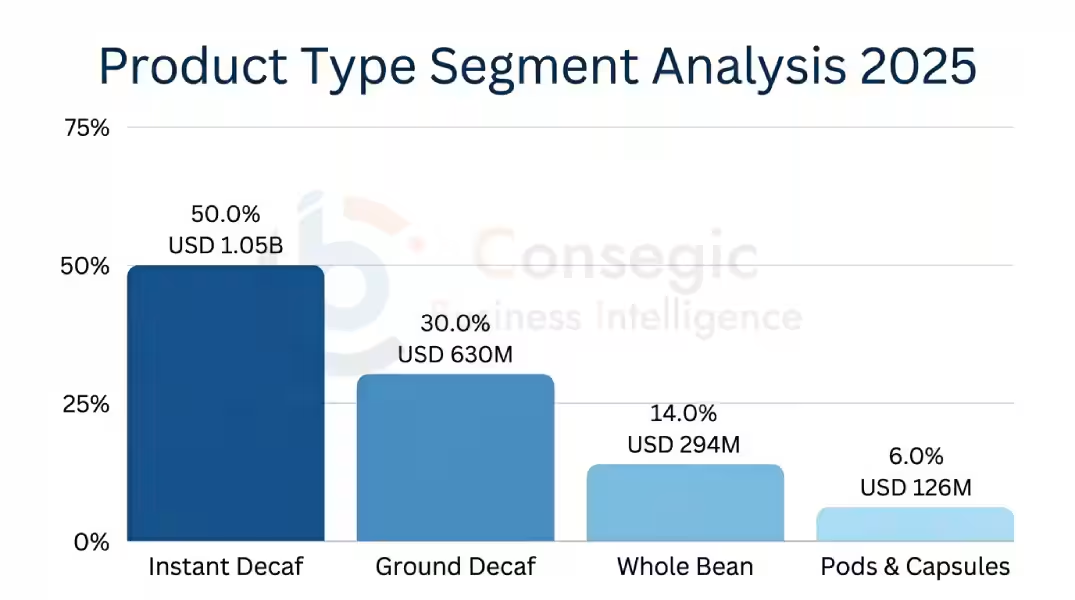
Instant Decaf Coffee: Position of market leadership at USD 1.05 billion that would represent 50.0 percent of the market value in 2025 and is expected to grow to USD 1.83 billion in 2034. This strong market is indicative of the consumption trends in Asia Pacific coffee where instant coffee comprises 60-70 percent of the total coffee consumption in the market such as India, China, Thailand, Indonesia and Philippines due to preference of convenience, cost reasons, and developed consumption behavior. Instant decaf products use spray-drying or freeze-drying process of decaffeinated coffee extracts, which provide the convenience of fast preparation with a 30-60 seconds dissolution time. The mainstream price positioning is USD 0.20- 0.40 and the premium is USD 0.45-0.70.
Ground Decaf Coffee: USD 630 million that implies 30.0 percent of the market value, serving home brewer coffee lovers who use drip coffee makers, French presses, pour-over, and espresso machines that are gaining more and more popularity among the representatives of urban middle classes. This segment shows the highest growth rate of 7.2 percent CAGR due to the new culture of specialty coffee, the use of home brewing equipment which is rising by 14.2 percent per annum and the tendency of premiumization where the consumers are willing to get the same kind of cafe experience at home. Ground decaf focuses on freshness by using nitrogen-flushed packaging, transparency of the origin, and differentiating the processing method.
Whole Bean Decaf Coffee: USD 294 million which is 14.0 percent of market value serve coffee lovers who focus on freshness by home grinding just before brewing. This high-end market targets specialty coffee lovers, and the coffee of whole bean decaf constitutes 28-38 percent of retail sales in specialty coffee shops. The focus of products lies in the transparency of roast date, storytelling on origin, and certification of processing methods such as organic and Fair Trade labels.
Single-Serve Pods and Capsules: USD 126 million which will reflect 6.0 percent of the market value that is growing at a rapid rate of 8.5 percent CAGR due to the adoption of single-serve coffee systems at 22 million households in Asia Pacific in 2024. Other compatible systems are Nespresso, Keurig K-Cup and local proprietary systems which provide the convenience of pre-portion servings and uniform extraction.
Through Distribution Channel: Market Access Analysis.
Supermarkets and Hypermarkets: The leading distribution channel with USD 945 million market value equivalent to 45.0 percent, which offers access to the mass market via large retail outlets which is over 95,000 modern trade outlets across Asia Pacific. Large retail outlets such as AEON, Lotte Mart, FairPrice, and Big Bazaar are allocating more shelf space to the decaf coffee segment and the promotion efforts are through sampling programs that have led to trial and creation of awareness.
Online Retail and E-Commerce: USD 525 million making 25.0 percent of market value, which exhibit the greatest growth rate of 9.8 percent CAGR as digital commerce changes the buying habits. Such platforms as Tmall, JD.com, Lazada, Shopee, and more specialized coffee e-tailers offer a wide range of choices, more information, feedback, and convenient delivery. Online subsegment that is experiencing quickest growth is the subscription services.
Coffee Shops and Cafes: USD 420 million with 20.0 percent of market value, which offers instant consumption and retail sales with the help of high positioning. The leading chains with 12,000+ Asia Pacific locations, local specialty chains, and independent cafes offer the vital trial opportunities and benchmarking of quality.
Convenience Stores: USD 147 million (7.0 percent of market value), that provides immediate access to high traffic places. Ready-to-drink decaf drinks and instant drinks are becoming increasingly available in chains such as 7-Eleven, FamilyMart and Lawson.
Specialty Retailers: USD 63 million which forms 3.0 percent of market value, which includes specialty coffee retailers, health food stores and direct brand sales to discerning consumers, as effective advisors and offerings of high quality.
Through Processing Method: Technology and Quality Positioning.
Swiss Water Process Decaf: High end market at USD 546 million or 26.0 percent of market value with chemical-free water and activated carbon filtration reaching 99.9 percent caffeine removal without loss of flavor complexity. Arrests health conscious and organic fans with premiums 35-50 percent higher than regular processing.
CO₂ Process Decaf: USD 525 million or 25.0 percent of market value and supercritical carbon dioxide extraction under controlled conditions. It has high preservation and sustainability benefits of CO2 recycling, and its use is found in high-end retail and specialty cafe services.
Solvent-Based Process Decaf: USD 1.03 billion of a market value of 49.0 percent, with an ethyl acetate or methylene chloride solvent at a cost-effective caffeine extract. It was used in applications in mainstream instant coffee and value-oriented divisions where a naturally decaffeinated claim could be made using ethyl acetate.
Regional Market Analysis
Japan: Mature Market Leadership and Premium Focus.
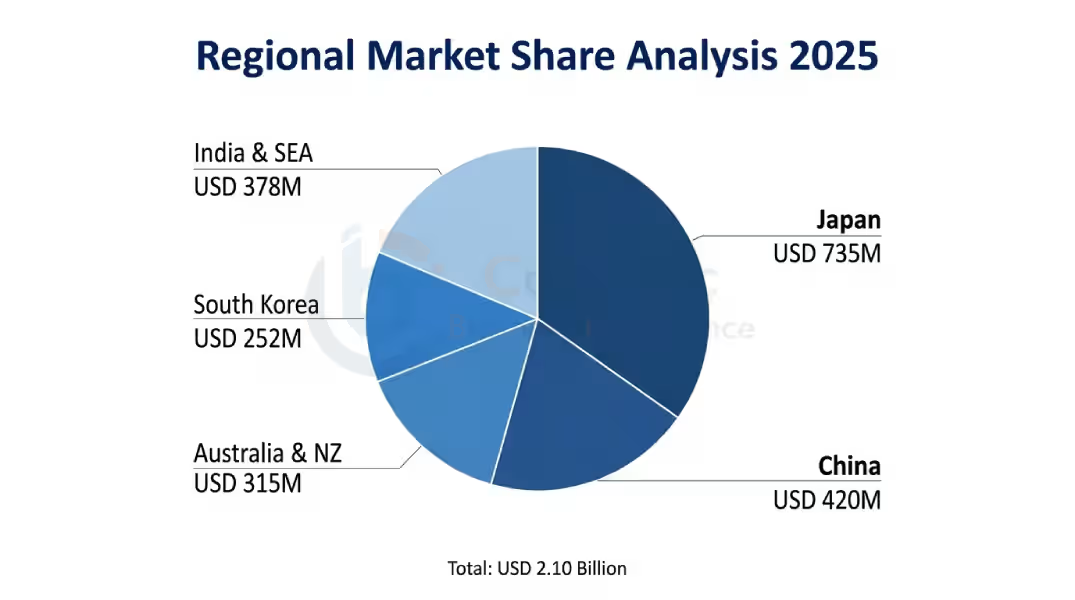
Japan has a market leadership of USD 735 million of 35.0 percent of the market value in 2025, which is estimated to rise to USD 1.20 billion in 2034. The Japanese market is characterized by outstanding features such as advanced coffee culture, per capita consumption of 3.6 kilograms of coffee per year, aging population with 29.1 percent of total population of 65 years and above developing consistent demand of caffeine-cut down drinks, and extensive retailing infrastructure with 90-95 percent of coffee retail outlets offering decaf drinks. Health awareness is at an extremely high level with 74 percent of the consumers highly controlling their caffeine levels to maximize their sleep and cardiovascular health.
The largest RTD coffee industry in the world proves that the proliferation of decaf has spread widely in convenience store chains such as 7-Eleven, Familymart and Lawson with a total of 58000 stores in operation. Premium positioning works effectively among those consumers who are ready to pay JPY 900-1,400 per 200-gram pack of quality decaf coffee against JPY 650-1,000 in a regular coffee pack, and quality is prioritized over the price of the product. The focus on technological innovation comprises decaffeination processes that are proprietary and do not affect aroma properties which are vital in achieving the acceptance of Japanese consumers.
China: E-Commerce Leadership and High-Growth Engine.
China exhibits USD 420 million at 20.0 percent of market value in 2025, which is estimated to hit USD 876 million in 2034, depicting 8.4 percent CAGR as fastest-growing large market. The growth in coffee consumption is remarkable due to the culture that is traditionally dominated by tea and the consumption level of coffee per capita has grown by 0.03 kilograms in 2010 to 0.15 kilograms in 2024, which means incredible growth along the runway. Urban middle-income growth with 600 million people forms new large stable market that is combined in the hands of educated professionals (25-40 years old) that are receptive to the western trends in wellness.
E-commerce leverage of 58 percent coffee sales being made online offers advantageous channel structure to develop decaf market by allowing brands to bypass the old retail barriers as it educates the consumer with all the available product information. Large competitors such as Luckin Coffee with 18,000 outlets and Starbucks China with 7,200 stores are increasingly providing decaf products, which gives them a great opportunity to build awareness. Health consciousness has been shown to evolve fast with government wellness programs such as Healthy China 2030 that develops enabling policy conditions.
Australia and New Zealand: Specialty and Premium Quality.
Australia and New Zealand are USD 315 million that comprises 15.0 percent market value, which is forecasted to achieve USD 511 million by 2034. Such mature markets are showing the highest regional penetration rates of decaf at 9-13 percent of coffee consumption, representing the long held specialty coffee culture, high consumer palates with a preference to distinctions in quality and broad retail representativeness. Premium decaf positioning will have receptive audiences because strong health consciousness with 79 percent of Australians seeking healthier lifestyles provide them.
The culture of specialty coffee would contribute to the further development of such high-end premiumization as single-origin decaf, estate-focused offerings, and the differentiation of the processing methods that occupy large market shares. Swiss Water or CO₂ processed choices are available more often in the independent roasters and customers are ready to pay AUD 20-32 per kilogram to have high quality decaf beans. The market also leads in sustainability certifications and direct-trade with farming communities of coffee farmers.
South Korea: Cafe Culture and Youth who are Health conscious.
South Korea covers USD 252 million translating into 12.0 percent of market value which is expected to grow to USD 401 million by 2034. The market is characterized by cafe culture and a very high density of coffee shops in the country especially in Seoul and Busan metropolitan areas which are ranked as some of the highest across the world. The demographics with the higher level of stress and a younger age tend to experiment with decaf to consume in the evening still being able to enjoy the social experience in coffee shops.
Large chains portray extensive decaf selections, and customers are ready to pay high prices to have high-quality products. Sleep hygiene and stress management health awareness initiatives help institutionalize decaf among working employees and university students.
India and Southeast Asia: Up-and-Coming Markets that are price sensitive.
Put together, India and Southeast Asia are USD 378 million, which comprises 18.0 percent of market value that consists of various stages of development and consumer preferences. India has a leading position as the coffee culture in the major cities such as Bangalore, Mumbai, Delhi and Chennai is expanding but the price factor restricts the premium positioning to the rich segment of the urban population. Its instant coffee dominance with 80 percent of the consumption gives it format established to introduce decaf.
The markets in Southeast Asia such as Indonesia, Vietnam, Thailand, Malaysia and Philippines display different characteristics compared to the mature markets of Singapore and have emergent prospects that need massive consumer education. The positive prospects of economic growth and urbanization contribute to good long-term perspectives and e-commerce offers essential market access of premium brands aimed on educated urban population.
Competitive Landscape and Key Market Players
Strategic Positioning and Market Leadership
Nestle S.A. (Switzerland - Asia Pacific Operations) - Mass Market Dominance.
Nestle still commands the market with projected 2024 Asia Pacific decaf sales of USD 315-350 million which is about 17-19 market share that is highly positioned at 25-30 percent in the instant decaf market. Competitive positioning of the company capitalizes on the iconic Nescafe brand with 38 percent share of regional market of instant coffee, diversified product portfolio of Nescafe Gold Decaf and Classic Decaf as well as regional variations and unmatched distribution coverage with well-developed supply chain infrastructure to reach 3.2 million retail outlets.
Product strategy focuses on affordability with competitive pricing positioning instant decaf at 20-30 percent above competitors with regular instant instead of 40-50 percent above competitors with specialty brands, mainstream flavor profiles that are targeted to meet widely held consumer preferences, and handy formats such as stick packs and refill pouches. Manufacturing: has regional plants in India, Indonesia and Philippines as well as Thailand which can be used to optimize costs and respond to the market.
Starbucks Corporation (United States - Asia Pacific Operations) - Premium Cafe Channel Leadership.
Starbucks has had good market share of over 11-13 percent with an estimated USD 210-245 million in decaf revenues in Asia Pacific with a preeminent market share of 32-38 percent of the cafe channel consumption. With 12,000 and more stores in Asia Pacific, 45 million customers per week, Starbucks offers critical decaf awareness building with the full menu offerings such as pike place roast decaf, espresso beverages, and seasonal items.
Product differentiation focuses on quality positioning by having exclusive sourcing relationship, Swiss Water or CO2 processing, and professional barista preparation that provide the same experiences. Retail product lines will bring cafe to consumers in home consumption with packaged products that are priced at premium prices in terms of brand equity and quality positioning.
UCC Holdings Co., Ltd. (Japan) - Leadership in Technological Innovations.
UCC is shown to have good regional presence where its estimated 2024 revenues are USD 140-165 million, which is 7-9 percent market share with concentrated strength of 18-22 percent in Japanese market and expanding operations in Southeast Asian market. The competitive positioning of the company utilizes technological superiority by their proprietary CO2 extraction techniques that boast of 98 percent aroma retention, extensive product line and distribution by retail and vending machine outlets.
Strategic focus is based on quality differentiation that works against poor taste perceptions due to stringent quality control and consumer educative programmes. The regional expansion focuses on premium markets in Taiwan, Thailand, and Singapore which are based on the Japanese quality heritage and technological focus.
The Industry Recent Developments.
Product Enhancement and Innovation (2024-2025)
Major producers launched next-generation decaf products that included functional ingredients that met certain wellness goals other than caffeine reduction. In September 2024, Nestle released Nescafe Wellness Decaf across Singapore, Malaysia, and Thailand, which contains vitamins B6 and B12 which help in metabolizing energy, magnesium which helps to relax, and anti-oxidants made of green coffee extract. The product had passed the introduction stage successfully as it sold 32,000 units within the first three months of launch, showing that the consumers are receptive to functional positioning at 35 percent premium over the basic products.
In December 2024, Japanese manufacturer AGF launched Blendy Decaf with Collagen, a product that positions itself at beauty-from-within aimed at female consumers aged 35-55 and uses 1,000 milligrams of hydrolyzed collagen per serving. In November 2024, Australian specialty coffee roaster Campos Coffee launched Immunity Boost Decaf, a blend of Swiss Water Process and vitamin C, zinc, and elderberry extract in the role of wellness-promoting beverage.
Sustainability and Certification Programs (2024-2025)
The big brands used a full-scale sustainability plan that covered both the environmental and social responsibility issues. In June 2024, Starbucks declared to obtain 100 percent of decaf coffee by certified sustainable schemes such as Fair Trade, Rainforest Alliance or C.A.F.E. Practices by 2027. The program responds to consumer research that shows that 71 percent of the consumers of coffee in the Asia Pacific region use sustainability certifications as a factor when buying coffee products.
In 2024, local roasters such as India's Blue Tokai Coffee and Singapore's Homeground Coffee were certified as B corporations with a broad range of sustainability commitments across sourcing, processing, operations, and community participation. These certifications offer brand differentiation in competitive specialty markets and are attracting conscious consumers who are interested in environmental and social responsibility.
Development and Digital Integration of E-Commerce Platform (2024-2025).
Brands increased online commerce potentials taking advantage of the online channels expansion and recurring revenue chances. In March 2024, Nestle introduced Nescafe Decaf subscription service in Australia, Singapore and Japan, which comes with a 15 percent discount on monthly deliveries and access to limited editions. The service recorded 15,500 active subscribers in 8 months with 74 percent of them remaining active in 6 months.
In October 2024, Chinese coffee brand Manner Coffee debuted decaf subscription service in 18 cities, with 950 stores as a convenient pickup option and home delivery, and in the first 2 months, Manner Coffee had 11,200 subscribers. These trends indicate that the industry appreciates the role of subscription models in the establishment of customer loyalty and streamline income.
Asia Pacific Decaf Coffee Market Report Insights
| Report Attributes | Report Details |
|---|---|
| Study Timeline | 2022–2034 |
| Base Year | 2025 |
| Forecast Period | 2026–2034 |
| Market Size in 2024 | USD 1.85 Billion |
| Market Size in 2025 | USD 2.10 Billion |
| Market Size in 2034 | USD 3.65 Billion |
| CAGR (2026–2034) | 6.3% |
| By Product Type | Instant Decaf (50.0%), Ground Decaf (30.0%), Whole Bean Decaf (14.0%), Pods & Capsules (6.0%) |
| By Processing Method | Solvent-Based (49.0%), Swiss Water Process (26.0%), CO2 Process (25.0%) |
| By Distribution Channel | Supermarkets & Hypermarkets (45.0%), Online Retail (25.0%), Coffee Shops & Cafés (20.0%), Convenience Stores (7.0%), Specialty Retailers (3.0%) |
| By Region | Japan (35.0%), China (20.0%), Australia & New Zealand (15.0%), South Korea (12.0%), India & Southeast Asia (18.0%) |
| Key Players | Nestlé, Starbucks, UCC Holdings, Suntory, JDE Peet's, Lavazza, Tata Consumer Products, Blue Tokai Coffee Roasters |
| Report Coverage |
|
Key Questions Answered in the Report
How large and how much would the Asia Pacific market of decaf coffee grow? −
Asia Pacific decaf coffee market has strong growth prospects with the market valued at USD 2.10 billion in 2025 and forecasted to grow USD 3.65 billion by 2034, which has an annual growth rate of 6.3 percent over the forecast time. This is a considerable growth rate compared to the general regional expansion in coffee market at 4.3 percent. per year, which means that it has been effective in developing the category and consumer acceptance is growing. The market penetration is still at 3-6 percent of total coffee drink in most of the Asia Pacific countries compared to 10-15 percent in the mature Western markets, indicating potential long-term growth in the market with further awareness and improvement in products supply.
What are the main forces that are moving the decaf coffee uptake in the Asian Pacific markets? +
The main force of growth lies in the increasing health awareness where 65 percent of urban consumers in the region are now in search of healthier and healthier drink options and 52 percent of the consumers are particularly worried about the effect of caffeine on sleep quality, heart and anxiety conditions. The consistent demand of evening coffee substitutes is driven by the phenomenon of the sleep economy, which deals with sleep disorders (1 in 3-4 urban population). The demographic indicators such as the ever-growing aging population that is set to reach 1.4 billion people over the age of 60 in 2050 form consumer segments that are generally sensitive to lower caffeine levels. Urbanization and increased incomes result in the expansion of the coffee culture, providing increasing addressable markets, and the trends of premiumization proved the intention to pay on the products positioned in terms of health.
What is the difference in the development and growth potential of regional markets in Asia Pacific? +
There exist great regional differences in the market development and Japan has the best characteristics of a mature market such as 35.0 percent market share, decaf penetration of 9-13 percent, extensive retail distribution and sophisticated consumer knowledge on quality differences. China has the greatest growth potential of 8.4 percent CAGR, which is propelled by the boom in the coffee culture, growth of the urban middle-class, and dominance of e-commerce, which makes markets reachable. Australia and New Zealand have premium quality concentration with the culture of specialty coffees to assist in high premiumization. South Korea exhibits high cafe culture among the healthy young generation and India and southeast Asia represent the various development levels that need a lot of consumer education and distribution building.
What is the Asia Pacific decaf coffee market structure competitive dynamics? +
Competitive structure in the market is moderately concentrated with the dominant manufactures having an approximate of 45-50 percent market share and the rest being widely distributed in regional specialty roasters and international premium brands. Nestle remains a leader of 17-19 percent share by capitalizing on Nescafe brand visibility and total distribution in the instant segment. Starbucks controls 32-38 percent channel share of the cafe channel by 12,000 plus outlets offering channel awareness building. Different segments have different levels of competition with the instant coffee being dominated by the existing multinationals and the specialty segments showing differentiated competitive power with possibilities of offering differentiation in terms of quality positioning and direct-to-consumer platforms.
What are the principal barriers to accelerated market development and what are they being done about it? +
The main limitations are the challenge of lasting taste perception where 48 percent of the consumers feel that decaf has poorer taste and this needs consumer education and quality improvement programs. Premium pricing 20-35 percent over the regular coffee restricts access in the price sensitive markets, which forces value positioning and lower cost product development. Availability is restricted by the distribution constraints of the decaf that is only available in 30-50 percent of stores, and the lack of awareness of the consumers is an obstacle to informed buying. The industry reactions are technological development to Swiss Water and CO2 processing that do not alter the flavor, e-commerce development that breaks distribution boundaries, subscription development that creates loyalty and intensive educational efforts in marketing that promotes and dispels misconception and accentuates health benefits.
Overview
Reputation & Certifications


Our Services
- Market Intelligence & Forecasting
- Custom Research Solutions
- Market Entry Strategy
- Competitive Intelligence
- Customer Insights
- Industry Innovation Analysis
- Investment Advisory