Jump to Content
Asia Pacific Flow Battery Market - Size, Share, Industry Trends, and Forecasts (2025-2034)
Asia Pacific Flow Battery Market Executive Summary
The Asia Pacific flow battery market represents a global center for long-duration energy storage innovation of long-term energy storage innovation, as the region is witnessing the unprecedented deployment of renewable energy sources, and the very concept of such storage systems, which can release within 4-12 hours and exhibit minimal degradation over decades of operation, is being sought. Flow battery systems operate on the basis of electrochemical energy storage with liquid electrolyte solutions of dissolved active species, flowing through electrochemical cells, which have some distinctive characteristics such as the ability to scale power and energy capacity independently, long cycle lifespan of over 15,000-25,000 cycles with minimal degradation, long operational life of 20-25 years, and the ability to supply continuous discharge periods of 4-12 hours as opposed to 1-4 hours of lithium-ion systems.
Asia Pacific Flow Battery Market Core Insights & Trends
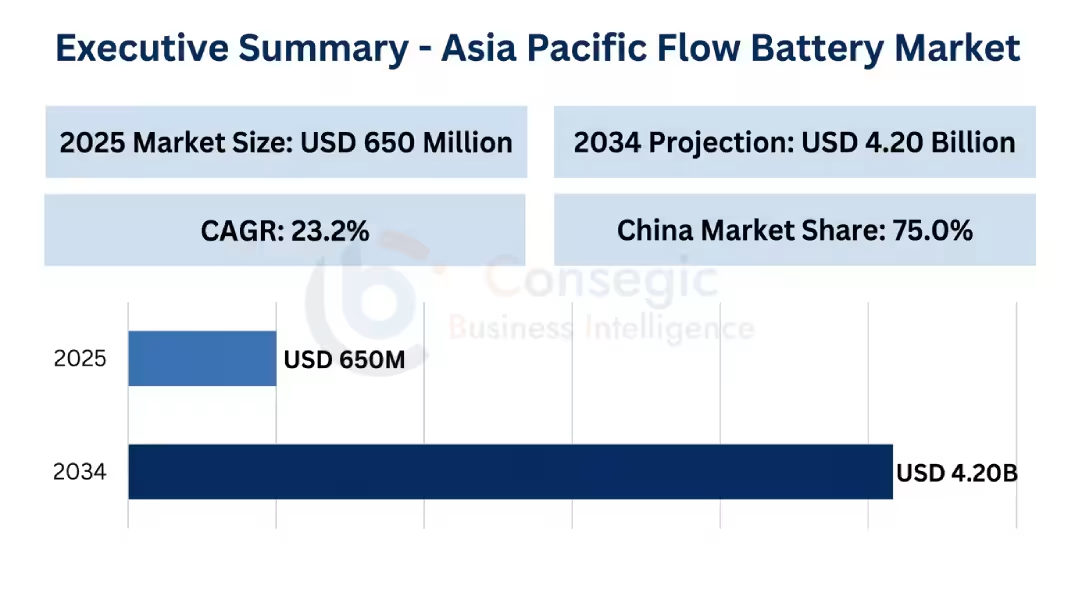
- Rapid Market Growth: Asia Pacific flow battery market projected to grow from $650M (2025) to $4.2B (2034) at -23% CAGR
- Key Driver: Massive 180-250 GW/year solar & wind additions fueling demand for long-duration storage
- China dominates the market with 75% share ($488M - $3.15B), 80-85% global capacity (3.2-4.5 GWh), and strong policy backing
- Australia & India/SEA are high-growth regions with 26.8% CAGR (Australia) and 28.5% CAGR (India/SEA), driven by grid needs and renewables
- Japan leads in innovation with 8% market share ($52M), 22.5% CAGR, and 250-400 MWh deployed capacity focused on advanced and resilient systems
- Overall takeaway: Flow batteries are becoming the preferred solution for long-duration, grid-scale storage in the Asia Pacific
- Policy support: Governments mandating 10-20% energy storage alongside renewable installations
The modern flow battery technologies include a variety of chemistries, such as vanadium redox flow batteries (VRFB) which lead the commercial market with 70-75% market share, zinc-bromine systems with a cost benefit in smaller-scale applications, iron-chromium configurations with improved safety profiles, and the new organic flow batteries using carbon-based electrolytes that are independent of the critical mineral. These systems show energy storage capacities of 500 kilowatt-hours in commercial systems to 1,600 megawatt-hours in utility-scale systems, power levels of 100 kilowatts up to 400 megawatts, round-trip efficiencies of 70-80% in VRFB systems, and energy densities of 25-40 watt-hours per liter in advanced systems.
The Asia Pacific flow battery market is valued at USD 650 million in 2025 (base year) and a projected growth of USD 4.20 Billion in 2034, representing a CAGR of 23.2%. This unprecedented growth will be propelled by the aggressive rollout of renewable energy deployments of 180-250 gigawatts of solar and wind capacity every year across the region, government mandates on energy storage of 10-20% of renewable installations as compared to manufacturing plants, and technological innovations that will decrease the costs of the systems by 35-45% between 2020 and USD 350-500 per kilowatt-hour.
China also leads the world in flow battery deployment of 75-80% installed capacity with 3.2-4.5 gigawatt-hours of flow battery systems deployed in 2024 relative to 400-800 megawatt-hours of the rest of Asia Pacific, due to domestic manufacturing capability to produce 60-70% of the global supply of vanadium, government policy that requires flow battery deployment in renewable projects, and strategic efforts to position flow batteries as the preferred technology in applications with 6-hours or longer. The success of large-scale installations has demonstrated commercial viability and helped establish technical standards as the 400 megawatt-hour Dalian Flow Battery Energy Storage Station has proved the viability of these types of installations in a commercial setting and has created technical standards in the international industry.
Market Scope & Overview
The Asia Pacific flow battery market is a complete energy storage system such as reduction-oxidation reaction to electrochemical stacks where electrical energy is converted to chemical potential, storage tanks of electrolyte with concentrations of 1.5-2.0 molar, power conversion converting between AC and DC conversion at efficiencies of 95-98, balance-of-plant such as pumps that circulate the electrolyte at flow rates of 20-100 liters per minute, thermal management of operating temperatures of 10-40 degrees Celsius, The success of large-scale installations has demonstrated commercial viability and helped establish technical standards
Modern flow battery systems have been shown to include technical capabilities such as a modular architecture that allows the independent scaling of power (megawatts) and energy (megawatt-hours) with addition of cell stacks or electrolyte volume, fast response times with a full power output in 50-200 milliseconds to respond to grid frequency changes, depth of discharge limits of 100% without degradation compared to 80-90 percent limits with lithium-ion systems, and operational flexibility with 20-25 year lifespans of 20–25 years. These systems allow time-shifting of renewable energy of 200-1,600 megawatt-hours to evening peak power, grid stabilization services of 25-400 megawatts of frequency regulation, industrial backup power of 4 -12-hour discharge demands, and microgrid applications, combining 1-50 megawatt-hours of storage capacity.
The technical architecture sets flow batteries apart from traditional battery technologies by separating energy storage (volume of electrolyte to the extent that it is needed) and power delivery (volume of stack), which allows cost-effective scaling of long-duration applications, where the cost of energy capacity is dominant in system economics. Vanadium redox flow batteries have energy costs of USD 350-500 per kilowatt-hour, compared to USD 400-600 per kilowatt-hour of 4-hour lithium-ion run times, with economies of scale improving as 8-12 hour run time applications have 8-12 hour flow battery energy costs that cause the cost of 8-12 hour lithium-ion systems to rise with run time.
The production centers are concentrated in the Asia Pacific region where China is running 20-30 flow battery production of 4-7 gigawatt-hours combined and Japan has 4-6 dedicated companies that specialize in high-end applications and South Korea, India and Australia are emerging in production. The regional supply chain involves vanadium mining and processing where China manufactures 60-70 percent of world vanadium pentoxide and membrane manufacture where specialized ion-exchange membranes have prices ranging between USD 250-400 per square meter and electrochemical stack manufacture which has a precision manufacturing tolerance of 0.1-0.3 millimeters.
Key Market Driver:
Integrating Renewable energy and Long-duration storage needs.
The primary structural driver of market growth is of the flow battery market is the underlying imbalance in the variability of generation patterns of renewable energy and the electricity demand patterns that create strong demand on the energy storage systems that can time-shift the 6-12 hour generation patterns over time to match the consumption patterns. The renewable energy capacity in Asia Pacific reached 1,950-2,150 gigawatts in 2024, with solar and wind contributing 70-80% of the new generation additions of 180-250 gigawatts annually due to the installations of 120-160 gigawatts by China, contributions of 25-35 gigawatts by India and Japan, South Korea, Australia, and Southeast Asian countries.
This potential produces 3,200-3,800 terawatt-hours each year although it shows substantial temporal variability with solar production being concentrated in 6-8 hour midday rays that give 75-85% of daily generation and wind being produced with a diurnal effect with 60-75% of daily generation. The renewable curtailment in China was 6-10% of potential generation in such provinces as Gansu, Xinjiang and Inner Mongolia amounting to 55-75 terawatt-hours of wasted renewable energy of USD 4-7 billion a year at wholesale electricity prices.
Government policies are increasingly requiring energy storage deployment to solve the challenges associated with integrating renewable energy, and China is requiring storage capacity to 10-20% of new renewable energy projects in areas where curtailment occurs, which translates to 2-6 hour requirements of 200-280 gigawatts of planned solar and wind energy through 2030. The National Electricity Plan of India aims at 47-63 gigawatt-hours of energy storage by 2032, the Strategic Energy Plan of Japan focuses its attention on storage to provide resilience in grid during natural calamities, and the renewable energy zones in Australia have considered the storage needs of 20-35 gigawatts, with the storage of duration of 4 to 8 hours.
The long duration storage economic argument gets stronger with higher rate of penetration of renewable energy with grid modeling studies showing that system with 40-60% renewable energy will need 6-12 hour storage capacity to attain 90-95% renewable energy use as opposed to 2-4 hour storage capacity needed to attain 20-30% renewable energy use. Flow batteries will meet this need at a low cost, where levelized cost of storage decreases to USD 0.12-0.20 per kilowatt-hour 4 hours batteries to USD 0.08-0.15 per kilowatt-hour 8 hour batteries, whereas lithium-ion systems rise up to USD 0.16-0.28 per kilowatt-hour over the same ranges of operating duration.
Key Market Restraint
High Start-up Capital and Vanadium price volatility.
The greatest obstacle to faster flow battery implementation consists of large capital demands and susceptibility to fluctuating costs of vanadium commodities touching on system economic advantages and project funding. Utility-scale (electrochemical stacks, electrolyte, power conversion systems, and balance-of-plant equipment) cost USD 500-750 per kilowatt-hour, which is 25-50 percent of the USD 400-500 per kilowatt-hour of lithium-ion systems. Utility-scale flow battery systems require significant upfront investment. USD 500-750 per kilowatt-hour is the initial investment required to install a complete flow battery system including utility-scale (4-hour) retrofit augmented with
Vanadium electrolyte constitutes 30-40 percent of the overall system prices and the 25-35 kilograms of vanadium pentoxide per kilowatt-hour of storage capacity exposes them directly to the commodity price volatility. Vanadium pentoxide was not only showing extreme volatility, increasing USD 6-10 per kilogram in 2020 and USD 20-32 per kilogram in 2024 as the primary production in China, Russia and South Africa became constrained, but demand was growing faster than production due to the various applications of the commodity in the steel industry, consuming 85-90 percent of the total vanadium output in the world, and also due to speculative trading in commodity markets. The volatility of prices makes financing project difficult with lenders asking 20-30% contingency costs and 40-50% equity requirements instead of standard lithium-ion 25-35%.
The scale constraints of manufacturing make cost a bigger issue and global flow battery production capacity of 5-8 gigawatt-hours per year is 2-3 percent of lithium-ion manufacturing capacity of 1, 200-1,800 gigawatt-hours, constraining economies of scale in component manufacturing. The production costs of USD 200-350 per kilowatt are required to produce an electrochemical stack, compared to USD 100-180 per kilowatt to produce a lithium-ion battery pack, which has the advantage of scale produced by the automotive industry.
Complicated balance-of-plant increases the cost via, but is not limited to, the addition of electrolyte circulation pumping and piping systems used to handle the corrosive vanadium solutions, thermal control to keep 15-35 degrees celsius operating temperature, The success of large-scale installations has demonstrated commercial viability and helped establish technical standards systems that synchronize the operation of the stack, electrolyte flow, and power conversion. The auxiliary systems add USD 150-250/kWh to overall costs and demand specialized maintenance skills and annual operating costs of 2.5-4.0% capital costs as opposed to 1.5-2.5% of capital costs in lithium-ion systems.
Key Market Opportunity:
Electrolyte Leasing Models and Alternative Chemistry Development.
The opportunities are enticing to the Asian Pacific flow battery markets in the implementation of novel financing mechanisms and technology diversification in overcoming the traditional cost and supply chain limitations. Electrolyte leasing models are becoming the business solution of the future with vanadium or other active material leased to the project owners instead of being bought and initial capital expended decreases by 30-40 percent and project economics enhanced. Financial institutions and electrolyte suppliers have 15-20 year leasing contracts at USD 8–15 per kWh of capacity which allow flow battery projects to obtain similar start ups to lithium-ion offerings and still benefit with long-term advantages.
The opportunities of alternative chemistries development are significant in the reduction of costs and diversification of the supply chain. The flow batteries made of iron-chromium use large quantities of cheap materials with feedstock cost of USD 3-8 per kilogram as opposed to the vanadium, which has a feedstock cost of USD 20-32 per kilogram, which could lead to the costs of electrolyte being reduced by 60-75 percent whilst offering the same performance characteristics. Systems based on zinc-bromine provide more energy density of 40-65 watt-hours per liter than 25-40 watt-hours per liter in VRFB, and can be installed in smaller sizes, appropriate to commercial and industrial environments with limited space.
Organic flow batteries are the most promising long-term opportunity, they use carbon-based active material based on renewable feedstocks and have no critical mineral dependencies whatsoever. High-technology organic systems have a cycle life of over 10,000-15,000 cycles, USD 10-20/kg/wh material prices versus USD 200-300/kg/wh in vanadium systems, and are fabricated using the current chemical industry infrastructure. The first commercial applications will occur in 2026-2027 and cost reductions of up to 40-60% of the entire system compared to VRFB alternatives are possible.
The chance is further to the vertical integration strategy, through which Australian firms can utilize the domestic resources of vanadium and zinc mining to gain the control of the supply chains and economies of scale. Chinese producers are also entering the market of electrolyte recycling and refurbishment, seizing 95-98 percent of vanadium worth at the end of the system life, and developing circular economy business opportunities. The government procurement programs offer further opportunities, as State grid corporation of China tender 4-6 gigawatt hours of energy storage every year and Indian utilities tender 3-5 gigawatt hours of storage with renewable projects up to 2030.
Market Segmentation Analysis
By Technology Type: Chemistry and Performance Analysis
VRFB -and Vanadium Redox Flow Batteries: Market Leadership.
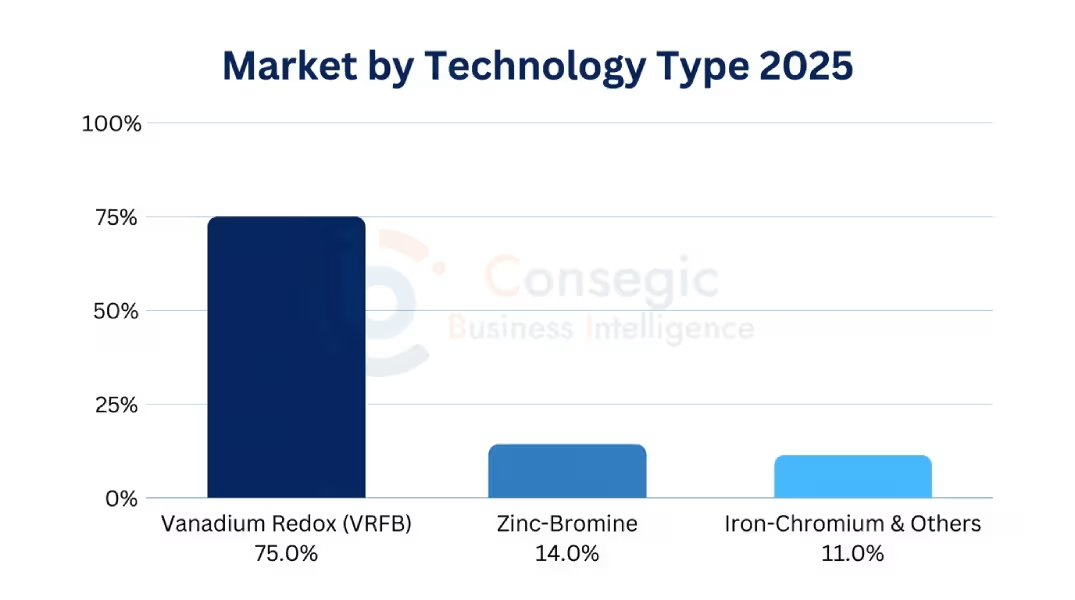
Vanadium redox flow battery systems keep the market overwhelming with USD 488 Million (75.0 of total market value) in the year 2025 with the expectation of USD 3.15 Billion by the year 2034 with 23.2% CAGR. These systems make use of vanadium ions in a variety of oxidation states (V2+/V3+ and V4+/V5+) dissolved in sulfuric acid electrolyte, which can be symmetrically chemistry with both positive and negative electrolytes being vanadium species, allowing the elimination of cross-contamination issues and indefinitely long electrolyte lifespan. Technical characteristics have the energy efficiency of 75-80% round-trip, power density of 0.8-1.2 watts per square centimeter of membrane area, energy density of 25-35 watt-hours per liter, and operating temperatures of 10-40 degrees Celsius.
Commercial VRFB units have a range of 1 megawatt-hour in commercial use up to 1,600 megawatt-hours in utility-scale facilities and the Dalian Flow Battery Energy Storage Station has operated with a capacity of 400 megawatt-hours, the largest operational flow battery facility in the world. The cost of the system has decreased by USD 600-900 per kilowatt-hour in 2020 to USD 400-600 per kilowatt-hour in 2025 due to manufacturing scale, vanadium electrolyte recycling programs recovering 95-98% of the material value and stack design optimization adding 40-50 points to power density.
Zinc-Bromine Flow Batteries: Competitive Alternative.
The USD 91 Million (14.0% of the market worth) with the growth rate of 25.5% CAGR is the zinc-bromine systems that have the cost benefits of using the good quantities of material with zinc and bromine feedstock being USD 3-6 per kilogram versus vanadium USD 20-32 per kilogram. These systems offer 40-65 watt-hours per liter energy density, better than VRFB, but have shorter life cycles of 8,000-12,000 cycles, and operation issues such as dendrite formation that requires regular maintenance of every 800-1200 cycles.
Iron-Chromium and Emerging Chemistries: Innovation Segment.
Iron-chromium, organic flow batteries and other new chemistries have USD 71 Million (11.0% of market value) and fastest growing rate of 28.5% CAGR due to innovation to overcome cost and performance shortcomings of the existing technologies. Systems based on iron-chromium provide safety benefits including non-toxic and non-flammable electrolytes and cost of materials USD 5-15 per kilogram, and organic flow batteries provide independence on critical minerals through the use of carbon-based active materials made using renewable feedstocks.
By Application: End-Use Market Analysis
Utility-Scale Grid Storage: Largest Application Segment.
Utility and grid-scale applications should be USD 358 Million (55.0% of the total market value) of 2025, which includes time-shifting of renewable energy storage of 200-1,600 megawatt-hours of solar and wind energy, frequency regulation of 25-400 megawatts of rapid response capacity within 50-200 milliseconds, transmission and distribution upgrade deferral, which saves USD 20-60 million of infrastructure investment, and black start capability that would facilitate grid recovery operations Projects vary in 20-1,600 megawatt-hours and discharge times 4-12 hours, power ratings 10-400 megawatts and operation profile of 280-450 full charge-discharge cycles per year.
Industrial and Commercial Applications.
Industrial and commercial USD 163 Million (25.0% of market value) with growth rate of 26.8% CAGR, alternate power needs in manufacturing plants, data centers, hospitals and telecommunications infrastructure is used in industrial and commercial applications. Plants implement 1-20 megawatts-hours of capacity that ensures 6-12 hours of reserve capacity, demand charge controls that may save 20-35 percent of monthly electricity bills, and quality conditioning of power supply which may cost USD 100,000-800,000 an occurrence of production interruption.
Microgrid and Remote Applications.
Microgrid, island, and remote are USD 97 Million (15.0% of market value), used in communities, military installations, mining operations, and industrial locations that need energy autonomy. The systems have a discharge range of 8-24 hours between 500 kilowatt-hours and 10 megawatt-hours with systems ranging between 500 kilowatt-hours to 10 megawatt-hours which combine with diesel generators, solar arrays and wind turbines to achieve 50-80 percent in fuel consumption and 99.9-99.99 percent of availability.
Small Commercial and Residential.
Small commercial and residential applications comprise USD 32 Million (5.0% of market value) and the highest growth rate of 32.5% CAGR, which is a developing segment with the costs going down and compact systems coming in the picture. Back up power, optimization of self-consumption in the solar and involvement in virtual power plant are offered in installations of 20-100 kilowatt-hours.
Regional Market Analysis
China: Devouring Domination in the market.
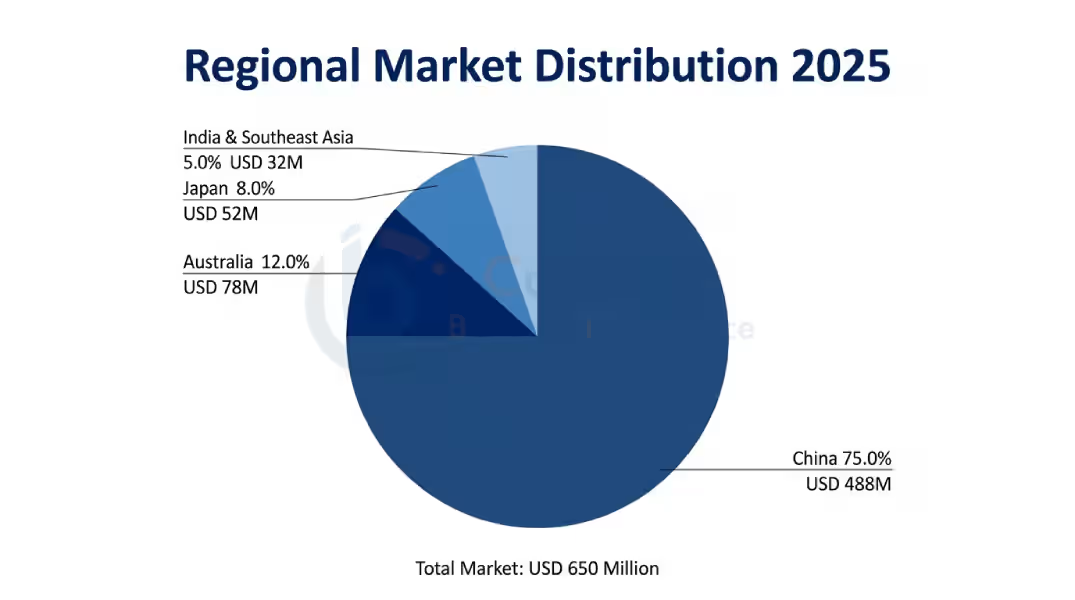
China accounts USD 488 Million (75.0% of total Asia Pacific market value) in 2025 that is projected to increase to USD 3.15 Billion in 2034 at 23.2% CAGR due to its overwhelming dominance via its domestic manufacturing potential, government policy favourable activities and aggressive implementation of renewable energy. Installed flow battery capacity of 3.2-4.5 gigawatt-hours are 80-85 percent of the world total, with 200-300 projects underway (2-1600 megawatt-hours) in operation in 2024.
Its production capacities are 20-30 flow battery manufacturing plants (combined yearly capacity of 4-7 gigawatt-hours) concentrated in Liaoning, Shandong, Jiangsu and Guangdong provinces. The largest manufacturers such as Rongke Power, Dalian Institute of Chemical Physics, Great Power and Shanghai Electric manufacture single systems encompassing locally-sourced materials such as vanadium electrolyte by Pangang Group and Chengde Guorui, membranes by Shandong Dongyue and power conversion systems by Sungrow and TBEA.
The 14th Five-Year Plan targets of 30+ gigawatts new energy storage, provincial requirements of 10-20% storage capacity of renewable projects and USD 0.04-0.06 per kilowatt-hour are all policy support measures. State grid corporation bids 4-6 gigawatt-hours per annum, with projects in Inner mongolia, Xinjiang, Qinghai and Gansu covering renewable curtailment ranging between 6-10 percent of possible generation.
Australia: The Rapidly Emerging Regional Market.
Australia has USD 78 Million (12.0% of market value) and the greatest regional growth rate at 26.8% CAGR which is due to unique grid topology that necessitates long-distance transmission, high rates of renewable penetration that cause curtailment problems and rich mineral deposits of vanadium and zinc deposits. The flow capacity of the country is 300-500 megawatt-hours of flow capacity across 25-40 installations including utility-scale projects in South Australia and Queensland as well as distributed systems to serve remote mining operations.
Local production projects comprise Redflow Limited creating zinc-bromine systems to be used in commercial and residential use, Australian Vanadium implementing integrated vanadium mining and electrolyte production and new alliances with international technology vendors that are setting up local assembly capacity. The government assistance includes the Australian Renewable Energy Agency funding of up to 30-50 percent of the demonstration project costs and renewable energy zones at the state level with an effective storage period of 4-8 hours.
Japan: Leadership Technology Innovation.
Japan has USD 52 Million (8.0% of market value) growth of 22.5% CAGR, where it focuses on technology innovation, grid resilience and premium applications. There is 250-400 megawatt-hours of flow-gates capacity spread 40-60 locations, such as 60 megawatt-hosts Hokkaido project by Sumitomo Electric and 2-8 megawatt-hour microgrids to enable disaster resilience.
Leadership in manufacturing involves Sumitomo Electric Industries with proprietary vanadium redox technology implemented in 20 plus countries, LE System with compact zinc-bromine systems to be commercialized and research institutes such as AIST with organic flow battery chemistries. The government subsidies such as Green Growth Strategy subsidies (40-60 percent of installation cost), low interest financing (0.5-1.5 percent /Annual) are provided.
India and Southeast Asia: Emerging Market.
India and South East Asian countries are USD 32 Million (5.0% of market value) with growth rate of 28.5% CAGR, which is attributed to renewable energy growth, energy access, and requirements of industrial development. It has an 80-150 megawatt-hours flow, 15-25 installations of flow battery capacity in operation in Rajasthan, Gujarat, and Karnataka used to demonstrate solar integration and grid stability.
Production-Linked Incentive scheme gives USD 3-4 billion in battery production including flow technologies with a target of 60-80 gigawatt-hours of domestic capacity by 2030. New manufacturers such as Thermax, Tata Power and ReNew Power are building projects between 8-80 megawatt-hours, and South-East Asian nations such as Thailand, Vietnam, and Indonesia are building 30-60 megawatt-hours to serve Island micro-grids and industry use.
Recent Industry Developments
Mega-Scale Projects Deployments (2024-2025)
China received contracts to install several large sizes of flow batteries to the tune of USD 600-850 million projects. The Dalian Flow Battery Energy Storage Station had undergone Phase III expansion to 400 megawatt-hours of total capacity with 100 megawatts of power rating based on a new vanadium redox technology of Rongke Power and had 75-78% round-trip efficiency. The facility offers full grid services such as peak shaving storage of overnight wind generation to be used in the daytime, frequency regulation in response within 100 milliseconds, voltage support, and black start response to aid in restoration of the grid.
The province of Shandong ordered 300 megawatt-hours of distributed flow generation capacity of 20-25 installations (8-25 megawatts capacity) including solar farms (1,200-1,800 megawatts capacity). Projects are granted better subsidies of USD 0.05/ kilowatt-hour on discharge and capacity payments of USD 70-90/ kilowatt-year and project returns of 14-18/ years operating periods.
Capacity Increase and Technology Innovation of manufacturing (2024-2025)
The major manufacturers reported capacity growth of USD 1.2-1.8 billion of capital funds. Rongke Power finished 3 gigawatt-hour factory in Dalian with annual production capacity of industry lead and vertical integration of stack fabrication, electrolyte production and system integration. The plant generates full systems with a cost of USD 350-450 per kilowatt-hour, which is 35-45% lower than what it costs in 2022 due to automated production and the economy of scale.
Next-generation stack designs developed by Dalian institute of chemical physics had 1.5-2.0 watts/square centimeter power density, which is 50-70% lower than conventional designs, and stack costs are lowered by 30-40 percent, due to smaller area requirements of membranes. Improved membrane material with ion selectivity and low resistance, design of flow fields that create 60 to 80 percent more active surface area, and 40 to 50 percent less pumping losses, three-dimensional electrode structures are examples of innovations.
Electrolyte Leasing and Alternative Chemistry Development (2024-2025)
The technology providers and financial institutions introduced new business models to capital cost barriers. China Development Bank set up USD 500 million of electrolyte leasing fund in association with big manufacturers to provide leasing contract 15-20 years with a decrease in project capital need by 30-40. Like measures were taken in Australia and Japan, where special financing vehicles were developed to maximize the number of commercial and industrial customers interested in flow battery solutions, without the need to spend heavily on upfront investment.
The flow battery technologies made progress towards commercialization with results of 12,000-18,000 cycle lifespan, 35-50 watt-hours per liter power densities, and material costs of USD 12-25 per kilowatt-hour. Commercial production starting in 2026-2027 is being aimed at by leading developers such as partnerships between Chinese and international research institutions, which would potentially be able to transform flow battery economics by removing the critical dependencies on minerals.
Competitive Landscape and Key Market Players
Strategic Positioning and Market Leadership
Rongke Power (China): Market Leader with no doubt.
Rongke Power aspires to dominate the Asia Pacific market with projected revenues of USD 120-150 Million in 2024, which is about 22-25% market share in the region, by its total portfolio of vanadium redox flow battery technology and regional leadership in utility-scale projects. Such competitive advantages as proprietary stack designs with 1.2-1.8 watts per square centimeter of power density, fully vertical integration with vanadium mining to system integration, reference-level 400 megawatt-hours Dalian project with demonstrations of commercial viability and operational excellence, strategic alliances with State Grid Corporation guaranteed continued project pipeline and 3+ gigawatt-hours of manufacturing capacity are competitive advantages.
Dalian Institute of Chemical Physics (DICP) - China: Technology Innovation Pioneer.
DICP is a powerful market player expected to have commercial revenues of USD 65-85 Million, market share of about 12-15% with a focus on technology licensing, research, and development of high-performance systems. The competitive advantages are core research abilities driving stack designs, membrane materials and electrolyte formulations, portfolio of intellectual property of 300 plus patents of critical flow battery technologies, partnership with major utilities and manufacturers in which it operates across various countries, government research funding to support development of advanced technologies, and technology licensing generating recurring revenues to its implementations throughout the world.
Sumitomo Electric Industries - Japan: Globe Technology Leader.
Sumitomo Electric has an estimated flow bathroom revenues of USD 45-65 Million, estimated market share, 8-12% and they concentrate on top-end applications, global markets, and technology licensing. Competitive advantages are established technology implemented in 20+ countries with installations up to 200-350 megawatt-hours, focus on reliability and performance when critical applications such as disaster recovery and micro grid systems are needed, diversification of business model through manufacturing, project development, and licensing of technology, and sustained innovation in stack design and system integration.
Other Major Market players:
- Great Power (China) - Multi-purpose battery producer with USD 40-60 Million flow battery revenue, using automotive battery experience.
- Shanghai Electric (China) - Flow battery systems and flow storage energy USD 35-55 Million with an industrial conglomerate.
- Redflow Limited (Australia) - Zinc-bromine manufacturer having revenues USD 25-40 Million which have commercial and residential applications.
- VRB Energy (Canada-China) - a technology provider, having Chinese manufacturing alliances, creating USD 20-35 Million.
- Invinity Energy Systems (UK-Australia-Canada) - Global developer with presence in Asia Pacific that is making USD 18-30 Million.
Asia Pacific Flow Battery Market Report Insights
| Report Attributes | Report Details |
|---|---|
| Study Timeline | 2022–2034 |
| Base Year | 2025 |
| Forecast Period | 2026–2034 |
| Market Size in 2025 | USD 650 Million |
| Market Size in 2034 | USD 4.20 Billion |
| CAGR (2026–2034) | 23.2% |
| By Technology | Vanadium Redox (75.0%), Zinc-Bromine (14.0%), Iron-Chromium & Others (11.0%) |
| By Application | Utility-Scale (55.0%), Industrial/Commercial (25.0%), Microgrids (15.0%), Residential (5.0%) |
| By Power Rating | Large-Scale >20MW (60.0%), Medium-Scale 1-20MW (30.0%), Small-Scale <1MW (10.0%) |
| By Region | Asia-Pacific, Europe, North America, Latin America, Middle East & Africa |
| Key Players | Rongke Power, DICP, Sumitomo Electric, Great Power, Shanghai Electric, Redflow, VRB Energy, Invinity Energy |
| Report Coverage |
|
Key Questions Answered in the Report
What is the market size of Asia Pacific flow battery and how is it expected to grow? −
The market volume of Asia pacific flow battery is estimated to be USD 650 Million in 2025 and will grow to USD 4.20 Billion by the year 2034 with the CAGR of 23.2% in the forecast period 2026-2034. This phenomenal growth has been occasioned by renewable energy capacity addition of 180-250 gigawatts, governmental energy storage requirements of 10-20 percent storage capacity in comparison to the renewable installations, grid modernization investments of USD 275-350 billion by 2030, and a technology that cuts the costs of the system by 35-45 percent by 2020 compared to 2030.
What is the dominant country in the Asia Pacific flow market? +
China accounts 75.0 percent of the total Asia Pacific market worth USD 488 Million in 2025, which is set to increase to USD 3.15 Billion in 2034. China uses 80-85 percent of the installed flow battery capacity at 3.2-4.5 gigawatt-hours that is fueled by local manufacturing capacity that supplies 60-70 percent of the world vanadium production, government policy that requires energy storage in all renewable projects, vertical integration in mining to system construction, and successful commercial implementations such as the largest 400 megawatt-hour installation in the world at Dalian.
What are the main pros of flow batteries compared to lithium-ion systems in long run applications? +
Flow batteries feature independent scaling of power and energy capacity permitting cost-effective long duration storage of 6-12 hours as compared to 1-4 hours typical of lithium-ion, extended cycle life in excess of 15,000-25,000 cycles with little degradation as compared to 80-90 cycles with lithium-ion, 20–25-year lifespan as compared to 10-15 years of lithium-ion, 100% depth of discharge with no degradation as compared to
What are some of the technical issues and cost constraints to market expansion? +
The major issues are high start-up capital costs (USD 500-750 per kilowatt-hour, which is 25-50% higher than the lithium-ion alternatives), volatility in vanadium prices between USD 6-10 per kilogram in 2020 and USD 20-32 per kilogram in 2024 (contributing to 30-40 percent of the system costs), low energy density of 25-40 watt-hours per liter resulting in larger footprints than
What are the ways in which the electrolyte leasing models are changing the economics of flow batteries? +
Electrolyte leasing models save 30-40 percent of the initial capital expenditure by treating vanadium or other active materials as independent financial assets leased to the owners of projects other than buying them outright. Financial institutions present 15-20 year lease contracts at USD 8-15 per kilowatt-hour of capacity and allow the flow battery projects to attain similar initial costs to lithium-ion options but retain long-term benefits. China Development Bank has set up USD 500 million of electrolyte leasing fund and similar initiatives are being introduced in Australia and Japan and flow battery technology has become available to both commercial and industrial clients without any heavy upfront investment conditions.
Overview
Reputation & Certifications


Our Services
- Market Intelligence & Forecasting
- Custom Research Solutions
- Market Entry Strategy
- Competitive Intelligence
- Customer Insights
- Industry Innovation Analysis
- Investment Advisory