Jump to Content
Asia Pacific Liquid Handling System Market - Size, Industry Share, Growth Trends and Forecasts (2025-2034)
Market Scope & Overview
The Asia Pacific liquid handling system market is a complex and fast growing market within the laboratory automation and life sciences instrumentation industry that includes precision devices, automated platform, and consumables that have been specifically engineered to precisely transfer, dispense, aspirate, and manipulate liquid samples in a variety of research, clinical diagnostics, pharmaceutical development, and biotechnology applications. These systems can be simple manual pipettes, which demand practitioner skill in their operation, up to full automation of workstations (robotic) capable of processing thousands of samples with minimal human involvement, which have found important applications to drug discovery screening, genomics research, clinical diagnostics, proteomics analysis, cell culture preparation, and in high throughput screening applications in pharmaceutical companies, biotechnology firms, academic institutions, clinical laboratories, and contract research organizations.
The market includes various technology platforms such as manual pipette, which serves basic laboratory requirements at USD 150-800 per unit, Electronic pipettes, featuring motorized aspiration and programmable volume adjustments, are priced between USD 3,000–15,000., automated liquid handling workstations with robotic arms with 96-channel liquid pipetting, and 384-channel liquid pipetting head, and immunoassay detection systems and based on sample storage that form complete laboratory automation solutions. Advanced systems are capital equipment investments of USD 50 000- 500,000 based on throughput capacity, complexity of integration and specialization of application.
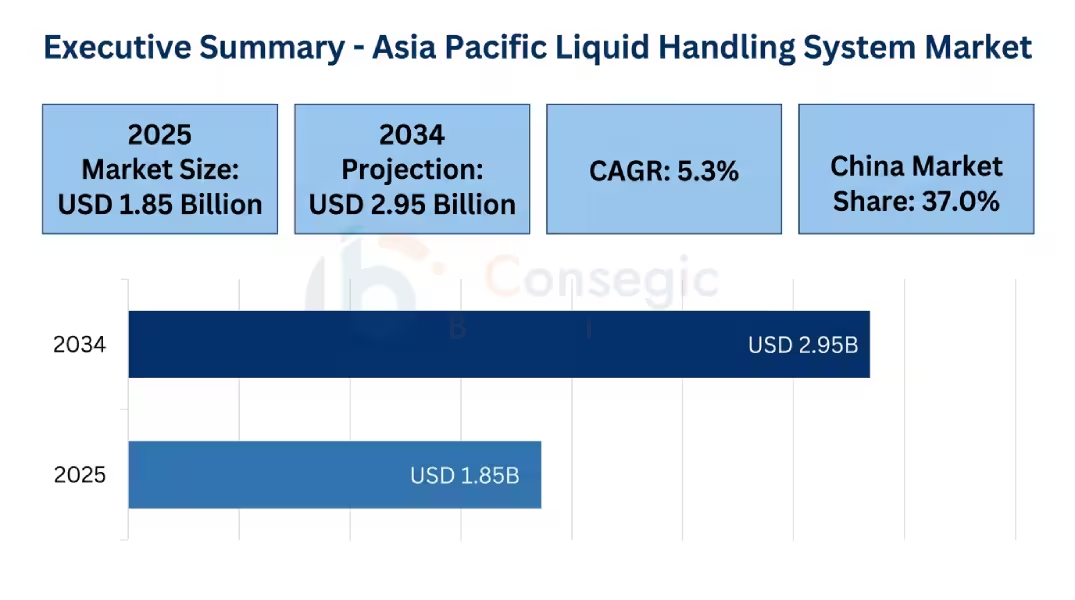
The market, valued at USD 1.85 billion in 2025, is projected to grow to USD 2.95 billion by 2034. This growth curve reflects the This growth reflects a CAGR of 5.3% during the 2026–2034 forecast period, driven by in pharmaceutical and biotechnology research and development activities in China, India, South Korea, and Singapore with regional R&D spending of more than USD 185 billion/year and growing at 8-10 percent, the increasing development of the clinical diagnostics infrastructure to meet rising healthcare demands in emerging economies, and the rising investment in genomics and personalized medicine research where the Asian Pacific genomic sequencing capacity has increased.
Key Market Insights
- Market expected to grow from USD 1.85 billion (2025) to USD 2.95 billion by 2034 (CAGR 5.3%)
- Asia Pacific liquid handling system market is a fast-growing segment in laboratory automation and life sciences
- China leads the market with 37% share (USD 685M in 2025), driven by strong pharma & biotech industry growth
- India is the fastest-growing market (6.6% CAGR), driven by pharma and biosimilars expansion
- Growth driven by rising pharmaceutical & biotech R&D in China, India, South Korea, and Singapore
Advancements in technological platforms have significantly improved system performance and efficiency.
Modern technology of liquid handling displays an exemplary level of sophistication with precision engineering, advanced control systems and intelligent software platforms with solutions to historic issues of accuracy, reproducibility and throughput constraints. The modern electronic pipettes are designed with brushless servo motors which offer dispensing accuracies of +-0.5-1.5 percent (depending on volume range) with a repeatability specification of less than coefficient of variation of 0.3 percent at 10 microliters or greater. These machines have user friendly interfaces, color touchscreen, wireless connectivity, protocol transfer, and data logging; they have ergonomic designs that minimize repetitive strain injuries that occur in 60-70 percent of laboratory technicians when they are undergoing extensive manual pipetting.
The best of technology is represented by automated liquid handling workstations, which also uses multi-axis robotic technology, a positioning error of +-0.1 millimeters, disposable tip technology that removes the risk of cross-contamination, and built-in liquid level detectors to ensure that varying volumes of samples are aspirated. High-throughput systems make use of 96-channel or 384-channel pipetting heads that allow simultaneous transfer of the entire microplate, and throughput is as high as 10,000-50,000 wells/hour versus 500-800 wells/hour with manual modes. The newest systems combine thermal temperature regulation at +-0.2 degrees Celsius sample temperature, a plate handling system operating 50-200 microplates automatically, and barcode reading to guarantee sample tracking and regulatory adherence.
The combination of AI and machine learning is a radical shift, and the current systems have automated protocol optimization schemes that consider historical dispensing data and modify protocol parameters such as aspiration speed, dispense height, and liquid class settings, reducing protocol development time by 25-35 percent and improving accuracy by 15-20 percent over manual optimization schemes. Predictive maintenance software measures system performance attributes such as pipetting precision, tip seating force and robotic positioning precision, detects performance decline patterns 4-8 weeks prior to failure and minimizes unplanned downtime by 55 percent in pilot installations.
Executive Summary
The market in Asia Pacific liquid handling system has strong growth attributes in terms of high growth in the pharmaceutical and biotechnology research, automation of laboratories, to overcome workforce challenges, and development of clinical diagnostics infrastructure. The market will grow by USD 2.95 billion in 2034, with an increase of 5.3 percent CAGR since USD 1.85 billion in 2025. Automated systems and consumables are the leading growth drivers, and manual pipettes are still needed in the emerging markets and small labs. The performance of the region is motivated by China, government investment, expansion of the pharmaceutical industry, and India, the showing the highest growth potential, due to the development of the biotechnology industry and modernization of clinical diagnostics.
Key Market Driver
Government support of R&D by Pharmaceutical and Biotechnology.
The basic force which contributes to market growth is the enormous expansion of the pharmaceutical and biotechnology research and development operations in the Asian Pacific countries which is enhanced by the substantial government investment programs favoring the innovation of life sciences and domestic growth of biopharmaceutical industry. The pharmaceutical R&D spending in China is USD 42 billion in 2024 according to the National Medical Products Administration, which is equivalent to a yearly growth of 12.5 percent and indicates China as the second biggest pharmaceutical R&D market worldwide. This wave of investment has led to a need to use automated systems to handle liquids in support of drug discovery screens, antibody-based research, cell lines engineering, and quality control assays in hundreds of growing biopharmaceutical institutions.
The Indian biotechnology industry is following the same growth pattern as it has reached USD 137 billion, growing at 14.1% annually in revenues in the industry as reported by the Department of Biotechnology in fiscal year 2023-2024. The BioE3 Policy announced by the government in 2024 aims to reach USD 300 billion in the value of the biotechnology sector by 2030, and a particular part of the policy is aimed at the development of research infrastructure and the implementation of technologies. The growth of the biopharmaceutical industry in South Korea would be due to the Bio-Health Innovation Strategy of the government, which provides KRW 2.4 trillion toward broader bio-health initiatives, indirectly supporting liquid handling systems. in the next five years, through the application of the sole technology that is more advanced in the development of antibody therapeutics and the production of cell therapies.
The growth of the contract research organization business in Asia Pacific with large CROs such as WuXi AppTec, Samsung Biologics, and other regional centers expanding operations in various parts of the region generates significant demand in the liquid handling system. These entities cater to pharmaceutical customers worldwide who need high-throughput screening, compound profiling and preclinical development services and the facilities serve 500,000- 2,000,000 samples per year and require fully automated systems with throughput of 20,000 -50,000 samples/day.
Key Restraints
Barriers of High Capital Investment and Technical Complexity.
Asia Pacific liquid handling system market has a big growth constraint because it requires a huge amount of capital to run automated platforms and is complex in nature, thus it needs specialized skills to operate, maintain and optimize the protocols. Wholesale liquid handling workstations start at USD 80,000 for basic 96-channel workstations and USD 500,000 for integrated workstations with robotic plate handling, thermal control and detection features representing significant capital investments that are difficult to afford particularly when dealing with small laboratories, developing market academic institutions, and start-up biotechnology firms with low funding.
This capital intensity introduces procurement barriers in the price-sensitive markets such as India, Indonesia, Philippines, and Vietnam where budgets in laboratories are still limited and the performance of the manual or semi-automated can be accepted at significantly lower levels of investments. The other barrier is technical complexity, where automated system needs specialized knowledge in terms of protocol development, system integration and system troubleshooting in case performance problems occur. A survey of the laboratory managers in the different markets in Southeast Asia has shown that 58 percent of them consider the absence of qualified personnel a major barrier to the adoption of automation, and 47 percent of them raise issues with regard to the complexity of the system and learning curve.
Key Opportunities
Automation of Clinical Diagnostics and Point of Care Testing.
The rapidly increasing development of clinical diagnostics network in Asia Pacific countries creates significant growth prospects to liquid handling systems that are streamlined to process immunoassay, molecular diagnostics sample preparation and a high throughput clinical testing application. In the Asian Pacific, the market of clinical diagnostics is more than USD 82 billion in 2024 with a growth rate of 7-9 percent per year due to aging population, rising cases of chronic diseases, expanding health insurance, and rising focus on preventive care and early disease detection.
The market of clinical laboratories in China displays an exceptionally high growth rate, and the number of independent clinical laboratories has grown, and will grow to be more than 2,800 in 2024 based on the estimations of the National Health Commission. Millions of samples are done each month at these centralized testing facilities and automated liquid handling systems are needed to perform immunoassay testing, clinical chemistry analysis and molecular diagnostics sample preparation. The growth of the diagnostics industry in India, where large chains such as Thyrocare, Dr. Lal PathLabs, and Metropolis Healthcare handle large laboratories networks of 50-100 million tests per year, is the factor that triggers the use of liquid handling systems to ensure operational efficiency and quality assurance in laboratories.
Market Segmentation Analysis
By Product Type: Technology Platform Analysis
Automated Liquid Handling Systems: Premium Automation Segment
USD 925 Million (50.0 percent of market value) of automated liquid handling systems will be in demand in 2025, which will increase to USD 1.48 Billion in 2034 at 5.4 percent CAGR. The entries in this category include fully automated workstations with robotic handling of samples, multi-channel pipetting head, built-in plate reader and plate washer, and fully automated software control packages. Such platforms are used in high-throughput screening assays in pharmaceutical drug discovery processing 50,000-200,000 compounds each year, genomics research centres doing next-generation sequencing sample preparation, and clinical diagnostics laboratories doing immunoassay testing.
Electronic and Manual Pipettes: Essential Segment
Electronic and manual pipettes account USD 518 Million (28.0 percent of market value), with the growth of USD 826 Million by 2034. This line offers the necessary tools to use in the daily laboratory practice, and the electronic pipettes have motorized dispensing, programmable protocols, and ergonomic layout that eliminate repetitive strain injuries. In cost-sensitive uses, in educational institutions and laboratories with moderate volumes of samples, manual pipettes continue to be used.
Consumables and Accessories: Recurring Revenue Stream.
Consumables such as pipette tips, reagent reservoirs, and microplates have a USD 296Million (16.0 percent of market value) with a growth to USD 472Million in 2034. This segment offers revenue streams that are recurring and which have constant consumable replenishment needs resulting in annuity type business model on the part of manufacturers.
Microplate Washers and Dispensers: Specialized Applications Segment.
Microplate washers and dispensers will be USD 111 Million (6.0 percent of market value) to USD 177 Million in 2034. The applications of these specialized systems include immunoassay such as ELISA tests, cell-based immunoassays, and high-content screening.
By Application: End-Use Market Analysis
Drug Discovery and Development: Main Use.
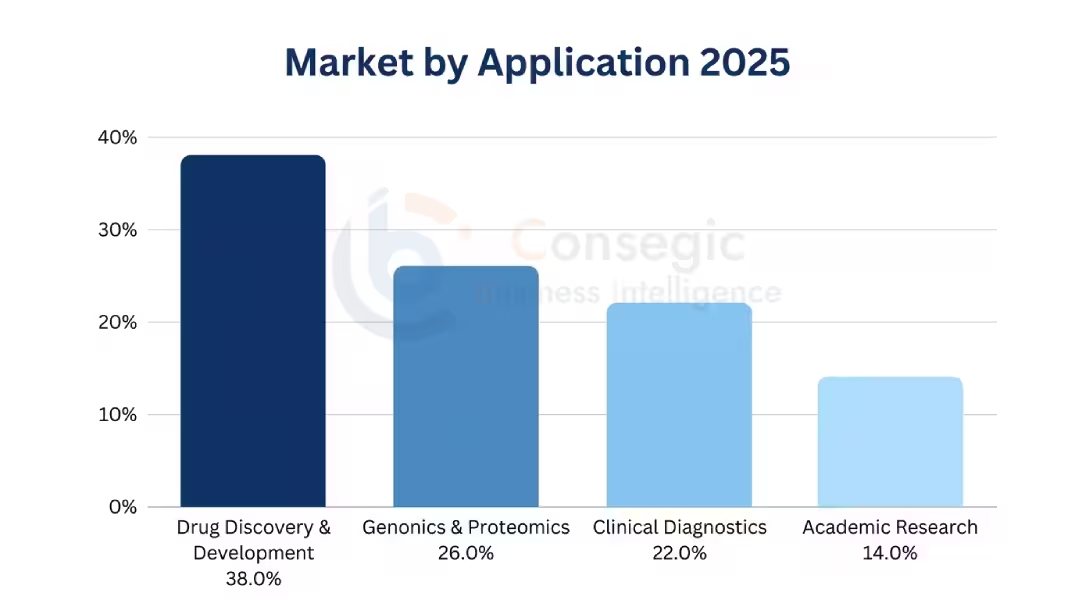
The applications of drug discovery and development are USD 703 Million (38.0 percent of market value) which is set to increase to USD 1.12 Billion by 2034. This category includes high-throughput screening of compound library, hit-to-lead optimization, antibody development and cell line engineering to manufacture biopharmaceuticals.
Genomics and Proteomics Research: Growth Segment.
The application of genomics and proteomics research has a USD 481 Million (26.0 percent of the market value) and will rise to USD 767 Million in 2034. This has next-generation sequencing library preparation, CRISPR gene-editing applications, and mass spectrometry of proteomics sample preparation.
Clinical Diagnostics: Volume Segment.
Applications of clinical diagnostics take USD 407 Million (22.0 percent of market value), and will increase to USD 649 Million in 2034. This category includes immunoassay analysis, clinical chemistry analysis, molecular diagnostics, and blood banking applications.
Government Research/Academic Research: Foundation Segment.
Government and academic research is USD 259 Million (14.0 percent of market value), which is expected to rise to USD 413 Million in 2034, and is used by university research laboratories, government research institutes and public health facilities.
Regional Market Analysis
China: Leadership on the Market and Booming Growth.
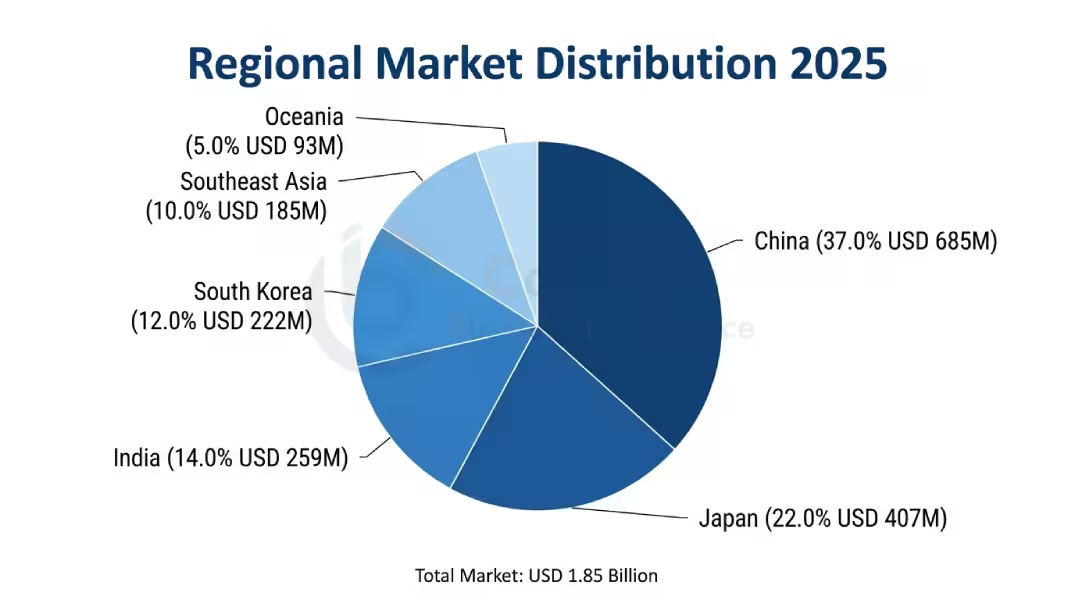
China is the market leader in liquid handling system with USD 685 Million (37.0 percent of market value) in 2025 which is estimated to grow to USD 1.09 Billion in 2034. The dramatic expansion of the pharmaceutical and biotechnology industry in the country is reflected in this leadership, as the pharmaceutical R&D is estimated at USD 42 billion in 2024, and the revenues of the biotechnology industry are estimated at USD 180 billion and above. Large pharmaceutical firms such as Shanghai Pharmaceuticals, Jiangsu Hengrui Medicine, and BeiGene have large research facilities that demand high-level liquid handling automation, and those contract research organizations such as WuXi AppTec and Pharmaron serve international pharmaceutical companies.
The government aid is valuable, and the 14th Five-Year Plan of Pharmaceutical Industry Development provides the huge amounts of resources to biopharmaceutical innovation and domestic technology development. Further growth of the academic research in the form of institutions such as Tsinghua University, Peking University, and Chinese Academy of Sciences brings in another demand, and centralized core at major universities has several automated liquid handling platforms.
India: The Rapidly Growing Market with the Developing Infrastructure.
India is USD 259 Million (14.0 percent of market value) which is growing to USD 459 Million by the year 2034 with the best growth rate of 6.6 percent CAGR in the region. This is the rapid pace of growth due to the booming pharmaceutical and biotechnology, and India is the largest generic drug manufacturer globally, and the new biosimilars manufacturing center. Pharmaceutical firms such as Sun Pharmaceutical, Dr. Reddy’s Laboratories and Biocon are investing heavily in their research capacity in relation to the development of new drugs and the production of biosimilars.
The CROs and CMOs show a strong growth and firms such as Syngene International, Jubilant Biosys, and GVK Biosciences among others have been offering services to multinational pharmaceutical companies. These organizations have invested a lot in automation of their laboratories that have realized cost competitiveness without compromising quality provisions needed by international customers.
Competitive Landscape and Key Market Players
Strategic Positioning and Market Leadership
Thermo Fisher scientific Inc. (United States) - Leadership of comprehensive Portfolios.
Thermo Fisher scientific dominates the Asia Pacific market of liquid handling system with an estimated 2024 regional revenue of USD 370-410 Million, which is about 21- 23 percent market share on products. The competitive positioning of the company is based on the complete product ranges comprising of manual pipettes to full automated platforms, good brand recognition featuring 70-75 percent recognition among laboratory professionals, large distribution channels and combination of liquid handling with thermal cycling and detection features.
Tecan Group Ltd. (Switzerland) - Automation Specialist.
Tecan still has a good market presence with projected 2024 Asia Pacific revenues of USD 280-320 Million, which amounts to about 16-18 percent market share with the focus on high-end automated workstation platforms. The competitive advantage of the company lies in Freedom EVO and Fluent platforms which are used in pharmaceutical drug discovery and clinical diagnostics purposes, modular system structure which allows customization of workflow, and end-to-end service offer.
Hamilton Company (United States) - Accuracy Leader Technologies.
Hamilton has a strong presence with estimated USD 185-225 Million revenues in the Asia Pacific market with 11-13 percent market share by specialization in precision automated liquid handling platforms. Microlab STAR and VANTAGE platform, high-accuracy requirements and high penetration in forensic and biobanking applications are the competitive positioning aspects of the company.
Other Major Market players.
- Eppendorf SE (Germany): USD 165-205 Million regional revenues and good standing in both manual and electronic pipettes and premium positioning.
- Beckman Coulter, Inc. (United States): USD 145-185 Million local incomes, clinical diagnostics specialization in Biomek automated systems.
- PerkinElmer, Inc. (United States): USD 125-165 Million regional revenues, business focus in life sciences research with JANUS workstations.
- Industry Developments in the recent past.
The Industry Recent Developments.
Integration of Artificial Intelligence and Machine Learning (2024-2025).
The key liquid handling system vendors declared the introduction of artificial intelligence that improves the work of the systems and predictive maintenance. Thermo Fisher Scientific introduced AI-based protocol optimization software that examines past dispensing data and automatically changes the parameters and showed a 25-35 percent decrease in the time it takes to develop the protocol and an increase of 15-20 percent in accuracy. Hamilton Company has also added predictive maintenance algorithms that monitors system performance parameters and tracks the degradation trends 4-8 weeks ahead of failures to cut down on the unplanned downtimes by 55 percent.
Solutions in Compact Automation (2024-2025)
In response to the smaller laboratories, manufacturers introduced smaller systems that are automated to provide automation advantages at a smaller capital investment. Eppendorf launched epMotion 5073m with 96-channel pipetting and a small footprint that consumed 60 percent of the space occupied by other systems in the market capable of similar tasks at USD 45,000 as opposed to USD 75,000-95,000 depending on the size of the platform.
Sustainability (2024-2025): Initiatives.
Large producers declared the extensive sustainability initiatives in terms of environmental issues of single-use consumables. Tecan Group introduced Freedom EVO Green Edition with energy saving components that reduce power usage by 40 per cent, reusable tip washing systems that cut disposable tip waste by 95 per cent and a package that is packed on 75 per cent recycled material that promises cost of ownership savings of 25-30 per cent in five years.
Asia Pacific Liquid Handling System Market Report Insights
| Report Attributes | Report Details |
|---|---|
| Study Timeline | 2022–2034 |
| Base Year | 2025 |
| Forecast Period | 2026–2034 |
| Market Size in 2024 | USD 1.75 Billion |
| Market Size in 2025 | USD 1.85 Billion |
| Market Size in 2034 | USD 2.95 Billion |
| CAGR (2026–2034) | 5.3% |
| By Product Type | Automated Systems (50.0%), Electronic & Manual Pipettes (28.0%), Consumables (16.0%), Washers & Dispensers (6.0%) |
| By Application | Drug Discovery (38.0%), Genomics & Proteomics (26.0%), Clinical Diagnostics (22.0%), Academic Research (14.0%) |
| By End User | Pharmaceutical & Biotech (45.0%), Academic & Research (25.0%), Clinical Diagnostics (20.0%), CROs (10.0%) |
| By Distribution Channel | Direct Sales (50.0%), Authorized Distributors (35.0%), Online Platforms (10.0%), GPO & Tenders (5.0%) |
| By Region | China (37.0%), Japan (22.0%), India (14.0%), South Korea (12.0%), Southeast Asia (10.0%), Oceania (5.0%) |
| Key Players | Thermo Fisher Scientific, Tecan Group, Hamilton Company, Eppendorf, Beckman Coulter, PerkinElmer, Agilent Technologies |
| Report Coverage |
|
Key Questions Answered in the Report
What is the market size of the Asia Pacific liquid handling system? −
The Asia Pacific system liquid handling is an industry that has strong growth potentials, with a 2025 value of USD 1.85 Billion, and a future growth scaled of USD 2.95 Billion with a compound annual growth rate of 5.3 percent. The market includes the annual sales of about 155 000-175,000 units of each type of products, with the volume of sales of manual and electronic pipettes including 75-80 percent of the unit volume, and a market value of 28 percent. Automated liquid handling systems are 8-12 percent of unit volumes achieving 50 percent of market value because capital equipment costs USD 50,000-500,000 per unit.
Which are the key growth makers in the Asia Pacific market? +
The key drivers of growth include rapid pharmaceutical and biotechnology R&D growth with regional expenditures of over USD 185 billion yearly growing by 8-10 percent, government support programs such as the pharmaceutical industry development plans of China and biotechnology programs of India, lab automation adoption due to skilled working shortages and reproducibility and infrastructure development of clinical diagnostics with the Asia Pacific diagnostics market of USD 82 billion in 2024 increasing at 7-9 percent per annum.
Does the Asia Pacific market have substantial regional differences? +
The industry has substantial regional variations in the market with China dominating a market share of 37.0 percent by advancing pharmaceutical R&D and government-backed innovation initiatives whereas Japan and India have a market share of 22.0 percent and 14.0 percent respectively due to the growing biotechnology industries and the emergence of contract research organizations.
What is the nature of the competitive environment and the market structure? +
Asia Pacific market has moderately competitive structure with Thermo fisher scientific controlling 21-23 percent of the market share with overall products portfolios and extensive distribution network, Tecan Group controlling 16-18 percent of the market share with high end automated platform and Hamilton with precision specialization technology. The market is well segmented with the premium automated systems being sold to pharmaceutical companies and big research institutions at USD 150,000-500,000 price ranges, and the value segments at USD 3,000-50,000 price ranges with the electronic and manual pipette products being sold to the cost consciousness customers.
What technology and product trends work to shape the evolution of the market? +
Developments such as integration of artificial intelligence and machine learning to optimize protocols and predictive maintenance, compact benchtop automation systems whose size can access more markets with 60 percent less bench space and cost 30-40 percent less than traditional systems, sustainability efforts to address environmental issues with reusable components and energy-efficient designs, and application-specific automation solutions with optimized workflows and pre-tested protocols have been made.
Overview
Reputation & Certifications


Our Services
- Market Intelligence & Forecasting
- Custom Research Solutions
- Market Entry Strategy
- Competitive Intelligence
- Customer Insights
- Industry Innovation Analysis
- Investment Advisory