Jump to Content
Asia Pacific Personal Consumer Electronics Market - Size, Share, Industry Trends, and Forecasts (2025-2034)
Executive Summary
The Asia Pacific personal consumer electronics market has the largest and the most dynamic technology ecosystem in the world, and it includes smartphones, laptops, tablets, wearable devices, wireless audio equipment, gaming consoles, and new technologies, including AR/VR headsets. This broad market caters to individual customers in the communication, entertainment, productivity, health monitoring and digital lifestyle applications in the diverse economies between the developed markets such as Japan and South Korea, and the emerging markets such as India, Indonesia, Vietnam and Philippines growing fast.
The market is characterized by extraordinarily high commercial scale with a valuation of USD 425.80 Billion in 2024 and USD 448.50 Billion of 2025 as the base year in terms of the analytical projections. According to market projections, there is a strong growth trend that will see the market is expected to reach USD 742.60 billion by 2034, with a compound annual growth rate of 5.7 percent during the 2026-2034 prediction period. This massive expansion momentum has been informed by several convergent forces such as the growing artificial intelligence adoption into consumer devices, the large-scale deployment of 5G networks, the growth in the population of middle classes with rising disposable incomes, the governmental movements toward digitalization, and the shift of device replacement cycles into ecosystem adoption models.
Asia Pacific Personal Consumer Electronics Market Report Insights
- Asia Pacific
- Dominated the market in 2022 with a 42.10% share, valued at USD 484.43 million, projected to reach USD 669.43 million by 2030
- China led the region with a 25.06% market share, driven by strong industrial growth
- Growth fueled by expanding automotive and aerospace industries
- Accounts for a significant share of global automotive production (~58.84%), boosting demand for carbide inserts
- Increasing industrial manufacturing activities accelerating product adoption
- North America
- Expected to witness steady growth with a CAGR of 5.1% (2023–2030)
- Growth driven by rising demand across automotive, aerospace, construction, and mining sectors
- Other Regions
- Europe, Middle East & Africa, and Latin America contribute to overall market expansion and diversification

Market Scope & Overview
The Asia Pacific personal consumer electronics market also functions under various regulatory and economic conditions including highly developed markets and high product safety standards to emerging markets having a developing digital infrastructure. The market has all-inclusive product categories that cater to the various consumer segments such as the premium flagship product with a price range well above USD 1,000, mid-range products with price ranges of USD 250-800 and entry-level products with prices below USD 250 and catering to price-sensitive consumer groups.
Modern personal electronics is highly technologically integrated with flagship smartphones that have more advanced features such as 5G connectivity with multi-gigabit download speeds, artificial intelligence processors with 20-40 trillion operations per second, camera systems with 200+ megapixel cameras with computational photography features, and display technologies with 120Hz+ refresh rates with up to 2000nits peak brightness. Premium laptops combine 16-32 core processors with dedicated graphics processors with 40-plus teraflops of computational power and 15-20 hours of operational capacity under normal use patterns.
The manufacturing ecosystem is characterized by a high level of vertical integration whereby the top companies manage design, component manufacturing, assembly process, and distribution channels. Supply chains regional supply chains include semiconductor fabrication plants in Taiwan, South Korea, and China that manufacture 68 percent of all semiconductors around the world, display-panel manufacturing based in China, South Korea, and Japan, and final assembly based in China, Vietnam, India, Thailand, and Indonesia where there are cost advantages and market proximity.
Key Market Driver
Artificial Intelligence Implementation and In-Device Processing Revolution.
The internalization of high-performance artificial intelligence features directly into the personal consumer electronics devices constitute the most notable force of the market, which is providing a transformative upgrade cycle wherein consumers upgrade their current devices to enable powerful AI-driven features that necessitate specific neural processing units and increased computing power. In 2024, the consumer electronics AI chipset market in the world was USD 22.8 billion and the Asia Pacific accounts for 58% of global demand due to concentration of manufacturing in the region and early trends of technology adoption.
The main processors of leading manufacturers offered dedicated AI processors with Apple's A17 Pro, which has a Neural Engine processing 35 trillion operations per second with 16 cores, Qualcomm's Snapdragon 8 Gen 3, which includes Hexagon NPU processing 73 trillion operations per second, MediaTek's Dimensity 9300 and Samsung’s Exynos 2400 provides advanced AI processing capabilities with high-performance NPUs delivering up to 180 trillion operations per second.
These specialized processors enable advanced software applications such as advanced on-device AI applications such as real-time language translation that supports 50+ languages, computational photography with multi-frame processing and generative content editing functions, voice assistants with natural language understanding and contextual awareness, personalized content recommendations with privacy preserving local processing, and health monitoring with AI powered pattern recognition to use as early warning systems.
China has the highest adoption of AI devices, with 285 million units shipped of AI-enabled smartphones in 2024 (42 percent of all smartphone shipments) and India with 48 million units shipped (28 percent of all smartphone shipments) and South Korea with 85 percent showing penetration of AI devices in premium smartphone purchases. Government programs such as the National AI Strategy by China, which plans to use USD 150 billion in AI development until 2030 and programs such as the National AI Mission in India, which plans USD 45 billion in AI ecosystem investments, are driving adoption in consumer electronics segments.
The AI-powered device segment attracts a high price and the average selling prices of AI-enabled smartphones are USD 720 up against USD 385 of the conventional smartphones which is 87 percent price premium. According to market research, 68 percent consumers aged between 18-40 years are willing to pay 20-35 percent of premiums on devices that have advanced AI capabilities and this will provide a favorable environment to optimize product mix and increase margins over the forecast period.
Key Market Restraint
Technology Geopolitical limitations and Supply Chain Vulnerabilities.
The Asia Pacific individual consumer electronics market is facing a significant threat of the weakness of supply chains and the increasing geopolitical conflicts on technology transfer, component availability, and manufacturing activities. The semiconductor sector, which is the core of all consumer electronics, portrays high concentration risk where Taiwan accounts 63 percent of semiconductor production in the world and South Korea accounts 28 percent forming potential disruption points in the whole supply chain in any part of the region.
Recent geopolitical changes such as export of technologies, state of the art semiconductor manufacturing tools as well as trade policy uncertainties are major factors that influence the market dynamics. United States export limitations on semiconductor manufacturing equipment of high technology to China impacted about USD 45 billion of potential technology shifts in 2023-2024, compelling Chinese producers to find other suppliers and potentially affecting the product development cycle.
Currency risks in emerging markets of Asia Pacific present further limitations where a number of currencies will suffer massive depreciation against the US Dollar in 2024 with Indonesian Rupiah going down 8.2 percent, Philippine Peso 6.4 percent and Vietnamese Dong 5.8 percent. Such currency flows raise the prices of imports of components and finished goods, which translates to retail price increases of 10–18% for consumer electronics in impacted markets making them less affordable and limiting demand growth.
The cycles of component shortages impact production planning with the supply of memory chips varying by 25-40 percent every quarter, display panels supply varies by 15-25 percent and specialized AI processors supply is constrained by foundry capacity. These supply constraints compel manufacturers to alter production plans which may slow down product releases into the market and reduce availability of inventory at the most active times of the year.
The long product life cycles of the modern electronic products only worsen the replacement demand since the flagship smart phones have operational life beyond 5-6 years due to software updates, battery replacement schemes, and modular repair programs. The major manufacturers adopted long-range software support plans such as Samsung committing 7 years of security patches, Apple committing 6-8 years of iOS updates, and Google committing 7 years of Android updates, which lowers the urgency to upgrade their current devices and prolongs the replacement timeline.
Key Market Opportunity
Aging Population: Ecofriendly Wearables and Ecosystems.
The integration of both personal gadget environment with health tracking services are unprecedented market prospects, especially to the fast-ageing demographics in the maturity Asia Pacific economies and the growing health-aware markets in the new economies. In 2024, the population aged 65+ in Japan grew to 29.8 percent, and in South Korea and China to 18.4 percent and 14.2 percent respectively, making the country an ideal market with the need to purchase health-related personal electronics with medical-grade monitoring features.
The rise in wearable gadgets with enhanced health-related functions such as constant monitoring of the heart rate, blood oxygen, ECG, sleep patterns, stress, and falls indicate high adoption rates. Smartwatches with FDA approved health tracking capabilities are sold at average selling prices of USD 385-650 as opposed to USD 125- 250 of plain fitness trackers, and offer decent revenue potential to manufacturers that make investments in integrating health technology into their products.
With wearable data increasingly being adopted into the medical records and preventive care programs of the regional healthcare systems, Singapore Health Hub platform that connects 2.8 million citizens with digital health services, Japan Society 5.0 initiative, which aims to get elderly populations to adopt health technologies, and K-Digital Health platform, which is aiming to connect 15 million citizens by 2027. The programs, backed by the government, generate long-term demand in the personal electronics that are health-conscious as well as generate repetitive revenue streams through subscription-based health insights programs and telemedicine.
Ecosystem integration opportunity is not limited to health monitoring but extends to the full portfolios of connected devices where consumers purchase more than one device produced by the same manufacturer to ensure a connected experience, application compatibility, synchronized data and integrated user experiences. First-mover manufacturers record ecosystem buyers are associated with 3.2x more lifetime value than single- devices buyers and ecosystem adoption has risen to 42 percent among the premium device buyers in developed markets in Asia Pacific.
Improvement of artificial intelligence in health monitoring capabilities allows predictive insights into health, personal wellness advice, and alert systems to potential health problems and develops strong value propositions to justify higher prices and motivate people to upgrade their devices to gain access to improved functionality.
Market Segmentation Analysis
By Product Type: Comprehensive Technology Portfolio
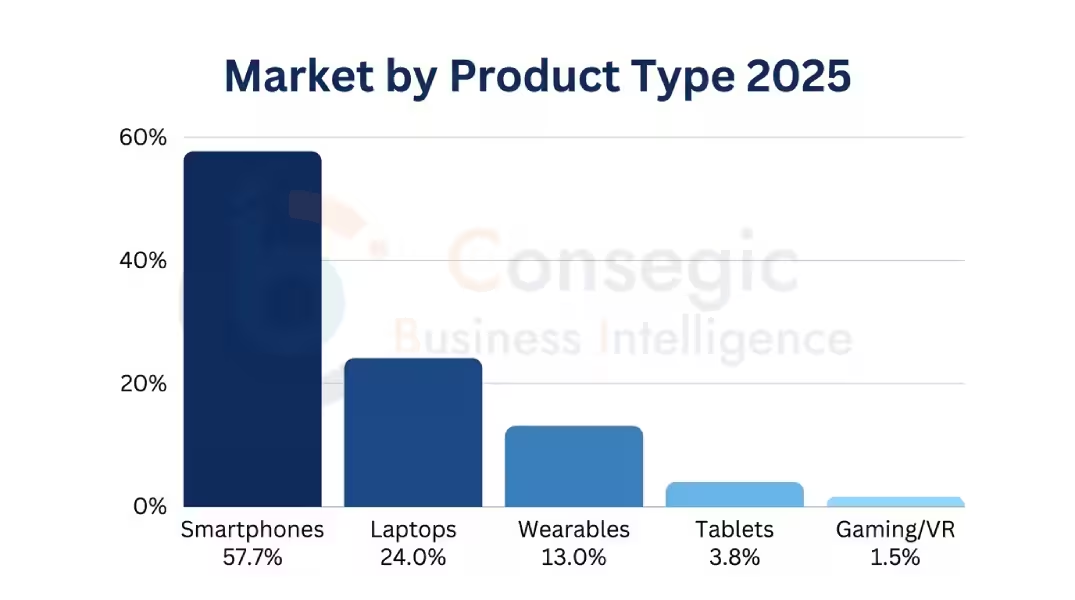
Smartphones Control the Market Valuation.
The largest market is Smartphones with USD 258.90 Billion of total market value, which will be 57.7 percent of the total market value in 2025, and USD 414.25 Billion in 2034. This segment includes the high-value flagship products above USD 800 with advanced AI and high-quality camera systems, middle-tier smartphones with a USD 250-800 range of products with balanced performance-wise and features, and low-end products under USD 250 that targets price-sensitive customers and first-time smartphone users.
The segment enjoys unending innovation cycles that bring more advanced artificial intelligence processing, smarter camera technology with computational photography, faster charging technology that can support 100W and more charging speeds, and new display technology such as foldable displays or high frequency rate display. In 2024, Asia Pacific smartphone shipments reached 1.32 billion units including China with 295 million units, India with 168 million units, Indonesia with 52 million units, Vietnam with 38 million units and Thailand with 28 million units.
Productivity Segment is powered by Laptops and Computing Devices.
In 2025, Laptops will have USD 107.64 Billion representing 24.0 percent of the market value, and this figure is projected to grow to USD 178.22 Billion by 2034. This category includes productivity-focused clamshell notebooks, 2-in-1 convertibles, game specific laptops with their own graphics cards, ultraportable laptops with a focus on mobility and battery life, and newer AI-enabled laptops with neural processing units to boost performance.
The lack of home-to-work and education digitalization efforts spurred the rapid acceptance of laptops with commercial shipments growing 35 percent in 2020-2024. Education initiatives such as the Digital Education Mission in India allocated 22 million laptops and tablets to learners in 20222024, and business hybrid work arrangements maintained the high demand of high-end business laptops.
Wearables Show the Best Growth Prospectus.
Wearable products such as smartwatches, fitness trackers, and wireless earbuds represent USD 58.27 Billion that constitutes 13.0 percent of market value in 2025 which is USD 118.51 Billions in 2034 showing the highest segment growth rate of 8.4 percent. Monitoring features such as heart rate, blood oxygen, ECG, sleep, and stress monitoring features make it easier to be adopted with 72 percent of users citing health features as their leading purchase reasons.
True Wireless Stereo (TWS) earbuds entered mainstream markets in all price points with shipments of 385 million True Wireless Stereo earbuds in Asia Pacific in 2024, which is a 28 percent growth in annual shipment. Premium models with active noise cancellation, spatial audio and health monitors are sold with average selling price USD 180-350, and entry-level models below USD 50 models lead to volume adoption in the emerging markets.
By Price Segment: Market Positioning Dynamics
Mid-range Segment has the biggest market share.
Mid-range prices of USD 250-800 command USD 197.74 Billion or 44.1 percent market worth in 2025 growing to USD 327.34 Billion in 2034. The segment provides the best balance between advanced capabilities and reachable prices, with 5G connectivity, multi-camera experience with AI support, rapid charging, and sufficient computing power to support the mainstream uses of the device such as gaming, photography, and everyday work.
Chinese brands such as Xiaomi, OPPO, Vivo, and Realme have shown specific competence in the middle-range positioning with the active integration of features, their competitive price policy, and the presence of an extensive chain of distribution in the new markets. The segment enjoys the trickle-down effects of technology where the devices that have higher-end features can be found in mid-range models within 12-18 months of launching the flagship.
Value Creation is created in Premium Segment.
High-end products over USD 800 will be USD 129.65 Billion with 28.9 percent of the market value in 2025, which is expected to be USD 215.35 Billion in 2034. This category includes Apple, Samsung, and high-end smartphones, high-end laptops with sophisticated processors and graphics, as well as premium wearable with full health tracking functionality.
The segment enjoys brand loyalty, ecosystem integration enjoyments, and status symbolism especially in the developed markets such as Japan, South Korea, Singapore, and urban China. The buyers of premium devices have a higher level of ecosystem adoption, extended brand retention, and more willingness to acquire accessories and services, which form positive lifetime value profiles.
By Distribution Channel: Evolving Retail Landscape
The Internet Retail shows quick expansion.
Online retailing channels such as e-commerce services, manufacturer direct-to-consumer websites and mobile commerce applications represent USD 197.74 Billion that count 44.1 percent of market value in 2025 with an estimated USD 356.65 Billion in 2034 showing the highest channel growth rate of 6.8 percent CAGR. The advantages of this channel include easy side by side comparison of products, competitive pricing, wide product range, in-depth product reviews and ratings and the provision of convenient home delivery services.
China is the pace setter in online retail of electronic products through sites such as Tmall, JD.com and Pendulous who together are projected to create USD 145 billion in consumer electronics gross merchandise value in the year 2024. In India, electronics sales in e-commerce amounted to USD 38 billion in 2024 and Amazon India, Flipkart, and new platforms hold 75 percent of the total market share. The platforms such as Shopee, Lazada and Tokopedia in Southeast Asia made USD 28 billion in transactions in electronics in the regional markets.
Offline Retail Still has Experiential Advantages.
The traditional retail channels such as specialty electronics, brand exclusive, and multi-brand retailers will constitute USD 161.46 Billion that will be considered 36.0 percent market value in 2025. Experiential features offered through this channel such as the evaluation of products through hands-on experience, instant gratification of purchasing products, customer sales service, technical support, and product demonstration especially relating to high end products and complex products.
Regional Market Analysis
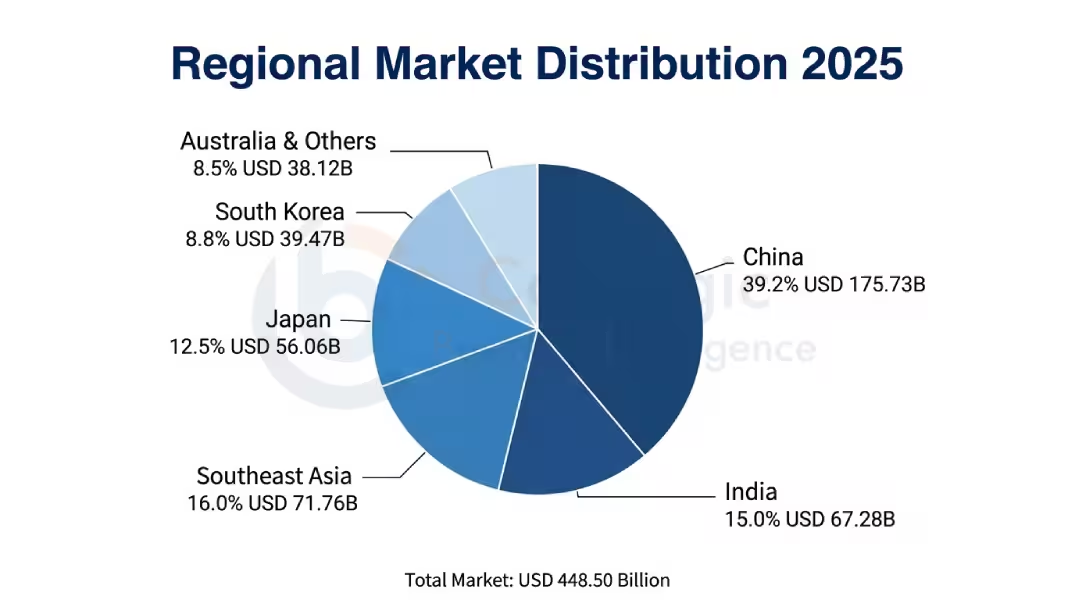
China: Factory and Biggest Consumer.
China takes the leading market share of USD 175.73 Billion which is 39.2 percent of the entire market value in 2025, with the projection of USD 291.08 Billion in 2034. The market enjoys the two-fold benefits because global manufacturing center contributes 45 percent to the global consumer electronics output amounting to USD 1.8 trillion per year, and also, happens to be the largest consumer market in the world with a 1.41 billion population and rising middle income brackets of over 420 million consumers.
In the combined smartphone market share in 2024, Apple with 16 percent, Huawei with 14 percent, OPPO with 15 percent, vivo with 13 percent, Xiaomi with 14 percent and Honor with 4 percent topped the list of domestic manufacturers. The market is characterized by high premiumization tendencies where the average prices of smartphones are expected to rise in the period between 2020 and 2024, including USD 285 to USD 420, as the population of the market is expected to migrate to the feature-rich devices with AI capabilities and premium quality of the material.
The government plans such as Made in China 2025 strategy and Digital Economy Development Plan encourage business upgrading of technology and consumption. The aim of the plan is to have the contribution of the digital economy reaching 50 percent of GDP in 2025 (based on 41.5 percent in 2022) by ensuring that there will be massive consumer electronics adoption of both urban and rural markets. In 2023-2024, provincial governments have used consumer electronics purchase subsidies of up to RMB 52 billion to stimulate replacement demand in rural markets especially, as well as contribute to the use of domestic brands.
India: Biggest Fastest Growing Market.
India is USD 67.28 Billion representing 15.0 percent of overall market value in the year 2025 with an expected growth to USD 133.47 Billion in the year 2034 with the fastest growth rate of 7.9 percent CAGR during the forecast period. This massive growth is owed to positive demographic trend with 1.43 billion population with 680 million people aged less than 35 years and rapidly growing middle class that is projected to rise to 600 million people before 2030, growing smartphone penetration of 52 percent in 2022 to 76 percent in 2024, and pervasive government digitization programs that is accelerating the use of technology.
Production Linked Incentive scheme provided INR 410 billion in support of domestic manufacturing of electronics, and attracted large investments such as Apple increasing iPhone production capacity to 32 million a year with a partnership with Foxconn and Tata Electronics, Samsung investing USD 950 million in manufacturing capacity development as the world largest smartphone factory, and Xiaomi building component manufacturing plants eliminating reliance on imports.
The market dynamics of smartphones depict stiff competition with Xiaomi, Samsung and Vivo as the market shareholders of 17 percent, 16 percent and 15 percent respectively in 2024, and OPPO, and Realme as market shareholders of 11 percent and 10 percent respectively. Market positioning focuses on low-cost segments with 68 percent of shipment being less than USD 300 but high-end segments above USD 800 that have shown excellent growth with 28 percent CAGR led by Apple and Samsung flagship models with finance schemes and trade-in programs.
Southeast Asia: New Growth Corridor.
Southeast Asia is USD 71.76 Billion that will contribute 16.0 percent to the overall market value in 2025, which is set to grow to USD 133.47 Billion in 2034 and has strong growth momentum at 7.1 percent CAGR. The region has a wide array of markets such as Indonesia with 275 million population, Vietnam 98 million, Philippines 115 million, Thailand 70 million, Malaysia 33 million and Singapore 6 million, which have a total population of 690 million people with median age of 30 years that will make the area conducive to technology adoption.
Indonesia has the best regional performance with USD 26.4 billion which is 37 percent of the Southeast Asian value with rapidly increasing smartphone adoption of 84 percent penetration and a growing middle-class estimated to be 140 million individuals by 2030. Vietnam takes USD 17.2 billion as 24 percent of the regional value with manufacturing industry development with electronics exports amounting USD 158 billion in 2024 and domestic consumption growth with urbanization and increasing incomes.
Recent Developments and Industry Dynamics
Integration and Development of Artificial Intelligence (AI) in the platform (2024-2025)
- In January 2024, Samsung introduced wide-ranging Galaxy AI suite in flagship Galaxy S24 series, with transformative features such as Circle to Search which enables visual search capabilities via camera input, Live Translate that provides real time voice and text translation in 15 languages, Generative Edit which offers AI-based photo manipulation and enhancement, Note Assist which provides meeting transcription with smart summarization, and Chat Assist which provides writing suggestions and tone adjustment. The company declared that it is going to expand Galaxy AI capabilities to 120 million devices by the end of 2025 to include mid-range Galaxy A series handsets.
- In September 2024, Apple unveiled Apple Intelligence platform integrated in iPhone 16 series, iPad Pro M4, and MacBook Air M3 devices, which have an improved Siri with natural language understanding, contextual awareness, AI-assisted writing features across all apps, email writing and summarization with natural language support, and on-device processing architecture, making sensitive data local.
- Xiaomi has increased HyperOS AI integration on flagship 14 Ultra series released in February 2024, with conversational AI assistant, supporting Mandarin and English, real-time language translation supporting 35 languages, AI-assisted photography with scene recognition and optimization, tuned to optimization depending on usage patterns, and smart home integration, allowing control of connected devices using natural language.
Capacity Building Within the Manufacturing (2023-2025) and Geographic (2023-2025) Diversifications.
In 2023-2025, Apple had invested USD 3.2 billion in production capacity expansion which led to a rise in iPhone production, which started at 8 million units in 2022 and reaching 32 million units in 2024 at 9 percent of the global iPhone production. In November 2023, Tata Electronics purchased the India business of Wistron, which resulted in the first Indian conglomerate involvement in the premium device distribution system of Apple and a domestic electronics manufacturing industry leader.
In the year 2024, Samsung made USD 1.1 billion investments in manufacturing expansion in India and expanded its Noida facility to reach an annual production capacity of 150 million smartphones making it the largest smartphone manufacturing facility in the world. This growth also includes a new level of automation such as robotized assembly lines, automated quality control devices, and sustainable production with a 25 percent lower energy usage than the older generation plants.
Vietnam became an important manufacturing center with total electronics exports of USD 158 billion in 2024, whereby Samsung set up smartphone production capacity of 280 million units annually, Foxconn raised assembly capacity of Apple products such as iPads, MacBooks, and Intel putting USD 1.8 billion in semiconductor assembly and test facility development to create 15,000 more employment.
5G Network Implementation and Portfolio Growth (2024-2025).
China has a wide-ranging network coverage with 3.85 million base stations deployed as of December 2024 across all the prefecture-level city networks and 99 percent administrative regions of counties to provide 925 million 5G subscribers, representing 54 percent of the mobile subscriber base. Key telecom companies such as China Mobile, China Unicom and China Telecom invested USD 185 billion in the development of 5G infrastructure between 2020-2024.
In 5G, India plans to roll out 5G in 180 cities by December 2024 with telecommunications operators dedicating USD 32 billion to acquire spectrum and build infrastructure that will serve 600 million subscribers to 5G by 2027. Reliance Jio implemented 450,000 5G base stations, which have a coverage of 5500 cities and towns, and Bharti Airtel implemented 380,000 base stations with coverage of major metropolitan areas and trading centers.
Manufacturers increased 5G device lines covering mass markets with Qualcomm launching the Snapdragon 4 Gen 3 processor that supports 5G connectivity in sub USD150 smartphones, MediaTek releasing Dimensity 6400 chipset to support 5G-based products at USD120 or lower, and UNISOC launching Tiger T820 platform to support 5G-based products in emerging markets.
Asia Pacific Personal Consumer Electronics Market Report Insights
| Report Attributes | Report Details |
|---|---|
| Study Timeline | 2022–2034 |
| Base Year | 2025 |
| Forecast Period | 2026–2035 |
| Market Size in 2025 | USD 4,985 Million |
| Market Size in 2035 | USD 448.50 Billion |
| Market Size in 2034 | USD 742.60 Billion |
| CAGR (2026–2034) | 5.7% |
| By Product Type | Smartphones (57.7%), Laptops (24.0%), Wearables (13.0%), Tablets (3.8%), Gaming/VR (1.5%) |
| By Price Segment | Mid-Range USD 250-800 (44.1%), Premium Above USD 800 (28.9%), Entry-Level Below USD 250 (27.0%) |
| By Distribution Channel | Online Retail (44.1%), Offline Retail (36.0%), Direct B2B & Carriers (19.9%) |
| By Region | China (39.2%), India (15.0%), Southeast Asia (16.0%), Japan (12.5%), South Korea (8.8%), Australia & Others (8.5%) |
| Key Players | Industrial, Utilities, Commercial, Distributed Generation |
| By Region | Samsung, Apple, Xiaomi, OPPO, Vivo, Realme, Huawei, Lenovo, ASUS, Sony, LG |
Key Questions Answered in the Report
How big and how big is the Asia Pacific market of personal consumer electronics? −
The Asia Pacific personal consumer electronic market can be regarded as having a magnificent commercial size with a valuation of USD 448.50 Billion in 2025 as the starting point of conducting a detailed market analysis. The market shows a strong growth trend with the forecasts that it is going to grow to USD 742.60 Billion in 2034 which translates into a compound annual growth rate of 5.7 percent within the 2026-2034 prediction time frame. This impressive expansion momentum indicates a combination of several intersecting factors such as the integration of artificial intelligence leading to the device upgrade cycles, the widespread implementation of 5G networks to facilitate the use of more applications related to enhanced connectivity, an increase in the population of middle-class people to over 2.2 billion people by 2030, and the government digitalization process that fosters the use of technology among the previously underserved demographics and geographic regions.
What are the dominant product lines in the market and what are the best growth prospects? +
Smartphones take dominant position in terms of USD 258.90 Billion with representation of 57.7 percent total market worth in 2025, bringing in combination of essential communication features, continuous innovation with 1.42 billion 5G subscribers in Asia Pacific. Laptops take the second-largest share at USD 107.64 Billion that constitutes 24.0 percent of market value with boosted hybrid work, digitalization programs in the education sector, and AI-enhanced computing needs. Wearable devices show the greatest growth potential of 8.4 percent CAGR that grows by USD 58.27 Billion in 2025 to USD 118.51 Billion in 2034 due to the ability to help people monitor their health, fit in fitness-tracking features, and integrate with smartphones, as well as the aging population that creates an opportunity in the medical-grade monitoring devices market.
Which are the main drivers of growth that are driving market expansion in Asia Pacific? +
The most meaningful growth driver is the integration of artificial intelligence where manufacturers are adding special neural processing units to support advanced on-device AI features such as real-time language translation, computational photography, the generation of content, and personalized assistance. Devices with AI potential command price premiums of 65-85 percent over traditional products and 68 percent of consumers aged 18-40 years are willing to pay 20-35 percent higher prices on advanced AI products. And the wide rollout of 5G infrastructure with regional governments spending USD 385 billion in 2020-2024, 5G supports 3.85 million base stations in China alone, and 925 million 5G subscribers that spur the device upgrade cycle. Digitalization initiatives such as the Digital India program by India, Digital Economy Development Plan in China, which aims at achieving 50 percent contribution to GDP by digital economies, and digital transformation plans by various countries in the Southeast Asia all facilitate the use of technology by emerging populations.
What are the best market areas in terms of performance and growth opportunities? +
China has dominant market position of USD 175.73 Billion that represents 39.2 percent of total market value in 2025 since it enjoys two-sided benefits as world manufacturing hub that manufactures 45 percent of all global consumer electronics and at the same time it has the largest consumer market of 1.41 billion populations and ever-growing middle classes of more than 420 million. India has the highest major market growth rate of 7.9 percent CAGR growing between USD 67.28 Billion in 2025 to USD 133.47 Billion in 2034 due to its favorable demographics with 680 million persons below the age of 35 years, smartphone penetration rate of 52 percent in 2022 to 76 percent in 2024 and Production Linked Incentive scheme that will attract USD 32 billion worth of manufacturing investments. The Southeast Asia demonstrates USD 71.76 Billion having high growth momentum at 7.1 percent CAGR representing a diverse market with a total population of 690 million consumers and median age of 30 years.
What are the changes in the competitive environment through technological advances? +
The integration of AI is fundamentally changing the nature of competitive dynamics with manufacturers differentiating on proprietary AI capabilities, on-device processing architecture, and ecosystem integration strategies. Major firms have invested 4-8 percent of revenues in AI research and development with Samsung Galaxy AI, Apple apples Apple Intelligence, and Xiaomi HyperOS developing different value propositions beyond their traditional hardware specifications and manufacturers are diversifying their device offerings as new opportunities emerge. The role of ecosystem strategies is growing as the company is providing integrated device portfolios where smartphones, wearables, laptops and connected accessories are able to deliver seamless user experiences, common applications and synchronized data to build brand loyalty and raise the customer lifetime value due to adoption patterns associated with multiple devices.
What are the challenges and opportunities defining the supply chain and manufacturing environment? +
Diversification in the supply chain takes a shorter time as manufacturers eliminate the single country production by geographically distributing production. The scheme of Production Linked Incentive in India has been effective in bringing in huge investments as Apple increased iPhone production to 32 million units yearly, Samsung created world's largest smartphone factory and several Chinese manufacturers set up local assembly units. Vietnam would become key manufacturing center with electronic exports functioning up to USD 158 billion in 2024, whereas Thailand, Indonesia and Malaysia would be targeted in component manufacturing investments. Nonetheless, geopolitical tensions and technology export controls pose a strategic challenge that needs supply chain resiliency planning, alternative sourcing strategy, and domestic capacity building in strategic technology areas such as advanced semiconductors, display panels and specialized components.
Overview
Reputation & Certifications


Our Services
- Market Intelligence & Forecasting
- Custom Research Solutions
- Market Entry Strategy
- Competitive Intelligence
- Customer Insights
- Industry Innovation Analysis
- Investment Advisory