Jump to Content
Asia Pacific Pet Food Packaging Market - Size, Share, Industry Trends, and Forecasts (2025-2034)
Asia Pacific Pet Food Packaging Market Executive Summary
Asia Pacific pet food packaging market is a dynamic and fast changing market in the wider industry of flexible and rigid packaging. It covers an extensive scope of forms such as bags, pouches, cans, containers, and specialized solutions that are meant to guarantee the quality of the nutritional values, safety of the products, convenience, and brand communication across dry pet food product, wet food, treats, and specialized nutrition products. The market has a wide range of consumer segments, including cost-conscious buyers and the high-end customers of the pet market. Its uses include dog food, cat food, small animal feed, aquarium food, and bird food products, in which the packaging qualities of being resistant to moisture, oxygen and light, resealable, portion controlled, and sustainable choice of materials are essential in maintaining the integrity of their products, increasing their shelf life and assisting them in meeting the changing expectations of consumers in the retail and e-commerce markets.
In the base year, the market is estimated to be USD 4.32 billion and is expected to hit USD 7.18 billion in the year 2034 which has a CAGR of 5.8% in 2026-2034. The contributing factors to this growth are various structural conditions such as the growing urbanization and development of nuclear homes (homes with a nuclear family) which are contributing to the rise in pet ownership rates. The current trend of humanization of pets where pets are increasingly being treated as family members is increasing the pressure on high quality, long lasting, and attractive packaging systems. Simultaneously, the rapid growth of e-commerce channels is demanding more resistant and protective packaging solutions that can carry out the multimedia logistics and handling requirements. Also, the luxury of pet food, especially to natural ingredients and specialized nutrition is influencing that an advanced packaging with high barrier properties is required. Meanwhile, an increased environmental consciousness is compelling manufacturers to seek recyclable and sustainable packaging options, as well as smart technologies including QR codes to facilitate provide traceability, product authentication, and a deeper customer experience.
Regional Trends and Insights
Market Growth
- Market Size: USD 1.85B (2025) → USD 3.68B (2034)
- Growth Rate: CAGR 7.9% (2026–2034)
- Indicates strong growth potential
Key Growth Drivers
- Rapid growth of cell & gene therapies
- Shift to serum-free & chemically-defined media
- Expansion of biologics manufacturing
- Rising investment in cellular agriculture
Emerging Region
- Eastern Europe: Fastest growing (CAGR > 9.5%)
- Growth in CDMOs & bioprocessing plants
- Increasing FDI & tech transfer activities
Innovation in Packaging and Materials.
The new pet food packaging has integrated the latest technologies which include multi-layered laminated structures which consist of a combination of polyethylene, polypropylene, polyester and special barrier films that offer an oxygen transmission rate of less than 1.0 cubic centimeters per square meter per 24 hours, moisture vapor transmission rate of less than 2.0 grams per square meter per 24 hours, high barrier metallized films with a barrier efficiency of 95-99 percent and zipper closure systems with slider mechanisms offering over 200 open-close cycles. High-end flexible packaging has a puncture resistance of 8-15 Newtons, tear propagation resistance of 450-750 grams force and seal strength of 15-30 Newtons per 15 millimeters width that would assure the product integrity even within the complicated distribution channels and handling by the consumer.
The wide-ranging changes are fundamental in the Asia Pacific pet care industry where the market value of USD 32.8 billion every year is witnessing transition to branded packaged products, shift toward premium and super-premium segments, growing at 12–15% annually, premiumization to natural ingredients and specialized nutrition with a need of sophisticated packaging protections, sustainability pressures which demand reduction of plastic packaging and recyclable packaging which requires use of QR codes and smart packaging to provide traceability, authenticity checking and consumer interaction. The forces in this industry are both a challenge and an opportunity to the manufacturers of pet food packaging who are innovating as per the changing brand requirements, regulatory standards and changing consumer preferences in various markets.

Key Drivers:
Trends of Pet humanization and premiumization.
The most significant source of demand is the cultural shift that is never been seen before to pet humanization throughout the Asia Pacific market where pets are now being treated as family members and thus getting high-quality food, special care and fancy packaging worthy of their status in the families. It is estimated by the regional pet industry that in 2024, the pet population in Asian Pacific consisted of 672 million companion animals, including 12.4 percent growth over 2019 and comprised of 418 million dogs, 186 million cats, 48 million small mammals, and 20 million other pets. This growth forms huge addressable market of packaged pet food where penetration rates of branded packaged products are growing to 44 percent in 2019, and 61 percent in 2024, across the region, due to urbanization, disposable income growth and fundamental changes to the pet-owner relationships.
The humanization of pet’s phenomenon has a vast effect on the packaging needs, with pet owners requiring high-end packaging design that is similar to that of human food, convenient packaging features such as resealable closures and single-portions, informative communication provided by a detailed description of nutritional value and the origin of ingredients used, and the use of sustainable materials as a reflection of environmental concern. The high price points of the premium and super-premium segments of the pet food market, 40-65 percent higher than the economy segments, experience 12-15 percent compound annual growth and demand advanced packaging solutions with high printing quality using photographic images, special barrier properties that maintain the nutritional values of the natural ingredients without any artificial preservatives, and novel packaging formats such as portion-controlled pouches and sustainable packaging materials that support premium positioning.
E-commerce Penetration and Growth of Digital Commerce.
The rapid growth of the use of e-commerce channels as the method of purchasing pet food completely changes the nature of the packaging needs where high durability, protective properties, and unboxing experiences that prevent any damage of the product during shipment and handling and leave a good brand image are required. In 2024, the Asia Pacific online pet food sales had hit USD 9.2 billion, forming 28.1 percent of the total pet food sales, and it showed compound annual growth of 31.4 percent since 2019, due to convenience, competitive pricing, subscription services and high product variety not available in the traditional retail outlets. There is a wide disparity on e-commerce penetration amongst the markets with China leading the pack with 45 percent penetration in online sales, South Korea with 36 percent, Japan with 32 percent and other emerging markets like India, Indonesia and Vietnam with 16-22 percent penetration but still increasing at a high rate.
The e-commerce distribution introduces certain packaging-related issues that demands higher puncture resistance to avoid product damage during automated sorting and handling systems, better seal integrity to avoid leakages of product during multiple handlers on the package, reduced package sizes that fit into the standard shipping boxes and avoid void fill-ups that reduce transportation expenses and consumer-friendly unpacking experiences with easy-open seals and clear disposal guidelines. The subscription-based pet food delivery systems, which constitute 32 percent of the online sales in the developed markets, create the need for consistent packaging quality, customized packaging components, eco-friendly packaging materials because the environmentally conscious consumers are now exploring packaging trash left behind by the routine deliveries.
Key Restraints:
Volatility in Raw Materials Prices and Supply Chain Disruptions.
Faces substantial challenges due to volatility in raw material prices of polyethylene, polypropylene, polyester resins and aluminum to the packaging market that poses unpredictable cost structures and margin pressures to the packaging manufacturers and brand owners. Volatility in polyethylene resin prices was 26-32 percent in 2022-2024 with the prices ranging between USD 950 per metric ton and USD 1,320 per metric ton, due to fluctuations in crude oil prices and maintenance shutdowns and supply-demand disequilibrium in the petrochemical plants. Polypropylene prices followed the same volatility trends with USD 1,020-1,380 per metric ton with polyester film prices with USD 1,720-2,340 per metric ton and formed a big issue regarding the long-term contract negotiation and stability in price.
The prices of metal cans aluminum were highly volatile between USD 2,180-3,240 per metric ton in 2022-2024 due to the cost of energy, the reduction of production in the face of environmental restrictions, and disruptions of the global supply chain bauxite and alumina supply. This variability poses specific problems to wet pet food containers in which 65-75 percent of packaging expenses goes to metal cans thus forcing the manufacturers to introduce surcharge systems, quarterly adjustments and appropriate inventory controls to reduce the exposure of price changes but at the same time preserve the competitive standing in price-sensitive market segments.
Regulatory Fragmentation and Compliance with Sustainability.
The increasing pressure on regulation in Asia Pacific markets which require more producer responsibility, recyclable packaging materials and less usage of plastics poses a high compliance burden and requires a lot of investment in material development and development of infrastructure. Regulatory environment differs radically in markets with Japan having in place a comprehensive plastic resource circulation strategy which aims to achieve 60 percent in recycling rate by 2030, South Korea adopting extensive producer responsibility that will force brands to pay recycling fees depending on the composition of packaging material and its recyclability, China having national policies which restrict the import and export of plastic waste, and Australia having aggressive 2025 National Packaging Targets of recyclable and compostable materials.
The technical complexity of designing recyclable multi-layer flexible packaging with the required barrier properties poses significant innovation needs because traditional laminated structures, where the different materials such as polyethylene, polypropylene, polyester and aluminum foil cannot be recycled using the existing mechanical recycling infrastructure. Recyclable mono-material structures made of polyethylene or polypropylene with more advanced barrier coats demand significant investment in research and development, and specialized processing equipment and validation tests showing the same level of barrier performance.
Future Opportunities:
Circular Economy Solutions and Sustainable Packaging Innovation.
The opportunity to innovate significantly consists of the creation of all-encompassing sustainable packaging options that will involve mono-materials to be recycled, post-consumer recycled materials, compostable substrate material and less material usage and required barrier properties and functional performance of said packaging. In 2024, the market value of the sustainable pet food packaging segment grew to USD 742 Million representing 17.2 percent of total market and a 11.8 percent compound annual growth rate as environmental conscious consumers are aggressively seeking brands that are environmentally responsible. The recyclable mono-material flexible packaging based on polyethylene or polypropylene with advanced barrier coating removes incompatible material layers allowing the effective recycling with the available infrastructure and the achievement of oxygen transmission rates of less than 2.5 cubic centimeters per square meter per 24 hours and moisture vapor transmission rates of less than 4.0 grams per square meter per 24 hours, which is adequate to allow the use of the package in dry pet food applications with a 12-18 month shelf life requirement.
The use of post-consumer recycled materials in the packaging of the pet food shows significant improvements in the environment with lifecycle assessment review showing that carbon footprint was reduced by 32-45 percent when using recycled material over the use of virgin plastic packaging, and food-contact safety requirements are met using approved recycling methods and barrier-layers to block potential contaminants to the product. Commercial recyclable pet food packaging solutions were introduced by major packaging manufacturers in 2024 with 25-45 percent post-consumer recycled content and fully recyclable through mono-material structures using polyethylene, with a 6-10 percent price premium over traditional multi-layer packaging packages, and a premium brand in need of sustainability differentiation.
Intelligent Packaging and Digital Incorporation Technology.
The combination of smart packaging systems such as QR codes, near-field communication tags, and augmented reality functions and time-temperature signal enables the possibilities of better consumer interactions, supply chain visibility, authenticity checks and real-time product data. In pet food applications, smart packaging adoption in the premium segment had reached 7.2 percent of total packaging” OR “overall packaging in 2024 based on counterfeit issues especially in China where counterfeit premium pet food represents an estimated 10–12 percent of market value, the traceability requirement which allows recalls to be managed and supply chain visibility, and consumer engagement opportunities which offer feeding recommendations, ingredient sourcing stories and loyalty programs.
The cost of the QR code integration is about USD 0.006-0.012 per package which includes printing costs as well as digital infrastructure, whereas the value generated by the technology is immense with the collection of consumer data, custom marketing messages and product authentication. The near-field communication tags, priced USD 0.08-0.22 each, can be used to authenticate smartphones and to provide evidence of tampering, as the encrypted data can be verified which is especially important in the case of super-premium products sold at price above USD 6.50 per kilogram where the counterfeiting concerns warrant increased packaging prices.
Market Segmentation Analysis
By Packaging Type: Format Innovation and Convenience Features
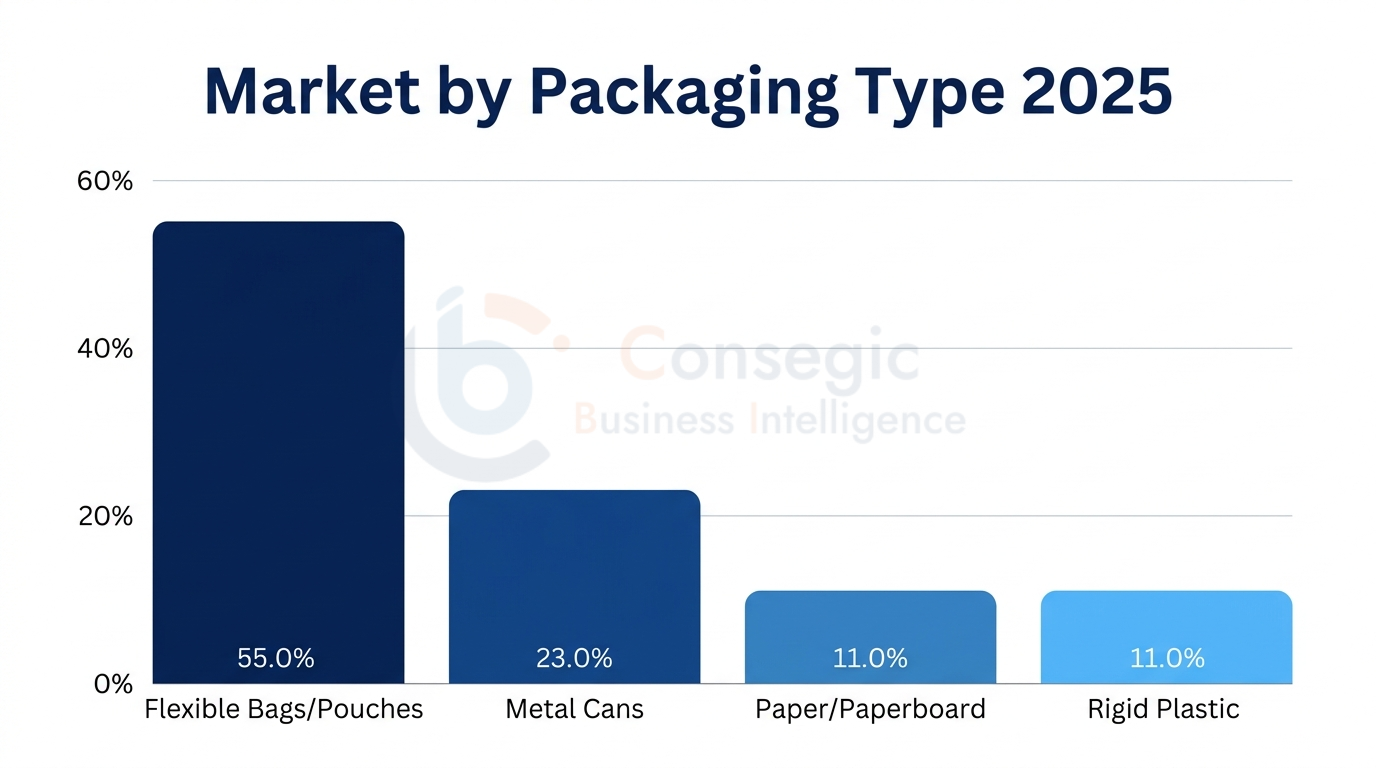
Flexible Bags and Pouches: Market Dominance Through Versatility
In the market, flexible bags and pouches take over with USD 2.38 Billion (55.0 percent of market value) in 2025 and USD 3.95 Billion with an estimated value in 2034. This product line includes stand-up pouches featuring a zipper-close option used in dry pet food applications, flat-bottom bags with high shelf performance and billboard graphics, pillow-shaped pouches in single-serving packages of wet food with weight sizes of 70-150 grams, retort pouches with a high shelf life of sterilized wet food and shrink bags that are used in a multi-pack format. The benefits of the flexible packaging are that it is lightweight, which means that it can reduce transportation costs up to 40-60 percent compared to rigid packaging, it utilizes less packaging material with a flat shipping design, which means that the warehouse space usage is also reduced by 50-65 percent before filling, and the packaging has a resealable closure, which is not only convenient to consumers, but also ensures the preservation of the product freshness after opening.
Metal Cans: Premium Wet Food Packaging Heritage
Metal cans reflect USD 0.99 Billion (23.0 percent of market worth) in 2025, and have 85–400-gram sizes of tinplate steel cans in single-serve wet food, aluminum cans with greater corrosion resistance to fish-based formulations, and easy-open ends with functions to pull tabs, eliminating can openers. Its metal package offers total oxygen and moisture protection allowing 24–36-month shelf life without refrigeration, retort process compatibility allowing sterilization to temperatures of up to 121 degrees Celsius and 60-90 minutes enabling quality perceptions of wet food products of high retail pricing of USD 4.20-7.80 per kilogram.
Paper and Paperboard Packaging: Sustainable Growth Alternative
Paper and paperboard packaging USD 0.48 Billion (11.0 percent of market value) in 2025 consists of kraft paper bags with inner liners made of polyethylene to protect goods and provide graphics surfaces, folding cartons to protect goods and biscuits, corrugated shipping containers due to e-commerce and bulk goods packaging, and molded pulp tray to offer multiple units. The paper packaging shows good growth of 8.2 percent compound annual growth rate due to the sustainability preferences and 64 percent of the pet owners of Asia Pacific reported they prefer paper packaging to plastic alternatives with similar barrier performance requirements.
Rigid Plastic Containers: Specialty Applications Focus
Rigid plastic containers will comprise USD 0.47 Billion (11.0 percent of market value) in 2025 such as polyethylene terephthalate jars of treats 200-800 grams offering product visibility, high-density polyethylene buckets of bulk dry food in 5–20-kilogram sizes, polypropylene tubs of semi-moist products, and injection-molded containers with snap-on lids of supplements and functional treats in 2025.
Regional Market Analysis
China: The Digital Commerce and Leadership in the Market.
The country of China wins at USD 1.68 Billion (39.0 percent market value) in 2025 and is projected to grow to USD 2.80 Billion in 2034. The market leadership has shown a mass population of 218 million companion animals of 124 and 94 million dogs and cats, high rate of urbanization with 66.8 percent urban population forming concentrated ownership of pets in cities, and the high growth of disposable income with average urban household income standing at USD 15,240 in 2024 and the shift of loose feed to packaged products is increasing at a remarkable rate with the market penetration increasing to 64 percent in 2024.
The Chinese market exhibits distinct trends such as size-sensitive packaging, with 500-gram to 2-kilogram package sizes constituting 72 percent of dry food sales, reflecting the prevalence of smaller living spaces and the importance of maintaining product freshness; strong adoption of e-commerce, with 45 percent of pet food sales occurring through online channels; a shift toward high-end packaging formats featuring matte finishes, embossing, and transparent windows to signal product quality; and increasing environmental awareness, with 52 percent of urban pet owners indicating their willingness to pay a 6–10 percent premium for sustainable and eco-friendly packaging solutions.
Japan: Innovation Leadership and Premium Market.
Japan is USD 0.78 Billion (18.0 percent of market value) in 2025, which is projected to increase to USD 1.29 Billion in 2034. The market traits entail the mature ownership of pets with 21.8 million companion animals in population of 124 million, greatest per-capita expenditure on pet food in Asia Pacific in USD 720/per annum, high level on high-end and super-premium products which forms 68 percent of market value, and sophisticated packaging anticipations with advanced graphics, convenient services and sustainable materials.
The Japanese market was a leader in the field of packaging innovation such as single-serving wet food pouch with easy-tear openings of between 40-70 grams to control portion sizes, resealable and stand-up pouch with slider zippers to maintain the freshness of dry food, transparent windows to check the products before buying, and advanced recycling platforms with 86 percent collection rate of plastic packaging and 97 percent of metal cans to enable a circular economy strategy.
Southeast Asia: Fast-paced Development and Production Center.
Southeast Asia covering Indonesia, Thailand, Vietnam, Philippines, Malaysia and Singapore constitutes USD 0.78 Billion (18.0 percent of market value) in 2025 with ambitious growth of USD 1.44 Billion in 2034 with the compound annual growth rate of 7.0 percent being the region highest growth profile. This is fuelled by high rates of growth in pet ownership with 108 million companion animals in 2024 growing 16.8 percent since 2019, urbanization with 54 percent of the population living in urban areas causing pet ownership to be concentrated in cities and the growing middle-class populations with 178 million households having reached middle-class status allowing them to spend discretionally on pet care and the shift to branded packaged products with penetration of 26 percent in 2019 to 42 percent in 2024.
Thailand is the major manufacturing center with USD 0.24 billion worth in both domestic and export markets; an example is the fact that Indonesia leads the Southeast Asian market with a population of 277 million, 17.2 million pet dogs and cats, and fast urbanization in the Jakarta, Surabaya and Bandung metropolis.
India: New Market with High Growth Opportunity.
India is USD 0.52 Billion (12.0 percent of market value) in 2025, which is projected to increase to USD 0.97 Billion in 2034, with the compound annual growth rate of 7.8 percent. The market factors are rising pet population of 29 million companion animals in 2024, rising middle classes with 325 million households reaching middle-class status generating addressable market, urbanization with 38 percent urban population showing higher levels of pet ownership, and low penetration of branded packaged products at 32 percent is creating large growth potential in the market as it matures and consumers move towards commercial products instead of homemade ones.
Competitive Landscape and Key Market Players
Strategic Positioning and Market Leadership
Amcor plc (Switzerland/Australia) - Future Leadership and Sustainability Innovation.
Amcor plc continues to hold a commanding market leadership as the firm is estimated to have 2024 market Asian Pacific revenues of USD 620-680 Million in pet food packaging that constitutes approximately 14.5-15.8 percent of the total market in the flexible packaging, specialty applications and sustainable solutions. The company has extensive manufacturing presence 16 manufacturing plants in China, India, Thailand, Indonesia, Australia and New Zealand, and manufactures 265,000 metric tons per annum of flexible packaging to be used in pet food products. The competitive positioning is anchored on technological leadership on high-barrier recyclable films with oxygen transfer rates less than 2.0 cubic centimeters per square meter per 24 hours of polyethylene-based mono-material structures, global scale competitive pricing, and integrity across regions, comprehensive product portfolio including stand-up pouches, flat-bottom bags, retort pouches and specialty formats, and leadership in sustainability with an AmLite brand including 25-45 percent post-consumer recycled content with food-contact compliance.
Huhtamaki Group (Finland) Flexible Packaging Specialization.
Huhtamaki Group has a strong competitive position with projected 2024 revenues in Asia Pacific amounting USD 380-440 Million as being about 8.8-10.2 percent market share based on emphasis on flexible packaging solutions and regional production ability. The company has production plants in China, India, Thailand and Australia with a total capacity of 125,000 metric tons per year, manufacturing stand-up pouches, retort packaging and specialty flexible format. The competitive strengths are the experiences in the retort flexible packaging applicable in wet pet food manufacturing, the development of sustainable packaging via blueloop material recyclability, the strong presence in emerging markets with lower production costs, and the overall technical support services to the brand owners who want the packaging to be optimized.
Mondi Group (Austria/South Africa) - Leadership (Sustainable Solutions).
The company has a major presence as the estimated 2024 Asia Pacific revenues of USD 340-400 Million constitute about 7.9-9.3 percent of the market share in the concentration on sustainable paper-based packaging and recyclable flexible solutions. It has manufacturing plants in China, India and Thailand with a total capacity of 135000 metric tons per year that manufacture kraft paper bags with barrier coating, recyclable stand up pouches and specialty applications.
Other Important Market Members:
- Constantia Flexibles Group: The company has about USD 260-320 Million revenues in Asia Pacific with a market share in the range of 6.0-7.4 percent, high barrier flexible packaging, China and India production plants with capacity of 68,000 metric tons per year, and sustainable packaging innovation.
- Sonoco Products Company: USD 180-230 Million Asia Pacific revenues, diversified portfolio with flexible packaging solutions, rigid containers and paperboard solutions, manufacturing operations in China and Australia and specializing in composite cans of the premium treats and supplements.
- Coveris Holdings: USD 160-200 Million Asia Pacific revenues, concentrate on flexible packaging of dry and wet pet food, high presence in developed markets such as Japan and Australia and specialize in resealable closure systems and high barrier laminates.
Recent Industry Developments
Packaging Innovation and Commercial Launches (2024-2025) Sustainable Packaging.
In February 2024, Amcor plc released AmPrima Plus which was a recyclable pet food packaging range using advanced polyethylene mono-material structure that achieves complete recyclability via current plastic recycling infrastructure and where moisture vapour transmission rates do not exceed 3.5 grams per square meter per 24 hours and oxygen transmission rates do not exceed 2.2 cubic centimeters per square meter per 24 hours, which is adequate to use in dry pet food applications with shelf life requirements of 12-18 months. The AmPrima Plus line uses 35 percent post-consumer recycled content which has been tested by International Sustainability and Carbon Certification, and has reduced 38 percent carbon footprint relative to the traditional multi-layer package through lifecycle assessment, and has been adopted by 22 major pet food brands in Asia Pacific in 2024, including Mars Petcare, Nestle Purana and regional premium brands.
In August 2024, Huhtamaki Group launched FreshLock sustainable pet food packaging solution that uses kraft paper as the outer component, with water-based barrier coating that removes the use of plastic lamination, water-based bio-based functional barrier made of renewable feedstock, advanced system of zipper closure keeping the product fresh, and is fully recyclable by paper recycling streams once the closure components are separated by consumers. The FreshLock solution has barrier properties of 4.2 cubic centimeter/square meter/24 hours oxygen transmission and 6.8 grams/square meter/24 hours moisture vapor transmission that results in 15 months shelf life in dry pet food, 72 percent renewable material content, and 12-15 percent premium over conventional flexible package pricing, and is also preferred by premium brands looking to differentiate themselves on sustainability.
Capacity Enhancement of Manufacturing and Regional Investment (2024-2025)
In March 2024, Constantia Flexibles Group announced it was investing USD 78 million in a new pet food packaging production facility in Guangzhou, China, with a capacity of 38,000 metric tons a year, 9 color rotogravure printing presses with 180 lines an inch resolution, solventless lamination technology, which avoids the release of volatile organic compounds, and automated quality control systems that used vision inspection and seal integrity testing. The facility opened in September 2024, with 2–4-day lead times to the Chinese domestic market as opposed to 12-18 days to have an international importation with European facilities, and high-barrier recyclable packaging with post-consumer recycled content to high-end pet food brands targeting sustainability-conscious customers.
In 2024, Mondi Group expanded Southeast Asian manufacturing capacity with USD 52 million investment in Bangkok, Thailand plant that added 28,000 metric tons/year capacity of kraft paper bags, recyclable flexible packaging, installed high-barrier coating lines producing high-quality paper substrates, and had digital printing capabilities to produce small-run of 3,000-8,000 units of e-commerce brands and product launches. The expansion serves an increasing demand in sustainable packaging in the Southeast Asia markets, decreases lead times of 8-12 days to 3- 5 days to serve the regional customers, and provides customization services such as variable data printing to custom package services, and limited-edition design.
Asia Pacific Pet Food Packaging Market Report Insights
| Report Attributes | Report Details |
|---|---|
| Study Timeline | 2022–2034 |
| Base Year | 2025 |
| Forecast Period | 2026–2035 |
| Market Size in 2025 | USD 4.32 Billion |
| Market Size in 2034 | USD 7.18 Billion |
| CAGR (2026–2034) | 5.8% |
| By Packaging Type | Flexible Bags/Pouches (55.0%), Metal Cans (23.0%), Paper/Paperboard (11.0%), Rigid Plastic (11.0%) |
| By Material | Flexible Plastics (60.0%), Metal (23.0%), Paper (11.0%), Rigid Plastics (6.0%) |
| By Pet Type | Dog Food (58.0%), Cat Food (35.0%), Other Pets (7.0%) |
| By Region | China (39.0%), Japan (18.0%), Southeast Asia (18.0%), India (12.0%), Other Markets (13.0%) |
| Key Players | Amcor, Huhtamaki, Mondi, Constantia Flexibles, Sonoco, Coveris, Sealed Air |
| Report Coverage |
|
Key Questions Answered in the Report
What is the size of the Asia Pacific pet food packaging market? −
The Asia Pacific, pet food packaging market is identified with strong growth attributes where value is expected to be USD 4.32 Billion in 2025, and the growth is expected to be USD 7.18 Billion in 2034 at 5.8 percent compound annual growth rate. The market nature reflects the various levels of maturity with developed markets such as Japan, South Korea and Australia having high penetration of branded packaged pet food of 78-86 percent and developed packaging expectation of resealable closures, high graphics and sustainable materials and emerging markets all having rapid growth with increasing penetration of 32-64 percent levels with increasing pet ownership of 12.4 percent per annum, urbanization creating concentrated possession in cities and a shift of loose feed into branded packaged products, which has created a significant growth runway. The industry caters to about 672 million companion animals of various species, with packaging volume standing at 65 percent, wet food at 26 percent and 9 percent of treats and supplements which create a significant economic activity in terms of packaging manufacturing and printing, distribution and recycling.
What are the significant drivers of expansion of the Asia Pacific market? +
The key growth trends include the humanization of pets, where owners increasingly treat pets as family members, driving demand for high-end packaging aesthetics, convenience features such as resealable closures and single-serve portions, and the use of sustainable materials aligned with environmental values; rapid e-commerce penetration, with online pet food sales reaching USD 9.2 billion and accounting for 28.1 percent of total sales, growing at a CAGR of 31.4 percent; and ongoing urbanization, with 54–67 percent of the population residing in urban areas, supporting higher pet ownership rates. Additionally, market growth is reinforced by continuous advancements in packaging technologies, including smart packaging, improved barrier materials, and innovative design formats that enhance product protection and consumer engagement.
Is there any difference in Asia Pacific market regionally? +
Regional disparities are quite high with regard to maturity of pet ownership, economic development and consumer inclinations. China has market share of 39.0 percent with domination through huge population of pets (218 million) and high rates of urbanization (66.8 percent urban population), increasing rates of transition between loose feeds to branded product (76 percent penetration in 2019, to 64 percentage in 2024) and widespread adoption of e-commerce (45 percent of sales online through major platform). The traits that show Japanese have 18.0 percent share and mature market features such as the highest per-capita expenditure of USD 720 per year, a high level of preference to premium goods of 68 percent of the market value, a high level of expectation in relation to packaging graphics and convenient features, and an extensive recycling system of 86 percent collection rate of plastic bags. Southeast Asia has 18.0 percent share and the fastest growth at 7.0 percent compound annual growth rate due to robust growth in pet ownership at 16.8 percent since 2019, urbanization producing concentrated markets, expansion in middle-class populations with 178 million households attaining middle-class status and the shift to loose feed to branded products. India has 12.0 percent share with emerging market dynamics such as increasing pet population of 29 million animals, increasing middle class, low penetration of branded products of 32 percent that will provide high growth potential, and price sensitivity that favored flexible packaging to the expensive prestigious products.
What are the competitive forces and market structure? +
Competitive structure of the Asia Pacific market is moderately concentrated in nature wherein Amcor plc enjoys 14.5-15.8 percent market share due to technological leadership in high-barrier recyclable films, global scale with 16 manufacturing plants in the region yielding 265,000 metric tons/annually, existence of comprehensive product range which covers all types of packaging, and leadership in sustainability with AmLite brand containing 25-45 percent post-consumer recycled content. Huhtamaki Group has a share of 8.8-10.2 percent due to its concentration in both flexibility in packaging and regional manufacturing capacities, mastery in retort packaging of wet pet food, innovation in sustainable materials with blueloop recyclable solutions and both high presence in emerging markets. Mondi Group owns 7.9-9.3 percent holding by specializing in sustainable paper-based packaging and recyclable flexible solutions, kraft paper bags experience in barrier coating and excellent sustainability repercussions. Competition is based on sustainability innovation where recyclable mono-material structures (cost 6-10 percent higher) are used, premium brands are acquired, barrier performance to an oxygen transmission rate of less than 2.5 cubic centimeters per square meter per 24 hours is attained, convenience features are added such as resealable zippers and easy-tear openings and cost-effective packaging that uses 60-70 percent less material per unit volume than metal cans.
What are the latest trends in the technology that are being used in the market? +
Other important technological advances include sustainable material innovations such as recyclable mono-material flexible packaging using polyethylene or polypropylene with advanced barrier coatings, achieving oxygen transmission rates below 2.5 cubic centimeters per square meter per 24 hours while remaining fully recyclable within existing infrastructure; increasing incorporation of recycled content through post-consumer materials; the use of biodegradable polymers such as polylactic acid (PLA) and polybutylene adipate terephthalate (PBAT) in single-serve applications offering 95–99 percent barrier performance; and the adoption of high-barrier metallized films that provide superior oxygen barrier efficiency, thereby enhancing product shelf life and protection.
Overview
Reputation & Certifications


Our Services
- Market Intelligence & Forecasting
- Custom Research Solutions
- Market Entry Strategy
- Competitive Intelligence
- Customer Insights
- Industry Innovation Analysis
- Investment Advisory