Jump to Content
Asia Pacific Small Modular Reactor Market - Size, Share, Industry Trends, and Forecasts (2025-2034)
Market Scope & Overview
The Asia Pacific small modular reactor (SMR) market is a strategically sensitive and fast-changing area in the regional energy infrastructure in the form of advanced nuclear reactor systems with electrical generating capacity most commonly less than 300 megawatts per module, manufactured in factories, enhanced passive safety features, modular construction strategies, and flexible deployment configurations to meet the needs of a wide variety of applications such as grid-connected baseload generation, industrial process heating, remote area power supply, desalination plants, hydrogen production, and coal plant replacement across the rapidly expanding economies of the region, driven by urgent energy transition needs.
The market shows a great growth potential of USD 925 Million in 2024 and USD 1.05 Billion in 2025 (base year) which is expected to have a significant growth of USD 4.65 Billion in 2034. This strong growth trend leads to a compound annual growth rate (CAGR) of 18.7 % consistently over the 2026-2034 forecast period driven by aggressive national decarbonization commitments, with major economies aiming for carbon neutrality between 2050-2070, energy security priorities necessitating the emergence of new technologies under the rubric of Generation III+ reactor designs that have been granted regulatory support, and significant government investment programs with regional countries providing a USD 95-135 billion investment in the development and commercial deployment of advanced nuclear technologies.
Regional Trends and Insights
- China
- Dominates the Asia Pacific SMR market with 50% share (USD 525 million in 2025), projected to reach USD 2.33 billion by 2034
- Strong government support and investment of over USD 25 billion under the national nuclear development plan
- Major SMR projects such as ACP100 (Linglong One) and HTR-PM reactors, with expansion plans for domestic use and exports
- South Korea
- Market valued at USD 210 million in 2025, expected to reach USD 930 million by 2034
- SMART reactor became the first SMR to receive Standard Design Approval, highlighting technological leadership
- Government investing KRW 420 billion to develop i-SMR reactors and expand global SMR exports
- Japan
- Market valued at USD 158 million in 2025, projected to reach USD 698 million by 2034
- 6th Strategic Energy Plan targets 20–22% nuclear electricity by 2030 to support decarbonization
- JPY 2.5 trillion Green Innovation Fund supporting advanced nuclear technologies and SMR development

Advanced Reactor Technology Platform.
Incorporating advanced engineering innovations with integral pressurized water reactor (iPWR) configurations that remove large-bore primary coolant loops and eliminate loss-of-coolant accident risks, designs with high-temperature gas-cooled reactor (HTGR) systems that allow industrial process heat use up to 750-950 degrees Celsius to produce steel and hydrogen and sodium-cooled fast reactor (SFR) designs with better fuel utilization and actinide burning capabilities to reduce waste, molten salt reactor (MSR) technologies with enhanced safety and fuel efficiency characteristics.
The nuclear energy industry in Asia Pacific is faced with a number of challenges such as the question of acceptance by the people in the wake of the Fukushima Daiichi accident heritage, the complication of regulatory systems that need to be harmonized across many jurisdictions, capital needs that are high where traditional large reactor projects have had 25-40 percent cost increases, and workforce development challenges needed within the region’s nuclear sector of growing the industry to 52,000-68,000 more qualified professionals by 2030 to support planned expansion initiatives and the deployment of advanced reactor systems across the region.
Key Drivers
Nationwide Decarbonization Pledges and Coal Fleet Replacement.
The main driver of the growth in the market of small modular reactor is the detailed national climate policy in the countries of the Asia Pacific region, with China aiming to make carbon neutral by 2060, which would require a need to add 450-550 gigawatts of non-fossil baseload capacity, with Japan intending emissions reductions of 46 percent by 2030 which would necessitate nuclear capacity addition and expansion, South Korea aims to achieve carbon neutrality by 2050, which would require nuclear energy to provide approximately 32–35 percent of the total power generation mix, thereby reinforcing the role of small modular reactors as a reliable low-carbon baseload solution.
According to the International Energy Agency, the electricity demand of Asia Pacific is expected to rise by 3.9 percent per annum up to 2034, which means that new generating capacity of 1,350-1,500 gigawatts will be needed to meet the sustainable economic growth, rapid urbanization, and the complete electrification of the transportation and industrial sectors. Although renewable sources such as solar photovoltaic and wind power are operating at unprecedented levels, their intermittency nature makes them rely on dispatchable base load capacity that maintains grid stability, reliability and quality reserves of power during peak operation periods and variability in renewable generation.
The area is already running about 485 gigawatts of coal-fired generation capacity of which 65–70% of plants are over 20 years old and will be retired in the next 15 years because of environmental regulations, economic competitiveness issues and carbon pricing programs. The small modular reactors offer special benefits to solve the coal replacement needs through flexible deployment arrangements that can be scaled up at a pace that reflects the demand growth pattern, utilization of existing sites by taking advantage of existing transmission infrastructure and cooling water system at the retiring coal plants, shorter construction schedules of 4-6 years instead of 8-12 years development of conventional large reactors, and a lower-risk financial profile with capital requirements of USD 4-7 billion per gigawatt compared to USD 7-12 billion of the traditional nuclear plants.
The 14th Five-Year Plan (2021-2025) of China specifically lists such advanced nuclear technologies as SMRs among the strategic priorities of the country, with a budget of CNY 145 billion (USD 20.5 billion) assigned to research work, construction of demonstration projects, and early commercial projects. The 10th Basic Plan of Long-term Electricity Supply and Demand in South Korea is to consider nuclear power as the baseload power, thus supporting the development of SMR with KRW 420 billion (USD 315 million) governmental support and modernization of regulatory framework. The 6th Strategic Energy Plan of Japan makes nuclear a major decarbonization facilitator and the Ministry of Economy, Trade and Industry has been promoting the development of SMR technologies via special funding programs and international cooperation projects.
Key Restraints:
Complexity of Regulations and Framework Limitations on licensing.
The Asia Pacific small modular reactor market faces considerable impediments in the form of regulatory frameworks and institutional capacity which poses significant doubts on timing of approvals, technical requirements, compliance costs and operational authorization cycle that has significant influence on project development schedules, financial planning and investment decision making procedures that affects project development processes significantly.
The existing regulatory frameworks in the region were designed with traditional large light-water reactors, which are a result of decades of operational experience, and need significant adjustment to consider the unique SMR characteristics such as factory fabrication and transportation logistics, multi-module plant designs, advanced passive safety systems, novel applications such as industrial process heat and remote area deployment, and new business models such as leasing and offering energy-as-a-service. In China, South Korea, Japan, and India, regulatory agencies are in the active process of formulating SMR-related regulations and licensing processes, yet overall frameworks are yet to be finalized with expected timelines of completion stretching to 2027-2031.
The licensing ambiguity is in the form of long pre-licensing consultation time of 24-36 months to first pass through design reviews, full safety demonstration program requirements of long-term testing and validation processes, and the conservative regulatory interpretations, placing emphasis on the existing precedents at the expense of technological innovation. According to industry surveys, regulatory approval procedures constitute 20-28 months of critical path project development plans and USD 180-350 million pre-construction project expenses of first-of-a-kind SMR deployments with later projects enjoying the benefit of regulatory precedence but incurring 15-22 months to obtain site-specific licensing and regulatory authorization to operate.
The issue of international harmonization complicates the field of regulation, as in various nations, various authorities have their own unique technical requirements, safety assessment procedures, documentation standards, and approval procedures which preclude economies of scale associated with standard reactor designs implemented in multiple jurisdictions. International Atomic Energy Agency (IAEA) aids in the coordination process consisting of the SMR Regulators Forum, technical working groups, although binding harmonization is not much because every nation retains sovereign control in nuclear safety regulation, environmental impact assessment, and emergency preparedness requirements.
Key Opportunities
Industrial Decarbonization and Integrated Systems.
Significant market potentials are seen on the basis of industrial sector decarbonization needs and the creation of integrated energy systems involving the generation of electricity, process heat provision and hydrogen generation, especially in energy-intensive manufacturing operations such as steel production, chemical production, cement production, aluminum smelting and petroleum refining where high temperature process heat provision mainly by fossil fuels takes up about 38-42 percent of industrial energy consumption and is a major source of carbon emissions that need the clean alternatives it offers.
Asia Pacific industrial sector contributes 61 percent of the world manufacturing output, which consumes about 195 exajoules of energy every year with 67-72 percent coming out of coal, natural gas and petroleum products. Comprehensive carbon pricing frameworks, emission trading, compulsory industrial emission levels and corporate carbon disclosure policies by the regional governments provide strong economic incentives to process heat options that are low-carbon and combined clean energy frameworks.
The high-temperature gas-cooled SMR (high temperature range of 750-950 degrees Celsius) can directly replace the combustion of fossil fuels in industrial activities, and demonstration projects are being developed to apply this technology in the steel industry (direct reduced iron production), to chemical production processes that need a high temperature steam feedstock and/or hydrogen feedstock (power generation) and to integrated hydrogen production using a high-temperature steam electrolysis facility or a thermochemical water splitting process. In December 2023, the HTR-PM demonstration project at the Shidaowan in China entered a commercial state of operation; it showed the technical and economic feasibility of using high-temperature reactor technology in industrial cogeneration projects.
Market Segmentation Analysis
By Reactor Technology: Design Platform Evolution
Light Water Reactor (LWR) SMRs: Near-Term Commercial Deployment
The small modular reactor of light water reactors captures the market of USD 651 Million in 2025 (62.0 percent of the market value) and is expected to grow to USD 2.88 Billion in 2034. This group includes designs of integral pressurized water reactor (iPWR) without external steam generators or primary coolant loops, advanced boiling water reactor (BWR) designs with natural circulation to increase safety, and evolutionary light water designs with the full passive safety system, long fuel cycles to 24 months, and proliferation resistance features through advanced fuel management systems.
LWR technology has the advantage of a long history of operating experience that totals more than 17,500 cumulative reactor-years in the Asia Pacific region, and is supported by well-established fuel fabrication and major component manufacturing supply chains, well-established regulatory frameworks with comprehensive licensing experience and operational experience, and familiarity in its workforce, which can reduce training needs and operational complexity. The major designs in the region are the ACP100 (Linglong One) by China with 125 MWe integral PWR design under construction at the Changjiang site, the SMART reactor of South Korea that has attained Standard Design Approval and aims at global deployment, and redesigns with enhanced passive safety and digital instrumentation.
High-Temperature Gas-Cooled Reactors: Industrial Applications Leader
High-temperature gas-cooled reactor SMRs USD 231 Million (22.0 percent of market value) in 2025, with helium coolant that allows outlet temperatures to hit 750-950 degrees Celsius, TRISO fuel particle offering an inherent safety approach through multiple ceramic coating layers preventing the release of fission products and graphite moderation that allows operation at high temperature without the risks of coolant phase change. The designs are aimed at industrial process heat, clean hydrogen generation, and improved efficiency in electricity generation based on improved power conversion systems such as supercritical CO2 cycles.
China is the world leader in HTGR development with HTR-PM demonstration project consisting of two 250 MWth reactor modules generating 210 MWe reaching a commercial operating point in December 2023, and which both proves technical feasibility and also gives important regulatory precedent on subsequent commercial deployments. Japan has active research in HTGR with the High Temperature Engineering Test Reactor (HTTR) of JAEA, and commercial operation plans in the 2030s are planned after the demonstration of hydrogen production capacities.
Advanced Reactor Concepts: Long-Term Innovation Pipeline
Modern reactor designs such as sodium-cooled fast reactors, molten salt reactors, and lead-cooled fast reactors are USD 168 Million (16.0 percent of market value) in 2025, and have possible benefits, such as improved fuel usage through fuel breeding, much higher reduction in waste through actinide burning, and distinctive safety attributes arising from inherent physical properties. These technologies are still in developmental and demonstration stages and a commercialized deployment is expected to be realized in 2030-2040 period after successful operation of demonstration projects and full regulatory framework put in place.
By Application: End-Use Market Deployment
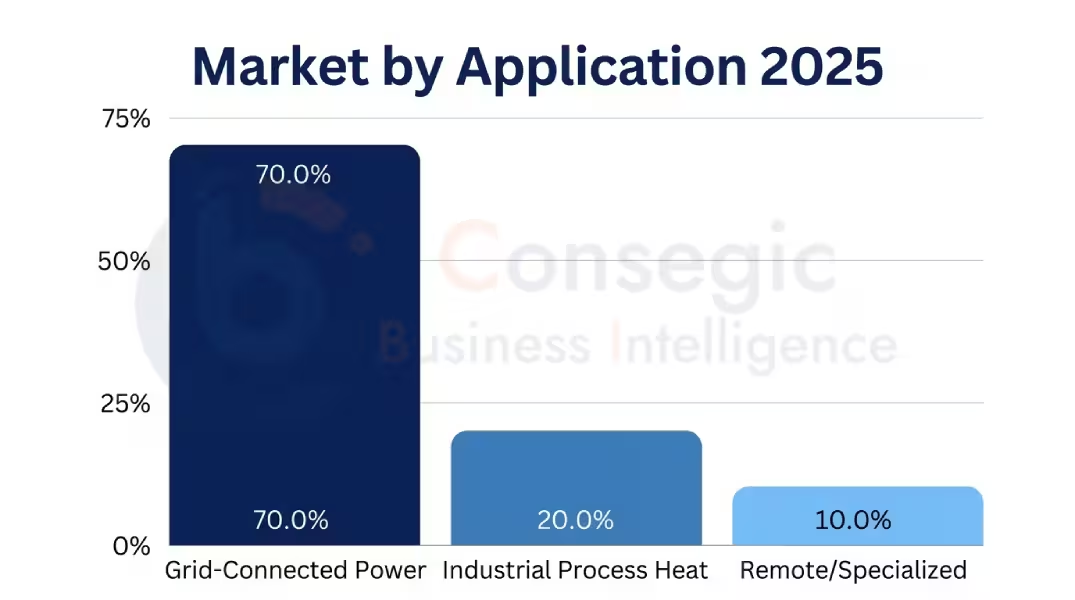
Grid-Connected Power Generation: Primary Application Segment
Grid-connected generation accounts for USD 735 million (70.0 percent of market value) of generation in 2025, which includes the baseload power supply to and on national and regional electricity grids, strategic capacity replacement of the retiring coal-fired power plants, and the necessary grid stabilization services to both support renewable energy integration and grid reliability. This segment has the advantage of being supported by the established power purchase agreements structures, utility scale project financing mechanisms, and easy integration with the existing transmission and distribution infrastructure.
Deployment scenarios include multi-module installations at current nuclear facilities with existing infrastructure and regulatory authorization, greenfield developments in areas where a new baseload is needed to contribute to economic development, and coal-to-nuclear conversions with existing transmission links, cooling water infrastructure, and skilled workforce potential at retiring coal plant sites, which offer massive cost benefits and maximum approval benefit to the community.
Industrial Process Heat and Cogeneration
Industrial uses (USD 210 Million 20.0 percent of market value in 2025) is the most rapidly growing area, with 26.3 percent CAGR, due to the strict requirements of decarbonization in industries, extensive carbon pricing schemes, and technological maturation of high-temperature reactor designs such that direct fossil fuel replacement is no longer necessary. The main applications are steel manufacturing plants that need a high temperature of heat in their processes, chemical sector plants in need of consistent steam and hydrogen, petroleum refinery plants in search of clean energy, and integrated industrial parks working on a total decarbonization program.
Remote and Specialized Applications
Remote area and special use are USD 105 Million (10.0 percent of market value) in 2025 which covers remote communities (no grid connection), remote mining facilities that require a dependable power supply, military bases that need a reliable energy supply, and island countries (heavy reliance on imported fuel). This segment shows strong potential in the industry of the extraction of resources in remote areas and in the Arctic where SMRs are incredibly beneficial compared to the complicated fuel transportation logistics and infrastructure needs.
Regional Market Analysis
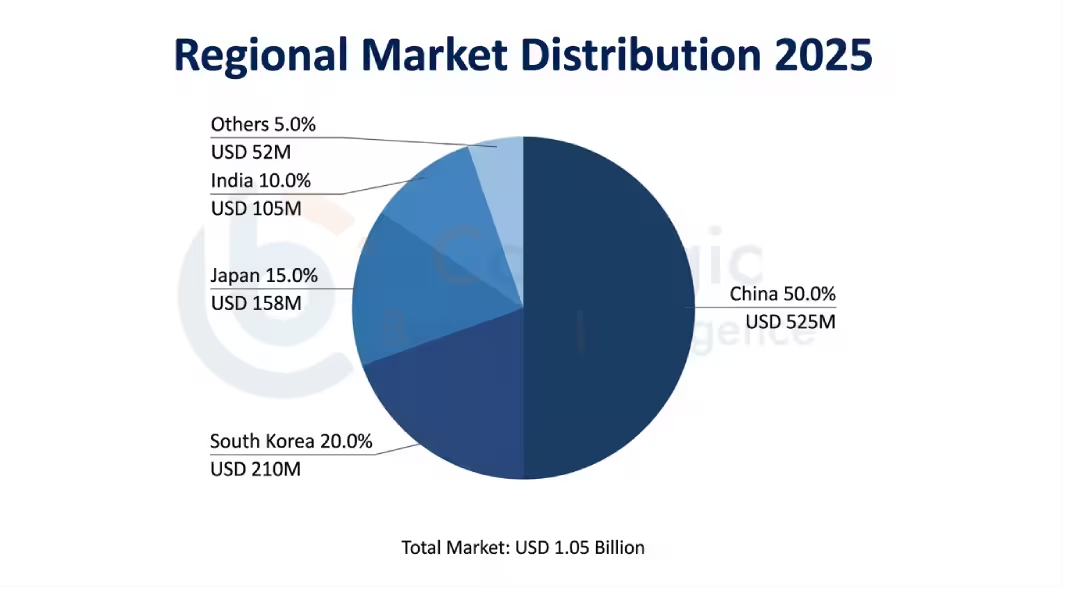
China: Leadership and Strategy of Aggressive Deployment in the Market.
China has taken over the market with USD 525 Million (50.0 percent of market value) of the Asia Pacific SMR market in 2025, which is expected to increase to USD 2.33 Billion in 2034, due to comprehensive national nuclear development strategy, substantial government investment programs of over USD 25 billion, and the ability of domestic nuclear supply chain, and the need to decarbonize the electricity system urgently (the need to replace coal-dependent electricity system with clean energy portfolio) supply.
The Medium and Long-Term Development Plan of Nuclear Power of China (2021-2035) sets ambitious goals of 75 GWe of nuclear power online by 2025 and 200-220 GWe by 2035, and SMRs are defined as the important technology pathway to achieve both domestic deployment and export goals. The China National Nuclear Corporation (CNNC), China General Nuclear Power Group (CGN) and State Power Investment Corporation (SPIC) are developing many SMR designs on various technology platforms with the full assistance of the government.
The major Chinese SMR projects include:
- ACP100 (Linglong One): 125 MWe integral PWR to be constructed at Changjiang site in July 2021, planned to go commercial in 2026-2027, with next-generation deployment planned to industrial applications and Belt and Road Initiative export markets.
- HTR-PM business operation: 210 MWe high-temperature gas-cooled reactor with commercial operation expected to occur in December 2023, and a larger-scale HTR-PM600 (650 MWe) is being developed.
- ACPR50S floating nuclear power plant: 60 MWe concept with offshore oil platforms, remote islands, and desalination of coastal areas.
- Development programs Advanced reactor development: There are several demonstration programs such as lead-cooled fast reactors and molten salt reactors with their operation in 2028-2032.
Competitive advantages of China encompass vertical supply chain and local manufacturing of all major nuclear parts, simplified regulatory mechanisms with National Nuclear Safety Administration offering quicker approvals to strategic national projects, large financing potential with state-owned enterprises and policy banks offering conducive conditions, and aggressive export plan that makes use of Belt and Road Initiative framework to make international SMR deployment that aids to the development of infrastructure in partner countries in Asia, Africa, and Latin America.
South Korea: Technology and Excellence and Export Orientation.
The case of South Korea USD 210 Million (20.0 percent of market value) in 2025, which is expected to rise to USD 930 Million in 2034, which can be described as the finest capabilities in reactor design, nuclear engineering, and the strategic focus on SMR technology export in terms of national objectives of industrial competitiveness and national technology leadership positioning.
In July 2012, the SMART (System-integrated Modular Advanced Reactor) of South Korea became the first SMR to receive the Standard Design Approval of Korea Institute of Nuclear Safety, becoming the first SMR to undergo extensive regulatory approval anywhere in the world. The 100 MWe integral PWR is focused on domestic implementation and foreign markets, and Saudi Arabia continues to have cooperation agreements on the possible deployment and other countries are showing interest in the acquisition and deployment of technology.
Korea Hydro & Nuclear Power (KHNP) and large industrial conglomerates are promoting i-SMR development program with new design of 170 MWe with advanced passive safety and the best modular construction techniques with domestic implementation in 2028-2030. The government has set aside KRW 420 billion (USD 315 million) up to 2028 in aid of development of the SMR technology, development of an extensive regulatory framework and activities in the promotion of international exports including financing support and technical assistance programs.
The competitive positioning strategies of South Korea focus on:
- Exceptional construction with proven capacity to deliver high profile nuclear projects on time and on budget, which otherwise would be difficult to achieve in the international industry.
- High-tech production facilities with full local supply chain of large components such as reactor pressure vessels, steam generators and advanced instrumentation systems.
- International relations such as joint work with major international nuclear corporations and membership in multinational consortia in the development of SMR.
- Close financing assistance by Korea Export-Import Bank and Korea Trade Insurance Corporation in developing international projects and technology transfer
Japan: Technology Innovation and Strategic Recovery.
Japan contributes USD 158 Million (15.0 percent of market value) in 2025, which is expected to increase to USD 698 Million in 2034, due to the recovering nuclear energy sector after the Fukushima Daiichi accident, the development capability based on advanced technology as decades of nuclear experience, and the strategic realization of the need of nuclear energy to achieve ambitious decarbonization goals and the ability to enhance energy security.
The 6th Strategic Energy Plan (October 2021) of Japan makes nuclear energy a key element in decarbonization, aiming at 20-22 percent of nuclear-generated electricity by 2030, which presupposes the gradual restart of the old reactors, as well as the creation of more advanced technologies, such as next-generation SMRs. The government developed Green Innovation Fund of JPY 2.5 trillion (USD 18.5 billion) dedicated to the overall decarbonization technology such as advanced nuclear technology, hydrogen production, and the use of carbon capture.
The SMR Japanese initiatives include:
- High-Temperature Engineering Test Reactor (HTTR): Research reactor at Japan Atomic Energy Agency that displays HTGR technology capability, and industrial cogeneration design development would be aimed at commercial scale use.
- High technology reactor collaborations: Mitsubishi Heavy Industries working with overseas SMR developers in designing light water reactors and developing new technologies in their production.
- Fast reactor development programs: The legacy of advanced reactor development including the reduction of wastes, breeding of fuels, and new safety features.
- Industrial integration efforts: Cooperation between utilities and industrial participants that seek to apply SMR to steel production, chemical manufacturing and hydrogen production.
Recent Industry Developments
Large constructive milestone and technology demonstrations (2024-2025)
China has made major technological breakthroughs with HTR-PM demonstration project at Shidaowan site successfully completing successful commercial operation transition in December 2023 with China National Nuclear Corporation in March 2024 announcing plans to build six more HTR-PM units at various locations including industrial sites in Shandong, Jiangsu and Inner Mongolia provinces to generate integrated electricity and use as a heat source in steel production facilities and chemical manufacturing facilities.
Construction of ACP100 (Linglong One) unit at Changjiang Nuclear Power Plant recorded the installation of reactor pressure vessel in September 2024, steam generator in November 2024, keeping the project on schedule to commence commercial operation in early 2027. CNNC declared to expand to eight other ACP100 units in different locations which would include industrial parks, remote areas and possible international locations of deployment after domestic demonstration had been successful.
In November 2024, the i-SMR development program in South Korea got preliminary design approval with Korea Institute of Nuclear Safety, and is moving on to full standard design approval expected in 2027. KHNP declared its strategic cooperation with Doosan Enerbility to create advanced components and develop innovative construction technologies, the first domestic location is planned to be selected and the environmental impact evaluation is expected to begin in 2025.
Strategic International Partnerships and Technology Cooperation (2024-2025).
International cooperation has increased in an even greater way with the signing of China-Pakistan comprehensive nuclear cooperation agreement in June 2024, incorporating guidelines on ACP100 unit construction at Chashma site as the first international export of Chinese SMR technology. The project will contain widespread technology transfer possibilities, intensive operator training schemes, fuel supply schemes, and full-term technical supports services, proving that China is determined to penetrate into the international SMR market.
In September 2024, South Korea-Poland strategic partnership set up an all-encompassing framework of the possible deployment of SMART reactors to serve the decarbonization goals and energy security improvement of Poland, with initial feasibility research funded under Korean government export promotion schemes and technical assistance schemes. In October 2024, Japan-Indonesia bilateral cooperation signed memorandum of understanding, which explores the opportunity to deploy SMR to remote islands to electrify them, use SMR in industries, as well as the possibility of deploying desalination plants in water-stressed areas.
Multilateral efforts Regional multilateral efforts were in place, such as the formation of Asia Pacific SMR Cooperation Forum in May 2024, which included government agencies, nuclear operators, technology developers, and research institutions of China, Japan, South Korea, India, and Indonesia among other ASEAN countries, aimed at harmonizing regulatory efforts, sharing of technical best practices, identifying collaborative research opportunities, and technology transfer and capacity building programs.
Evolution of regulatory framework and development of standards (2024-2025).
In January 2025 China issued comprehensive SMR regulations, which provide standard licensing routes to standard designs of reactors, clarified technical supports of multi-module plant designs, delineated emergency planning zone criteria under consideration of safety features and expedited approval procedures allowing construction licenses to be issued in 20-26 months to pre-approved designs in appropriate locations with existing infrastructure.
In March 2024, the Nuclear Safety and Security Commission of South Korea launched a review of comprehensive SMR regulations, with revised regulations anticipated by the end of 2026 based on international best practices, to cover the particular features of SMR such as factory fabrication requirements, with transportation logistics, passive safety system qualification and new business models, such as leasing arrangements and energy-as-a-service offerings.
In June 2024, International Atomic Energy Agency increased the membership of SMR Regulators Forum, uniting regulatory authorities of Indonesia, Philippines, Vietnam and Thailand with previous members, which contributes to the improved exchange of knowledge and promotes regulatory harmonization in the Asian Pacific region, as well as capacity building efforts by nuclear energy developing nations developing a more comprehensive regulatory framework on advanced technologies in reactor construction.
Asia Pacific Small Modular Reactor Market Report Insights
| Report Attributes | Report Details |
|---|---|
| Study Timeline | 2022–2034 |
| Base Year | 2025 |
| Forecast Period | 2026–2034 |
| Market Size in 2024 | USD 925 Million |
| Market Size in 2025 | USD 1.05 Billion |
| Market Size in 2034 | USD 4.65 Billion |
| CAGR (2026–2034) | 18.7% |
| By Reactor Technology | Light Water Reactor (62.0%), High-Temperature Gas-Cooled (22.0%), Advanced Concepts (16.0%) |
| By Application | Grid-Connected Power (70.0%), Industrial Process Heat (20.0%), Remote/Specialized (10.0%) |
| By Power Output | Micro SMRs 1-10 MWe (8.0%), Small 10-100 MWe (32.0%), Medium 100-300 MWe (60.0%) |
| By Deployment Model | Government Programs (60.0%), PPP Structures (26.0%), Industrial Applications (9.0%), International (5.0%) |
| By Region | China (50.0%), South Korea (20.0%), Japan (15.0%), India (10.0%), Others (5.0%) |
| Key Players | CNNC, CGN, SPIC, KHNP, MHI, Toshiba, JAEA, NPCIL, Doosan Enerbility |
| Report Coverage |
|
Key Questions Answered in the Report
What does the SMR Asia Pacific market size and growth trend look like? −
The Asia Pacific market of small modular reactor shows high growth prospects at USD 1.05 Billion in 2025 with the growth to USD 4.65 Billion by 2034 with excellent growth at strong CAGR of 18.7 percent. It is projected that the market would have 135-165 units of SMRs getting operational status by 2034, equivalent to 28–38 gigawatts of installed nuclear capacity, which would be contributing significantly to regional decarbonization efforts, as well as energy security and industrial competitiveness efforts through the diversification of clean energy supply.
Which nations and regions are the leaders in SMR developmental projects? +
China has the largest market share of 50.0 percent, with the full national strategy that is backed by government investment of more than USD 25 billion, numerous operational projects and under-construction projects, and well-integrated domestic supply chain in China. South Korea holds a 20.0% market share with SMART design that has been granted regulatory authority, advanced i-SMR program and high export orientation. Japan constitutes 15.0 percent in terms of HTGR research capacity and nascent commercial schemes whereas India constitutes 10.0 percent in terms of local development schemes and the rising international collaboration schemes.
What are its main applications and market drivers? +
Baseload generation through grid connection is the most dominant with 70.0 percent application share, high coal capacity replacement requirements, renewable energy integration support, and constant electricity supply requirements. The fastest growing segment is industrial process heat applications with a 26.3 percent CAGR due to decarbonization of the steel industry, the needs of the chemical manufacturing industry, and clean hydrogen production prospects. Due to national decarbonization commitments necessitating the addition of between 450 and 550 GWe of clean baseload capacity, coal fleet replacement requirements, and energy security requirements following geopolitical supply shocks, are the principal drivers.
What are the regulatory and technological issues that are influencing market development? +
The regulatory complexity poses a major obstacle as the majority of the national authorities have formulated SMR-specific licensing principles, which establish uncertainty in the timeline of first-of-a-kind projects at the average of 20-28 months and the compliance costs of USD 180-350 million. Additional complexity is in terms of international harmonization regulations, thorough safety demonstration procedures and emergency planning determinations. But China, South Korea and Japan are undertaking regulatory modernization efforts that are creating smooth channels of facilitated deployment and technology standardization.
What reactor technologies have the most commercial potential? +
Light water reactor SMRs and 62.0 percent of the market share dominate the near-term deployment due to the long history of operations, supply chains and developed regulatory frameworks to allow expedited licensing and deployment. High temperature gas-cooled reactors are projected to grow with high share (22.0 percent) especially in industrial use where process heat and hydrogen are needed. The development of advanced concepts such as fast reactors and molten salt system are 16.0 percent and have longer development cycles but potentially offer high benefits in fuel utilization efficiency and waste reduction capabilities.
What is the amount of investment and how is it funded to develop its market? +
In 2024, regional research and development investment is USD 4.8 billion, of which China has invested CNY 145 billion, South Korea invested KRW 420 billion and Japan invested JPY 250 billion under Green Innovation Fund to advanced nuclear technologies. The overall estimated investment in SMR implementation up to 2034 is over USD 42-55 billion that includes demonstration facilities, first commercial units, supportive infrastructure, such as fuel fabrication plants, overall regulatory infrastructure development, and large workforce training programs to ensure that the industry will have sufficient human capital.
Overview
Reputation & Certifications


Our Services
- Market Intelligence & Forecasting
- Custom Research Solutions
- Market Entry Strategy
- Competitive Intelligence
- Customer Insights
- Industry Innovation Analysis
- Investment Advisory