Jump to Content
Augmented Analytics Market - Size, Share, Industry Trends, and Forecasts (2025-2032)
Augmented Analytics Market Size:
Augmented analytics market size is estimated to reach over USD 103.12 Billion by 2032 from a value of USD 16.80 Billion in 2024 and is projected to grow by USD 20.78 Billion in 2025, growing at a CAGR of 25.5% from 2025 to 2032.
Augmented Analytics Market Scope & Overview:
Augmented analytics integrates artificial intelligence, machine learning, and natural language processing to automate data analysis, enhancing decision-making processes across industries. This technology simplifies complex data interpretation, enabling organizations to generate insights with minimal human intervention. By leveraging automation, it streamlines data preparation, pattern detection, and predictive modeling, improving efficiency in analytics workflows.
Key features include automated data discovery, real-time insights, natural language query capabilities, and AI-driven recommendations. These functionalities enable faster data-driven decision-making, reduce analytical biases, and enhance accessibility for non-technical users. Advanced visualization tools further improve the interpretation of complex datasets, facilitating strategic planning and operational optimization.
Industries such as finance, healthcare, retail, and manufacturing utilize this technology to refine business intelligence, improve forecasting accuracy, and optimize resource allocation. The ongoing evolution of data analytics tools continues to enhance the scalability and effectiveness of automated insights, driving efficiency across various business sectors.
How is AI Impacting the Augmented Analytics Market?
AI is the foundational technology of the augmented analytics market. It automates and streamlines every stage of the analytics process, from data preparation to insight generation. Machine learning algorithms analyze vast, complex datasets to identify hidden patterns, trends, and anomalies that human analysts might miss. Natural language processing (NLP) allows users to query data in plain English, democratizing access to powerful insights and eliminating the need for specialized coding skills. This combination makes data analysis faster, more accurate, and more accessible to a broader range of business users, ultimately enabling more informed and agile decision-making across organizations.

Augmented Analytics Market Dynamics - (DRO):
Key Drivers:
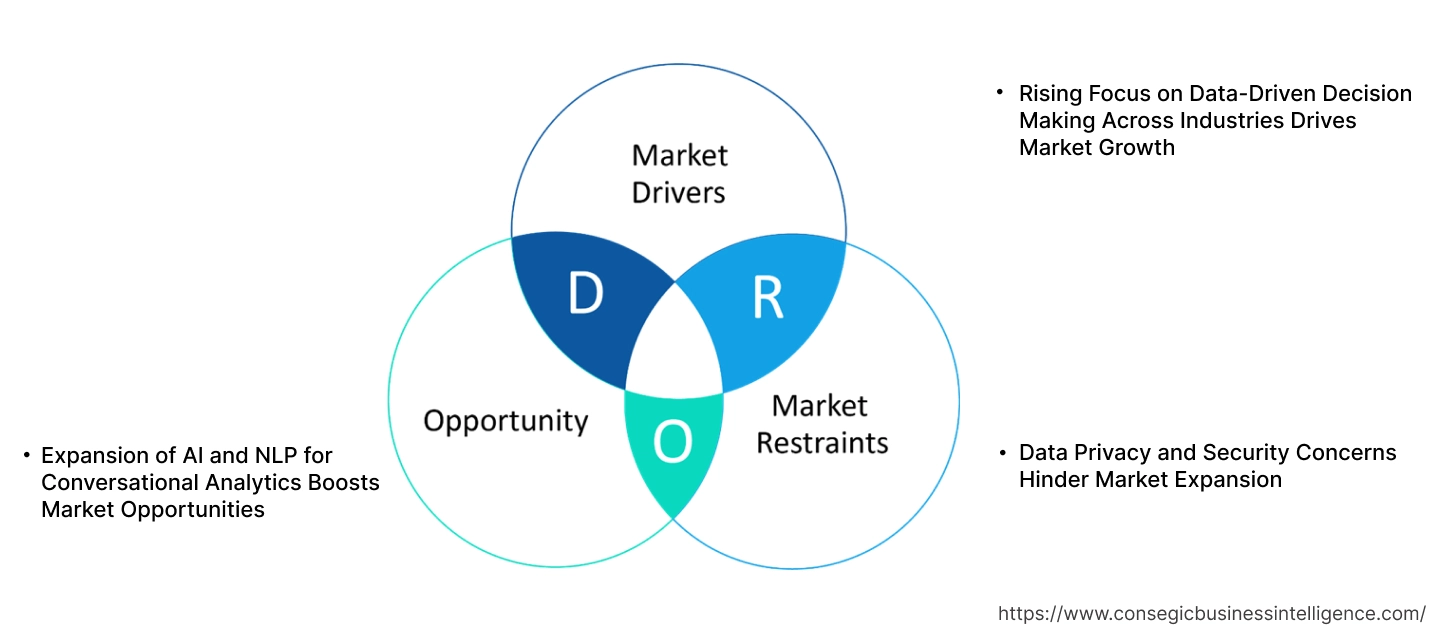
Rising Focus on Data-Driven Decision Making Across Industries Drives Market Growth
Businesses are shifting from traditional analytics models to AI-powered platforms that provide real-time insights, predictive forecasting, and automated recommendations. The demand for intelligent analytics is rising in finance, healthcare, retail, and manufacturing, where organizations require actionable insights to optimize operations, enhance customer experiences, and mitigate risks. Augmented analytics leverages machine learning, natural language processing (NLP), and automation to streamline data interpretation, making insights accessible to non-technical users and executives. In healthcare, AI-driven analytics improve patient diagnostics and treatment strategies, while in finance, real-time analytics assist in fraud detection and investment decision-making. Additionally, the integration of AI-driven analytics in supply chain management and marketing automation is enabling businesses to enhance efficiency and competitive advantage.
- For instance, according to the ThoughtSpot sponsored report by MIT SMR Connections, 83% of early adopters view GenAI as a competitive Of the 1,000 global respondents, 67% are already leveraging generative AI for analytics use case, with 26% planning to, and 7% evaluating its use.
As industries increasingly adopt self-service, AI-driven analytics platforms, augmented analytics market expansion is expected to accelerate, driving innovation in business intelligence solutions.
Key Restraints:
Data Privacy and Security Concerns Hinder Market Expansion
Organizations process large volumes of sensitive business, customer, and financial data, making them vulnerable to cyber threats, data breaches, and regulatory compliance challenges. Industries such as finance, healthcare, and government must ensure strict adherence to GDPR, CCPA, and other global data protection laws, adding complexity to analytics implementation. The demand for secure AI-driven analytics is rising, but concerns over unauthorized access, algorithmic biases, and ethical data usage create barriers for businesses adopting advanced solutions. Additionally, as cloud-based and multi-cloud analytics platforms expand, the risk of data exposure and cross-border data transfer regulations further complicate deployment. Organizations must invest in robust encryption, access control mechanisms, and AI-driven security frameworks to address these risks. Overcoming these challenges is essential for ensuring augmented analytics market growth, enabling broader adoption across industries while maintaining data security compliance.
Future Opportunities:
Expansion of AI and NLP for Conversational Analytics Boosts Market Opportunities
Traditional analytics platforms require technical expertise to interpret complex datasets, but AI-driven conversational interfaces allow users to query data, generate reports, and receive actionable insights using natural language. This advancement is driving demand for self-service analytics solutions, allowing professionals across industries to access real-time insights without relying on data scientists. NLP-powered analytics enhance customer engagement, workflow automation, and business intelligence, making it easier for enterprises to identify trends, detect anomalies, and optimize processes. Industries such as retail, healthcare, and finance are integrating conversational AI to streamline operations and improve strategic planning.
- For instance, in January 2025, Qlik introduced Data Flow for faster data-to-decisions in Qlik Cloud Analytics. This tool is designed to address the time-intensive challenges of preparing datasets for analytics and AI, allowing users to visually combine, clean, and shape data through an intuitive drag-and-drop interface and reducing the reliance on technical scripting skills enabling a broader range of users—both technical and non-technical—to create high-quality, AI-ready datasets.
As businesses seek more efficient ways to analyze data and improve decision-making, the growth of AI-powered analytics solutions is accelerating, creating significant augmented analytics market opportunities for companies investing in conversational intelligence.
Augmented Analytics Market Segmental Analysis :
By Component:
By component, the augmented analytics market is divided into software and services.
The software segment accounted for the largest revenue share in 2024.
- AI-driven data analytics platforms are transforming decision-making by automating data discovery, visualization, and pattern recognition.
- The demand for real-time data insights and predictive analytics is driving adoption across industries, particularly in BFSI, healthcare, and retail.
- Segmental analysis suggests that the integration of machine learning (ML) and Natural Language Processing (NLP) is enhancing data-driven decision-making.
- Augmented analytics market trends indicate that automated data discovery tools are revolutionizing enterprise analytics workflows, reducing reliance on traditional BI tools.
The services segment is expected to experience the fastest CAGR during the forecast period.
- Managed analytics services are gaining traction as enterprises seek expert guidance in deploying AI-powered analytics solutions.
- The need for cloud-based analytics consulting and integration services is increasing as organizations transition to automated, self-service BI platforms.
- Segmental analysis suggests that businesses are leveraging consulting services to accelerate their digital transformation efforts.
- Augmented analytics market expansion is being driven by the need for scalable analytics solutions, helping businesses optimize data management and reporting capabilities.
By Deployment Mode:
Based on deployment mode, the market is segmented into On-Premise and Cloud-Based.
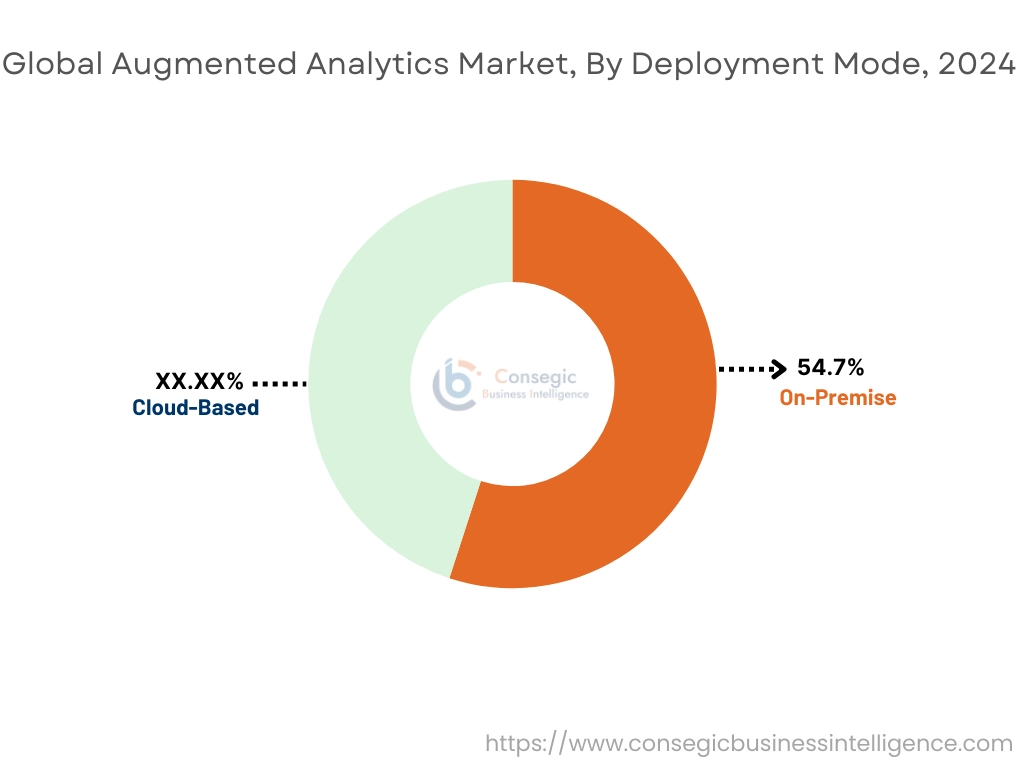
The on-premise segment held the largest revenue of augmented analytics market share by 54.7% in 2024.
- Enterprises in highly regulated industries such as BFSI and healthcare prefer on-premise solutions for data security, compliance, and control.
- The demand for in-house AI-driven analytics platforms remains strong among organizations that require customizable, high-performance data processing.
- Augmented analytics market analysis highlights that hybrid deployment models are emerging, combining on-premise security with cloud scalability.
- Trends suggest that large enterprises will continue leveraging on-premise analytics solutions, particularly for advanced data governance and real-time insights.
The cloud-based segment is expected to have the fastest CAGR during the forecast period.
- Cloud analytics adoption is accelerating, driven by the growing need for scalable, AI-powered data insights across industries.
- The need for cost-efficient, AI-driven cloud analytics platforms is fueling market adoption, particularly among SMEs and digital-first enterprises.
- Segmental trends indicate that cloud-based platforms are enhancing enterprise agility, enabling faster decision-making and real-time collaboration.
- Market growth is driven by continuous advancements in cloud computing, big data analytics, and AI-driven automation.
By Organization Size:
By organization size, the augmented analytics market is categorized into large enterprises and small & medium enterprises (SMEs).
The large enterprises segment held the largest revenue share in 2024.
- Enterprises with vast datasets rely on AI-driven analytics to optimize operations, improve decision-making, and enhance customer experiences.
- The demand for automated insights and predictive modeling tools is accelerating adoption in large corporations across finance, manufacturing, and IT.
- Augmented analytics market trends suggest that large enterprises are integrating AI-powered analytics to drive innovation and business intelligence.
- Market analysis shows that companies are leveraging automated analytics solutions to eliminate manual reporting inefficiencies and enhance productivity.
The SME segment is anticipated to experience the fastest CAGR during the forecast period.
- SMEs are increasingly adopting cloud-based analytics solutions to gain competitive insights and improve operational efficiency.
- The need for affordable, AI-powered self-service analytics platforms is driving adoption among small businesses.
- Segmental analysis indicate that SMEs are prioritizing automation and real-time reporting tools to enhance decision-making.
- With AI-powered insights becoming more accessible, SMEs are driving market expansion, particularly in digital-first industries.
By Vertical:
Based on vertical, the market is segmented into banking, financial services, and insurance (BFSI), retail & e-commerce, healthcare & life sciences, IT & telecommunications, manufacturing, government & public sector, energy & utilities, media & entertainment, and transportation & logistics.
The BFSI segment held the largest augmented analytics market share in 2024.
- AI-powered fraud detection, risk assessment, and predictive analytics are transforming the financial sector.
- The need for real-time insights into customer behavior and transaction patterns is fueling adoption among banks, insurers, and fintech firms.
- Augmented analytics market analysis suggests that financial institutions are leveraging AI-driven analytics for portfolio optimization, regulatory compliance, and customer engagement.
- Trends indicate that AI-powered augmented analytics will continue to reshape financial forecasting and fraud prevention strategies.
The healthcare & life sciences segment is expected to experience the fastest CAGR during the forecast period.
- AI-powered analytics is revolutionizing clinical decision-making, drug discovery, and personalized medicine.
- The requirement of real-time patient monitoring, predictive diagnostics, and medical research analytics is accelerating adoption in healthcare.
- Market trends highlight the growing role of AI in patient care optimization, hospital resource management, and medical imaging analysis.
- With the increased adoption of data-driven healthcare solutions, the industry is expected to drive significant augmented analytics market growth.
Regional Analysis:
The regions covered are North America, Europe, Asia Pacific, the Middle East and Africa, and Latin America.
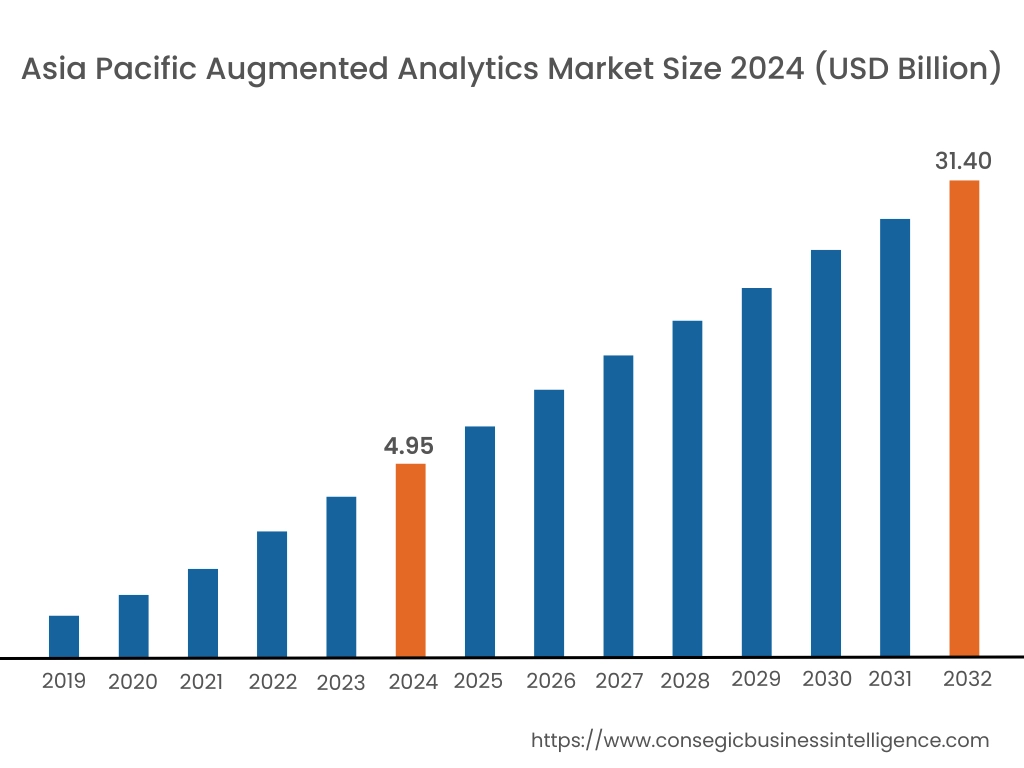
Asia Pacific is estimated to reach over USD 31.40 Billion by 2032 from a value of USD 4.95 Billion in 2024 and is projected to grow by USD 6.14 Billion in 2025. Out of this, China accounted for the maximum revenue share of 34.2%.
The Asia Pacific region is experiencing rapid growth in the augmented analytics market, propelled by expanding economies, increasing internet penetration, and a growing need for analytics solutions. Countries such as China, India, and Japan are investing heavily in digital transformation initiatives and the expansion of mobile and IoT networks. The proliferation of connected devices and the deployment of advanced infrastructure have heightened the need for efficient analytics solutions to handle the surge in data and ensure reliability. This environment creates a significant augmented analytics market demand with vendors offering scalable and robust solutions tailored to the region's dynamic needs.

North America region was valued at USD 5.57 Billion in 2024. Moreover, it is projected to grow by USD 6.88 Billion in 2025 and reach over USD 33.42 Billion by 2032.
North America dominates the augmented analytics industry, due to its robust IT infrastructure and early adoption of advanced technologies. The presence of leading vendors has solidified the region's market position. The rapid rollout of digital transformation initiatives and significant investments in data analytics have further propelled the need for augmented analytics solutions. Industries across the region are increasingly seeking advanced analytics capabilities, especially with the rise of big data and complex datasets. This trend presents a substantial augmented analytics market opportunity for solutions offering robust functionalities.
Europe maintains a strong position in the market, driven by the region's focus on digital transformation and government initiatives supporting data infrastructure development. Countries like Germany, the United Kingdom, and France are at the forefront, utilizing augmented analytics solutions to enhance operational efficiency and ensure seamless data integration. The increasing adoption of cloud-based analytics solutions is notable, as organizations prioritize scalability and flexibility. The region's emphasis on data privacy and compliance also fuels the demand for advanced analytics and data management tools.
In the Middle East & Africa, the augmented analytics market is emerging, with growth primarily driven by investments in data infrastructure and the adoption of modern technologies. Countries like the United Arab Emirates and Saudi Arabia are leading the charge, focusing on digital transformation and smart city initiatives. The increasing complexity of data, coupled with the need for robust analytics measures, has led organizations to adopt advanced augmented analytics solutions. While challenges such as limited skilled workforce and high initial costs persist, the region offers potential for market expansion as businesses recognize the value of efficient data management in achieving operational excellence.
Latin America's market is gradually gaining traction, influenced by the region's growing investments in data infrastructure and the increasing adoption of digital technologies. Countries like Brazil and Mexico are witnessing a surge in demand for augmented analytics solutions across various industries, including telecommunications, banking, and healthcare. The emphasis on enhancing data performance, ensuring security, and reducing operational costs drives organizations to implement advanced analytics tools. Despite economic fluctuations, the region presents opportunities for vendors offering cost-effective and scalable solutions tailored to meet the specific needs of Latin American enterprises.
Top Key Players & Market Share Insights:
The augmented analytics market is highly competitive with major players providing products and services to the national and international markets. Key players are adopting several strategies in research and development (R&D), product innovation, and end-user launches to hold a strong position in the global augmented analytics market. Key players in the augmented analytics industry include -
- Qlik (USA)
- SAP SE (Germany)
- Synergies Intelligent Systems (USA)
- Pyramid Analytics (Netherlands)
- DataRobot (USA)
- ThoughtSpot (USA)
- Alteryx (USA)
- Domo (USA)
- Scandit (Switzerland)
- Squirro (Switzerland)
Recent Industry Developments :
Product Launches:
- In November 2024, ThoughtSpot launched Spotter, the autonomous agent for analytics. This tool makes data insights accessible to any business user, in any industry, with actionable answers from their data at any time.
Partnerships:
- In January 2025, Qlik partnered with Redington as a distributor to drive AI adoption across the Middle East and Africa. This partnership offers streamlined partner access, localized expertise, enablement at scale and a comprehensive solution portfolio to the companies involved.
- In October 2024, Squirro and Recenso Services announced a strategic partnership aimed at delivering enterprise-ready Generative AI solutions to the telecommunications sector.
Augmented Analytics Market Report Insights:
| Report Attributes | Report Details |
| Study Timeline | 2019-2032 |
| Market Size in 2032 | USD 103.12 Billion |
| CAGR (2025-2032) | 25.5% |
| By Component |
|
| By Deployment Mode |
|
| By Organization Size |
|
| By Vertical |
|
| By Region |
|
| Key Players |
|
| North America | U.S. Canada Mexico |
| Europe | U.K. Germany France Spain Italy Russia Benelux Rest of Europe |
| APAC | China South Korea Japan India Australia ASEAN Rest of Asia-Pacific |
| Middle East and Africa | GCC Turkey South Africa Rest of MEA |
| LATAM | Brazil Argentina Chile Rest of LATAM |
| Report Coverage |
|
Key Questions Answered in the Report
How big is the Augmented Analytics Market? −
Augmented analytics market size is estimated to reach over USD 103.12 Billion by 2032 from a value of USD 16.80 Billion in 2024 and is projected to grow by USD 20.78 Billion in 2025, growing at a CAGR of 25.5% from 2025 to 2032.
What specific segmentation details are covered in the Augmented Analytics Market report? +
The Augmented Analytics market report includes specific segmentation details for components, deployment mode, organization size and vertical.
Which is the fastest-growing region in the Augmented Analytics Market? +
Asia Pacific is the fastest-growing region in the Augmented Analytics market. These trends are encouraged by expanding economies, increasing internet penetration, and a growing need for analytics solutions.
Who are the major players in the Augmented Analytics Market? +
The key participants in the augmented analytics market are Qlik (USA), SAP SE (Germany), ThoughtSpot (USA), Alteryx (USA), Domo (USA), Scandit (Switzerland), Squirro (Switzerland), Synergies Intelligent Systems (USA), Pyramid Analytics (Netherlands) and DataRobot (USA).
Overview
Reputation & Certifications


Our Services
- Market Intelligence & Forecasting
- Custom Research Solutions
- Market Entry Strategy
- Competitive Intelligence
- Customer Insights
- Industry Innovation Analysis
- Investment Advisory