Jump to Content
Automotive Engine Market - Size, Share, Industry Trends, and Forecasts (2025-2032)
Automotive Engine Market Size:
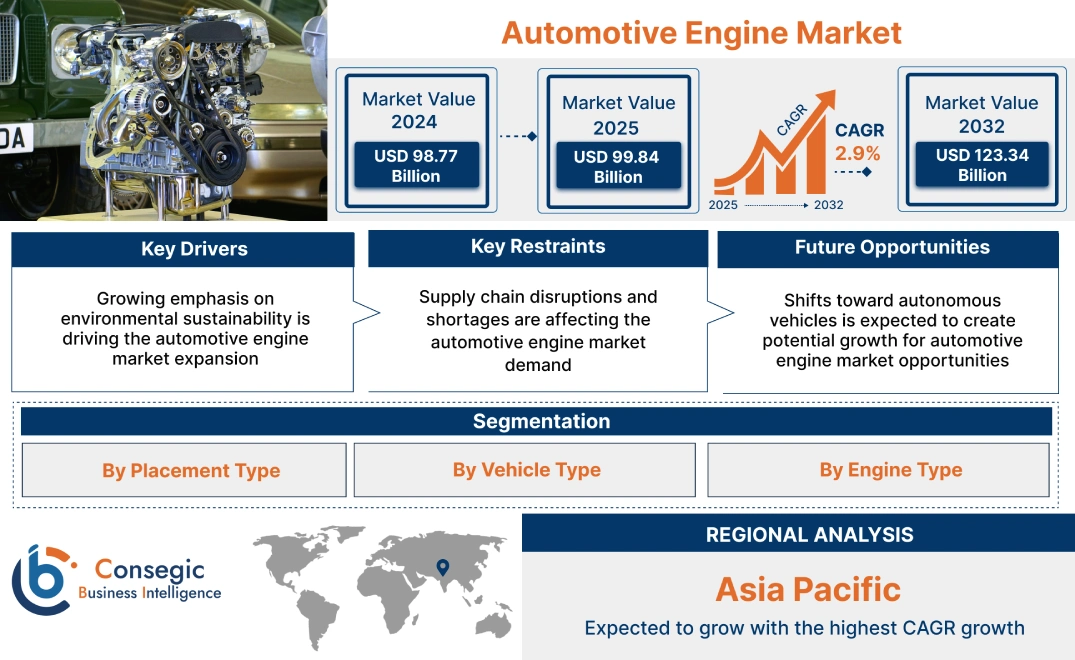
Automotive Engine Market Size is estimated to reach over USD 123.34 Billion by 2032 from a value of USD 98.77 Billion in 2024 and is projected to grow by USD 99.84 Billion in 2025, growing at a CAGR of 2.9% from 2025 to 2032.
Automotive Engine Market Scope & Overview:
An automotive engine is the component of motor vehicles that converts the chemical energy in fuel into mechanical energy. It also drives the generator and several accessories, such as power steering pump air-conditioning compressor. Engine technologies have advanced significantly over the years, driven by the ever-increasing demand for fuel efficiency, performance, and environmental sustainability. The market encompasses a wide array of engine types, including internal combustion engines (ICE), hybrid powertrains, and electric motors, each catering to diverse consumer needs and regulatory requirements across different regions.
Automotive Engine Market Dynamics - (DRO) :
Key Drivers:
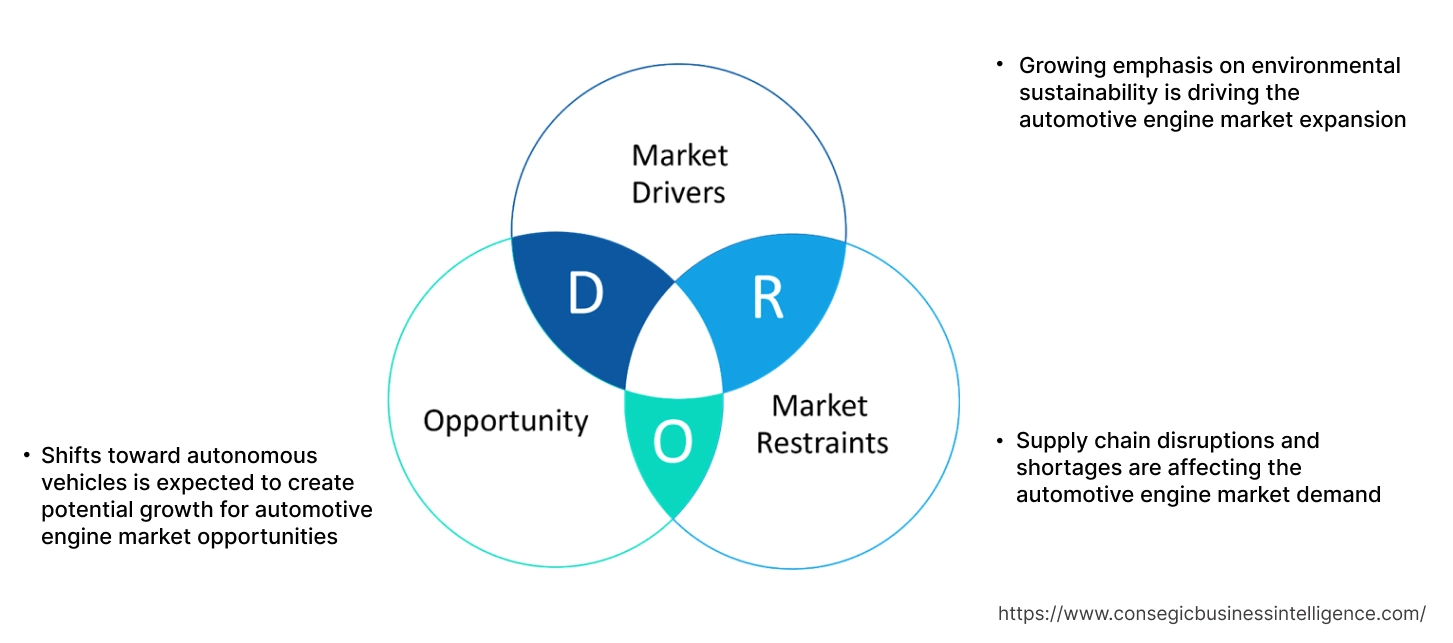
Growing emphasis on environmental sustainability is driving the automotive engine market expansion
The global market has undergone significant transformations with a pronounced emphasis on environmental sustainability in recent years. This shift is primarily driven by stringent regulations aimed at reducing emissions and mitigating the environmental impact of vehicles. Automakers are increasingly investing in research and development to develop engines that are more fuel-efficient and eco-friendlier. Further, technologies such as hybridization, electrification, and advancements in traditional internal combustion engines are among the key factors driving the global market. Hybrid and electric vehicles have gained considerable traction as viable alternatives to traditional gasoline and diesel engines. These vehicles utilize a combination of electric motors and conventional engines, reducing reliance on fossil fuels and minimizing emissions. Moreover, advancements in battery technology have led to improved energy storage capacities, enabling longer driving ranges and faster charging times. As a result, consumers are increasingly inclined towards purchasing vehicles that offer lower emissions and reduced environmental impact.
- For instance, in In February 2024, Nikola Corporation announced the launch of its all-electric hydrogen fuel cell truck, the Nikola Tre, for the North American market. This new model aims to enhance long-haul capabilities and reduce greenhouse gas emissions in the freight industry.
Thus, according to the automotive engine market analysis, the growing advancements related to sustainable and eco-friendly automotive engines are driving the automotive engine market size.
Key Restraints:
Supply chain disruptions and shortages are affecting the automotive engine market demand
The global market is currently facing significant restraints due to supply chain disruptions and shortages. These disruptions are primarily attributed to various factors, including the ongoing global semiconductor shortage, logistical constraints, and geopolitical tensions affecting raw material supply. As automotive manufacturers rely heavily on complex supply chains spanning multiple countries and industries, any disruption has cascading effects downstream, impacting engine production and assembly.
One of the critical components affected by these shortages is semiconductor chips, which are crucial for the operation of modern automotive engines. These chips are used in engine control units (ECUs) and various other electronic components essential for engine performance, emissions control, and overall vehicle operation. The shortage of semiconductor chips has forced many automotive manufacturers to scale back production or even temporarily halt assembly lines, leading to delays in delivering vehicles to customers and impacting revenue streams. Thus, the analysis depicts that the aforementioned factors would further hamper the automotive engine market size.
Future Opportunities:
Shifts toward autonomous vehicles is expected to create potential growth for automotive engine market opportunities
As self-driving technology advances, traditional combustion engines are facing competition from electric and hybrid powertrains, which are becoming increasingly favored for their compatibility with autonomous systems. Automakers are not only focusing on enhancing engine efficiency but also on integrating engines with advanced driver-assistance systems (ADAS) and autonomous driving features. Further, the integration of artificial intelligence (AI) and machine learning algorithms in autonomous vehicles is revolutionizing the way engines operate. AI-powered systems can optimize engine performance in real-time, adapting to changing driving conditions and maximizing efficiency. This not only enhances the overall driving experience but also contributes to reduced emissions and improved fuel efficiency. As a result, the global market is undergoing a transformation where innovation, sustainability, and autonomy are shaping the global landscape.
- For instance, in December 2021, Waymo announced the partnership with Geely, to develop all-electric, autonomous ride-hailing vehicle, utilizing Geely’s Zeekr EV platform and Waymo’s autonomous driving technology. The car is designed for specifically autonomous hailing trips, which has a flat door, B-pillarless design, reclining seats, and sliding doors.
Thus, based on the above automotive engine market analysis, the growing technological advancement in the automotive sector is expected to drive the automotive engine market opportunities.
Automotive Engine Market Segmental Analysis :
By Placement Type:
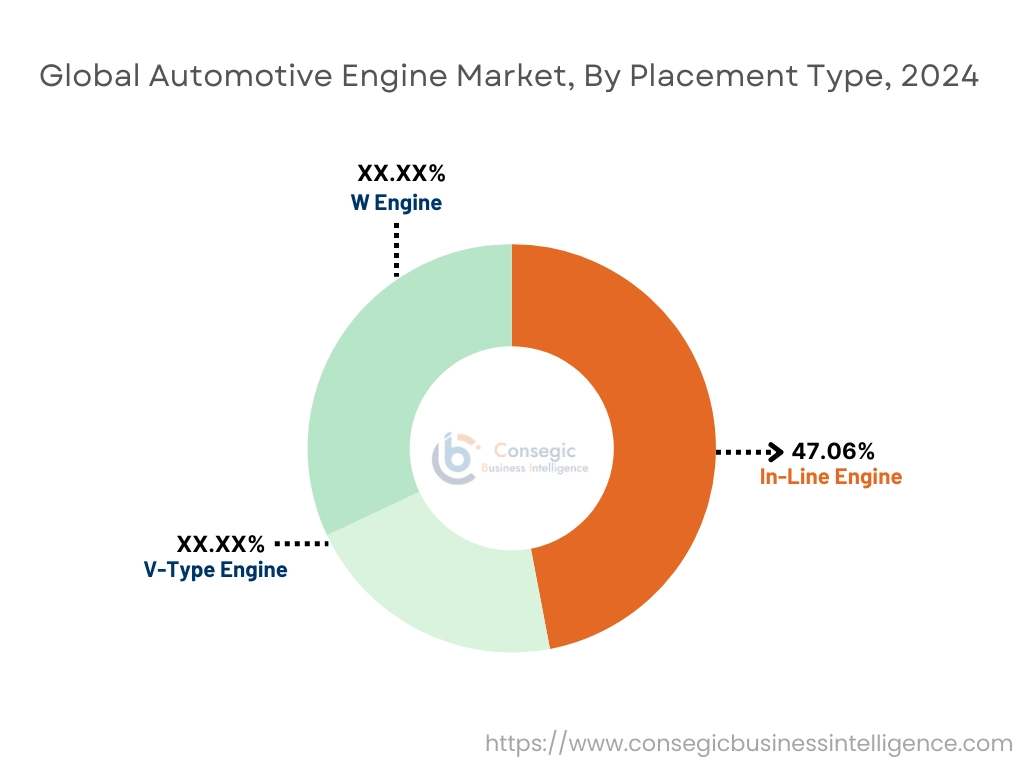
Based on placement type, the global market is segmented into in-line engine, V-type engine, and W engine.
Trends in the placement type:
- The growth of e-commerce and logistics is increasing the demand for commercial vehicles, which in turn drives the demand for reliable and efficient engine placements.
- Manufacturers are constantly innovating to develop engines that offer higher power output, improved fuel efficiency, and reduced emissions. This has led to the introduction of advanced engine technologies such as turbocharging, direct fuel injection, and cylinder deactivation systems, among others.
- Thus, the above factors and trends are driving the automotive engine market demand and share.
The in-line engine segment accounted for the largest revenue share of 47.06% in the year 2024.
- In-line engines are also known as straight engines, which feature cylinders aligned in a single straight line along the crankshaft. This configuration is commonly found in smaller vehicles, including compact cars and some entry-level sedans.
- In-line engines are valued for their simplicity, compactness, and ease of maintenance. They typically offer good fuel efficiency and are well-suited for applications where space is limited, such as front-wheel-drive vehicles.
- For instance, in March 2022, Stellantis unveiled its 3.0 litre, twin-turbo, six-cylinder straight engine, named Hurricane. The engine provides better fuel economy and fewer emissions, while generating more horsepower and torque.
- Thus, based on the above analysis, these developments and trends are further driving the automotive engine market growth.
The V-type engine segment is anticipated to register the fastest CAGR during the forecast period.
- V-type engines have cylinders, which are arranged in a V-shaped configuration when viewed from the front. This arrangement allows for a more compact design compared to in-line engines while offering improved balance and smoothness due to the offset cylinder banks.
- V-type engines are popular choices for a wide range of vehicles, including luxury sedans, SUVs, trucks, and performance cars. They accommodate varying numbers of cylinders, ranging from four to twelve or more, and are known for their versatility and power delivery.
- The above factors are expected to drive the automotive engine market share during the forecast period.
By Vehicle Type::
Based on vehicle type, the market is segmented into passenger vehicle and commercial vehicle.
Trends in the vehicle type:
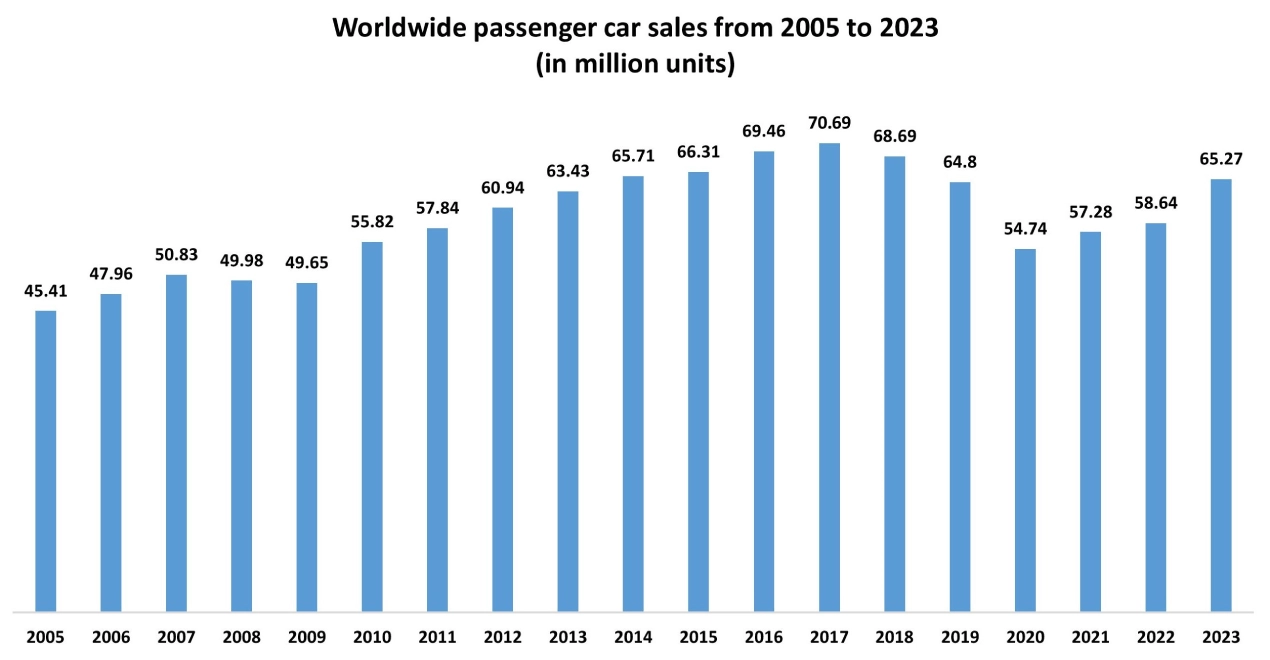
- The growth of the global automotive sector directly influences the demand for advanced automotive products and solutions. The rise in vehicle production across all segments leads to an increased need for original equipment and replacement parts including engines.
- Older vehicles tend to experience greater wear and tear, resulting in an increased probability of requiring steering systems replacements. This factor drives a consistent need for replacement parts in the aftermarket.
The passenger vehicle segment accounted for the largest revenue share in the year 2024.
- The passenger vehicle segment has witnessed a significant shift towards electric vehicles (EVs) as part of the broader transition to cleaner, more sustainable energy sources.
- Consumers are increasingly opting for EVs due to their lower environmental impact, reduced fuel costs, and improved performance. This transition is also supported by governments worldwide, which are introducing stricter emission standards and offering incentives for electric car buyers.
- The increased availability of financing options and the development of affordable vehicle models are making passenger vehicles more accessible to a broader consumer base. As a result, automakers are adapting their strategies to cater to the diverse needs of consumers in these high-growth markets, including offering affordable, fuel-efficient, and compact vehicles.
- For instance, in June 2024, Tata Motors launched Altroz Racer, a sports model in the hatchback segment. The features of the car include 1.2 litre turbo petrol engine, torque of 170 Nm with a power of 120 Ps at 5500 rpm.
- The market analysis depicts that these developments in the passenger vehicle segment are driving the automotive engine market growth.
The commercial vehicle segment is anticipated to register the fastest CAGR during the forecast period.
- Governments around the world are implementing increasingly stringent emissions standards, such as Euro VI in Europe and EPA regulations in the United States, to curb air pollution and mitigate the environmental impact of commercial vehicles. These regulations mandate the adoption of cleaner engine technologies, exhaust after treatment systems, and alternative fuels to reduce emissions of harmful pollutants such as nitrogen oxides (NOx), particulate matter (PM), and greenhouse gases (GHGs).
- Manufacturers are investing in research and development to develop and commercialize electric vehicles, hybrid drivetrains, natural gas engines, and hydrogen fuel cell technologies to comply with emissions regulations and meet customer demand for cleaner, more sustainable transportation solutions.
- For instance, in India, the commercial vehicle sales increased from 9.62 lakh to 9.68 lakh units. In addition to this, the sales of medium and heavy commercial vehicles increased from 3.59 lakh to 3.73 units while sales of light commercial vehicles decreased from 6.03 lakh to 5.95 lakh units in fiscal year 2023-24.
- Thus, above factors are expected to drive the automotive engine market trends during the forecast period.
By Engine Type:
Based on engine type, the automotive engine market is segmented into internal combustion engine (ICE) and electric.
Trends in the engine type:
- Petrol vehicles are traditionally favoured for their balance of performance, fuel efficiency, and relatively lower upfront costs compared to other fuel types. Despite increasing concerns about environmental sustainability, petrol vehicles continue to be a popular choice in many regions due to their extensive infrastructure and ease of maintenance.
- Hybrid vehicles combine an ICE with an electric motor, offering a compromise between fuel efficiency and reduced emissions. These vehicles appeal to consumers intending to transition toward greener options without completely abandoning traditional fuelling methods.
The internal combustion engine (ICE) segment accounted for the largest revenue in the year 2024.
- Gasoline engines are also known as petrol engines, are being a prime component in the automotive sector. These engines utilize gasoline as their primary fuel source, relying on spark ignition to combust the air-fuel mixture within the engine cylinders.
- Gasoline engines are commonly found in a wide range of vehicles, from compact cars to high-performance sports cars. They are favoured for their smooth operation, quick acceleration, and relatively lower initial cost compared to other engines.
- Diesel engines operate on a compression-ignition principle, where the air-fuel mixture ignites solely due to the high pressure created by the compression stroke within the engine cylinders. This design provides diesel engines with higher torque output and better fuel efficiency, making them preferred choices for applications requiring heavy hauling or long-distance driving.
- Diesel engines are known for their durability and longevity, making them attractive for fleet operators and businesses looking for reliable and cost-effective transportation solutions.
- These developments in the internal combustion engine segment are driving the automotive engine market trends.
The electric segment is anticipated to register the fastest CAGR during the forecast period.
- The advancements in battery technology have significantly enhanced the efficiency and range of electric vehicles (EVs), further boosting the adoption of electric engines.
- With the ongoing developments in lithium-ion batteries and the emergence of solid-state battery technology, EVs equipped with electric motors are becoming increasingly competitive with their internal combustion engine counterparts in terms of performance, range, and affordability.
- Technological advancements in electric engine technology have made them more efficient, reliable, and cost-effective. Manufacturers are investing heavily in research and development to improve battery technology, increase charging infrastructure, and enhance the overall performance of electric vehicles.
- Thus, above factors are expected to drive the global market trends during the forecast period
Regional Analysis:
The global market has been classified by region into North America, Europe, Asia-Pacific, MEA, and Latin America.
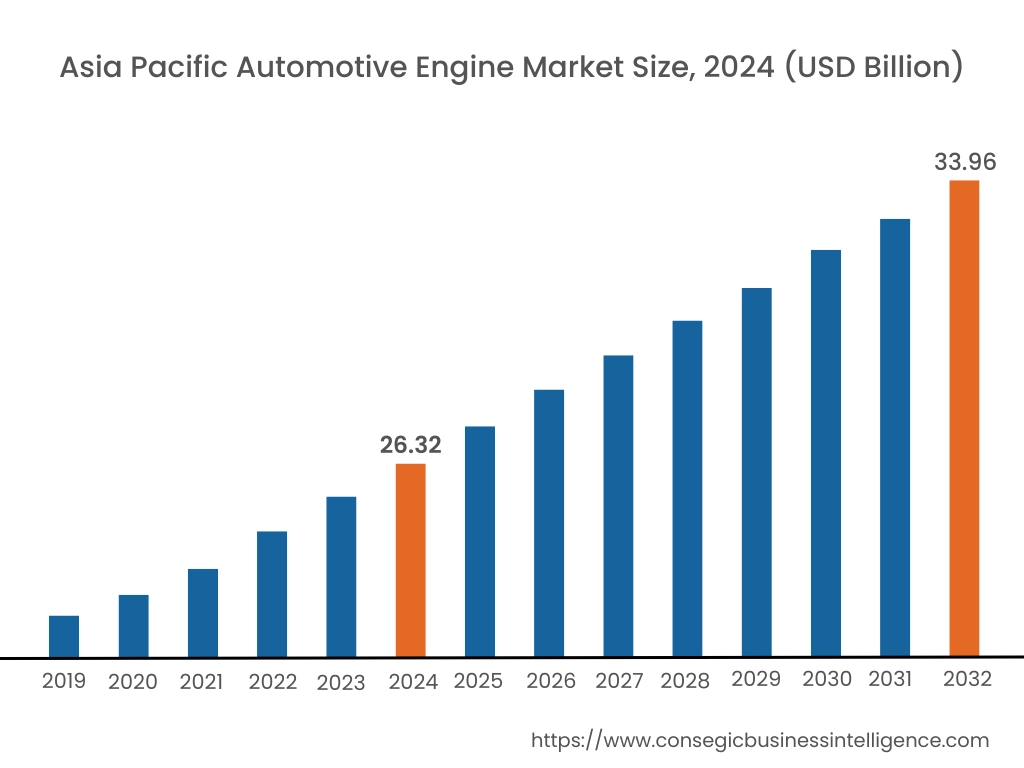
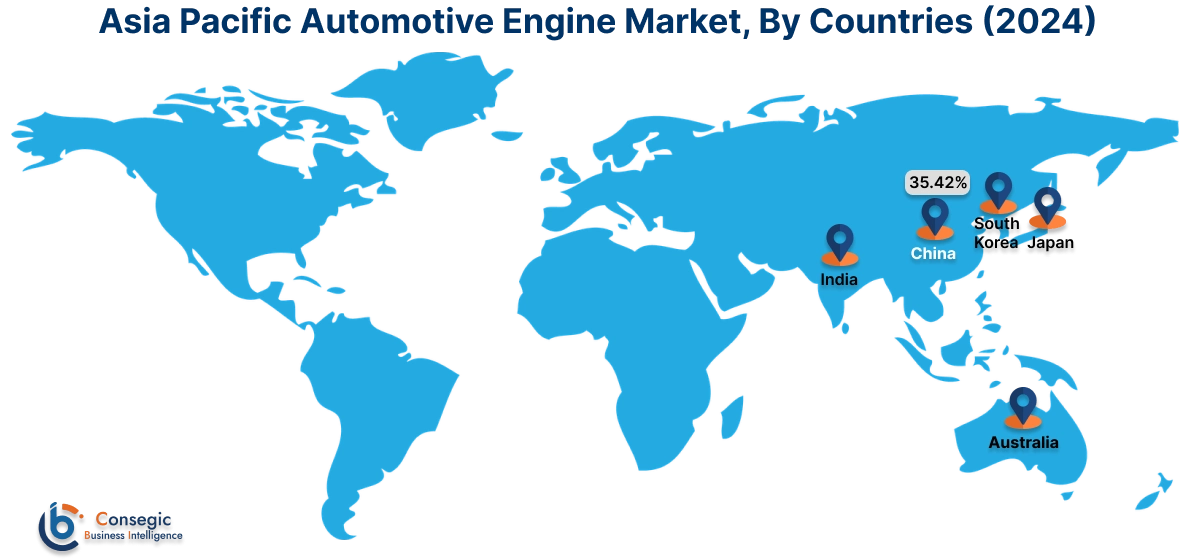
Asia Pacific automotive engine market expansion is estimated to reach over USD 33.96 billion by 2032 from a value of USD 26.32 billion in 2024 and is projected to grow by USD 26.68 billion in 2025. Out of this, the China market accounted for the maximum revenue split of 35.42%. Asia Pacific emerges as a dynamic and rapidly evolving market for automotive engines, fueled by the growth of emerging economies such as China, India, and South Korea. The region serves as a manufacturing hub for numerous automotive OEMs, leveraging cost advantages and a vast consumer base. In recent years, there has been a surge in need for compact and fuel-efficient engines, driven by urbanization, rising income levels, and government initiatives promoting clean energy technologies. Further, countries such as China, Japan, and South Korea are at the forefront of EV development and adoption in the region. China has emerged as the largest EV market globally, with strong government support and incentives for both manufacturers and consumers. The region’s rapid urbanization and need for efficient, low-emission transportation solutions contribute to the growing market for electric commercial and passenger vehicles. These factors would further drive the regional automotive engine market share during the forecast period.
- For instance, in September 2023, BYD Co. Ltd. launched the U8 Premium edition passenger vehicle under its Yangwang sub-brand. The vehicle boasts a plug-in hybrid system, offering a long trip capability range of upto 1,000 Km. The passenger vehicle features a 1,200 horsepower, which can sprint from 0 to 100 km/h in 3.6 seconds.
North America market is estimated to reach over USD 36.76 billion by 2032 from a value of USD 29.83 billion in 2024 and is projected to grow by USD 30.12 billion in 2025. The region boasts a significant presence of key automotive manufacturers, and a strong consumer base inclined towards performance-driven vehicles. With a growing focus on sustainability, there's an increasing need for fuel-efficient engines and alternative propulsion systems, and a driving innovation in this market. Further, automakers in the region are able to develop EVs with longer ranges, faster acceleration, and enhanced performance, with improved energy storage capabilities of modern batteries. This has led to a surge in the production of electric vehicles across the region, with both established manufacturers and startups investing heavily in electrification initiatives. Consequently, the need for electric engines, which are the key components of EV propulsion systems, has risen, which are creating lucrative opportunities for manufacturers in the regional market.
- For instance, in August 2022, Cummins, Inc. announced the acquisition of Meritor, Inc., to position themselves as a leading provider of combined powertrain solutions across electric and internal combustion applications. With this acquisition, Cummins intends to deliver decarbonized solutions to global customers by boosting Meritor’s investment in electrification and development of power business.
According to the analysis, the automotive engine industry in Europe is projected to witness significant development during the forecast period. The region's emphasis on innovation, stringent emissions regulations, and consumer need for fuel-efficient vehicles drive its market share in the global automotive sector. Additionally, initiatives promoting electric mobility and sustainable transportation further shape Europe's position as a prominent player in the global market. Additionally, Latin American countries showcase a diverse automotive market characterized by varying consumer preferences and economic conditions. Moreover, government incentives and regulations aimed at reducing emissions and enhancing fuel efficiency are driving the automotive engine market in the region. Further, in the Middle East & Africa, the increasing urbanization and infrastructure development are expected to drive the need for commercial vehicles and construction equipment, thereby influencing the need for specialized engines tailored to these applications.
Top Key Players & Market Share Insights:
The global automotive engine market is highly competitive with major players providing products to the national and international markets. Key players are adopting several strategies in research and development (R&D), product innovation, and end-user launches to hold a strong position in the market. Key players in the automotive engine industry include-
- AB Volvo (Sweden)
- Cummins Inc. (U.S.)
- Mitsubishi Heavy Industries (Japan)
- Renault Group (France)
- Scania AB (Sweden)
- Volkswagen Group (Germany)
- Ford Motor Company (U.S.)
- Fiat S.PA. (Italy)
- General Motors (U.S.)
- Honda (Japan)
- Hyundai Motor Company (South Korea)
- Mercedes-Benz (Germany)
Recent Industry Developments :
Business Expansions:
- In February 2025, Horse announced the production of 1.3 litre, four-cylinder HR13 engine at its facility in Curituba, Brazil. The engine was designed specifically for Latin American market. The engine runs on ethanol blends and gasoline and is fully in compliance with L8 emission standards.
Automotive Engine Market Report Insights:
| Report Attributes | Report Details |
| Study Timeline | 2019-2032 |
| Market Size in 2032 | USD 123.34 Billion |
| CAGR (2025-2032) | 2.9% |
| By Placement Type |
|
| By Vehicle Type |
|
| By Engine Type |
|
| By Region |
|
| Key Players |
|
| North America | U.S. Canada Mexico |
| Europe | U.K. Germany France Spain Italy Russia Benelux Rest of Europe |
| APAC | China South Korea Japan India Australia ASEAN Rest of Asia-Pacific |
| Middle East and Africa | GCC Turkey South Africa Rest of MEA |
| LATAM | Brazil Argentina Chile Rest of LATAM |
| Report Coverage |
|
Key Questions Answered in the Report
How big is the Automotive Engine market? −
Automotive Engine Market Size is estimated to reach over USD 123.34 Billion by 2032 from a value of USD 98.77 Billion in 2024 and is projected to grow by USD 99.84 Billion in 2025, growing at a CAGR of 2.9% from 2025 to 2032.
Which is the fastest-growing region in the Automotive Engine market? +
Asia-Pacific is the region experiencing the most rapid growth in the market. The region emphasis on electric and hybrid electric vehicles is reshaping the automotive engine market, with a shift toward electrification and sustainable mobility solutions.
What specific segmentation details are covered in the Automotive Engine report? +
The automotive engine report includes specific segmentation details for placement type, vehicle type, engine type, and region.
Who are the major players in the Automotive Engine market? +
The key participants in the market are AB Volvo (Sweden), Cummins Inc. (U.S.), Ford Motor Company (U.S.), Fiat S.PA. (Italy), General Motors (U.S.), Honda (Japan), Hyundai Motor Company (South Korea), Mercedes-Benz (Germany), Mitsubishi Heavy Industries (Japan), Renault Group (France), Scania AB (Sweden), Volkswagen Group (Germany), and others.
Overview
Reputation & Certifications


Our Services
- Market Intelligence & Forecasting
- Custom Research Solutions
- Market Entry Strategy
- Competitive Intelligence
- Customer Insights
- Industry Innovation Analysis
- Investment Advisory