Jump to Content
Biomass Gasification Market - Size, Share, Industry Trends, and Forecasts (2025 - 2035)
Biomass Gasification Market Scope & Overview
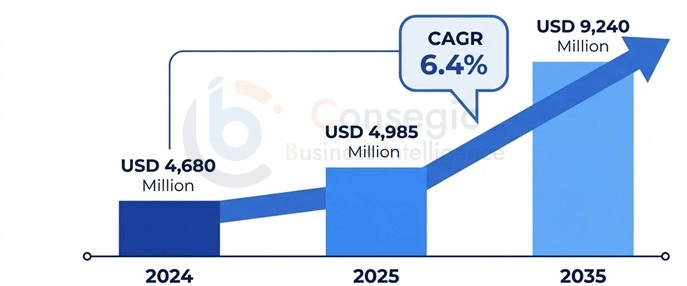
The world biomass gasification market is a revolutionary branch of the renewable energy and waste-to-energy sector, as a key thermochemical technology, which is used to convert organic compounds into power generation, heat generation, production of biofuels, and chemical products by transforming organic materials into synthesis gas (syngas). The market value will be USD 4,680 Million in 2024 and USD 4,985 Million in 2025 (base year), and it is expected to grow significantly to USD 9,240 Million in 2035. This growth rate will reflect a compound annual growth rate (CAGR) of 6.4 percent over the forecast period 2026-2035 due to the accelerating decarbonization commitments, the circle economy initiatives, agricultural wastes valorization opportunities, and advanced biofuel mandates in the developed and emerging economies.
Regional Trends and Insights
- Asia-Pacific biomass gasification market, the fastest-growing region, was valued at USD 2,094 million in 2025, and is projected to reach USD 4,050 million by 2035, growing at a CAGR of 6.8%
- European biomass gasification market, a major regional market, was valued at USD 1,645 million in 2025, and is projected to reach USD 3,050 million by 2035, growing at a CAGR of 6.3%.
Biomass gasification is a thermochemical form of conversion that uses high temperatures (usually 700-1,400 o C) in the presence of limited oxygen, transforming organic feed-stock such as wood chips, agricultural residues, energy crops, and organic waste into combustible syngas that mainly contains hydrogen, carbon monoxide, methane and carbon dioxide. In 2024 the installed biomass capacity reached approximately 7,400 megawatts thermal (MWth) world wide covering about 42.5 million metric tons of feedstock biomass every year and with an estimated total value of investment of millions of dollars, very significant long-term market potential is offered to the technology providers, project developers, and equipment manufacturers.
Market Channel Distribution Analysis:
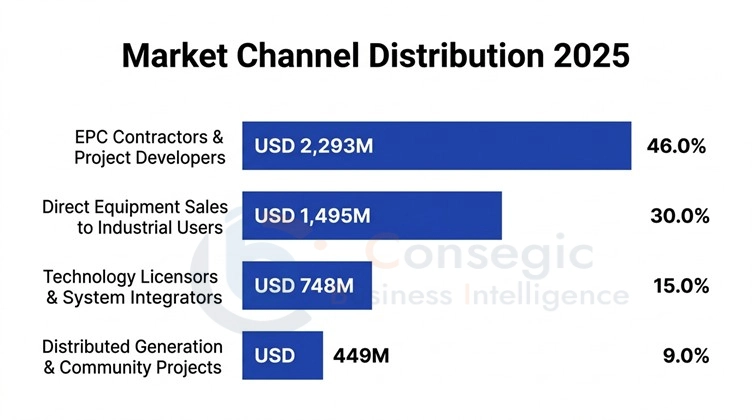
The biomass gasification market has four different sales and delivery channels where each has different customer segments that offer differentiated value propositions and model of project delivery. The overall market revenue allocation has a high level of difference based on the type of customers, the magnitude of the project, and geographical aspects:
- EPC Contractors and Developers of the Project: USD 2,293 million (46.0% of the total market value)
- Direct Sales of Equipment to the Industrial Users USD 1,495 Million (30.0% of market revenue)
- Technology Licensors and system integrators: USD 748 Million ( 15.0% market share )
- Distributed Generation and Community Projects USD 449 Million (9.0% of the total value of the market)
By 2024, the world had invested USD 685 Million in the development and commercialization of biomass gasification technology, with technology suppliers estimated to spend around 9.2% of the revenue on system applications to enhance the efficiency of gasification and syngas cleaning system, development of advanced feedstock preprocessing technologies, and system integration with downstream uses. There is an essential change in the industry towards integrated concept of biorefinery including generation of power, biofuel production coupled with biochemical synthesis with massive adoption in the industrial, utility-scale, and distributed energy uses.
Biomass Gasification Market Dynamics (DRO)
Key Drivers:
Decarbonization Mandates and Net-Zero Commitments
The greatest structural driver within all markets worldwide has been the pressing necessity to decarbonize the energy systems and industrial processes in order to achieve ambitious climate commitments under the Paris agreement and national net-zero goal. About 142 nations with over 88 percent of the total amount of greenhouse gas emissions worldwide have set their net-zero targets by the middle of the century, which forms significant policy incentives in support of renewable energy technologies such as biomass gasification. The Renewable Energy Directive III of the European Union requires a minimum share of renewable energy of 42.5 percent by the year 2030, further adding provisions about advanced biofuels production and the production of renewable hydrogen by gasifying biomass.
Biomass gasification has some special benefits to hard-to-decarbonize industries such as steel, cement, chemicals and heavy transportation where direct electrification can be technically or economically difficult. In industry, the 2024 figure of USD 1,895 Million is reached, and steel producers are considering the use of biomass derived syngas to replace coal in the blast furnace industry, which would save 65-75% of carbon emissions as compared to the traditional metallurgical coal processes.
Waste Management Pressures and Circular Economy
The growing trend in the implementation of the principles of the circular economy provides biomass gasification technologies with significant opportunities to transform agricultural wastes, forestry wastes, and organic municipal wastes into useful energy products and chemical feeds. In 2024, the global municipal solid waste (MSW) has passed 2.3 billion tonnes and is expected to hit 3.0 billion tonnes by 2050. In most developing economies, organic waste fractions constitute 45-55 per cent of total MSW volumes posing an urgent waste management challenge.
The biomass gasification facilities offer two benefits as they offer a complying form of waste disposal and a valuable energy carrier. Waste accepting gate fees are normally USD 45-120 per tonne, which is much better in enhancing the economics of the project, as well as dealing with the environmental concerns involved in landfilling and open burning of agricultural wastes.
Key Restraints:
High Capital Costs and Technical Complexity
Biomass gasification is also faced with significant technical problems such as tar formation, ash management, and syngas purification needs, and system reliability that have traditionally been a limiting factor to commercial implementation. The most important technical barrier is tar compounds, the concentration of which is between 5-150 grams per normal cubic meter in raw syngas, based on the design of the gasifier and conditions of its operation. The accumulation of tar leads to the fouling of downstream equipment, the poisoning of catalysts, and system shutdowns, requiring costly cleanup systems which increase the overall capital requirements by 25-40 percent.
Small-scale biomass gasification plants typically cost USD 3,500-5,800/kilowatt in capital expenditure whereas the large-scale installations cost USD 2,200-3,600/kilowatt, which is much higher than the cost of conventional fossil fuel power plants. Bankability in project finance structures necessitates larger equity (30-40) and long term offtake agreements to gain bankability.
Feedstock Supply Chain and Quality Variability
The economics of biomass gasification is severely reliant on a regular, economical feedstock supply, however the biomass materials are markedly different in their make-up, moisture levels, ash traits and seasonality. The feedstock costs generally take 35-55 percent of the overall operating expenses, whereas transportation economics shows that the economically viable collection radius extends to 50-80 kilometers in case of low-density agricultural residues and 100-150 kilometers in case of densified wood pellets.
Future Opportunities:
Advanced Biofuels and Green Hydrogen Production
The interplay between the biomass gasification process and catalytic synthesis processes provides transformational pathways to generating sustainable aviation fuel (SAF), renewable diesel, and platform chemicals using a wide range of biomass feeds. The aviation fuel market in the world is USD 850 Million in 2024 with a growth rate of 42.5% per year and the aviation industry has committed to combining 10% of the unusual gas in its fuel blending by 2030.
Biomass gasification provides interesting routes to renewable hydrogen synthesis by reforming of syngas and water-gas shift reaction, and may be less expensive than water electrolysis in areas where low-cost biomass is abundant. The market in green hydrogen across the globe was USD 4,850 Million in 2024 and it is projected to grow at 48.5% per annum and the amount demanded is projected to be 530 million metric tons per annum in 2050.
Market Segmentation Analysis
By Gasifier Type: Technology Configuration Analysis
Fluidized Bed Gasifiers: Market Leadership
The fluidized bed gasifiers are commanding a market leadership of USD 2,243 Million or 45.0 percent of the total market value in 2025, where the forecasts are USD 4,160 Million at 6.4 percent CAGR in 2035. This is technology includes bubbling fluidized bed (BFB) and circulating fluidized bed (CFB) designs ranging in capacity between 5-100 MWth to industrial process heat, utility-scale power generation and integrated biorefinery to use.
Fixed Bed Gasifiers: Small-Scale Implementations.
Fixed bed gasifiers comprise USD 1,495 Million (30.0) of total market value and are utilized in small-scale applications between 50 kilowatts thermal and 2 MWth capacity (accounting 160 tonnes per hour) used to generate distributed power, in small-scale industrial heating applications and in which simplicity and low tar production have been beneficial.
Other Gasifier Technologies.
Updraft gasifiers, other designs such as entrained flow and plasma gasification represent USD 1,247 Million (25.0% of market value).
By Application: End-Use Sector Analysis
Power Generation: Largest Application Segment
The biggest area of application would be power generation which will have USD 1,744 Million in 2025, which is 35.0 percent of the total market value projected to USD 3, 234 Million in 2035 with 6.4 percent CAGR. This category includes utility-scale biomass power generation and captive power generation by industries, as well as distributed generation systems.
Heat Production and Industrial Applications.
The heat production in industries takes USD 1,495 Million (30.0%), biofuel production USD 997 Million (20.0%), and other applications such as chemical synthesis and production of hydrogen USD 749 Million (15.0%).
By Feedstock: Biomass Resource Analysis Agricultural Residues: Dominant Feedstock Category
The feedstock consumption is dominated by agricultural residues at USD 1,994 Million (40.0%), consisting of rice husks, wheat straw, corn stover, sugarcane bagasse and other crop residues. Wood and forestry biomass is USD1,495 Million (30.0%), energy crops USD748 Million (15.0%) and municipal solid waste USD 748 Million (15.0).
Regional Market Analysis
Asia-Pacific: Fastest-Growing MarketAsia-Pacific market is biomass gasification that has USD 2,094 Million in 2025, which is 42.0% of the global biomass market, and with high booming demand at 6.8% CAGR to USD 4,050 Million in 2035, the biomass gasification market is the fastest growing market. China is the biggest national market with 48.5% of regional value, then India with 28.5% then Japan with 10.5% and the Southeast Asian countries with 12.5 percent.
The market of biomass gasification in China is projected to reach USD 1,015 Million in 2025, which is predetermined by strong renewable energy objectives and the priorities on agricultural waste management. The installed capacity of the country is about 3,850 MWth in 1,240 facilities where more than 19.5 million metric tons of biomass is processed each year.
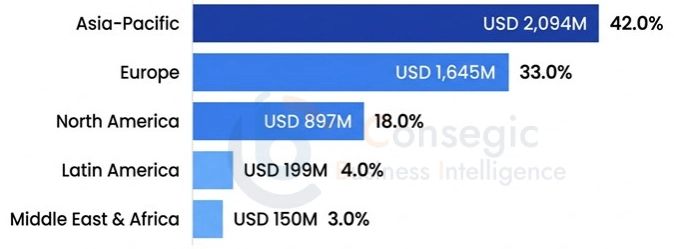
The European market of biomass gasification was USD 1,645 Million in 2025 and 33.0% of the market value, and is projected to reach USD 3,050 Million in 2035 with a CAGR of 6.3%. Germany, Sweden, Finland and Austria are all 62 percent of the regional demand, and the governments have a great support of the policies on renewable energy and the carbon pricing mechanisms.
North America: Innovation HubIn the year 2025, the market of North American biomass gasification was estimated at USD 897 Million which is 18.0 percent of the market value and is expected to reach USD 1,665 Million in the year 2035 at the CAGR of 6.4 percent. The US has taken majority of market value of 82.5 and there is high concentration on advanced biofuel production and use of waste to energy.
Other RegionsLatin America accounts USD 199 Million (4.0%), Middle East and Africa USD 150 Million (3.0%) and both have growth potential due to the availability of agricultural biomass.
Competitive Landscape and Key Market Players
Market Leadership and Strategic Positioning Valmet Corporation (Finland) - World Leader of Technologies.Valmet continues to dominate the market with a projected USD 485 Million biomass gasification revenue in 2024 amounting to 9.8 per cent global market share. Its business unit, the Energy and Environmental business, is an entity that deals with full gasification systems and integrated biorefinery.
Andritz AG (Austria) - Full Solutions Provider.Andritz has about 8.5% of the world market share on biomass gasification revenue of USD 420 Million in 2024 and they offer total gasification systems and biomass handling machines.
ThyssenKrupp industrial solutions AG (Germany).ThyssenKrupp has a market share of about 7.2% in the world market through the gasification technology with its revenue at USD 355 Million in 2024 and focuses on large scale industrial applications.
Additional Key Market Participants:- Siemens Energy AG- 6.5% market share
- Air Liquide Engineering & Construction- 5.8% market share
- Synthesis Energy Systems- 4.5% market share
- EQTEC plc- 3.2% market share
- Ankur Scientific Energy Technologies- 2.8% market share
Recent Industry Developments
Valmet - Advanced Gasification Technology Introduction.
In early 2025, Valmet announced its new generation CircFlow CFB gasifier with a new fluidization dynamic that have a carbon conversion efficiency of 85-90 percent and a tar formation rate of 60 percent lower than traditional systems.
Andritz - Integration Biofuel Production.
Andritz successfully commissioned 180,000 metric tons of residual forestry into an USD 185 Million integrated biomass gasification and Fischer-Tropsch synthesis plant in Finland that will produce 52 million liters of renewable diesel and sustainable aviation fuel.
ThyssenKrupp - Green Hydrogen Initiative.
ThyssenKrupp declared an investment of USD 220 Million in biomass gasification-based hydrogen production plants throughout Europe, with a 45,000 metric tons annual goal of renewable hydrogen by 2028.
Biomass Gasification Market Report Insights
| Report Attributes | Report Details |
|---|---|
| Study Timeline | 2022–2035 |
| Base Year | 2025 |
| Forecast Period | 2026–2035 |
| Market Size in 2025 | USD 4,985 Million |
| Market Size in 2035 | USD 9,240 Million |
| CAGR (2026–2035) | 6.4% |
| By Gasifier Type | Fluidized Bed (Bubbling & Circulating), Fixed Bed (Downdraft & Updraft), Entrained Flow, Others |
| By Application | Power Generation, Heat Production, Biofuel Production, Chemical Synthesis, Others |
| By Feedstock | Agricultural Residues, Wood & Forestry Residues, Energy Crops, Municipal Solid Waste, Others |
| By Capacity | Small-Scale (<1 MW), Medium-Scale (1-10 MW), Large-Scale (>10 MW) |
| By End-User | Industrial, Utilities, Commercial, Distributed Generation |
| By Region | Asia-Pacific, Europe, North America, Latin America, Middle East & Africa |
| Key Players | Valmet Corporation, Andritz AG, ThyssenKrupp Industrial Solutions, Siemens Energy, Air Liquide Engineering, Synthesis Energy Systems, EQTEC plc, Ankur Scientific, Nexterra Systems |
| Report Coverage |
|
Key Questions Answered in the Report
What is the size of Biomass Gasification market? −
The global bio-mass gasification market shows a good financial performance with a value of USD 4,985 Million in 2025 with a growth of USD 9,240 Million by 2035 due to the commitment of decarbonization, renewable energy and circular economy with advanced biofuel development.
What is the most rapidly expanding market in the Biomass Gasification market? +
Asia-Pacific is the largest and the fastest-growing regional market with 6.8% CAGR, fueled by the high supply of agricultural residues, priority of rural energy access, industrial expansion, and government policies supporting the region in China, India, and Southeast Asian countries.
In the Biomass Gasification report, what are the specific details of segmentation? +
The report has encompassed extensive segmentation by Gasifier Type (Fluidized Bed, Fixed Bed, Entrained Flow), Application (Power Generation, Heat Production, Biofuel Production), Feedstock (Agricultural Residues, Wood and Forestry, Energy Crops, MSW), Capacity (Small, Medium Large-Scale), End-User (Industrial, Utilities, Commercial) and Regional market with smaller sub-segmentation.
What are the key Biomass Gasification market players? +
Valmet Corporation (9.8% market share), Andritz AG (8.5% market share), ThyssenKrupp Industrial Solutions (7.2% market share), Siemens Energy AG (6.5% market share), Air Liquide Engineering and Construction (5.8% market share), Synthesis Energy Systems (4.5 percent market share), and several providers of technology in the region with specialized applications and regional market are the competitive players.
What are the major technology trends that are influencing the market up to the year 2035? +
The key trends in the industry are advanced tar reduction and syngas cleanup systems that lower the cost of downstream processing by 40-55, integrated biorefinery concept that combines power, fuels, and chemicals production, modular units of gasification that allow quick deployment, biomass-to-hydrogen production to support the development of the green hydrogen economy, and AI-driven optimization systems that increase the efficiency and reliability of operations by 25-35.
Overview
Reputation & Certifications


Our Services
- Market Intelligence & Forecasting
- Custom Research Solutions
- Market Entry Strategy
- Competitive Intelligence
- Customer Insights
- Industry Innovation Analysis
- Investment Advisory