The acaricides market is witnessing substantial growth as the global agricultural and livestock industries intensify efforts to combat mite and tick infestations. Acaricides are chemical or biological agents used to control these harmful arachnids, which cause severe economic losses by reducing crop yield, livestock productivity, and animal health. Their use extends across agriculture, veterinary medicine, and domestic pest control, contributing significantly to the protection of food security and public health.
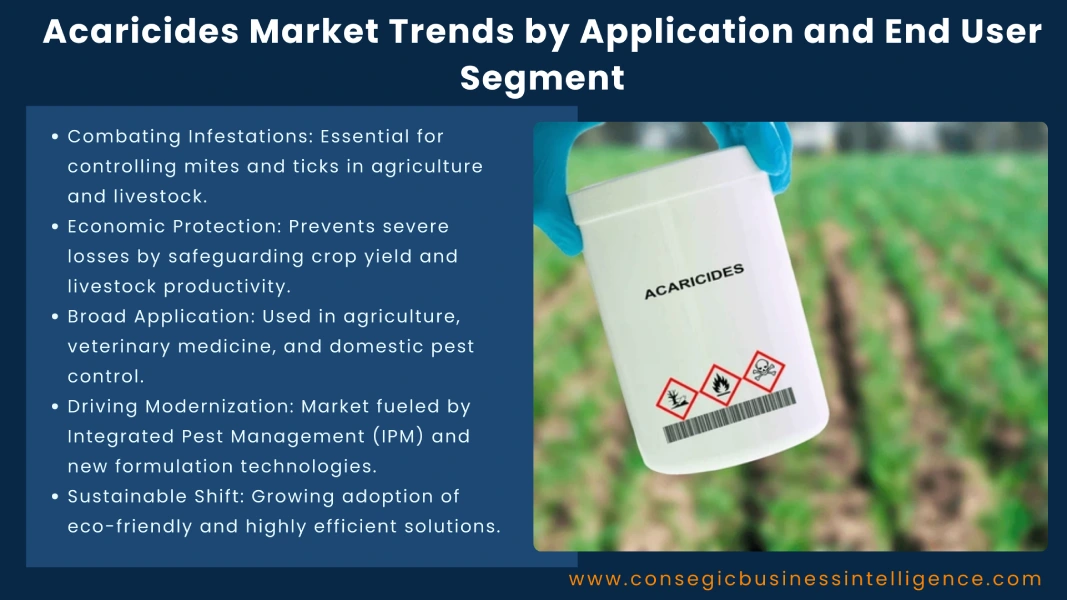
Driven by rising awareness of integrated pest management (IPM), advancements in formulation technologies, and the growing adoption of eco-friendly solutions, the market is evolving toward more sustainable and efficient products. In this blog, we will be exploring the key trends shaping the acaricides market, categorized by application and end user segment, and how these trends are transforming pest management practices globally.
Emerging Trends by Application:
- Crop Protection in Agriculture
Agriculture remains the largest application segment in the acaricides market, accounting for a major share of global demand. Mites such as Tetranychus urticae (two-spotted spider mite) and Panonychus ulmi (European red mite) pose serious threats to crops like cotton, citrus, soybeans, and fruits.
The increasing prevalence of resistant mite species has driven innovation in novel active ingredients and biological formulations. Manufacturers are developing products with new modes of action, such as mitochondrial inhibitors and hormonal disruptors, that enhance efficacy while minimizing environmental impact.
Additionally, precision farming technologies are enabling targeted acaricide application, reducing chemical use and improving effectiveness. The integration of drones and smart sprayers helps farmers monitor mite populations and apply treatments more efficiently, supporting the global shift toward sustainable agriculture.
- Livestock and Animal Health Protection
Livestock farming represents another major application area for acaricides. Ticks and mites in cattle, sheep, poultry, and swine can transmit diseases such as anaplasmosis, babesiosis, and mange, leading to substantial economic losses.
Recent trends show a growing demand for pour-on, injectable, and systemic acaricides that provide longer protection and ease of use. Veterinary pharmaceutical companies are investing in combination therapies, where acaricides are blended with antiparasitic or insect growth regulators to enhance performance and prevent resistance.
The rise of organic and antibiotic-free livestock production is also influencing acaricide development. Companies are introducing plant-based formulations and essential oil-based acaricides that are safe, residue-free, and compatible with organic certification standards responding to consumer demand for cleaner animal-derived products.
- Public Health and Domestic Pest Control
Beyond agriculture and livestock, acaricides are gaining prominence in public health applications, particularly for controlling ticks that transmit diseases like Lyme disease and Rocky Mountain spotted fever. Urbanization and changing climate patterns have expanded tick habitats, prompting public health agencies to adopt proactive tick management programs.
In the residential and commercial sectors, acaricides are increasingly used for indoor pest management, targeting dust mites and storage pests. The shift toward low-odor, non-toxic formulations has boosted consumer adoption in home-care products. Furthermore, pest control companies are leveraging microencapsulation and slow-release technologies to enhance safety and prolong acaricide effectiveness in both indoor and outdoor environments.
- Industrial and Horticultural Applications
Acaricides are also used in industrial greenhouses, horticulture, and ornamental plant cultivation, where mite infestations can devastate high-value crops. Advanced biological acaricides, derived from natural extracts or beneficial fungi like Beauveria bassiana, are gaining traction as eco-friendly alternatives to conventional chemicals.
Manufacturers are focusing on integrating biocontrol solutions with chemical acaricides to develop hybrid products that ensure fast action while maintaining sustainability. This hybrid trend is particularly strong in Europe and North America, where regulatory restrictions encourage the use of environmentally safe pest management methods.
Emerging Trends by End User Segment:
- Farmers and Growers
Farmers represent the largest end-user group in the acaricides market, using these products extensively in field crops, fruits, and vegetables. The growing adoption of precision agriculture and integrated pest management systems has shifted farmer preference toward products that are both efficient and sustainable.
Technological tools like GPS-guided sprayers and remote pest-monitoring systems allow farmers to optimize acaricide application based on real-time data, minimizing waste and improving field health. Educational initiatives and government subsidies promoting responsible pesticide use are also influencing farmer purchasing behavior toward regulated, certified acaricide products.
- Veterinary Clinics and Animal Care Providers
Veterinary clinics and animal care facilities are key end users in the livestock and companion animal segments. They play an essential role in recommending and administering acaricidal treatments for animals suffering from tick-borne diseases or infestations.
With the growing awareness of zoonotic disease prevention, veterinarians are adopting broad-spectrum acaricides that provide protection across multiple species. New product formulations such as spot-on applications, oral chewables, and long-lasting collars have enhanced compliance among pet owners, driving strong growth in the companion animal segment.
Furthermore, veterinary clinics are collaborating with pharmaceutical companies to participate in clinical trials aimed at developing next-generation acaricides that balance potency with safety for both animals and humans.
- Pest Control Companies and Service Providers
Professional pest control services form a significant end-user category in urban and commercial pest management. As the demand for safe, effective, and eco-friendly pest control solutions grows, these companies are shifting toward acaricides with low toxicity and longer residual action.
Advancements in formulation chemistry have led to the introduction of microencapsulated and gel-based acaricides that reduce odor, improve user safety, and provide consistent performance. Service providers are also adopting digital management tools for scheduling, tracking, and reporting acaricide application, improving transparency and operational efficiency.
- Research Institutions and Agrochemical Manufacturers
Research institutions and agrochemical companies play a dual role as end users and innovation drivers in the acaricides market. They conduct field trials, efficacy studies, and resistance management programs that guide new product development.
Recent collaborations between research bodies and manufacturers have accelerated the creation of acaricides that align with international environmental and safety standards. Many companies are investing in nanotechnology and bio-based formulation research, focusing on controlled-release systems and environmentally degradable carriers. This R&D focus is expected to shape the next generation of acaricides, catering to both commercial and ecological needs.
Conclusion
The acaricides market is entering a transformative phase driven by innovation, sustainability, and precision-driven applications. From agriculture and livestock protection to public health and horticultural uses, the industry is expanding across multiple sectors with a strong emphasis on eco-friendly solutions and integrated pest control.
End users including farmers, veterinarians, pest control companies, and research institutions are increasingly adopting advanced technologies to enhance effectiveness and safety. The market’s future lies in biological innovations, digital agriculture tools, and resistance management strategies, which will define the evolution of acaricide formulations and applications worldwide.
As global agricultural productivity and animal health remain critical priorities, the adoption of modern acaricide technologies will continue to grow, ensuring sustainable pest control and long-term protection for both crops and livestock.