Introduction: The Convergence of Blockchain Technology and Gaming
With the advent of blockchain, there is a trend towards the emergence of decentralized platforms, where gamers are entirely responsible for controlling their digital assets. Blockchain gaming includes the adoption of decentralization, smart contracts, and tokenization of assets in the gaming world enabling safe transactions without relying on any intermediary institutions. While traditional gaming is usually done in a controlled environment like the regulated server, blockchain gaming entails trust less systems where ownership can be easily verified beyond the game itself.
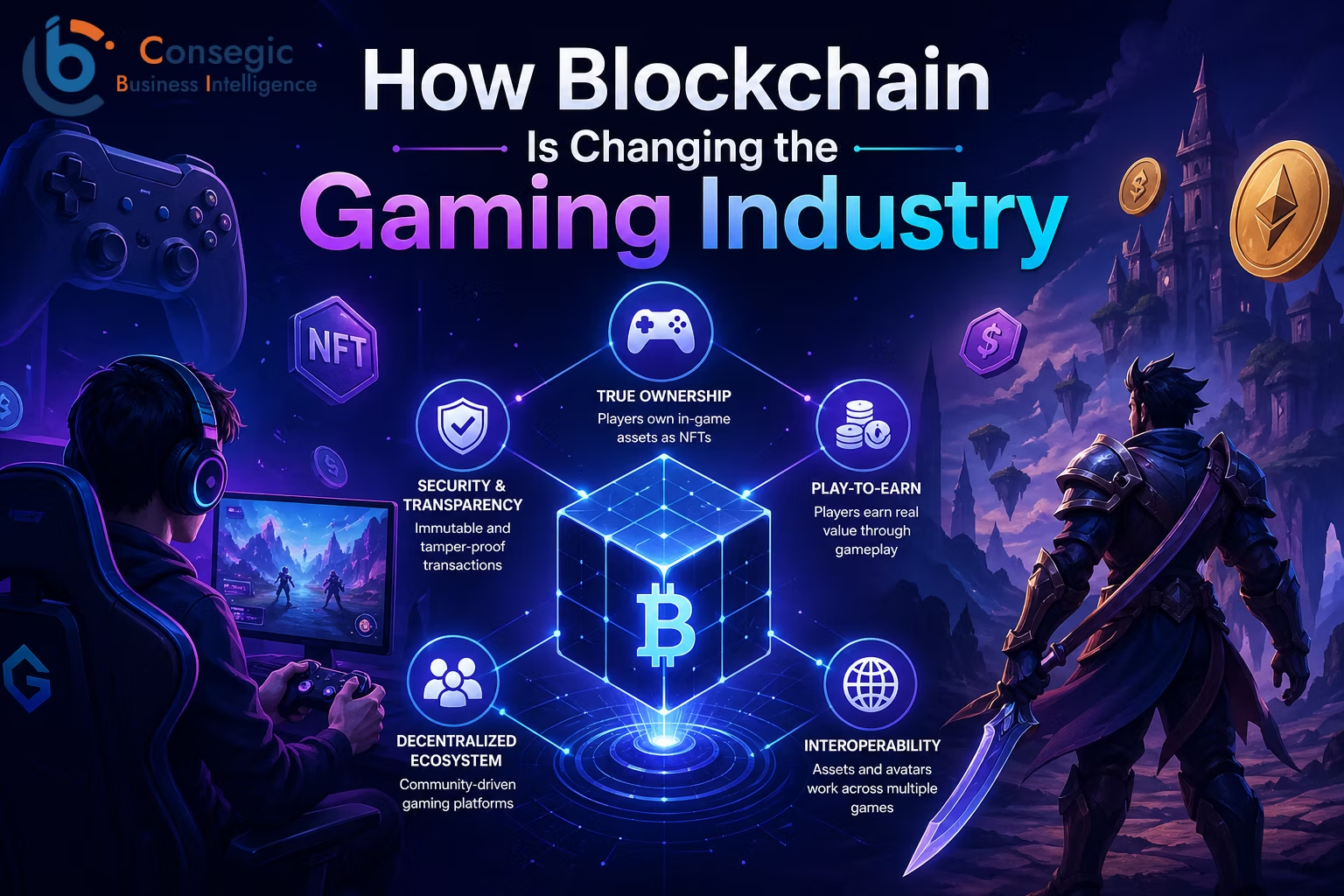
History of the evolution of blockchain gaming reveals its fast-growing nature. To begin with, the first stage was the period of experimental games, like CryptoKitties, that proved the possibilities of utilizing NFTs (Non-fungible tokens) in the gaming world (2017-2019). Secondly, the second stage (2020-2022) was characterized by developing game economies whereby players could earn money by just playing and making achievements. Lastly, the mature stage (2023-2025) entailed the development of sustainable economies, improved gameplay, and enhanced digital ownership among others.
This trend is important since it creates a shift in the meaning of gaming from being strictly recreational to becoming an interaction between engagement and economics. Gamers themselves become not only passive users but stakeholders, while venture capitalists begin to show interest in their newly created virtual economies. The potential market is expected to reach hundreds of billions of dollars by 2030, which will ensure significant growth perspectives for the blockchain gaming sector.
How Do Digital Ownership and NFTs Empower Players with True Asset Control?
Digital ownership is among the key disruptive elements in blockchain-based games that have radically changed the interaction between players and in-game items. The problem with conventional gaming models lies in the fact that players do not own in-game objects but merely use them because they are hosted on the game developer’s servers, which means they cannot transfer or sell them.
Among the key benefits associated with NFTs are the ability to purchase, trade, or sell them on decentralized platforms, proof of rarity ensured by blockchain-based protocols such as ERC-721 and ERC-1155, as well as the longevity of such assets, which means they can retain their value despite the demise of the game itself.
There is an inherent economic empowerment created by this change. Gamers have the ability to trade digital goods such as virtual lands, characters, and collectibles. Consequently, gamers have evolved into not just gamers but also into traders, creators of their NFTs, and investors in virtual worlds.
In addition to the above trends, there are other trends emerging in 2025 such as embedded wallets, NFT rentals, and even royalty for creators. Ownership goes beyond the technological aspect to create greater player involvement.
Play-to-Earn Evolution: From Speculation to Sustainable Gaming Economies
The Play-To-Earn (P2E) game model brought about a new revolution within the gaming industry through the earning of cryptocurrencies and tokens via gameplay. Axie Infinity became one of the most popular platforms within the first stage due to the capability to earn money from virtual economies. The main problem associated with the initial stage included excessive speculation and poor economic design.
A number of issues began emerging during this time. Firstly, many P2E platforms experienced an inflation problem due to excessive rewards for players. Secondly, financial rewards were prioritized more compared to gameplay, resulting in a lack of interest on the part of players. As a consequence, the generation of regular income became challenging for the majority of players.
In 2025, a trend towards the implementation of the “play-and-own” strategy, where both gameplay and ownership of assets are important. In the new economy, the main objective is to provide engaging gameplay and monetization comes second. Nowadays, the attention of game developers is focused on creating stable token economics, which includes limited supply of tokens, NFTs as tools of utility, and well-balanced economies within games.
Today, there are more options for generating profits than just receiving tokens as a reward for actions. The list also includes such sources of income as assets’ growth in value, staking, involvement in governance, and trading commissions.
Decentralization and Community Governance: Shifting Power to Players
Decentralization is revolutionizing the dynamics of control in the gaming industry through empowerment of the players rather than the developers in controlling the rules, updates, and economic policies of the game. In traditional gaming systems, it is the developer that has total control. Blockchain-powered games have taken things a step further as it introduces an element of transparency through the use of DAOs.
DAOs (Decentralized Autonomous Organization) play a crucial role in making blockchain-based games different from other types of games. They give the players the power to participate directly in the decision-making process. For instance, they get a chance to vote for the features that would be incorporated into the game or the changes that should be made regarding the game's economy.
Another layer that makes this framework even more effective is that of ecosystems powered by players themselves. This approach involves the development of community-based content, as well as systems of transparent governance structures.
Decentralization provides numerous advantages in terms of its effect on gaming communities. Among them are increased player commitment to a game, decreased dependency on centralized control, and more democratic game design.
Interoperability, Scalability, and the Future of Blockchain Gaming
Interoperability is becoming one of the main attributes of blockchain gaming because digital items can operate across various titles and even different blockchain networks. In an ideal situation, for instance, the same avatar, skin, or item would be used by players in all related virtual worlds in order to create a consistent digital identity. Although interoperability represents a step closer to a metaverse reality, at present it still exists only in a “light” version through the connection between cosmetics or identity features.
Another serious barrier for blockchain game development was scalability. Initial blockchain games faced such challenges as sky-high transaction fees, extremely low transaction speed, and poor UX/UI that prevented their wider adoption among non-gamers. Fortunately, 2025 brought many improvements in that direction, including layer-2 scaling protocols such as Polygon and Immutable, better-performing and energy-saving subnets and consensus algorithms (Proof-of-Stake), and so on.
Future prospects indicate that innovations will continue at an increasing pace. For instance, cross-chain ecosystems are emerging with the goal of linking disparate networks together, whereas personalized NFTs powered by AI will emerge. In addition, the process of onboarding is becoming simpler and easier, thus simplifying blockchain interactions within games.
Conclusion
The convergence of blockchain with the gaming space is disrupting the entire ecosystem by enabling gamers to own assets within games, and also providing active participation within the game spaces. What started off as an experiment has now become a groundbreaking business model that strikes a balance between entertainment and monetization. The use of NFTs, play-to-own, and DAOs is among several other technological innovations that enable gamers to be stakeholders and not just participants. Even though there are challenges associated with these innovations, including scalability and interoperability; however, most of these challenges are being addressed.