A couple of years ago, "AI agent" was mostly a buzzword you'd hear at a conference and forget by lunch. That's no longer the case. Walk into almost any large enterprise today and you'll find software that doesn't just answer questions or summarize documents- it takes action. It books the appointment, flags the fraudulent transaction, reroutes the shipment, reorders the part before it runs out. That shift, from AI that assists to AI that acts, is what people mean when they talk about "agentic AI” and it's no longer a pilot project tucked away in an innovation lab. It's running in production, at scale, with real budgets and real accountability attached to it.
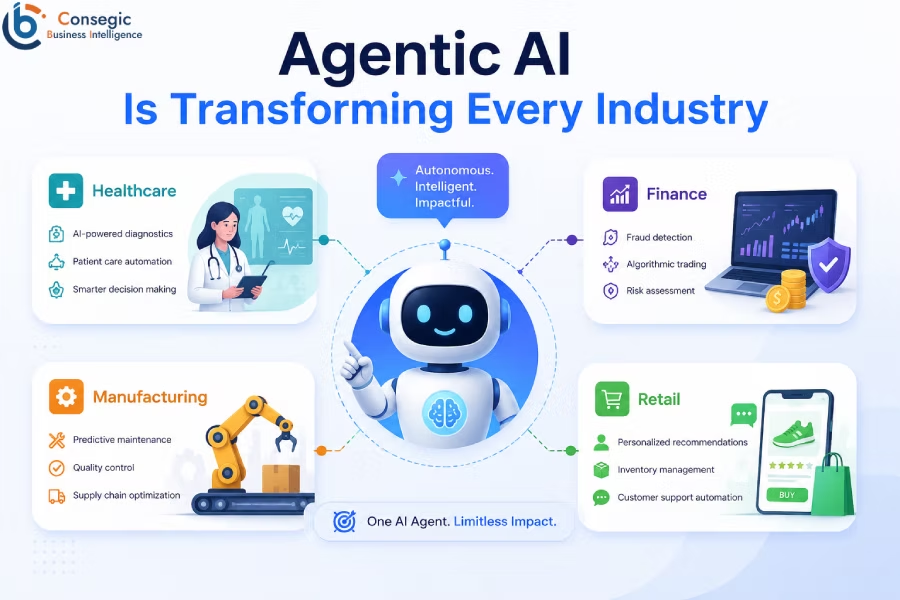
What makes this moment different isn't just better models. It's that these systems can now plan multi-step tasks, call other software tools, check their own work and adjust course when something goes wrong- all with minimal human hand-holding. Gartner has predicted that by the end of 2026, more than 40% of enterprise applications will embed role-specific AI agents and industry surveys suggest more than half of companies already have agents running in production. The interesting part isn't the prediction, though. It's what's already happening on the ground.
Healthcare: From Paperwork to Patient Time
Healthcare has always had a strange imbalance: the people best trained to save lives spend an enormous amount of their day on documentation instead. Agentic AI is starting to correct that. Ambient clinical assistants now sit in on patient visits, generate notes automatically and update records without a clinician typing a single word. AtlantiCare, a New Jersey health system, rolled out one such assistant and saw an 80% adoption rate among the providers who tried it- with those who used it cutting documentation time by 42%, saving roughly 66 minutes a day per clinician. That's more than an hour returned to actual patient care, every single day.
Beyond paperwork, agentic systems are increasingly involved in monitoring. Instead of a nurse checking a chart every few hours, an AI agent can watch a patient's vitals continuously and alert staff or even adjust a medication protocol within preset boundaries the moment something looks off. Roughly four in ten healthcare executives already use AI for exactly this kind of inpatient monitoring and the broader promise is significant: some estimates suggest AI-powered imaging and monitoring tools could help prevent millions of diagnostic errors a year. None of this replaces doctors. It just means fewer things slip through the cracks while doctors are stretched thin.
Finance: Precision at a Scale No Human Team Could Match
If there's one industry built for agentic AI, it's finance. The work is rule-heavy, data-dense and unforgiving of mistakes- exactly the conditions where autonomous agents thrive. JPMorgan now runs over 450 agentic AI use cases in daily production, everything from fraud detection to generating full investment banking presentations in about 30 seconds, a task that used to eat hours of a junior analyst's week.
Then there's Klarna, whose AI customer service agent has become something of a case study in its own right: it reportedly handled the workload equivalent of 853 full-time employees and saved the company around $60 million. Salesforce, meanwhile, used agentic contract automation to cut roughly $5 million in legal costs. Across the industry, companies report an average ROI of 171% on agentic AI deployments nearly three times what traditional automation typically delivers. Fraud detection is another area quietly transformed: agents that once just flagged suspicious transactions after the fact can now intervene in real time, blocking a fraudulent charge before any money actually moves.
Manufacturing: Factories That Fix Themselves Before They Break
Manufacturing has been talking about "predictive maintenance" for a decade, but agentic AI is what's finally making it autonomous rather than advisory. Instead of a dashboard telling a technician that a machine might need attention, agents now monitor equipment continuously, detect early signs of wear and schedule maintenance on their own- often before a human would have noticed anything wrong at all.
The bigger shift is happening at the supply chain level. Agentic systems are starting to manage logistics and production end-to-end: rerouting inventory in real time when a shipment is delayed, expediting orders when demand spikes and adjusting production schedules dynamically instead of waiting for a planner to notice a bottleneck. Analysts expect this trend to accelerate sharply, with the global AI-in-manufacturing market projected to grow at a compound rate above 40% through the next decade. What's notable is the direction of travel: from isolated, single-purpose agents toward orchestrated systems where dozens of specialized agents coordinate on something as complex as an entire supply chain.
Retail: Personalization Without the Guesswork
Retail has always chased personalization, but doing it well used to require armies of analysts and marketers. Agentic AI collapses that effort. Dynamic pricing agents now adjust prices in real time based on demand, inventory levels and competitor activity- no human sets the new price during a surge, the system just does it. Some retailers using these tools have reported gross profit gains in the tens of millions of dollars annually.
On the customer-facing side, agents are handling everything from personalized product recommendations to fully autonomous customer service conversations that resolve issues without ever routing to a human. Behind the scenes, the same agentic approach is reshaping supply chain operations for retailers too- restocking shelves, managing supplier relationships and predicting demand shifts before they show up in sales data.
The Common Thread
Look closely at these four industries and a pattern emerges: agentic AI works best in environments that are high-volume, rule-governed and dependent on coordinating across multiple systems. That's precisely why finance, healthcare administration, manufacturing and retail have become the earliest and biggest winners. It's not that agentic AI is smarter than a human expert- it's that it can act continuously, at a scale and speed no team of humans could sustain, freeing people up to focus on the judgment calls that actually need them.
We're still early. Multi-agent systems- where dozens of specialized agents collaborate on something as sprawling as a hospital's entire patient-care journey or a global supply chain- are only just beginning to move from concept to reality. But the direction is clear. Agentic AI isn't a future trend to prepare for. It's already inside the workflows of the world's biggest companies and the gap between those who've adopted it and those still watching from the sidelines is only going to grow.