The Growing Need for Sustainable AI in a Climate-Conscious World
Artificial intelligence technology has revolutionized the industry through the possibilities of automation, predicting the future, and speeding up decision-making. Its further implementation worldwide is bringing the discussion not only of its economic effects but also its influence on the environment. Therefore, Sustainable AI has appeared to address environmental problems through the use of artificial intelligence technology with a lower energy consumption, emission of carbon dioxide, and other resources involved.
Sustainability has become one of the key aspects that governments and businesses should consider in the process of their digital transformation to fulfill Environmental, Social, and Governance (ESG) objectives and obligations in terms of the global climate changes. AI contributes to the achievement of ESG objectives because it makes the process of energy efficiency and industrial optimization, renewable energy integration, and waste reduction easier. Nevertheless, the growing popularity of large AI models and energy-consuming data centres is causing discussions of excessive consumption of electricity and water and high carbon dioxide emissions.
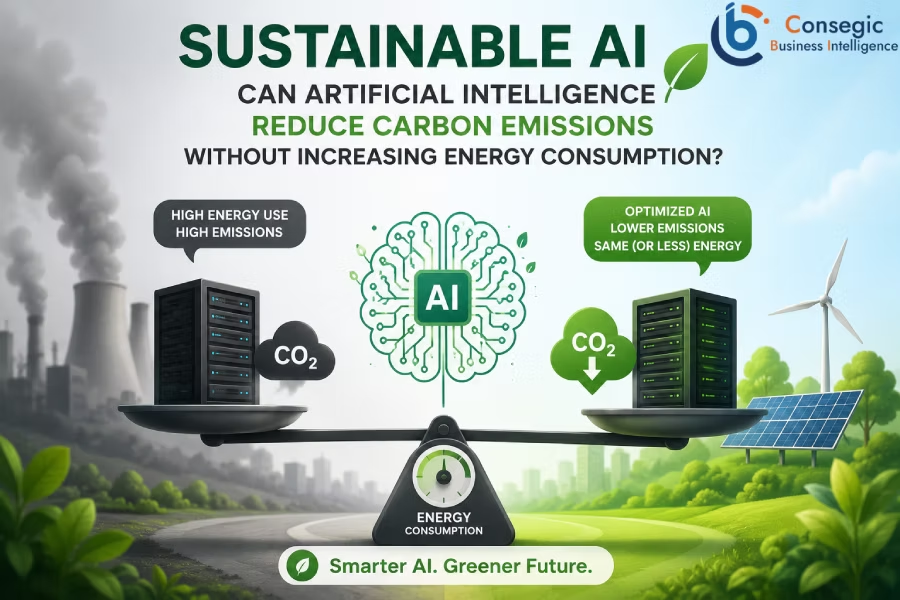
Moreover, sustainable AI provides an opportunity to balance innovation and environmental responsibility through energy-efficient AI models, eco-friendly infrastructure, and sustainable practices in general.
How Artificial Intelligence Can Help Reduce Global Carbon Emissions?
The application of artificial intelligence is increasingly becoming an important way of reducing carbon emissions in the world today owing to its effectiveness in efficiency, resource management, and the transition towards a low carbon economy. Among the uses of artificial intelligence in reducing carbon emissions are the application of AI in the energy sector through smart grid technologies that enable matching of the generation and consumption of electrical energy. This helps in integrating renewable energy such as solar and wind energy into the grid. The application of artificial intelligence helps in predicting energy generation and hence energy wastage and fossil fuel energy plants.
In addition to energy management, artificial intelligence can be used in the transportation sector to optimize routes, predict traffic situations, and control fleets to decrease fuel consumption and greenhouse gas emissions. Moreover, in the manufacturing industry, artificial intelligence makes it possible to conduct predictive maintenance of equipment thus increasing efficiency and decreasing excessive energy use.
Furthermore, the agricultural industry is another field that has seen great environmental gains because of the use of AI. AI uses soil composition analysis, weather forecasts, and condition analysis of crops to maximize irrigation, fertilization, and pest eradication to minimize emissions created during agricultural operations. Moreover, carbon emissions can be monitored using AI through the analysis of satellite images, industrial information, and environmental sensors.
Understanding the Energy Challenges Behind Artificial Intelligence
Despite the many positive impacts of artificial intelligence on environment, there are a number of serious energy and material issues associated with its fast development. Today, training and deploying modern AI requires a lot of computational power. For instance, training an advanced AI may entail using thousands of GPUs over weeks and even months, which leads to high electricity expenditure. In line with the growing popularity of AI, data centres are facing increasing demand for energy resources.
However, apart from requiring energy for operations, AI uses vast amounts of water for server cooling purposes. With the existing issues related to limited water resources in certain geographical areas, this poses a serious challenge for the future of environmentally sustainable development of AI. Moreover, production of dedicated AI equipment such as semiconductors and processors consume large amounts of resources.
Other issues relate to the continued use of energy produced by burning fossil fuels within data centres, thus creating additional carbon emissions for AI processes. The increased development of more advanced AI systems has made it necessary to find a balance between innovation and energy conservation. It has become necessary to address such problems by making it possible to track and report energy usage of AI accurately, make computations more efficient, and utilize energy from renewable sources.
Innovations Driving Energy-Efficient and Sustainable AI Development
The emerging trend of Sustainable AI has led to numerous inventions that make the use of artificial intelligence technology eco-friendlier without lowering its effectiveness. Perhaps, one of the most important achievements in this regard has been the creation of energy-efficient AI models using methods of model compression, pruning, quantization, and knowledge distillation. As a result, it has become possible for an AI system to perform its work faster and more accurately while consuming less energy.
Another area where progress has been made includes hardware inventions. IT companies are developing AI accelerators and new types of processors that can provide much better computing performance and, at the same time, consume much less energy. On a larger scale, the cloud providers are making great efforts to build sustainable data centres powered by renewable energy sources, advanced liquid cooling, and AI-powered energy optimization systems.
Another notable innovation is Edge AI, which involves carrying out data processing on local devices without depending entirely on the cloud for data computation. This minimizes the data transmission volume, saves energy, and ensures improved reaction time. Additionally, carbon-aware computing is a development that allows for the completion of tasks using renewable energy when such energy is abundantly available. This makes the technology much greener and energy-efficient. This development is happening due to the policies formulated by governments to counter climate change.
The Future of Sustainable AI: Balancing Climate Benefits with Energy Efficiency
In the future, Sustainability in AI will be determined by the capacity of government bodies, tech companies, researchers, and industries to strike a proper balance between innovation and long-term sustainability concerning the environment. As artificial intelligence technologies become widely used in medicine, industry, banking, transportation, and other fields, the need for computing power will only increase. In order to make the future development of AI sustainable, it is advisable to invest in hardware solutions, algorithms and energy from renewable sources.
Moreover, future AI applications will be built for sustainability, not retrofitted for sustainability. Scientists are working on ways to test how much harm AI technologies cause to the environment, for example, by calculating the carbon footprint. At the same time, rising pressure from stricter environmental regulations and ESG requirements pushes businesses toward sustainable AI.
AI technology would still aid global climate change efforts via improved renewable energy management, climate modelling, industrial efficiency, and resource management. New technologies, such as green computing, sustainable cloud infrastructure and carbon neutral data centres, are emerging and present an opportunity for AI technology to become not only a driver of economic growth but also an enabler of environmental sustainability.
Conclusion
Sustainable AI is an example of how AI technology can help decrease global carbon emissions and assist in climate action initiatives in the various sectors. While offering numerous environmental advantages through the optimization of energy systems, transport, industry, and resources, the increasing computational requirements of AI also bring about certain obstacles when it comes to energy consumption, carbon footprint, and water use. Thus, the future of AI lies in implementing more energy-efficient approaches to modelling, developing renewable-powered data centres, and engaging in sustainable practices.