Wireless communication has come a long way in the last four decades and each generation has been accompanied by an important breakthrough in terms of innovative capabilities. While 1G was limited to only voice communication, 5G provides the ability to send high-speed data from one end to another. The implementation of 5G has brought significant progress in cloud computing, IoT, autonomous technologies, and other technological applications with its fast speeds, lower latency, and increased network capacity. Nevertheless, as more and more innovations emerge, scientists and technologists already think of a solution that will come after 5G – 6G.
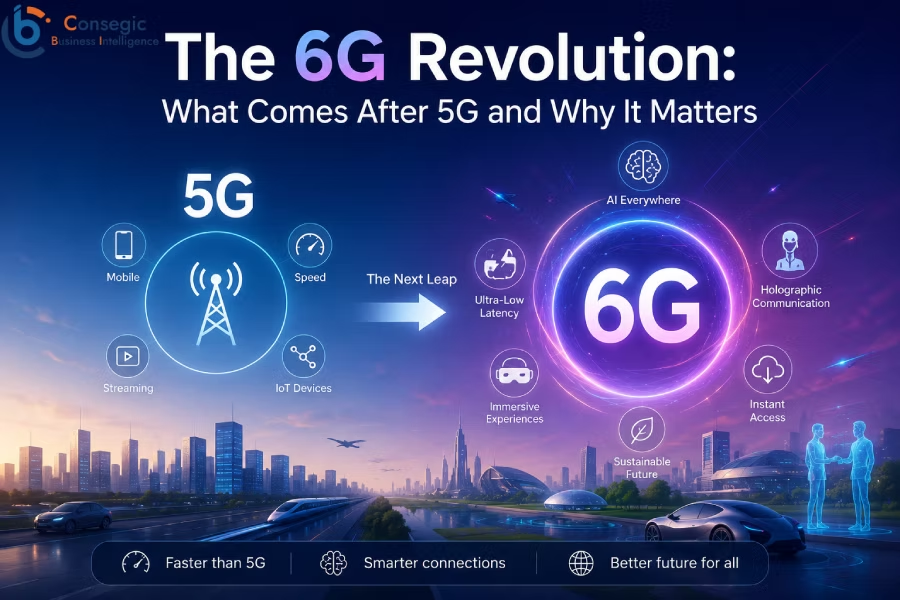
It is expected to become available for commercial use in approximately 2030, and is anticipated to mark the next milestone in communication history. 6G is supposed to provide the peak data rate of 1 terabit per second (Tbps), which will be 100 times higher than the speed of currently existing 5G networks. Contrary to 5G, 6G will include AI in its basic design, allowing the network to optimize itself, use the resources efficiently, and provide high-quality immersion experience. Several countries, including the US, China, Japan, South Korea, Finland, India and the European Union are investing billions of dollars in 6G research and development, recognising its potential to shape the future of telecom, drive digital transformation and unlock new opportunities across industries.
How 6G Technology Will Transform Connectivity and Communication
The switch from 5G to 6G entails more than just a faster internet connection; it means a complete change of how networks function and how they connect people and things. Where the 5G standard offers a maximum speed of 10 Gbps under optimal conditions, the 6G technology is estimated to attain a peak data transmission rate of about 1 Tbps. This huge leap, alongside the ultra-low latency of less than one millisecond, makes it possible for real-time communication in areas such as autonomous transport, factory automation, robotic surgery at distance, and holographic teleconferencing.
One of the key characteristics of 6G will be its AI-centric architecture where the AI algorithms will monitor network performance, forecast traffic behaviour and optimise connectivity without human intervention. Moreover, 6G technology is expected to integrate traditional cellular networks with satellites, drones and high-altitude platforms to provide consistent, uninterrupted global connectivity even in remote areas.
6G will also offer many immersive services such as augmented reality (AR), virtual reality (VR), mixed reality (MR), and even holographic communications with no perceptible delays. Further, improvements in energy efficiency, intelligent spectrum usage and reliability will help to build sustainable digital ecosystems. Overall, all these achievements will allow 6G to become the technological basis for the next stage of digital transformation around the world.
Key Innovations Driving the Development of 6G Networks
Several revolutionary advancements are propelling the development of the next generation networks – 6G. For example, the Terahertz (THz) frequency band is expected to play an essential role as 6G emerges. The THz spectrum falls in the approximate range of 100 GHz and 3 THz. Higher frequencies allow for incredibly fast transfer speeds up to 1 Tbps that are required for certain uses of high-speed communications with enormous capacity. Even though the transmission distance of the signal is limited, specialists work to overcome this issue through innovative antenna technology and network architecture. In addition, artificial intelligence and machine learning algorithms will be built into 6G systems and provide for predictive maintenance, traffic management, and resource allocation.
Digital twin is another innovation that is to become part of the 6G infrastructure. Real-time replicas of the physical environments (such as factories, hospitals, smart cities) will enable more productive functioning in these settings. Another innovation is extended reality (XR), which combines VR, AR, and MR and provides for immersive experiences in education, healthcare, manufacturing, and entertainment. Moreover, the Internet of Everything (IoE) is one more advancement to be supported by 6G, which help billions of smart devices to be connected and integrated with to provide secure, scalable, and highly efficient global connectivity.
Challenges to 6G Deployment: Infrastructure, Security, and Global Standards
In spite of the promising capabilities, there are many challenges associated with the implementation of 6G on a large scale. The creation of the 6G ecosystem requires a considerable expenditure of resources to build the next generation telecommunications infrastructure that includes the dense placement of base stations, development of fiber-optical networks and the use of efficient semiconductor technologies. The propagation characteristics of the Terahertz frequencies make operators work out innovative solutions in order to ensure reliable coverage without raising deployment costs.
Additionally, the issue of cybersecurity is becoming increasingly important since the networks based on AI can connect billions of devices and exchange huge amounts of sensitive data. Moreover, the need to protect the information from cyberattacks and to provide the users with privacy requires the use of efficient encryption methods and secure frameworks. One more problem related to the implementation of the 6G networks is the question of energy efficiency since the enormous number of computations is required for functioning of such systems. Lastly, one of the most challenging aspects is the creation of widely accepted standards and policies of spectrum allocation through cooperation of different countries, regulatory authorities and organizations like International Telecommunication Union (ITU) and the 3rd Generation Partnership Project (3GPP)
The Future Impact of 6G on Industries, Smart Cities, and Everyday Life
With the use of 6G, the future will witness revolutionary changes within many industries and in daily lives due to the creation of intelligent ecosystems which will extend well beyond mobile communications. In smart cities, 6G will enhance traffic management, public transport, energy distribution, garbage collection, and emergency services through sensor systems and AI-driven infrastructure. There will be real-time monitoring of patients as well as AI-driven diagnostic systems and remote robotic surgeries performed at extremely low latencies.
In the manufacturing sector, 6G will facilitate the process of becoming a part of Industry 5.0 by using automation, collaborative robots, and predictive maintenance systems. In addition, autonomous cars will be able to communicate with each other and the infrastructure of cities. Moreover, in education, the role of immersive holographic classroom systems and interactive extended reality systems will be significant. Entertainment will get new forms such as ultra-high-definition streaming and cloud gaming and holographic communication. Furthermore, the benefits of 6G in agriculture include AI-driven precision farming, connected sensors, and autonomous machinery. Governments and companies around the world continue their investments in the development of 6G systems, and 6G is expected to become one of the key factors of the global digital revolution within the coming decade.
Conclusion
From 5G to 6G is an evolution into the age of intelligence, ultra-speeds, and connectivity that have never been seen before. Being capable of reaching the speed of up to 1 Tbps, AI-native networks, Terahertz spectrum, and zero latency. Moreover, 6G is expected to bring about innovations in different spheres of life, create opportunities for advanced technologies, such as holographic communications, autonomy, and Internet of Everything, as well as provide improvements to many industries and smart cities. To make all of this possible, considerable efforts should be put into infrastructure, security, energy efficiency, and worldwide collaboration towards creating standards. By developing 6G, governments, scientists, and technology companies are going to make it a driving force of innovations and digital transformation for years to come.