A few years ago, if you'd told a hospital CFO that the next big budget line item would be "AI software," you might have gotten a skeptical laugh. Now it's one of the first things on the agenda at nearly every health system planning meeting. Something shifted and it wasn't marketing hype alone. It was a slow accumulation of pressure on physicians, on budgets, on patient outcomes that finally reached a point where the old way of doing things stopped being good enough.
So, what changed, exactly? It helps to start with what doctors are actually up against day to day.
Too Much Information, Too Little Time
Picture a hospitalist starting a twelve-hour shift with fifteen patients on her list. Each one has a different combination of lab values, imaging results, prior diagnoses, current medications and notes scribbled by three other specialists who saw them earlier in the week. She's expected to absorb all of it, cross-reference it against the latest treatment guidelines and make sound decisions often in the few minutes she has between rounds.
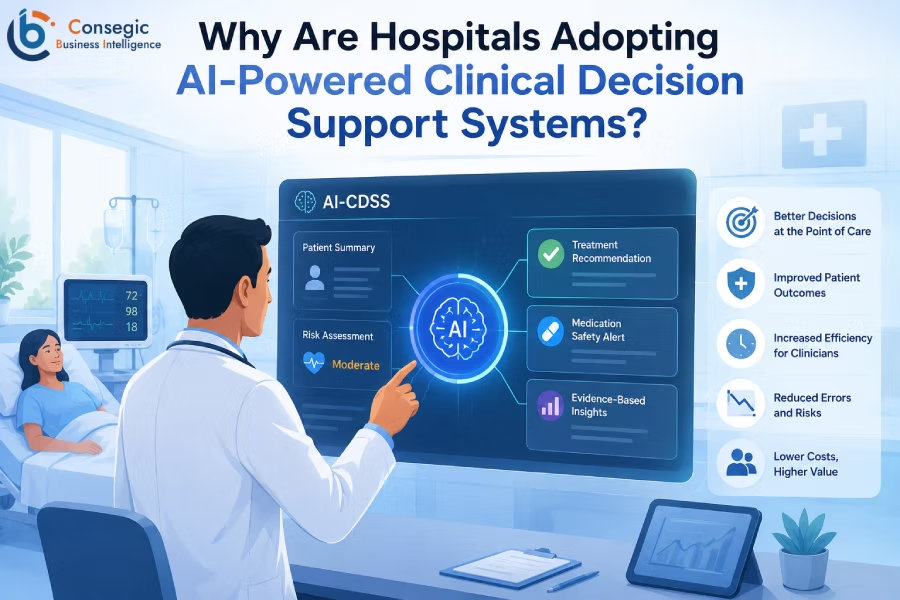
No one is built to do that perfectly, every time, for every patient, year after year. Medical knowledge itself has exploded; what a doctor learned in residency a decade ago may already be outdated. Clinical decision support tools exist because of this gap. They're not trying to replace the physician's judgment- they're trying to do the tedious part of the job that no human can do reliably at scale: scanning everything at once and surfacing what actually matters right now.
Fewer Missed Diagnoses
Misdiagnosis is one of those problems hospitals don't love to talk about publicly, but it's persistent and expensive- both in terms of patient harm and lawsuits. Most of the time it isn't because a doctor was careless. It's because a rare condition didn't show up the way the textbook described or because a subtle pattern across several lab values got lost in the noise of a busy shift.
This is where AI tools have proven genuinely useful. By comparing a patient's full clinical picture against enormous datasets of similar cases, these systems can nudge a physician toward possibilities they hadn't considered yet. It's not a verdict- it's a second set of eyes that never gets tired, never gets distracted by the four other crises happening down the hall and doesn't forget that one rare presentation it read about once.
Catching the Mistakes Before They Reach the Patient
Ask any hospital pharmacist what keeps them up at night and medication errors will come up fast. A new prescription that interacts badly with something the patient is already taking. A dosage that's fine for a healthy adult but dangerous for someone with reduced kidney function. These mistakes happen not because staff are negligent, but because the math and the cross-checking required are genuinely hard to do perfectly, every single time, under time pressure.
AI-powered systems built into the prescribing workflow catch a lot of this automatically- flagging dangerous interactions or dosage issues the moment an order is entered, before it ever reaches the patient. Given how common medication-related harm is across hospitals, even modest improvements here add up to a real number of people who don't get hurt.
Giving Burned-Out Clinicians Some Room to Breathe
Burnout in medicine isn't new, but it's gotten worse and a lot of it traces back to administrative weight rather than the actual practice of medicine. Endless documentation. Constant manual cross-checking. Hours spent piecing together a patient's history from scattered records instead of treating the person in front of them.
Hospital leaders have started to notice that decision support tools, when implemented well, take some of that weight off. If a system can summarize a patient's history in seconds or flag the lab result that actually needs attention out of forty that don't, that's mental bandwidth a nurse or physician gets back- bandwidth they can spend on the human parts of the job that drew them to medicine in the first place. This is increasingly framed less as a "technology upgrade" and more as a retention strategy, at a time when hospitals badly need to hold on to experienced staff.
Keeping Pace with Value-Based Care
Healthcare has been inching away from a model where hospitals get paid for volume and toward one where they get paid for outcomes. That shift puts real pressure on hospitals to standardize care and stay current with evolving clinical guidelines, because readmissions, complications and length-of-stay numbers now carry financial consequences.
The trouble is that guidelines change constantly and it's unrealistic to expect every clinician to track every update across every specialty. AI tools that stay current with the latest evidence and quietly apply it at the point of care help hospitals avoid the kind of treatment variation where two patients with nearly identical conditions get noticeably different care depending on which doctor happened to be on duty that day.
Stretching Thin Specialist Coverage Further
Rural and underserved hospitals face a problem that's less about data overload and more about scarcity- there simply aren't enough cardiologists, neurologists, or other specialists to go around. A small community ER might not have a stroke specialist on call at 3 a.m.
AI decision support can act as a stand-in for that missing expertise in the moment it's needed most, helping a general physician recognize patterns that would normally require a specialist's trained eye or helping triage which patients genuinely need an emergency transfer versus which can be safely managed locally. It doesn't close the staffing gap entirely, but it narrows it in ways that matter for patient outcomes.
Doctors Aren't Handing Over the Keys
It would be misleading to suggest this transition has been smooth or universally embraced. Plenty of physicians remain wary- worried about algorithms trained on biased data, concerned about over-reliance dulling their own clinical instincts or simply skeptical of a system they can't fully see inside of. Those concerns are legitimate and the hospitals doing this well tend to treat AI as a second opinion that sits alongside the physician, never as the final word. Oversight committees, ongoing validation and ways to override or question the system's suggestions have become standard parts of any serious rollout.
Where This Is Heading
None of this is really about hospitals chasing the newest tech trend for its own sake. It's a response to a simple reality: medicine has gotten too complex, too data-heavy and too fast-moving for any one clinician to carry it all in their head, no matter how skilled they are. AI-powered decision support tools are catching on because they address that complexity directly, while leaving the actual decisions- the ones that require empathy, context and human judgment- squarely in the hands of the people trained to make them. The hospitals figuring this out best aren't the ones with the flashiest software. They're the ones treating it as a quiet partner in the background, there to catch what a tired, overloaded human might otherwise miss.