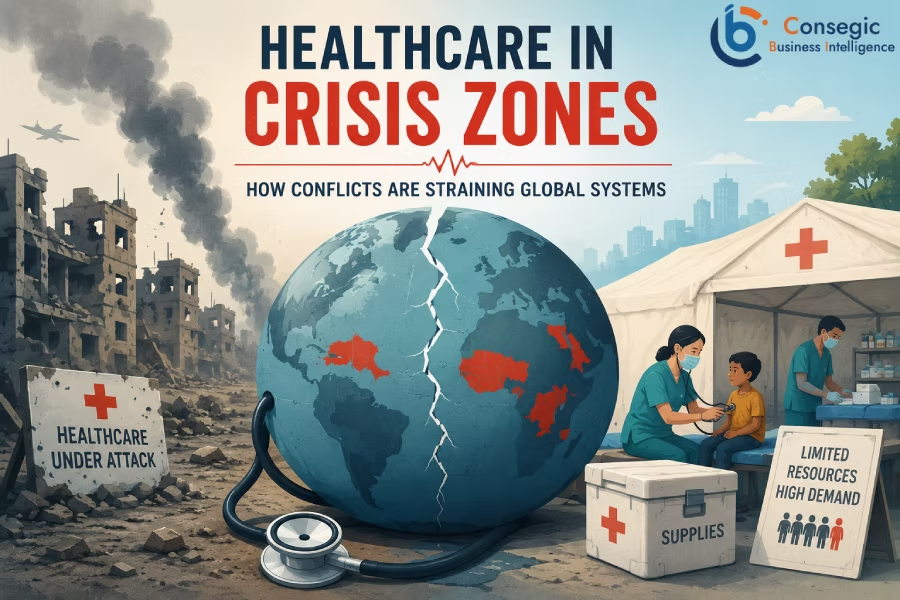
This war spares no one– least of all the sick. In the most shattered corners of the earth, where the landscape is scarred by bombs, where populations are blocked from help, where health facilities are attacked and millions are forced to flee from the ashes of Gaza and the flooded displacement camps of Sudan, to Ukraine’s war-ravaged towns and the shadowy forgotten streets of Myanmar, health facilities are not just overwhelmed. They are actively being destroyed.
This is not simply a crisis. It’s a catastrophe.
The Scale of the Problem
There are currently more than 50 active armed conflicts worldwide, affecting over 100 countries either directly or through displacement and refugee flows. The United Nations estimates that more than 300 million people are in need of humanitarian assistance which is the highest figure ever recorded. At the center of this crisis is a health system under siege.
Hospitals are being bombed. Medical supply chains are being severed. Doctors, nurses and aid workers are being killed or forced to flee. Attacks on healthcare facilities have reached alarming levels in recent years, with hundreds of documented incidents annually. The World Health Organization recorded over 1,700 attacks on healthcare in conflict zones in a single recent year alone- averaging nearly five per day.
These are not accidents. In many cases, the targeting of medical infrastructure is a deliberate strategy of war, a means of breaking civilian resilience by eliminating the very institutions designed to preserve life.
What Gets Lost When Healthcare Disappears
The immediate consequences are devastating and visible. Wounded civilians cannot receive surgery. Children cannot be vaccinated. Women die in childbirth from complications that would be entirely survivable under normal conditions. Chronic disease patients face death sentences when supply chains are disrupted.
But the secondary effects are equally catastrophic and far less visible. When healthcare systems collapse, infectious diseases resurge. Cholera, measles, typhoid and tuberculosis- diseases long thought controllable- make vicious comebacks in overcrowded, under-resourced displacement settings.
The Democratic Republic of Congo has faced repeated mpox and Ebola outbreaks intensified by conflict. Yemen's protracted civil war gave rise to one of the worst cholera outbreaks in recorded history, with over 2.5 million suspected cases. In these environments, disease spreads rapidly and by the time it reaches the international community's attention, containment becomes exponentially harder.
Mental health, too, is a silent casualty. Trauma, grief and the chronic stress of living under bombardment produce lasting psychological damage especially in children. In most crisis zones, mental health services are the first to disappear and the last to return.
The Global Ripple Effect
One of the most persistent misconceptions about conflict zone healthcare crises is that they are geographically contained. They are not.
The COVID-19 pandemic demonstrated, with brutal clarity, that infectious disease does not respect borders. The same logic applies to any pathogen that gains a foothold in a population too traumatized and resource-starved to contain it. A drug-resistant strain of tuberculosis incubating in a displacement camp in the Sahel can travel, via refugee flows and migration routes, to European cities within months.
Global health systems are also strained by the sheer volume of displaced populations requiring care. More than 120 million people have been forced to flee their homes by 2025. This is more than ever before in history and millions are seeking safety and shelter in host countries, many of which have depleting resources already and can struggle with malnutrition, traumatized health and poor immunization among displaced arrivals who need emergency care, further strain.
Wealthier nations are not immune either. The political and social pressures generated by large-scale migration have reshaped electoral landscapes across Europe and North America. The ripple effects of war-zone suffering are, in this sense, genuinely global.
The Funding Paradox
Global health funding for humanitarian crises is chronically inadequate, yet the reasons are paradoxically self-defeating. When crises are acute and visible- when a city is flattened or a famine is broadcast- donor generosity tends to spike. But the structural, long-term investment required to rebuild healthcare systems in post-conflict settings rarely materializes at scale.
The result is a perpetual cycle: systems collapse, emergency funds flow in to manage the acute phase, the crisis recedes from headlines, funding dries up, the rebuilt infrastructure is fragile and the next conflict or disease outbreak shatters it again. Haiti is perhaps the most painful case study. Decades of intervention, billions of dollars in aid and repeated natural and political disasters have produced a healthcare system in near-permanent crisis.
Meanwhile, the humanitarian funding gap- the difference between what is needed and what is pledged- has widened dramatically. In 2024, the UN's humanitarian appeals were less than 40% funded. This is not simply a matter of donor generosity. It reflects a structural failure to treat global health as a security issue rather than a charity issue.
The Way Forward: Protecting Health as a Red Line
There’s no silver bullet at the intersection of armed conflict and healthcare failure. But there are principles that, if adhered to, can make a profound difference to the size of the crisis.
Building a resilient health system into every reconstruction effort. When a war ends, rebuilding a hospital is insufficient; strengthening local health providers, fortifying supply chains and laying the foundations for community-level networks should be a given. Global health should be reoriented as a strategic priority in global governance- one of concern to, say, the UN Security Council and G7 member states the same as weapons proliferation or energy insecurity.
Conclusion
Healthcare in crisis zones is not a distant problem for those fortunate enough to live in peace. It is a mirror of our collective choices- about how we fund international institutions, how we hold aggressors accountable and how seriously we take the principle that human life has inherent worth regardless of geography.
Every bombed hospital is a policy failure. Every preventable death in a displacement camp is a failure of political will. And every disease outbreak that begins in a war-ravaged community and travels across borders is a reminder that we are, in sickness and in health, bound to one another far more tightly than any border wall or geopolitical rivalry would suggest.
The question is not whether the world can afford to protect healthcare in conflict zones. The question is whether we can afford not to.