Money is changing. Not in the slow, generational way it usually does. The shift from barter to coins, from coins to paper, from paper to plastic but rapidly, deliberately and at the direction of governments. Central Bank Digital Currencies, or CBDCs, are no longer a theoretical concept debated in academic papers. They are live, they are being tested across dozens of countries and the race to establish the first truly global digital currency is accelerating in ways that carry profound implications for trade, sovereignty, financial inclusion and the future architecture of the global economy.
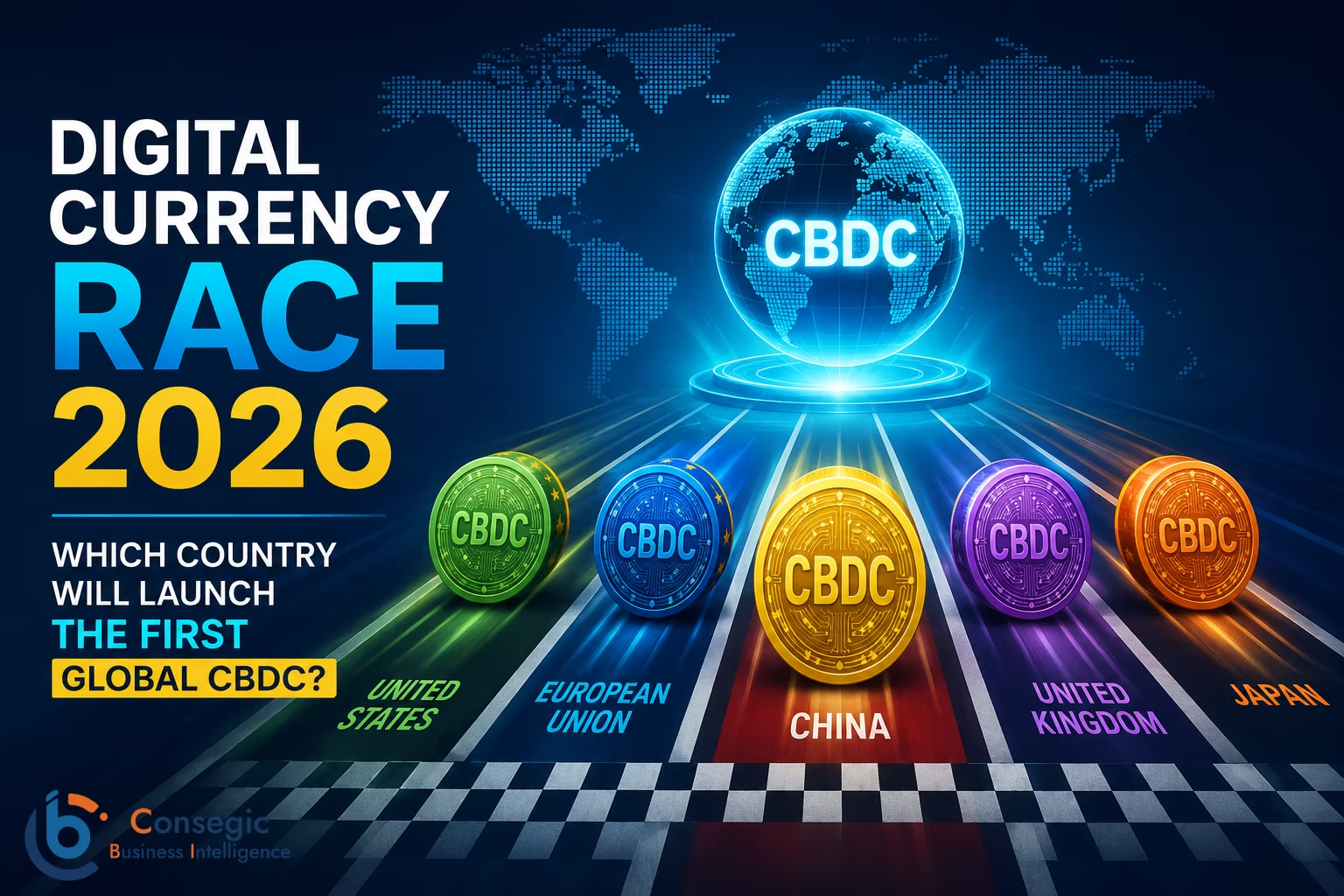
The question for 2026 is no longer whether CBDCs will reshape global finance. It is who will shape them and on whose terms.
What Is a CBDC, and Why Does It Matter?
Essentially a Central Bank Digital Currency is the virtual manifestation of a country’s national sovereign currency, created and supported solely by that country’s central bank. It’s neither a cryptocurrency such as Bitcoin as is not decentralized, it’s neither volatile nor does it exist beyond the oversight of the state. They are, in essence, the digital equivalent of cash- with all the sovereign backing that implies and all the surveillance potential that entails.
The appeal for governments is obvious. CBDCs represent programmable money- money that can be tracked, traced, have tax automatically imposed, issued conditionally, or can be moved across countries instantly at almost no cost. For central bankers, they represent a mechanism for pursuing monetary policy objectives with much greater specificity and for citizens of underserved nations, in principle, they grant access to financial services outside of traditional banks.
But what is at stake goes way beyond domestic functionality. If and when a CBDC attains international status, enabling cross-border use, inclusion in global trade and settlement between nations, that alone would represent one of the most substantial realignments of global monetary power since Bretton Woods established the US as the world’s monetary king in 1944.
The Contenders: Who's Leading the Race?
China: The Frontrunner
No country has moved further, faster, on CBDCs than China. The digital yuan- officially known as the e-CNY- has been in active pilot programs since 2020, with trials spanning dozens of cities and hundreds of millions of transactions. By 2026, China's digital currency has been distributed via lottery, integrated into major payment platforms, used at international sporting events and tested in cross-border payment corridors with Hong Kong, the UAE, Thailand and others.
China's ambitions are explicit. The e-CNY is not merely a domestic payment tool- it is a strategic instrument designed to internationalize the renminbi and reduce reliance on the US dollar-dominated SWIFT system. Through the mBridge project, a multi-currency cross-border CBDC platform developed with the Bank for International Settlements and several central banks, China has been quietly building the infrastructure for a parallel global payment network, one that operates outside Western financial architecture.
Whether this constitutes the "first global CBDC" is a matter of definition. China has reach, infrastructure and political will. What it lacks, at least for now, is the voluntary adoption of major Western economies.
The European Union: Methodical and Motivated
The European Central Bank has been working on the digital euro since 2021 and by 2026, the project has moved through its investigation and preparation phases into early implementation stages. The EU's approach is characteristically deliberate- extensive consultation, robust privacy frameworks and a cautious eye on the political sensitivities of replacing cash.
The digital euro, as conceived, would function as a complement to cash rather than a replacement: available to all eurozone citizens, private by design for small transactions and capped in individual holdings to prevent it from destabilizing the commercial banking system.
It is designed for the single market first and cross-border utility second. But with the eurozone representing the world's largest unified economic bloc by many measures, a fully operational digital euro would carry significant global weight by virtue of sheer economic gravity.
The United States: Cautious, Contested, and Consequential
America has engaged in more politics around the potential adoption of a CBDC than any other leading economy. The Federal Reserve did its homework and research extensively, but has repeatedly put off launching an actual project unless such a digital dollar received buy-in from Congress - an endorsement that is rooted in both deeply held democratic ideals and diametrically opposing beliefs about what a state-backed digital dollar would entail.
For the foreseeable future, at least for now, by 2026, that is likely where the US will stay. That is to say, it possesses the ability, the will is divided and hesitant and Congressional approval seems unlikely.
Some politicians support it because they believe an outright CBDC is essential to keeping the dollar the leading global currency. Others frame it as a government surveillance apparatus that would give the state unprecedented visibility into citizens' financial lives. This tension has not been resolved and America's absence from the CBDC launch league is itself a defining feature of the global race.
India, Brazil, and the Rising Middle Powers
Beyond the great powers, a cohort of large emerging economies has moved with surprising speed.
India's digital rupee pilot, launched by the Reserve Bank of India, has expanded steadily and is being positioned as a tool for financial inclusion in a country where hundreds of millions remain outside the formal banking system. Brazil is at forefront with DREX, one of the most technologically advanced CBDC projects in emerging world using programmable finance, digital assets. Nigeria was one of the first in the world to put its eNaira CBDC live with a launch in 2021 although progress so far has been glacial providing harsh lessons on launching without clear traction.
The Real Race: Standards, Not Speed
Here is the insight that most CBDC coverage misses: the race to launch the first "global" CBDC is not primarily about which country flips the switch first. It is about which country, or coalition, sets the technical standards, governance frameworks and interoperability protocols that others will inevitably adopt.
This is how the dollar became the world's reserve currency- not through a dramatic announcement, but through the slow accumulation of infrastructure, trust and network effects. The same dynamic will govern CBDCs. The country or bloc that establishes the dominant cross-border payment protocol- the rules about how digital currencies talk to one another, how they settle, how they handle compliance and sanctions- will exercise enormous structural power over global finance for decades.
China understands this, which is why mBridge is as important as the e-CNY itself. The EU understands this, which is why the digital euro's privacy architecture is a political statement as much as a technical specification. The US, for all its hesitation, holds a structural advantage simply by virtue of dollar dominance the question is whether it will leverage that advantage before others build around it.
The Risks Nobody Wants to Talk About
For all the enthusiasm among central bankers and fintech evangelists, CBDCs carry risks that deserve honest scrutiny.
Privacy is the most immediate. A programmable currency is, by definition, a traceable currency. Even with robust legal protections, the infrastructure for total financial surveillance would exist in a way it never has before and infrastructure, once built, tends to be used. The gap between what CBDCs are designed to do and what they could be weaponized to do is a gap that depends entirely on the integrity of governments and legal systems that are not uniformly trustworthy.
Financial stability is another concern. If citizens can hold digital currency directly with the central bank, what happens to commercial banks during a crisis? The risk of a digital bank run- where fear triggers mass conversion of deposits into CBDC holdings- is a structural vulnerability that no central bank has fully solved.
Finally, there is the geopolitical risk of fragmentation. Rather than producing a single global digital currency, the CBDC race may produce competing blocs- a dollar-aligned system, a Chinese-led system and a European system- each with incompatible standards and political allegiances. That outcome would be more complex, more fragmented and potentially more volatile than the imperfect but unified dollar system it partially displaces.
Conclusion: Power Follows Infrastructure
The digital currency race of 2026 is, at its core, a race about power, who controls the rails on which the global economy runs, whose rules govern the movement of value across borders and whose vision of money prevails in the century ahead.
No single country has yet launched a CBDC that can genuinely claim global reach. China is closest in ambition and infrastructure. The EU is closest in democratic legitimacy and regulatory sophistication. The US holds the advantage of incumbency but risks squandering it through political paralysis.
What is certain is this: the outcome of this race will not be determined by technology alone. It will be determined by trust, by governance, by the willingness of nations to adopt frameworks they did not design and by the political choices made in the next few years by governments still debating whether the digital future of money is an opportunity or a threat.
In monetary history, the nations that build the infrastructure write the rules. The race is on.