Let me take you back to 2013 for a second.
A man in a restaurant is wearing what looks like a normal pair of glasses, except there's a small glass prism above his right eye. He's recording you. Or checking email. You have no idea- but it feels deeply strange and you want him to leave.
That was Google Glass. It died not because the technology was bad, but because it made everyone uncomfortable, cost $1,500 and looked like a prop from a sci-fi film.
The reason to bring that up now, in 2026, is that smart glasses are back and this time, nobody's leaving the restaurant.
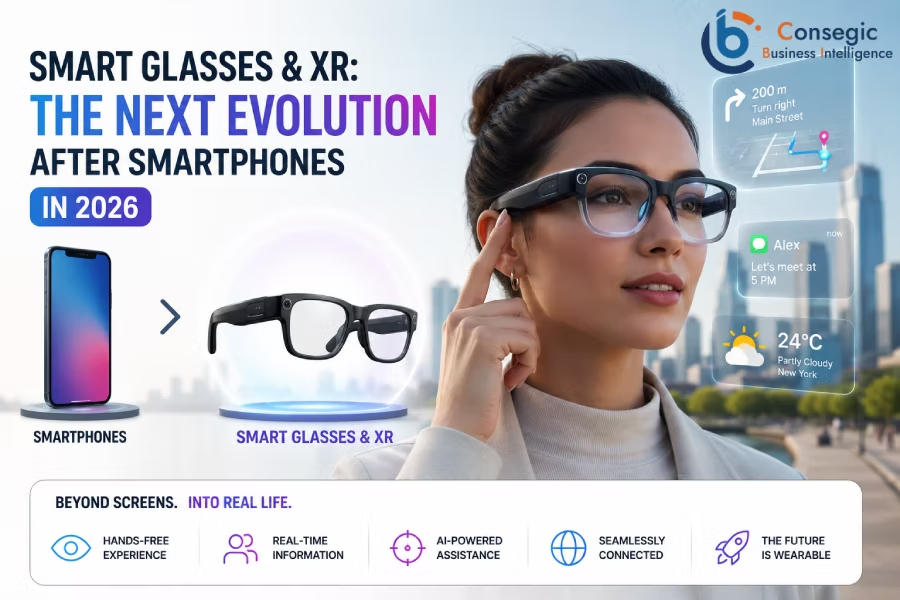
How Meta Cracked the Code Nobody Else Could
The turnaround started with a deceptively simple insight: people will wear technology on their faces only if it looks like something they'd wear anyway.
Meta figured that out first. Its partnership with Ray-Ban produced smart glasses that looked exactly like Ray-Bans because they were Ray-Bans. Classic Wayfarer shapes. Stylish. Normal.
By the end of 2025, over 7 million pairs had sold in a single year, tripling the prior total. Meta held around 76% of the global smart glasses market- one company, one product line, three-quarters of an entire category.
The Gen 2 models, at $379, packed a 12-megapixel camera, 8 hours of battery life and Meta AI built in. You could ask them what restaurant you were standing outside, have them read your messages, or take photos without pulling your phone out. None of it felt like science fiction because none of it looked like science fiction.
That's the formula nobody cracked before. Now that it has been, everyone is sprinting to catch up.
2026: The Year the Race Actually Started
The smart glasses 2026 landscape looks almost nothing like it did two years ago. The question has shifted from "will people buy these?" to "which ecosystem owns the next decade of personal computing?"
Google is back- doing everything differently from last time. At Google I/O 2026, it previewed Android XR smart glasses alongside Samsung, partnering with Warby Parker and Gentle Monster for design. The message was clear: eyewear first, gadget second. Audio-only versions launch fall 2026, with display models on the 2027 roadmap. Early forecasts suggest Google could sell nearly 2 million units this year alone- more than Meta Ray-Ban's entire first year. The weapon it brings is Gemini: an AI that recognizes objects in your environment, floats live translation captions in your peripheral vision and understands context in ways Meta AI doesn't yet match.
Snap entered with its Specs- confirmed for fall 2026 at around $2,195. Dual Snapdragon processors, a 51-degree field-of-view waveguide display, fully standalone. It sits somewhere between AI glasses and an XR headset. Ambitious but whether anyone outside early adopters will spend that much remains the real question.
Even Realities walked into CES 2026 with the G2 and quietly stole the show. They look like normal glasses, accept prescription lenses and nobody on the show floor noticed they were smart glasses. Turn-by-turn directions, live translation, useful notifications- hidden inside ordinary frames. Sometimes the most impressive tech product is the one nobody notices.
Where Is Apple?
Apple was apparently on track to announce its smart glasses- codenamed N50- by late 2026. Then came development delays and the launch has been pushed to late 2027.
What we know: built-in cameras, speakers, microphones, high-quality acetate frames designed in-house and a custom chip based on the Apple Watch S-series. Apple Intelligence as the AI layer and no AR display- that's a second-generation feature. The first Apple smart glasses are AI glasses, not AR glasses. Which, as it turns out, is exactly what Meta proved the market actually wants.
The edge Apple brings is something Meta can't replicate: deep, system-level integration with iPhone, iMessage, Apple Maps and everything hundreds of millions of people already use daily. Tim Cook is reportedly treating this as his top priority. For now, though, the market is moving without them.
The XR Technology Powering All of This
None of this happens without a parallel revolution in the underlying XR technology. The global XR market in 2026 is estimated at around $117 billion, with AR commanding roughly 50% of the total. IDC forecasts 33.5% growth this year, with annual device shipments projected to hit 50 million units by 2030.
A few things made the current hardware generation possible. Qualcomm's Snapdragon AR1 now powers both Meta's Ray-Ban line and Google's Android XR glasses shared silicon means scale and lower costs. AI moved from cloud to edge, so devices process visual input locally without constant connectivity and waveguide optics finally got good enough to embed a real display inside a normal-looking lens without making the frames look absurd.
The result is hardware that's wearable, capable and affordable- for the first time, all at once.
The Part Nobody Wants to Talk About
There's something uncomfortable sitting in the middle of all this.
In October 2025, the University of San Francisco issued a warning after a man wearing Ray-Ban Meta glasses was recorded approaching women on campus and sharing footage online. Swedish newspapers later reported that footage captured by the glasses had allegedly been reviewed by contractors, including recordings in private situations. The UK's Information Commissioner's Office wrote to Meta demanding answers in March 2026. A class-action lawsuit was filed in US federal court the same day.
The LED recording indicator on the Ray-Ban Meta can, according to reports, be disabled by third parties for a fee.
As Google launches Android XR glasses this fall with cameras in every frame style, the question of how we establish consent norms for wearable cameras- for everyone around the wearer, not just the wearer- becomes urgent. One major cruise line has already banned smart glasses entirely on its ships. The glasses that win long-term won't just have the best AI. They'll be the ones that build trust with the people who never chose to wear them.
The Honest Verdict
Smart glasses 2026 are not yet the smartphone. The smartphone didn't need a demo. Smart glasses still do.
But the trajectory feels genuinely different from every previous false start. The XR technology works. The hardware is light enough. The price is reasonable enough and 7 million units sold in a single year proved that "enough" can build a real market. When Google launches this fall and Apple enters in 2027, the comparison to early smartphones stops feeling like hype.
We've spent fifteen years staring down at a glass rectangle in our hands. The next fifteen might look very different.
The only thing Google Glass got wrong, it turns out, was being about a decade early.