On April 1, 2026 a rocket lit up the Florida sky and four astronauts left Earth behind. For the first time since Apollo 17 in 1972, human beings were heading toward the Moon. Commander Reid Wiseman, pilot Victor Glover, mission specialist Christina Koch and Canadian astronaut Jeremy Hansen strapped themselves into NASA's Orion spacecraft, named Integrity, and did something no crew had done in over half a century: they broke free of Earth orbit entirely.
Ten days later, they splashed down in the Pacific Ocean off San Diego, having flown farther from Earth than any humans in history- 4,06,740 kilometers, breaking a record that had stood since Apollo 13.
It was a moment that deserved to stop the world and in some ways, it did. But here's the thing- it was also just one piece of a much larger, faster, messier and more fascinating story unfolding above our heads every single day.
Welcome to the space race 2026. It looks nothing like the one your grandparents watched on grainy black-and-white televisions.
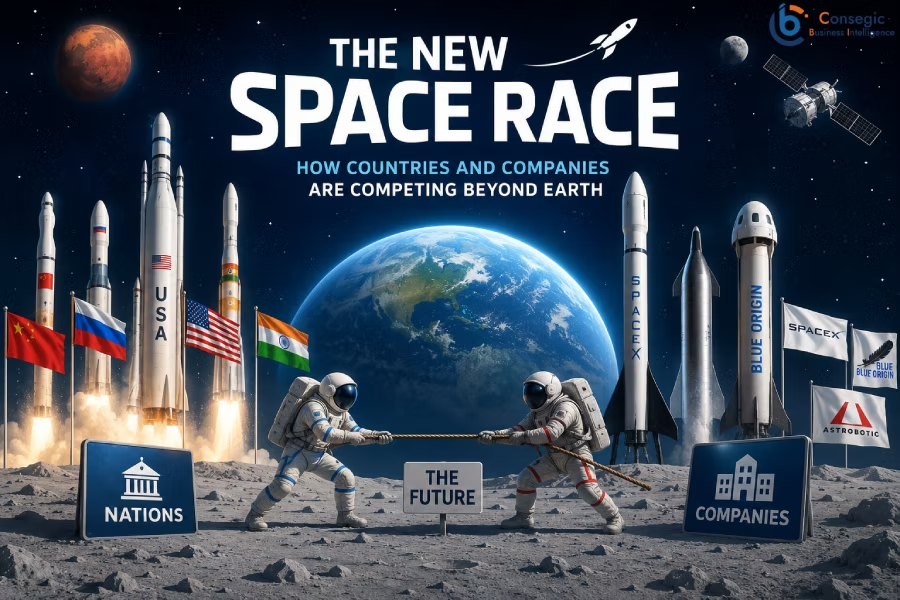
This Isn't Your Grandfather's Space Race
The original space race was clean in its structure, if not its politics. Two superpowers. One finish line: the Moon. One winner.
What's happening now is something altogether different. It's multipolar, commercial and deeply entangled with the everyday technologies billions of people rely on- GPS, weather forecasts, internet connectivity, financial systems. Space isn't a distant frontier anymore. It's infrastructure.
The primary geopolitical rivalry is still between the United States and China. Both nations are laser-focused on the lunar south pole- a region believed to hold water ice that could be converted into fuel and drinking water, making it the most strategically valuable piece of real estate beyond Earth. The US is pushing forward with its Artemis program. China is advancing its Chang'e lunar exploration series, with Chang'e-7 targeting a south pole landing later in 2026 and Chang'e-8 in 2028 expected to test the actual use of lunar resources in place.
China isn't being subtle about its intentions either. Its officials have spoken openly about establishing what they call an "Earth-moon space economic zone"- a long-term vision of a cislunar economy anchored by China's own presence on the Moon.
Meanwhile, Russia, once the great rival that launched Sputnik and put the first human in space, has been largely sidelined by sanctions and the fallout from its war in Ukraine. It plays a supporting role in China's camp now, a junior partner in the International Lunar Research Station (ILRS) that Beijing is building as its alternative to the US-led Artemis Accords. As of mid-2026, 67 nations have signed the Artemis Accords; 13 have joined the ILRS. The Moon, it turns out, is also a place where diplomatic allegiances are being sorted.
The Private Space Companies Are Running the Show
If governments are setting the geopolitical stage, private space companies are increasingly the ones building the sets, writing the scripts and controlling the budget.
This is the part of the space race 2026 that would have seemed like science fiction even fifteen years ago. SpaceX now commands roughly 82% of the market share in private-company orbital launches. Its Starlink satellite network has more than 9 million customers. Its Starship rocket, the most powerful ever built, is a central component of NASA's plans to actually land astronauts on the Moon in the Artemis III mission and as of 2026, the company is reportedly preparing for what could be the largest IPO in history.
Think about that for a moment. A private rocket company, which didn't exist 25 years ago, could soon be publicly valued higher than most of the world's biggest corporations.
SpaceX's closest competitor in the US market is Blue Origin, founded by Jeff Bezos. Blue Origin has paused flights of its New Shepard suborbital rocket to redirect resources toward its New Glenn heavy-lift rocket and its Blue Moon lunar lander both central to its bid for NASA contracts. The space tourism PR stunts are over. This is a company that has decided it wants to be a serious player in deep space.
Then there's Rocket Lab, publicly traded and genuinely profitable, scaling up with its new Neutron medium-lift rocket slated for a maiden flight in late 2026. Relativity Space, now led by former Google CEO Eric Schmidt, holding over $2.9 billion in launch contracts and betting everything on a rocket built largely by 3D printing. Sierra Space, preparing to land its Dream Chaser spaceplane- an honest-to-goodness winged spacecraft- before year's end.
The 2025–2026 period has already seen a wave of space IPOs: Firefly Aerospace, Voyager Technologies, Karman and others. The industry that once relied almost entirely on government checks is starting to look like a real commercial marketplace.
The Space Technology Trends That Actually Matter
Beyond the headline missions and the billionaire rivalries, the most consequential space technology trends of 2026 are quieter but their impact reaches all the way down to Earth.
Reusable rockets changed everything. This one is easy to underestimate because it's already happened. But the ability to land a rocket booster and fly it again- something SpaceX proved was possible and has now turned into routine- has slashed the cost of reaching orbit by orders of magnitude. That falling launch cost is the root cause of almost everything else happening in the space industry right now.
Satellites are becoming the nervous system of modern civilization. Low Earth Orbit has become a fast-evolving marketplace where companies compete and innovate at rapid speed. Satellite internet, Earth observation, precision navigation, climate monitoring, defense surveillance- all of it depends on the thousands of satellites currently operational, with tens of thousands more planned. Amazon's $11.6 billion acquisition of Globalstar in this period wasn't a curiosity; it was a signal that the world's largest companies now consider space-based connectivity core to their businesses.
One of the emerging space technology trends that doesn't get enough attention is the convergence of artificial intelligence with satellite operations. Orbital platforms are increasingly being considered as AI computing infrastructure. While AI enables smarter Earth observation, predictive analytics and autonomous mission management at a scale that human operators simply can't match.
In-space servicing is becoming a real industry. As satellite constellations expand, the ability to refuel, repair and deorbit satellites in orbit is no longer a nice-to-have but it's essential. Companies like Astroscale are already operating commercial debris-removal services. ClearSpace, contracted by the European Space Agency, is launching its first active debris-removal mission in 2026. The orbital environment is getting crowded and managing that congestion is becoming a business unto itself.
Global players are catching up fast. Europe is seeing new launch providers emerge, with Isar Aerospace targeting its Spectrum maiden flight in mid-2026. India's commercial space sector is surging, with companies like Skyroot and Agnikul offering low-cost small-satellite launch alternatives. Japan's ArkEdge Space is carving out a niche in microsatellite technology. The space race 2026 is genuinely global in a way that would have been unthinkable during the Apollo era.
Why It All Actually Matters
It's tempting to frame all of this as a competition between egos and nations- Musk vs. Bezos, USA vs. China, flags planted in lunar regolith and there's truth to that framing. But it misses the deeper story.
Space is now central to how modern economies function and how modern militaries operate. The United States Space Force, established in 2019, exists because adversarial nations have been developing capabilities to jam, blind and destroy satellites. China reorganized its military space capabilities under a new force structure more than a decade ago. Today we are in what analysts are calling a period of "unmanaged competition" in space- no binding international frameworks, no enforcement mechanisms, no arms control treaties for orbital assets.
At the same time, the commercial space industry is genuinely improving life on Earth. Faster, cheaper access to orbit means better climate data, more reliable communications, precision agriculture, disaster response. The global space economy is projected to reach as much as $2 trillion by 2040, with private companies expected to lead the growth.
Government spending on space reached $138 billion in 2025. Private investment added another $9 billion. These aren't hobbyist numbers. They're the kind of investment figures that reshape industries and change the trajectory of economies.
The Race Has No Finish Line
Here's what's different about the space race 2026 compared to the one that ended when Neil Armstrong stepped off a ladder in the Sea of Tranquility- there is no finish line. Nobody gets to plant a flag, declare victory and go home.
The Moon isn't the destination- it's the beginning. Mars is the stated goal for both SpaceX and NASA. Asteroid mining is a serious industry now, not a sci-fi premise. Commercial space stations are being designed to replace the International Space Station when it deorbits around 2030. The question of who governs all of this- who writes the laws, who adjudicates disputes, who decides what is and isn't allowed in orbit- remains dangerously unanswered.
What's certain is that the momentum is real, the money is real, and the ambition is unlike anything humanity has organized since the Cold War lit a fire under two superpowers and sent them racing for the sky.
The crew of Artemis II is home now. They splashed down, were hoisted into helicopters and landed at Ellington Airport to cheers and family and the particular kind of exhausted joy that only astronauts know. But the race they came back to is still very much underway and accelerating.