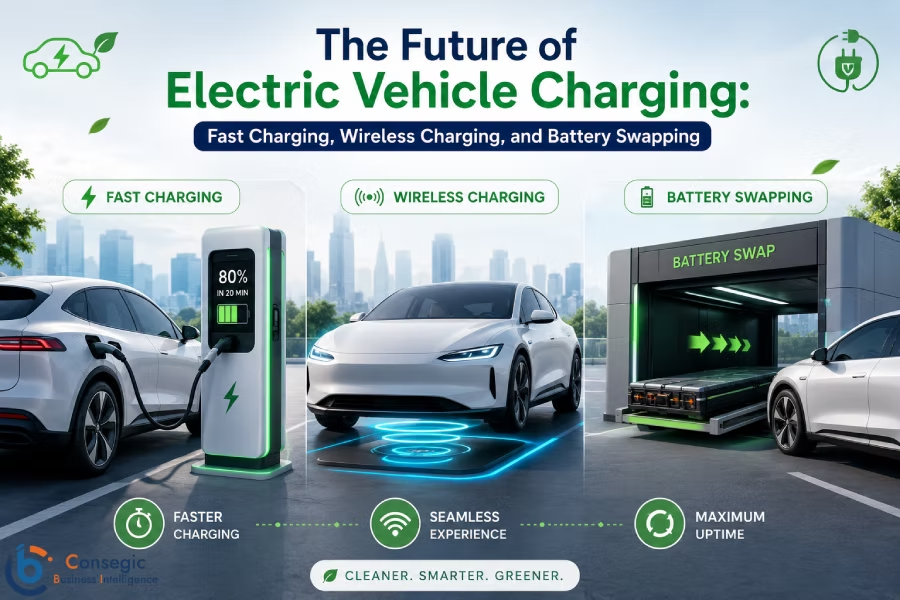
A few years ago, "range anxiety" was the phrase every EV skeptic reached for. Today, the conversation has shifted. Batteries have gotten bigger, cars have gotten more efficient and the real bottleneck isn't how far you can go- it's how quickly you can plug back in. Charging infrastructure has become the defining battleground for the electric vehicle industry and three technologies are racing to solve it: fast charging, wireless charging and battery swapping. Each takes a completely different approach and each is likely to play a role in how we power our cars over the next decade.
Fast Charging: The Workhorse of the EV Revolution
Fast charging, technically known as DC fast charging, is already the backbone of long-distance EV travel. Instead of trickling electricity into a battery over several hours like a home charger, DC fast chargers push high-voltage direct current straight into the battery pack, bypassing the car's onboard converter. The result: a 10-to-80% charge in 20 to 30 minutes for many modern EVs and even faster for cars built around 800-volt architectures.
That last point matters more than people realize. The jump from 400-volt to 800-volt electrical systems, pioneered by manufacturers like Hyundai, Kia and Porsche, has been one of the quietest but most important shifts in EV engineering. Higher voltage means you can push more power through thinner cables without generating excessive heat, which translates directly into faster charging times. Some newer platforms are already flirting with charging speeds that add over 200 miles of range in less than 15 minutes- genuinely comparable to a gas station stop.
The infrastructure side is catching up too. Charging networks are expanding along highway corridors and battery chemistry itself is evolving to tolerate faster charge rates without degrading as quickly. Silicon-anode batteries and improved thermal management systems are helping cars accept higher currents without overheating, which has historically been the limiting factor.
But fast charging isn't a perfect solution. It's hard on batteries over time, it requires expensive high-power infrastructure and it doesn't solve the problem of everyday convenience- most people still don't want to sit in a car for even 20 minutes just to top up. That's where the other two technologies come in.
Wireless Charging: Convenience Without the Cable
The principle behind wireless charging in electric vehicles is something that many people can relate to their cellphones– inductive charging. The inductive charge is delivered by sending an electromagnetic field through a coil in the floor or charging pad to the coil in the bottom of the vehicle. Park your car over the pad and it starts charging automatically.
The appeal is obvious. No cables to plug in, no connectors to wear out, no need to step outside in the rain. For fleets of delivery vans, taxis, or ride-share vehicles, wireless charging pads installed at depots or taxi stands could keep vehicles topped up during natural downtime without any driver intervention at all.
The more futuristic version of this technology is dynamic wireless charging- coils embedded directly into road surfaces that charge vehicles while they're driving. Pilot projects in Sweden, Germany and parts of the United States have tested "electric roads" that could, in theory, let EVs drive indefinitely without ever stopping to charge, dramatically shrinking the battery size needed in each car.
The catch is cost and efficiency. Wireless charging is generally less efficient than a direct plug-in connection, since some energy is lost as heat during the wireless transfer. Retrofitting roads with charging coils is also an enormous infrastructure investment and alignment between the vehicle's receiver coil and the ground pad has to be precise to work well. For now, wireless charging is more likely to show up first in controlled environments like depots, driveways and dedicated lanes before it becomes a mainstream feature of public roads.
Battery Swapping: Skipping the Wait Entirely
Battery swapping takes a fundamentally different approach: instead of charging a battery, you replace it. Drive into a swap station and a robotic system removes your depleted battery pack and slides in a fully charged one- often in under five minutes, faster than filling a gas tank.
This isn't a new idea, but it's found real traction in China, where companies like Nio have built out extensive swap networks and normalized the idea of not owning your battery outright. Instead, drivers subscribe to battery access, paying a monthly fee and swapping packs as needed. This also solves one of the thorniest problems in EV ownership: battery degradation. Since the battery isn't tied to a specific car, aging packs can be cycled out of the system, refurbished, or repurposed for stationary energy storage, rather than being stuck in one vehicle for its entire life.
The challenge with battery swapping is standardization. It only works at scale if manufacturers agree on battery pack dimensions, mounting points and electrical interfaces- something the industry has historically resisted, since battery design is often a competitive differentiator. Building swap stations is also capital-intensive and the model works best in dense urban areas with high vehicle throughput rather than sparse rural regions.
Three Paths, One Destination
It's tempting to ask which of these technologies will "win," but that framing probably misses the point. Fast charging is likely to remain the default for long road trips and public infrastructure, simply because it's the most flexible and doesn't require special vehicle hardware beyond a standard port. Wireless charging will likely carve out a niche in fleet operations, autonomous vehicles and home charging, where hands-free convenience matters more than raw speed. Battery swapping will probably stay concentrated in markets like China and in commercial fleets where uptime is critical and centralized infrastructure investment makes sense.
What's more interesting than any single winner is how these technologies might combine. Imagine an autonomous ride-share fleet that swaps batteries during off-peak hours, drivers who wirelessly top up overnight in their garages and fast chargers reserved for the long highway hauls where speed truly matters. The future of EV charging isn't likely to be a single standard- it's likely to be a layered system, with each technology solving the specific use case it's best suited for.
The bigger picture is this: as batteries improve and charging technology matures, the friction between gas-powered convenience and electric practicality keeps shrinking. Whichever combination of these three technologies ends up dominating, the direction is clear- plugging in, or not plugging in at all, is about to get a lot easier.