Data Centers and Digital Infrastructure: The Hidden Backbone of the AI Revolution
Artificial intelligence has transformed the world in ways many of us use every day. From generative AI applications to smart assistants and business automation, AI is powering major changes across technology and industry. But one piece of this transformation often goes unnoticed by the public, which is the massive digital infrastructure supporting it, primarily data centers. These facilities and their related networks are the foundational pillars of the AI revolution in 2026, and understanding them helps explain why AI is surging forward so rapidly.
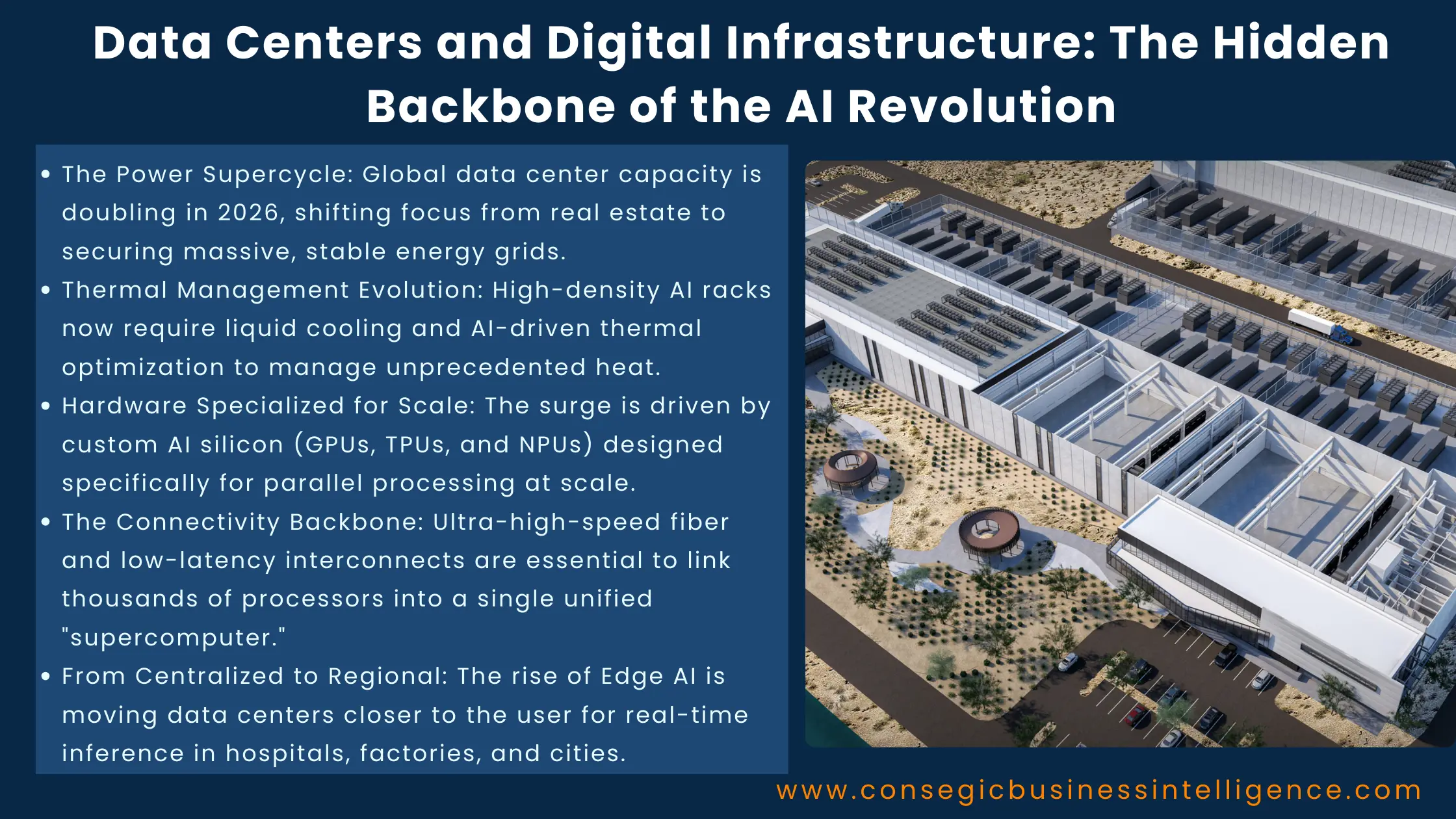
What Are Data Centers and Why Do They Matter
In simplest terms, a data center is a facility that houses computer systems and related components, such as storage and network equipment. These facilities provide the computing power needed to run applications, store vast amounts of information, and support internet services. In the context of AI, data centers are essential because AI models require immense computational resources to train and operate.
Without reliable digital infrastructure, powerful AI tools would not scale or deliver responses at the speed and volume users expect. Data centers are not just physical buildings with servers, they are the digital backbone that keeps the AI economy running, enabling everything from cloud computing to real-time analytics and communication networks.
The Role of AI in Driving Data Center Growth
Artificial intelligence is one of the most demanding workloads in modern computing. AI models, especially large language models, need enormous processing power and memory to train and run. This has driven unprecedented expansion in data center capacity around the world. Industry forecasts show the data center market is expected to grow rapidly through the end of the decade, with AI as one of the biggest demand drivers. In fact, projections indicate that data center energy demand could increase significantly because of AI workloads as organizations deploy more advanced systems to meet computing needs.
This has fueled a global surge in data center construction and infrastructure investment, with cloud providers, telecom companies, and hyperscalers scaling capacity to stay ahead of AI requirements. Data centers have rapidly evolved from supporting routine online services to enabling high-performance AI computing on a global scale.
Building the Infrastructure for AI
To support AI, data centers have become more complex and powerful. Traditional servers are being replaced or supplemented with specialized hardware, such as GPUs and AI accelerators, which can handle parallel computing tasks much more efficiently. Companies are also investing in advanced network infrastructure that connects these data centers securely and at high speed.
In addition to raw computing power, data centers require robust power supply and cooling systems to run efficiently. AI workloads generate more heat and consume more electricity than typical computing tasks, so operators must design facilities that manage these challenges. This includes investing in new power grid capacity, renewable energy sources, and innovative cooling technologies that reduce operational strain and environmental impact.
Environmental Challenges and Sustainability
Data center energy and resource use is a topic of wide discussion. As data centers grow to support AI, so too does their power consumption. Studies and projections suggest that electricity usage by data centers may rise significantly by the end of the decade, with AI being a major factor in that growth. This is prompting industry and government leaders to rethink how these facilities are powered and cooled.
Sustainability initiatives include increasing the use of renewable energy, optimizing cooling and power systems, and exploring new design techniques that reduce environmental impact. While data centers do use substantial energy and water in some cases, responsible planning and innovation are helping shape a greener approach to digital infrastructure.
Edge and Distributed Infrastructure for Real-Time AI
While large centralized data centers handle training massive AI models, edge data centers are becoming more important for AI that needs to operate in real time. Edge infrastructure brings computing closer to where data is generated or used, such as in smart devices, autonomous systems, or Internet of Things networks.
This is especially critical for applications that cannot tolerate delays, such as autonomous vehicles, real-time language translation, or industrial automation. The growth of edge infrastructure represents a shift in how digital infrastructure is designed to support both centralized AI training and distributed AI inference. Together, these systems make AI more responsive, scalable, and resilient.
Economic and Social Impacts
Data center expansion is not just about technology but also it influences national economies and job markets. Significant investments in data center construction create jobs, stimulate related industries, and attract capital to regions that host these facilities. In some economies, spending on digital infrastructure has been forecasted to contribute to overall economic growth.
However, this growth also brings challenges, including regulatory questions about power use, environmental considerations, and local infrastructure strain. Balancing economic benefits with sustainability and community impact is an ongoing conversation among policymakers and industry stakeholders.
The Future of Data Centers and AI
Looking ahead, data centers will continue to evolve as AI becomes more integrated into business, healthcare, communication, and daily life. Innovations like smarter energy management, predictive maintenance powered by AI, and carbon aware infrastructure planning will shape next-generation facilities.
The ongoing expansion of digital infrastructure ensures that AI will have the support it needs to grow. Whether through giant hyperscale campuses or networks of edge facilities, data centers will remain the hidden backbone of the global AI ecosystem.
Conclusion
Data centers and digital infrastructure are often overlooked in conversations about artificial intelligence. Yet they are the essential foundation that makes AI possible at scale. From powering large-language model training to supporting real-time inference on edge devices, these facilities enable AI systems to perform work that would otherwise be impossible.
As we move deeper into 2026 and beyond, understanding this hidden backbone helps contextualize the technological advances shaping our world. The growth of data centers reflects not only the needs of AI but also the broader demand for connectivity, storage, and computing capacity. Investing in resilient, efficient, and sustainable infrastructure will be crucial to unlocking the full potential of the AI revolution while balancing economic and environmental goals.