From family homes in one corner of the world to a quiet apartment in the other- a quiet transformation is taking place across the screen worldwide and the traditional gatekeepers of television are finding it increasingly difficult to adapt.
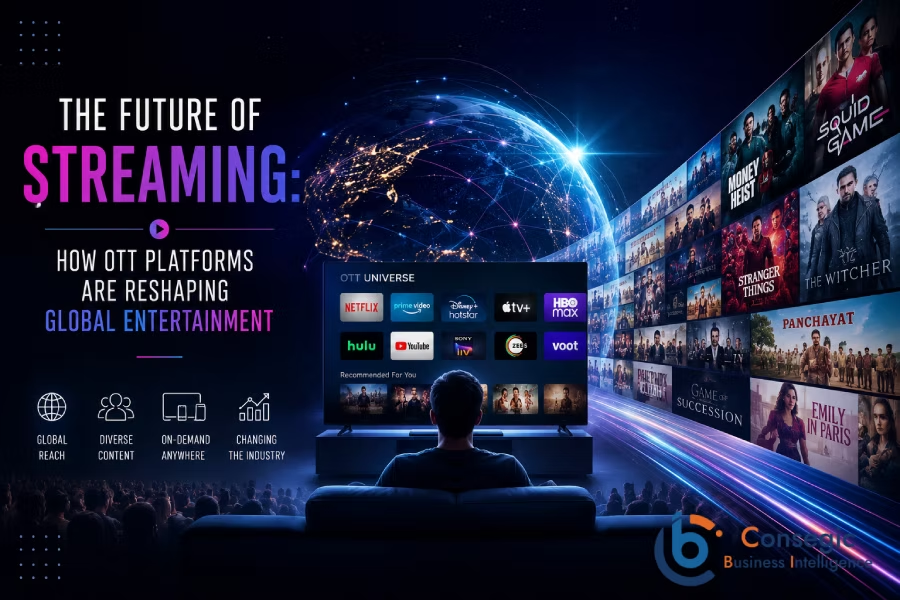
Not too long ago, television schedules controlled the rhythm of most households. People watched whatever the network selected and exactly when the network allowed it. Today that reality feels as outdated as dial up internet.
Over the top (OTT) streaming platforms like Netflix, Amazon Prime, Disney+ etc. along with various regional competitors have completely reshaped how people consume stories, news, sports and culture. This evolution is not only technological but also is social, economical and profoundly human.
The Emergence of the On-Demand Viewer
The OTT boom did not happen overnight. It started quietly in 2007 when Netflix shifted from DVD by mail rentals to online streaming. What followed was more than a decade of behavioural conditioning- audience becoming used to full seasons releasing together, uninterrupted viewing without advertisements and recommendation system that often understood their preference better than close friends.
This change in consumer behaviour become permanent. Once people experienced the freedom of watching content whenever and wherever they wanted, going back to scheduled television felt like moving backwards.
Today, the average global consumer pays for nearly three platforms simultaneously- a number that has remained surprisingly stable despite the global concerns about “subscription fatigue”. The demand for content continues to be enormous and streaming services have reacted by dramatically increasing spending on original productions to compete with- and often outperform- traditional Hollywood blockbusters. Netflix alone spent $17 billion on content in 2025, a number larger than the GDP of several smaller countries.
OTT has transformed television in the same way the printing press transformed manuscripts- it did not merely alter the format; it democratised who had the ability to tell stories.
Localisation: The New Arena of Competition
Perhaps the most significant transformation in streaming is the growing focus on local storytelling. For many years, western platforms distributed American and British entertainment globally assuming it would naturally appeal everyone. The massive success of South Korean dramas like Squid Game and Spanish thriller like Money Heist, completely destroyed that assumption. Audience were not only willing to read subtitles- they were ready to embrace them.
That discovery sparked a localisation race across the industry. Netflix now creates content in more than 50 languages. Amazon has made major investments in South Asian storytelling after recognising the enormous- and still largely underserved- Indian subcontinent audience.
Regional services such as Hotstar in India, Viu across Southeast Asia and Showmax throughout Africa have become powerful competitors, deeply connected to local cultures in ways global corporation often struggle to imitate. The future of streaming will not revolve around one universal platform but around a diverse ecosystem of services, each communicating naturally with its own audience.
Technology as a Storytelling Force
Behind every smooth streaming experience exists an infrastructure of remarkable complexity. Adaptive bitrate technology changes video quality within milliseconds to match internet conditions. Content delivery network store popular titles closer to viewers, helping reduce delays across regions and continents.
Yet the most influential technology reshaping OTT today is artificial intelligence- not as a replacement for creativity, but as a powerful creative partner. AI now helps guide content commissioning by analysing viewing patterns on a massive scale. It powers recommendation system responsible for a large percentage of content discovery on a leading platform. In post-production, AI supported dubbing and lip sync technologies are significantly reducing localisation costs while improving quality.
Looking ahead, personalised and interactive storytelling, where narratives shift dynamically according to viewer preference is moving closer to mainstream adoption every year.
The Return of Advertising
Ironically, subscription streaming, once thought to be the death of advertising, is what brought it back. Now that subscription growth is shifting and customers churn rates are climbing, nearly all of the major platforms are offering ads and cheaper, ad-supported plans that make money off of the same kinds of targeted ads seen on linear television.
Both Netflix and Disney+ launched ad-supported plans in 2022, Max's arrived a year later, luring millions of value-seeking users that might have never given subscriptions a try. The result of this was a new and far more sophisticated advertising system than that which has traditionally been broadcast through television networks.
Streaming services collect granular data about which users are watching, when they are watching, how long they are watching and which shows they replay. Using all this information, advertisers are not only able to reach specific demographics, but to target viewers based on proven preferences and emotional traits.
The Question of Consolidation
The streaming wars of the early 2020s, when nearly every media company launched its own competing service, have now shifted towards consolidation and restructuring. Mergers, bundled offerings and platform closures have narrowed the market. Discovery merged with Warner Bros, Paramount+ strengthened itself through Showtime integration and Apple TV+ continues to position itself as a prestige focused platform instead of competing on sheer volume. The industry is gradually settling into a structure dominated by a handful of global giants alongside a healthy layer of niche and regional platforms.
This consolidation is not simply about corporate organisation. It reflects the harsh economies of producing premium content. Building a subscriber base large enough to support multi billion dollars production budgets requires a level of scale that very few companies can achieve alone. The services that continue succeeding will be those capable of combining strong financial resources with authentic creative direction, along with deep understanding of the audience and what viewers genuinely want.
What Comes Next
The next major frontier of OTT is spatial computing. As augmented reality and mixed reality headsets continue to evolve, streaming experiences will no longer remain limited to rectangular screens mounted on walls. Immersive entertainment- where audience step inside stories instead of simply watching them- will redefine the connection between viewers and narratives. Live sports, long considered the strongest territory of traditional television are already moving towards streaming platforms with broadcasting rights transforming the economics of global sports.
At the same time, the creator economy continues blurring the line between professional and independent content. Platforms capable of promoting and monetising smaller creators alongside expensive original productions will build the most dynamic and resilient entertainment ecosystem.
By 2030, audiences will have access to level of choices that are genuinely difficult to imagine today and the platforms intelligent enough to keep viewers at the center of every decision will be the ones shaping the next chapter of the extraordinary industry story.