Officially, the 52nd G7 Summit in Évian-les-Bains was about economics- France billed it as a forum to address "unsustainable" imbalances in global trade and capital flows. Unofficially, and almost immediately, geopolitics took over the agenda. Russia's war in Ukraine, the fragile aftermath of the US-Iran conflict and an increasingly uneasy consensus on China dominated three days of meetings on the shores of Lake Geneva, the same town that hosted Russia's last appearance at the table back when the group was still the G8.
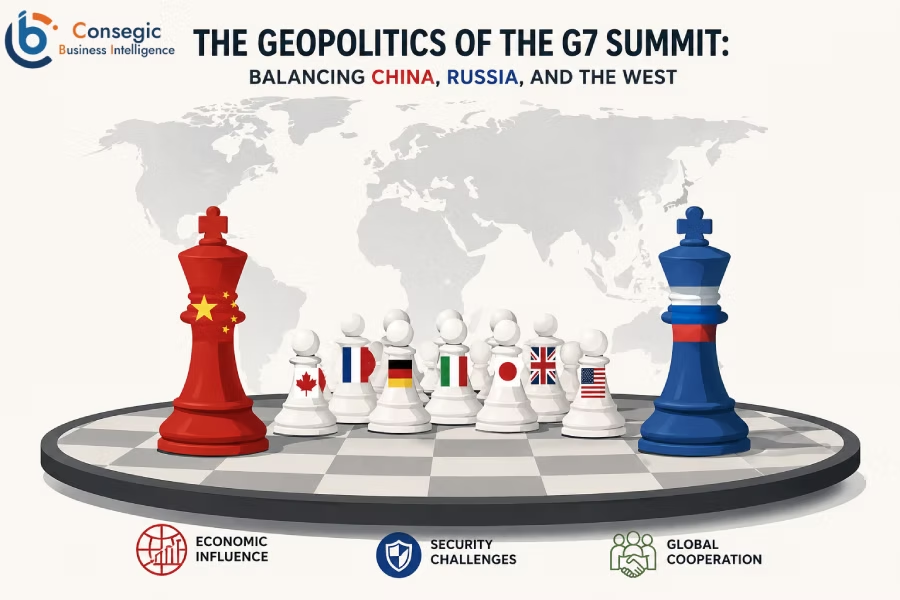
What emerged wasn't a unified Western Front so much as a series of overlapping, fragile agreements, each one more brittle than the joint statements suggested. Here's how the G7 is currently positioning itself between Beijing, Moscow and its own internal fractures.
China: Consensus on Paper, Division Underneath
If there was one area where G7 leaders found genuine common ground, it was a shared concern over China's economic trajectory. China's current account surplus has surged to a record amid weak domestic demand and an export boom that has continued despite higher US tariffs and member states broadly agree that the scale of Chinese industrial subsidies and excess manufacturing capacity poses a structural risk to the global economy. Trade ministers meeting in Paris ahead of the summit reaffirmed shared concerns over what they termed "non-market policies and practices," including opaque industrial subsidies and forced technology transfer.
But the agreement is shallower than it looks. G7 members remain deeply economically intertwined with China- it is simultaneously the group's biggest shared concern and, for several members, an irreplaceable trading partner. That tension shaped the summit's approach: rather than confrontation, Macron reportedly explored direct engagement with Chinese leadership, including discussion of a possible phone call, partly to reassure Germany and other EU members that the G7 is pursuing dialogue before escalation. The logic, according to people close to the discussions, was that a visible attempt at constructive engagement makes any subsequent harder response easier to justify domestically.
Separately, Poland confirmed it had signed a France-led non-paper calling on the EU to strengthen its trade defense instruments against Chinese overcapacity, suggesting that whatever happens at the G7 level, parallel and possibly more concrete action is building inside the European Union itself.
Russia and Ukraine: A Fragile Transatlantic Alignment
Ukrainian President Volodymyr Zelensky's appearance at Évian produced what looked, briefly, like the alignment European leaders had been hoping for. G7 leaders agreed to increase military support for Ukraine, including air defense systems and long-range capabilities, to bolster Ukraine's energy resilience and to tighten sanctions on Russian oil and gas- reportedly including new measures targeting Moscow's "shadow fleet" of tankers used to evade existing restrictions.
Analysts close to the discussions describe this consensus as considerably more fragile than the joint language implies. It rests on a US negotiating posture toward Russia that European officials privately doubt will hold, especially with President Trump signalling a return to direct involvement in Ukraine talks just as the war enters a period Europeans see as genuinely favourable to Kyiv- Russia's spring offensive has reportedly produced its slowest territorial gains in three years, alongside mounting economic strain at home. European leaders worry that Washington's history of leniency toward Moscow could resurface and squander what they view as real leverage.
The result is a two-track European strategy: keep working to bring Washington along, while quietly building the capacity to negotiate independently if that alignment breaks down. That includes pushing for expanded European production of air defense systems and co-production agreements with the US, with Ukraine itself seeking licenses to manufacture Patriot missile components domestically- a hedge against the possibility that American support narrows or comes with strings European leaders can't accept.
The Iran Factor and Strains on the Western Alliance
Hanging over both the China and Russia conversations was the immediate aftermath of the US-Iran conflict. A US-brokered framework agreement, announced just before the summit, opened a 60-day negotiating window and offered the prospect of reopening the Strait of Hormuz- a relief for European economies sensitive to energy price shocks. But the speed with which the framework was assembled has left European officials sceptical it will prove as durable or comprehensive as the original Iran nuclear deal, particularly regarding Tehran's regional proxy networks.
The episode also exposed a real rift between the US and Europe: limited European military contribution during the Iran conflict reportedly contributed to US troop withdrawals from Germany, with the Trump administration using the moment to push for a broader reduction in American conventional forces dedicated to NATO. That tension is expected to carry directly into the NATO summit in Ankara in early July, where Secretary of State Marco Rubio has already signalled that "significant changes" to the alliance's posture are coming.
The Middle Power Question
One structural shift distinguished Évian from past G7 gatherings: the deliberate inclusion of India, Kenya, Brazil, Egypt and South Korea in outreach sessions throughout the summit, not just a single side event. This reflects a broader argument gaining traction in foreign policy circles- that with the US and China increasingly positioned as competing poles, middle powers sit in a position to help stabilize the international order rather than simply choosing sides. Whether that translates into real influence on outcomes like the China trade response or Ukraine negotiations, or remains a largely symbolic gesture toward the Global South, is one of the more open questions to come out of the summit.
What the Fragility Actually Means
The throughline across all three relationships- China, Russia and the transatlantic alliance itself- is that the G7's public statements describe more unity than its private deliberations actually contain. The China consensus survives because confrontation remains economically costly for everyone involved. The Russia-Ukraine alignment survives because, for now, US and European interests happen to point the same direction, not because the underlying disagreements about Moscow have been resolved and the alliance holding all of this together is being tested by exactly the kind of burden-sharing disputes that surfaced during the Iran crisis.
None of this means the summit's declarations were meaningless. Sanctions commitments, military support pledges and trade-defense language all carry real consequences once implemented. But the honest takeaway, echoed by multiple people who watched the talks closely, is that European leaders left Évian with a clear lesson: alignment with Washington remains worth pursuing, but it can't be counted on indefinitely- which is exactly why so much of the summit's quieter work was about building options in case it doesn't hold.