Green Hydrogen: The Missing Link in the Global Energy Transition
As the world races toward cleaner and more sustainable sources of energy, one technology has emerged as a potential game-changer: green hydrogen. It is being called the “missing link” in the global energy transition because it has the potential to connect renewable energy generation, industrial decarbonization, and long-term energy storage into one powerful solution. While solar and wind energy have already transformed the way we produce electricity, green hydrogen offers something unique, which can help decarbonize sectors that are difficult to electrify and provide stability to renewable energy systems.
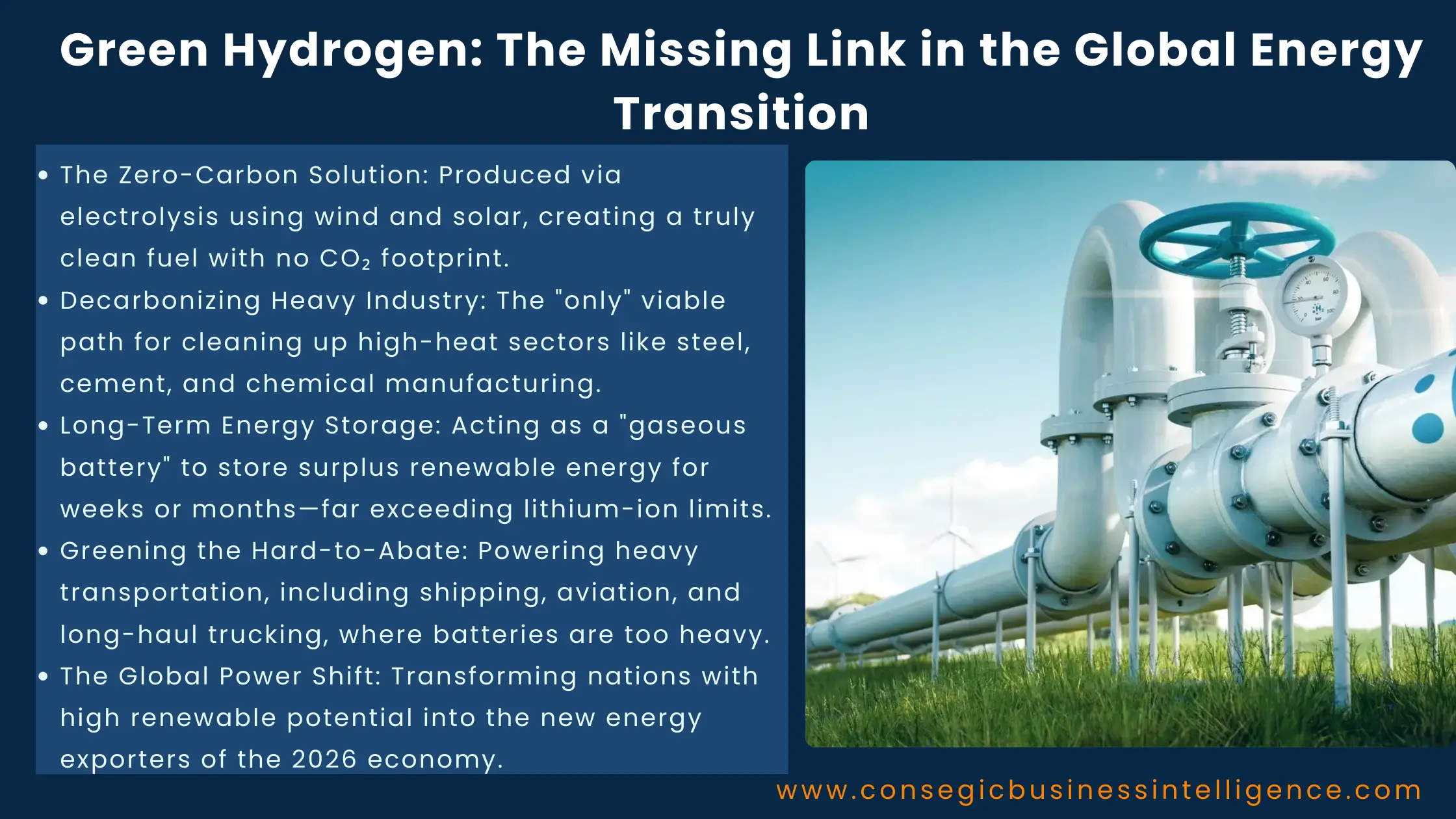
What Is Green Hydrogen and Why Does It Matter
Hydrogen itself is not new. It has been used for decades in industries such as refining, chemicals, and manufacturing. However, most hydrogen produced today is made from natural gas or coal, a process that emits large amounts of carbon dioxide. This form is known as gray hydrogen. When the carbon is captured and stored, it becomes blue hydrogen.
Green hydrogen, on the other hand, is produced through electrolysis, a process that uses renewable electricity from sources like solar and wind to split water into hydrogen and oxygen. Because it does not rely on fossil fuels and generates no greenhouse gas emissions during production, it is considered the cleanest form of hydrogen available.
The growing interest in green hydrogen comes from its ability to serve as both a fuel and an energy carrier. It can store renewable energy for long periods and release it when needed, helping balance supply and demand in electricity systems.
The Role of Green Hydrogen in the Energy Transition
The shift toward renewable energy is already well underway, but not every industry can easily switch to electricity. Heavy industries like steel, cement, chemicals, and long-distance transport still rely on fossil fuels because of the high heat and energy intensity their processes require. Green hydrogen offers a clean alternative that can replace coal, oil, and natural gas in these sectors.
For example, steel production traditionally depends on coking coal to remove oxygen from iron ore. Using green hydrogen instead can achieve the same result without carbon emissions, leading to the concept of “green steel.” Similarly, in transportation, hydrogen fuel cells can power trucks, buses, trains, and even ships that are difficult to electrify with batteries alone.
In this way, green hydrogen acts as a bridge between renewable electricity and industries that are hard to decarbonize. It makes it possible to move toward a truly net-zero economy by filling the gaps that other clean energy sources cannot yet address.
How Green Hydrogen Supports Renewable Energy
One of the biggest challenges with solar and wind power is their intermittency, which is they only produce energy when the sun is shining or the wind is blowing. Green hydrogen can help solve this problem by turning excess renewable power into hydrogen, which can then be stored for later use. This process, known as power-to-gas, allows renewable electricity to be converted into a storable fuel that can be used to generate power during periods of low supply.
This capability is crucial for building more resilient and flexible energy systems. Hydrogen can store energy for weeks or even months, something batteries cannot yet do cost-effectively at large scales. By acting as a long-term energy storage solution, green hydrogen helps ensure that renewable energy remains reliable and consistent, even when weather conditions change.
Global Momentum and Investment
Around the world, investment in green hydrogen is growing rapidly. Countries across Europe, Asia, and the Middle East are developing national hydrogen strategies aimed at scaling up production and reducing costs. Major energy companies are building large-scale electrolysis projects powered by renewable energy, and several governments are offering financial incentives to accelerate deployment.
The European Union has been particularly active, identifying hydrogen as a core component of its climate strategy. Meanwhile, nations like Japan and South Korea are investing heavily in hydrogen technologies to power vehicles and industries. Even regions rich in renewable resources, such as Australia and the Middle East, are positioning themselves as future exporters of green hydrogen to global markets.
This growing momentum reflects a shared recognition that hydrogen could play a vital role in achieving net-zero emissions by 2050 and in reshaping the global energy landscape.
Challenges on the Road Ahead
Despite its promise, green hydrogen still faces significant challenges. The technology for large-scale electrolysis remains expensive, and the process requires substantial amounts of renewable electricity. Producing green hydrogen on a global scale will demand massive investments in both renewable infrastructure and hydrogen production facilities.
Transportation and storage are also hurdles. Hydrogen is a light gas that must be compressed or liquefied for long-distance shipping, which adds complexity and cost. Developing the pipelines, storage tanks, and refueling networks needed for a full hydrogen economy will take time and coordination between governments and private sectors.
However, as renewable energy costs continue to fall and technology improves, these challenges are expected to ease. The focus now is on scaling up production to bring down costs through economies of scale just as solar and wind technologies became affordable through global expansion.
The Path Forward: From Promise to Reality
The next decade will be critical for turning green hydrogen’s promise into widespread reality. Governments, industries, and technology companies are working together to create standards, build infrastructure, and encourage investment. Innovation will play a key role in improving the efficiency of electrolysis systems and integrating hydrogen with existing power grids.
As more sectors adopt green hydrogen, its use will extend far beyond heavy industry. It could eventually become a central part of household energy systems, power generation, and even aviation fuel. By connecting renewable energy with new markets and uses, green hydrogen represents the next phase of the global clean energy transition.
Conclusion
Green hydrogen stands out as the missing link in achieving a sustainable and fully decarbonized energy system. It connects renewable power to industries and sectors that have so far been left behind in the transition. While challenges remain in cost, infrastructure, and scale, the pace of innovation and investment shows that the world is ready to embrace hydrogen as a cornerstone of the clean energy future.
As countries push toward carbon neutrality, green hydrogen offers more than just another energy source, it offers a vision of a balanced, resilient, and sustainable world powered by clean energy from every direction.