The ISOBUS component market is evolving rapidly as modern agriculture moves toward greater automation, digitalization, and equipment interoperability. ISOBUS, based on the ISO 11783 standard enables seamless communication between tractors, implements, and farm management systems regardless of manufacturer. By standardizing data exchange and machine control, ISOBUS simplifies farm operations and supports precision agriculture practices.
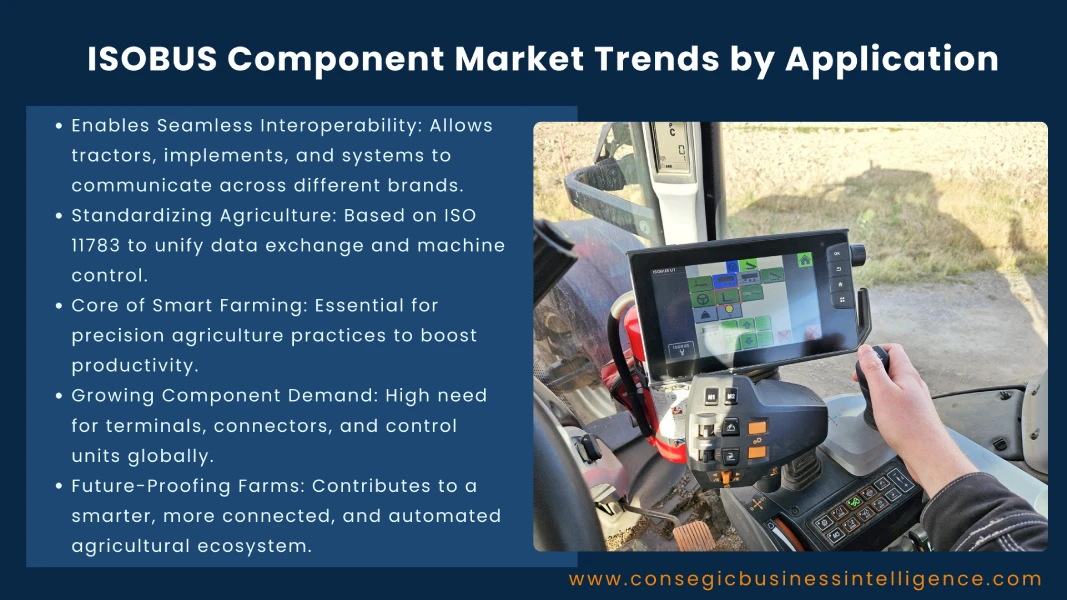
As farmers worldwide adopt smart farming technologies to increase productivity and reduce operational costs, demand for advanced ISOBUS components such as terminals, connectors, control units, and software tools continues to grow. In this blog, we will explore the key application trends shaping the global ISOBUS component market and how they contribute to a smarter, more connected agricultural ecosystem.
- Precision Farming and Variable Rate Application (VRA)
One of the strongest application areas driving ISOBUS growth is precision farming, where data-driven decision-making improves crop yield and resource efficiency. ISOBUS components enable real-time communication between sensors, implements, and tractors, allowing more accurate field operations.
With Variable Rate Application, farmers can automatically adjust seeding, fertilizing, and spraying parameters based on soil characteristics and crop requirements. ISOBUS-compatible implements ensure that tractors can dynamically modulate application rates, reducing waste and optimizing input use.
As farms adopt multi-sensor systems, GPS-guided equipment, and automated field mapping tools, ISOBUS serves as the backbone for interoperability helping precision farming expand across different crop types and regions.
- Autonomous and Semi-Autonomous Farm Machinery
The rise of autonomous and semi-autonomous agricultural machinery is another major trend reshaping ISOBUS component demand. Automated tractors, smart implements, and robotic harvesters rely heavily on ISOBUS networks for synchronized communication and control.
ISOBUS components such as Task Controllers, Control Units, and Virtual Terminals allow machines to exchange data, self-adjust parameters, and complete operations with minimal human intervention.
Manufacturers are also developing next-generation ISOBUS software to support intelligent path planning, collision avoidance, and multi-machine coordination.
As more farms integrate autonomous solutions to address labor shortages and improve efficiency, ISOBUS becomes essential for bridging machine intelligence across diverse brands and systems.
- Enhanced Connectivity for Smart Farm Management Systems
Modern farms increasingly depend on cloud platforms, IoT sensors, and remote monitoring tools. ISOBUS-enabled equipment provides the data foundation for these smart farm ecosystems, allowing farm managers to monitor equipment performance, receive real-time operational feedback, and schedule maintenance more effectively.
Applications such as fleet management, telematics, and machine diagnostics are gaining traction, with ISOBUS data streaming directly into farm management information systems (FMIS).
This trend is especially prominent in large-scale commercial farming, where coordinated equipment operations can significantly reduce downtime and optimize logistics.
As connectivity technologies such as 5G and LPWAN expand into rural regions, ISOBUS will continue to enhance the digital infrastructure of smart farming.
- Efficient Crop Planting and Harvesting Operations
Crop planting and harvesting represent core applications where ISOBUS components deliver operational efficiency and accuracy. Implements such as seed drills, planters, balers, and harvesters rely on ISOBUS networks to communicate data and maintain precision across varying field conditions.
ISOBUS-enabled section control ensures that equipment avoids overlaps or skips during planting or spraying, improving yield uniformity. Harvesters equipped with ISOBUS systems provide real-time feedback on grain quality, moisture levels, and throughput, data that supports better crop management decisions.
With increasing mechanization in developing economies, ISOBUS-based planting and harvesting solutions are becoming more accessible, driving strong market expansion across Asia, South America, and Eastern Europe.
- Spraying and Fertilization Management
The demand for accurate spraying and fertilization is rising as farmers work to reduce chemical use while maintaining crop productivity. ISOBUS components support precision spraying systems that regulate flow rates, nozzle activation, and chemical dosage automatically.
ISOBUS-compatible sprayers use data from soil sensors, crop health imagery, and yield monitors to deliver site-specific treatments, minimizing over-spraying and environmental impact.
Emerging trends include integration with smart booms, auto height-adjustment systems, and real-time droplet analysis, all controlled through ISOBUS communication modules. As environmental regulations tighten globally, precision-controlled ISOBUS spraying solutions are becoming industry standard.
- Tractor and Implement Compatibility Across Brands
One of the core advantages of ISOBUS technology is cross-brand compatibility. Farmers no longer need to buy tractors and implements from the same manufacturer as ISOBUS components ensure seamless communication regardless of equipment brand.
Applications such as plug-and-play implement connection, shared data storage, and unified operator terminals are creating a more flexible agricultural environment. Farmers can now operate mixed fleets without performance limitations, lowering equipment costs and improving operational flexibility.
This trend is particularly strong in regions like Europe and North America, where farmers often use diverse equipment brands and require reliable interoperability across all agricultural operations.
- Livestock Farm Management and Feed Distribution
ISOBUS is expanding beyond traditional crop applications and entering the livestock management sector. Automated feed mixers, bedding distributors, and livestock monitoring vehicles are being equipped with ISOBUS modules to ensure accurate feeding routines and efficient resource use.
These systems help livestock farms maintain consistent feeding schedules, track nutrition data, and optimize feed distribution, all essential for promoting livestock health and improving productivity. As livestock farming becomes increasingly technology-driven, ISOBUS integration is expected to grow rapidly in this segment.
Conclusion
The ISOBUS component market is evolving in response to the growing demand for smart, automated, and interconnected agricultural solutions. From precision farming and autonomous machinery to advanced spraying, planting, and livestock management, ISOBUS is transforming how modern farms operate.
By enabling seamless communication between multi-brand equipment and supporting smart data-driven applications, ISOBUS continues to play a central role in the digitalization of agriculture. As global farmers seek higher efficiency and sustainable operations, the adoption of ISOBUS components across diverse applications will continue to accelerate, shaping the future of intelligent farming worldwide.