The facial fat transfer market is experiencing rapid growth as consumers and clinicians alike turn to natural, minimally invasive aesthetic solutions. Facial fat transfer, also known as autologous fat grafting involves extracting a patient’s own fat from areas such as the abdomen or thighs and injecting it into the face to restore lost volume, smooth wrinkles, and enhance contours. Unlike synthetic fillers, this procedure uses biological tissue, resulting in more natural outcomes and longer-lasting results.
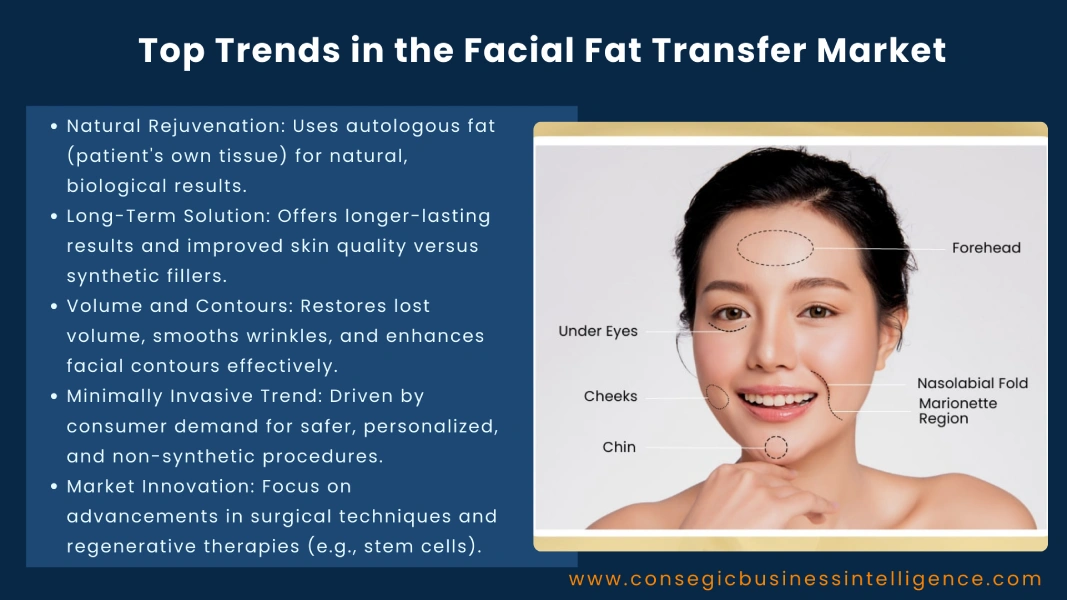
With the rising focus on personalized cosmetic procedures, advances in surgical techniques, and growing awareness about regenerative therapies, the market is moving toward safer, more efficient, and patient-centric approaches.
In this Blog, we will explore the top trends shaping the global facial fat transfer market and how these innovations are redefining aesthetic medicine worldwide.
- Growing Demand for Natural and Long-Lasting Results
One of the most significant trends driving the facial fat transfer market is the shift toward natural aesthetics. Patients today prefer subtle enhancements that preserve facial harmony rather than overfilled, artificial looks. Fat transfer offers dual benefits as it not only rejuvenates the face but also contours the donor area.
As a result, many cosmetic surgeons are recommending fat grafting over dermal fillers for clients seeking longer-lasting and biologically compatible results. The natural integration of fat cells with facial tissue promotes smoother, more stable volume retention, making this procedure a preferred choice among patients seeking authenticity in appearance.
- Technological Advancements in Fat Harvesting and Processing
Modern fat transfer procedures have evolved significantly with advancements in liposuction and purification technologies. Traditional manual extraction techniques have been replaced by closed-loop systems that minimize contamination risk and preserve the viability of fat cells.
New devices now allow surgeons to separate viable adipocytes and stem cells efficiently, ensuring better graft survival rates. Technologies like micro- and nano-fat grafting also allow precise correction of delicate areas such as under-eye hollows and fine wrinkles. These technological innovations are boosting both procedural safety and long-term aesthetic outcomes, accelerating global adoption.
- Integration of Stem Cell-Enriched Fat Grafting
A major breakthrough in the market is the increasing use of stem cell-enriched fat grafts. By isolating and reinjecting adipose-derived stem cells along with fat tissue, surgeons can significantly enhance tissue regeneration and graft survival.
This approach not only improves volume retention but also stimulates collagen production, leading to rejuvenated and healthier skin texture. Clinics in regions such as North America, Europe, and South Korea are pioneering this method, combining regenerative science with aesthetic treatment. As regulatory frameworks evolve, stem cell-based fat transfer is expected to become a standard practice in facial restoration.
- Rising Popularity of Minimally Invasive and Combination Procedures
Consumers are increasingly drawn to non-surgical or minimally invasive options that promise faster recovery and reduced downtime. Facial fat transfer fits this trend perfectly, often performed under local anesthesia with minimal scarring.
Furthermore, surgeons are combining fat grafting with energy-based treatments such as laser resurfacing, radiofrequency tightening, or platelet-rich plasma (PRP) therapy to maximize rejuvenation results. This multimodal approach enhances skin quality, firmness, and facial definition, creating comprehensive anti-aging solutions that appeal to modern patients seeking convenience without compromising results.
- Expanding Applications Beyond Aesthetic Enhancement
While traditionally used for cosmetic rejuvenation, facial fat transfer is gaining ground in reconstructive and post-traumatic applications. Surgeons are using autologous fat grafts to treat facial asymmetry, scarring, burns, and congenital deformities.
Moreover, fat transfer is being explored as a complementary therapy in oncology reconstruction following tumor removal or radiation therapy. The biological compatibility and regenerative potential of fat tissue make it an ideal material for restoring both aesthetics and function, broadening its use across medical disciplines.
- Surge in Male Aesthetic Procedures
Another emerging trend is the rising acceptance of aesthetic treatments among men. Traditionally dominated by female patients, the facial fat transfer market is witnessing a steady increase in male clients seeking natural facial rejuvenation.
Men prefer procedures that maintain subtle enhancements, for example, restoring midface volume or improving jawline definition without over-correction. Clinics are now tailoring marketing and procedural techniques to meet this growing demographic, helping expand the market’s reach beyond conventional boundaries.
- Growing Medical Tourism and Global Accessibility
Countries like Thailand, South Korea, Turkey, and India are becoming popular destinations for patients seeking cost-effective facial fat transfer procedures without compromising quality. These nations offer advanced technologies, internationally accredited clinics, and skilled surgeons at significantly lower costs than Western markets.
This rise in medical tourism is making aesthetic procedures more globally accessible, creating opportunities for both patients and providers. Moreover, collaboration between international clinics and cosmetic device manufacturers is helping standardize procedures, ensuring consistency in outcomes across borders.
- Focus on Training, Safety, and Standardization
As demand grows, the industry is placing stronger emphasis on clinical training, procedural safety, and regulatory compliance. Surgeons are increasingly adopting standardized fat harvesting and injection protocols to minimize complications such as fat embolism or uneven volume distribution.
Organizations like the American Society of Plastic Surgeons (ASPS) and the International Society of Aesthetic Plastic Surgery (ISAPS) are introducing training modules and safety guidelines to enhance practitioner expertise. The focus on data-driven techniques and real-time imaging tools ensures precision, patient safety, and consistent results across practices.
Conclusion
The facial fat transfer market stands at the intersection of regenerative medicine and aesthetic innovation. With patients demanding natural results, minimal invasiveness, and lasting outcomes, fat grafting has evolved into a cornerstone procedure in cosmetic and reconstructive surgery.
Trends such as stem cell-enriched grafting, minimally invasive techniques, expanded medical applications, and global accessibility are transforming the market landscape. At the same time, growing investments in training and safety standards are ensuring that these procedures deliver optimal results with reduced risks.
As technology advances and awareness spreads, the facial fat transfer market is set to experience sustained growth, driven by innovation, patient-centric care, and the global pursuit of natural beauty through science.