Jump to Content
Bottle Sealing Wax Market - Size, Share, Industry Trends, and Forecasts (2025-2032)
Bottle Sealing Wax Market Size:
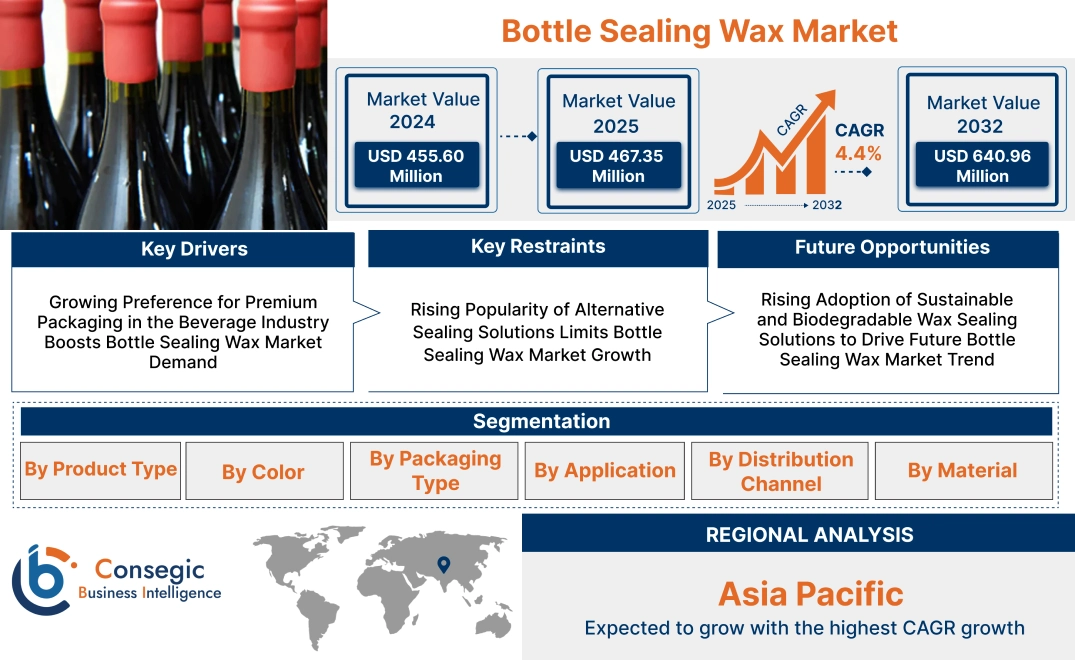
Bottle Sealing Wax Market size is estimated to reach over USD 640.96 Million by 2032 from a value of USD 455.60 Million in 2024 and is projected to grow by USD 467.35 Million in 2025, growing at a CAGR of 4.4 % from 2025 to 2032.
Bottle Sealing Wax Market Scope & Overview:
Bottle sealing wax is a protective coating applied to bottle necks to ensure secure sealing and enhance visual appeal. It provides a durable, tamper-evident seal that prevents contamination and leakage. This wax is available in various colors and finishes, including matte, glossy, and metallic, to support branding and customization.
Key properties include flexibility, heat resistance, and strong adhesion to glass surfaces. It is designed for easy application and removal without leaving residue. Some formulations include food-grade and eco-friendly options. Bottle sealing wax enhances product presentation and preserves contents by creating an airtight barrier.
It is widely used in the wine, spirits, and craft beverage industries. Additional applications include sealing gourmet food packaging, cosmetics, and specialty bottles. End users include wineries, distilleries, breweries, and luxury packaging manufacturers.
Bottle Sealing Wax Market Dynamics - (DRO):
Key Drivers:
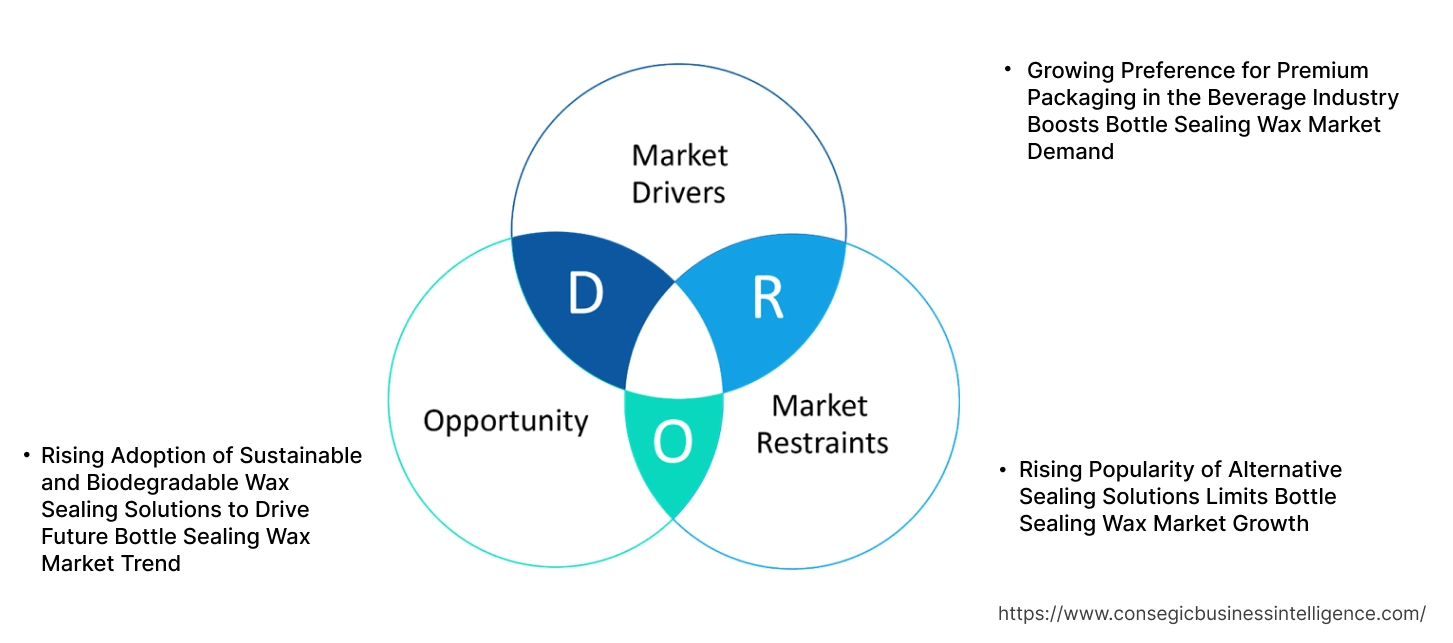
Growing Preference for Premium Packaging in the Beverage Industry Boosts Bottle Sealing Wax Market Demand
Premium packaging plays a crucial role in enhancing brand image and consumer perception, particularly in the beverage industry. Bottle sealing wax is widely used to create an elegant and sophisticated appearance for high-end alcoholic beverages such as wine, whiskey, and craft spirits. The wax seal adds a traditional and artisanal touch while ensuring product authenticity and protection against counterfeiting. Additionally, bottle sealing wax improves the tamper-evident security of bottles, reinforcing consumer confidence in product integrity. For example, premium wineries utilize wax sealing to distinguish their limited-edition collections from standard offerings, appealing to collectors and enthusiasts. The increasing inclination of beverage manufacturers toward unique and aesthetically appealing packaging solutions is propelling the demand for bottle sealing wax in the market.
Key Restraints:
Rising Popularity of Alternative Sealing Solutions Limits Bottle Sealing Wax Market Growth
The adoption of alternative bottle sealing solutions such as synthetic closures, screw caps, and shrink bands poses a significant challenge to the bottle sealing wax market. These alternatives offer advantages such as ease of opening, cost-effectiveness, and mass production efficiency, making them a preferred choice for many beverage manufacturers. Unlike wax seals, synthetic closures provide a uniform sealing process, reducing inconsistencies in packaging. Additionally, screw caps have gained widespread acceptance in the wine and spirits industry due to their convenience and ability to preserve product freshness for extended periods. For instance, major wineries shifting toward screw caps for their mainstream products have reduced the application of bottle sealing wax, particularly in mid-range price segments. The increasing preference for modern, efficient sealing methods is limiting the bottle sealing wax market expansion.
Future Opportunities:
Rising Adoption of Sustainable and Biodegradable Wax Sealing Solutions to Drive Future Bottle Sealing Wax Market Trend
The growing focus on sustainability and eco-friendly packaging solutions presents a significant bottle sealing wax market opportunity. Manufacturers are developing biodegradable and plant-based waxes to cater to the increasing trend for environmentally responsible packaging materials. These sustainable alternatives reduce plastic usage and lower the environmental impact associated with conventional petroleum-based sealing wax. Additionally, the integration of natural dyes and compostable components in bottle sealing wax aligns with the sustainable initiatives of beverage companies and regulatory policies promoting green packaging. For instance, organic wineries and craft distilleries are expected to adopt biodegradable wax seals to reinforce their brand commitment to sustainability and attract eco-conscious consumers. The transition toward environmentally friendly bottle sealing wax solutions is anticipated to create new bottle sealing wax market growth prospects for market participants in the coming years.
Bottle Sealing Wax Market Segmental Analysis :
By Product Type:
Based on product type, the bottle sealing wax market is segmented into beads and blocks/bricks.
The beads segment accounted for the largest revenue share in 2024.
- Beads offer ease of use and precise application, making them suitable for both small-scale and large-scale sealing processes.
- They are preferred in various industries including wine, spirits, and cosmetics due to their ability to create an aesthetically pleasing and protective seal.
- Their smaller size allows for better melting efficiency, reducing waste and enabling customization in sealing operations.
- The trend for beads continues to rise due to increasing customization needs and their compatibility with both manual and machine sealing techniques.
- Therefore, according to bottle sealing wax market analysis, the growing preference for convenient, efficient, and cost-effective sealing solutions contributes to the bottle sealing wax market expansion.
The blocks/bricks segment is anticipated to register the fastest CAGR during the forecast period.
- Blocks/bricks are widely used in large-scale sealing applications where bulk melting is required for continuous operations.
- They are preferred in industrial applications due to their cost-effectiveness and ability to provide a uniform seal over large batches.
- The increasing adoption of machine sealing methods in food and beverage and pharmaceutical industries supports the development of this segment.
- Their ability to maintain product integrity and enhance branding further contributes to their rising ask.
- Thus, according to bottle sealing wax market analysis, the scalability and suitability of blocks/bricks for high-volume production operations make them a key contributor to market growth.
By Color:
Based on color, the bottle sealing wax market is segmented into blue, green, and custom colors.
The custom colors segment accounted for the largest revenue share in 2024.
- Custom colors allow brands to differentiate their products, enhance shelf appeal, and reinforce brand identity.
- They are widely adopted in premium product packaging, especially in the wine and spirits industry.
- Customization options enable businesses to align wax colors with label designs and packaging themes.
- Therefore, according to the market analysis, the rising consumer preference for visually distinctive packaging drives the requiement for this segment.
The blue segment is anticipated to register the fastest CAGR during the forecast period.
- Blue wax is gaining popularity due to its association with premium branding, particularly in whiskey and craft beer packaging.
- The increasing use of blue wax in limited edition and specialty packaging contributes to its rising demand.
- The ability to create an elegant and classic appeal in product presentation enhances the growth of this segment.
- Thus, according to the market analysis, as brands focus on differentiating their packaging through color psychology, the blue wax segment continues to expand.
By Packaging Type:
Based on packaging type, the bottle sealing wax market is segmented into manual sealing and machine sealing.
The machine sealing segment accounted for the largest revenue share in 2024.
- Machine sealing ensures consistent application, efficiency, and reduced operational costs in high-volume production.
- It is widely used in large-scale beverage and pharmaceutical packaging processes.
- The automation trend in manufacturing drives the adoption of machine sealing techniques.
- Therefore, according to the market analysis, the ability to enhance productivity and maintain uniformity across batches contributes to its dominance in the market.
The manual sealing segment is anticipated to register the fastest CAGR during the forecast period.
- Manual sealing is preferred by small-scale producers and artisanal brands due to its flexibility and customization benefits.
- It is widely used in luxury and handcrafted products where branding aesthetics are a priority.
- The growing trend for premium and handcrafted packaging solutions fuels the scale up of this segment.
- Thus, according to the market analysis, as niche brands and craft industries continue to expand, the need for manual sealing solutions increases.
By Application:
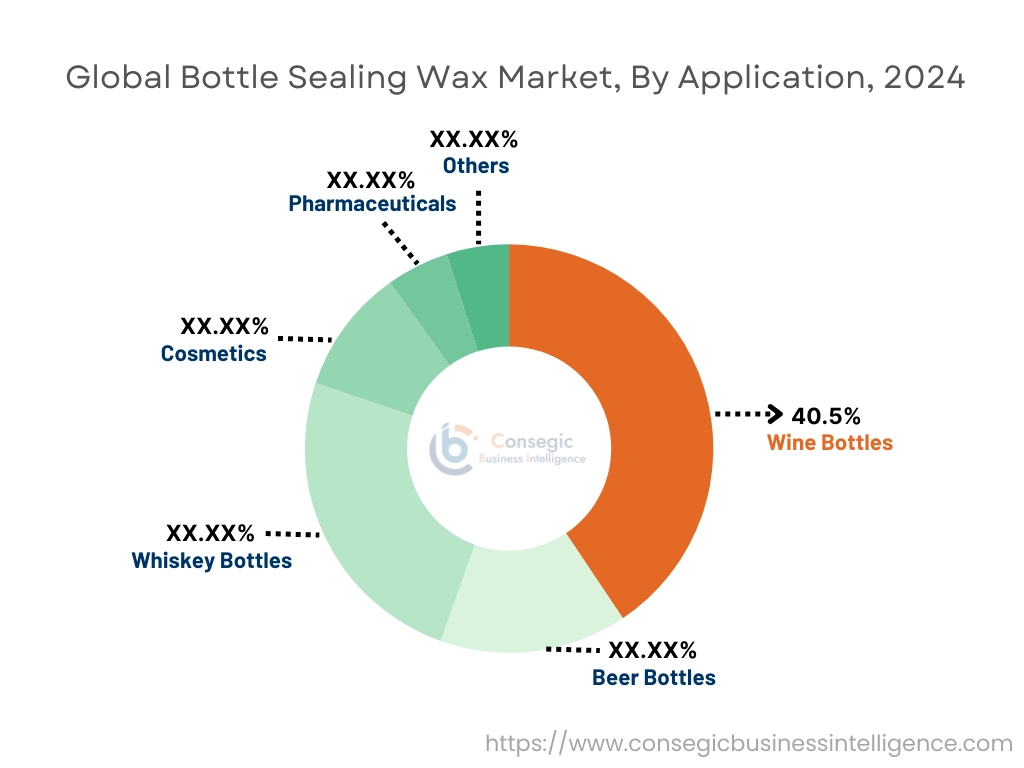
Based on application, the bottle sealing wax market is segmented into wine bottles, beer bottles, whiskey bottles, cosmetics, food and beverages, pharmaceuticals, and others.
The wine bottles segment accounted for the largest revenue share of 40.5% in 2024.
- The wine industry extensively uses bottle sealing wax for premium branding and product differentiation.
- Wax seals provide a traditional and luxurious aesthetic while ensuring product security.
- The rising requirement for vintage and artisanal wines enhances the use of wax-sealed packaging.
- Therefore, according to the market analysis, the ability to protect against tampering and oxidation contributes to its widespread adoption.
The whiskey bottles segment is anticipated to register the fastest CAGR during the forecast period.
- Whiskey brands increasingly use wax seals to create a premium, heritage-driven appeal.
- The growing craft whiskey movement emphasizes unique packaging, boosting wax adoption.
- Wax-sealed whiskey bottles enhance consumer perception of exclusivity and authenticity.
- Thus, according to the market analysis, the scale up of high-end whiskey markets supports the rapid growth of this segment.
By Distribution Channel:
Based on distribution channel, the bottle sealing wax market is segmented into direct sales and distributors.
The direct sales segment accounted for the largest revenue share in 2024.
- Direct sales provide manufacturers with greater control over pricing, branding, and customer relationships.
- It allows companies to cater to specific customer requirements, including bulk orders and customization.
- Therefore, according to the market analysis, the ability to maintain consistent quality and optimize supply chain efficiency enhances its market dominance.
The distributors segment is anticipated to register the fastest CAGR during the forecast period.
- Distributors offer extensive market reach and supply chain benefits, making wax accessible to a larger audience.
- They facilitate the availability of bottle sealing wax across different industries and geographical regions.
- The rising ask for small-scale packaging solutions and bulk procurement creates new opportunities in this segment.
- Thus, according to the market analysis, the ability to streamline distribution and enhance product accessibility contributes to market growth.
By Material:
Based on material, the bottle sealing wax market is segmented into natural wax and synthetic wax.
The natural wax segment accounted for the largest revenue share in 2024.
- Natural wax is widely preferred due to its eco-friendly composition and biodegradability.
- It is extensively used in premium packaging applications, including organic wines and sustainable cosmetic brands.
- Consumer demand for environmentally friendly packaging solutions strengthens the adoption of natural wax.
- Therefore, according to the market analysis, the ability to provide a smooth and durable seal while aligning with sustainability trends enhances its market share.
The synthetic wax segment is anticipated to register the fastest CAGR during the forecast period.
- Synthetic wax offers higher durability, water resistance, and consistency in sealing applications.
- It is preferred in large-scale production due to its uniform melting properties and cost efficiency.
- The growing requirement for industrial-scale sealing solutions supports the adoption of synthetic wax.
- Thus, according to the market analysis, the versatility and ability of synthetic wax, to meet varied application requirements contribute to its rapid expansion.
Regional Analysis:
The regional segment includes North America, Europe, Asia Pacific, Middle East and Africa, and Latin America.
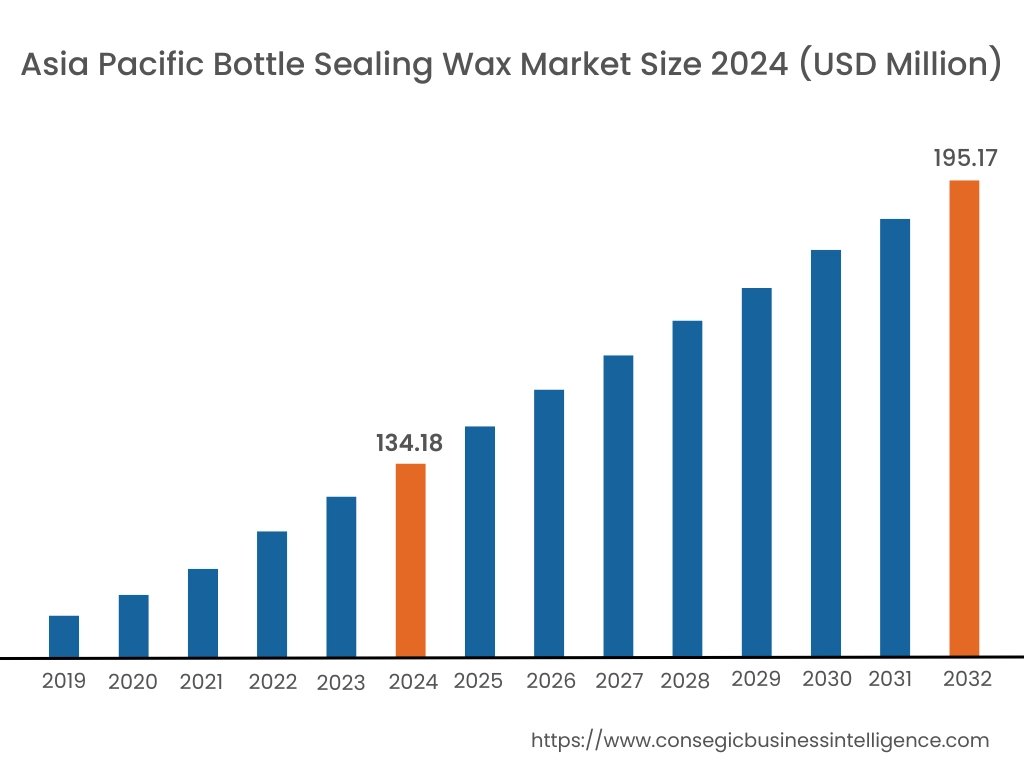
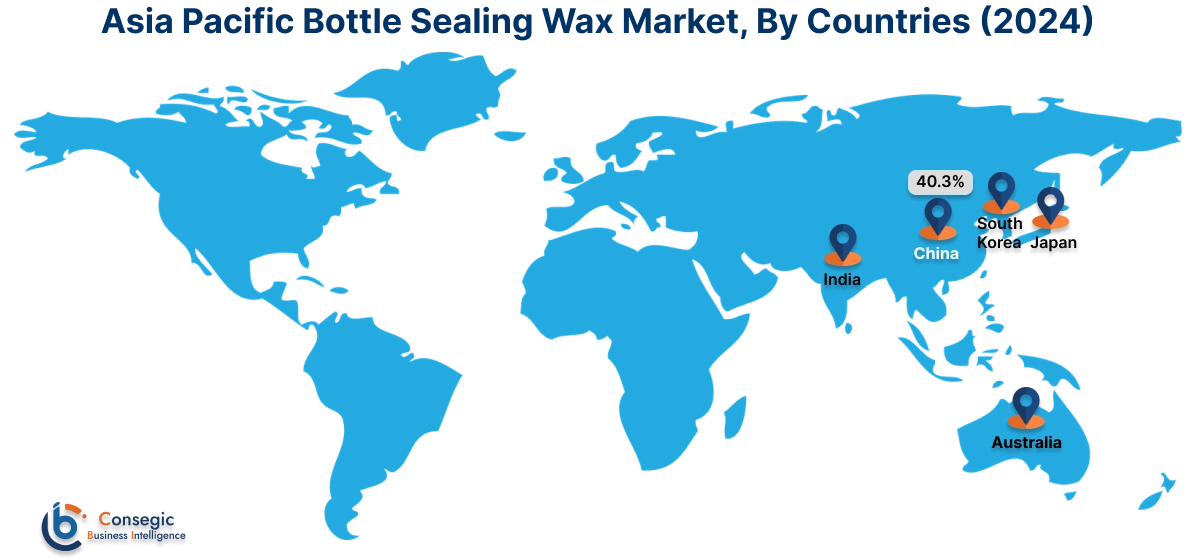
In 2024, Asia-Pacific was valued at USD 134.18 Million and is expected to reach USD 195.17 Million in 2032. In Asia-Pacific, China accounted for the highest share of 40.3% during the base year of 2024. Asia-Pacific exhibits increasing demand for bottle sealing wax due to the expanding wine and spirits industry in China, Japan, Australia, and India. Rising disposable income and evolving consumer preferences drive the requirement for premium alcoholic beverages with attractive packaging. The growing influence of Western-style branding and packaging in emerging economies boosts the adoption of wax-sealed bottles. The rise in local wine production, particularly in China and Australia, strengthens market prospects. Regulations on food-grade sealing materials affect product formulations and compliance standards. Expanding retail and online liquor sales contribute to the need for tamper-evident packaging, further supporting market performance. The ask for artisanal and craft beverage production, including specialty wines and traditional liquors, also encourages the use of wax sealing.
In 2024, North America was valued at USD 151.13 Million and is expected to reach USD 207.74 Million in 2032. North America holds a significant share in the bottle sealing wax market due to the strong presence of premium wineries and distilleries in the United States and Canada. The need for aesthetic and protective packaging in the beverage industry influences market performance. Growing consumer preference for premium and vintage-style packaging in wine, whiskey, and craft spirits supports the use of sealing wax. The presence of key market players and advanced packaging technologies enhances product availability. The increasing adoption of eco-friendly and sustainable sealing materials aligns with regulatory policies on packaging waste reduction. The build-up of direct-to-consumer alcohol sales and e-commerce further supports requirement for secure and tamper-evident packaging solutions.
Europe demonstrates steady demand for bottle sealing wax, supported by a well-established winemaking industry in France, Italy, Spain, and Germany. The ask for premium packaging solutions in the spirits sector, particularly for whiskey, cognac, and champagne, influences market performance. Stringent regulations on packaging sustainability drive manufacturers to develop biodegradable and non-toxic sealing wax formulations. The presence of luxury alcohol brands and heritage wineries sustains requirement for high-quality wax sealing to maintain product authenticity and appeal. Technological advancements in wax application, including automated sealing equipment, improve efficiency in large-scale production. Increasing consumer interest in organic and natural wines also drives ask for eco-friendly sealing materials. E-commerce expansion and cross-border alcohol trade impact packaging and labeling requirements, affecting the sealing wax industry.
The Middle East and Africa have a developing bottle sealing wax market, influenced by rising ask for luxury beverages in the hospitality and tourism sectors. The growth of high-end hotels, fine-dining restaurants, and exclusive wine cellars increases the use of high-quality packaging solutions. Countries like the United Arab Emirates and South Africa exhibit rising ask for premium imported wines and spirits, supporting wax-sealed bottle sales. Import regulations on packaging materials impact supply chain dynamics and product availability. Limited local production of sealing wax affects market accessibility, leading to reliance on imports. The growth of halal-certified non-alcoholic beverages in some regions creates new opportunities for wax-sealed premium packaging. Government restrictions on alcohol sales in certain countries limit market expansion, but exigency persists in duty-free retail and private clubs.
Latin America experiences growing ask for bottle sealing wax, driven by an expanding wine and spirits industry in Argentina, Chile, Brazil, and Mexico. Increasing exports of premium alcoholic beverages influence market trends, as international markets require secure and tamper-evident packaging. The adoption of traditional wax sealing methods in artisanal products, including craft tequila, rum, and mezcal, supports product demand. Economic fluctuations and varying trade regulations impact raw material sourcing and pricing. The growing trend of local craft beverage production, including specialty wines and traditional liquors, boosts the need for distinctive packaging. Sustainability initiatives in the packaging sector encourage manufacturers to explore biodegradable wax alternatives. Expanding online alcohol sales and direct-to-consumer distribution further enhance the importance of wax-sealed packaging for product differentiation and security.
Top Key Players & Market Share Insights:
The global bottle sealing wax market is highly competitive with major players providing products and services to the national and international markets. Key players are adopting several strategies in research and development (r&d), product innovation, and end-user launches to hold a strong position in the global bottle sealing wax market. Key players in the bottle sealing wax industry include-
- Blended Waxes, Inc. (United States)
- Calwax, LLC (United States)
- Swix Wax (Norway)
- Brissa Group (India)
- International Group, Inc. (Canada)
- Cire Trudon (France)
- The British Wax Refining Company Ltd. (United Kingdom)
- Jax Wax Pty Ltd. (Australia)
- The Darent Wax Company Ltd. (United Kingdom)
- Gulf Wax (Royal Oak Enterprises, LLC) (United States)
Bottle Sealing Wax Market Report Insights:
| Report Attributes | Report Details |
| Study Timeline | 2019-2032 |
| Market Size in 2032 | USD 640.96 Million |
| CAGR (2025-2032) | 4.4% |
| By Product Type |
|
| By Color |
|
| By Packaging Type |
|
| By Application |
|
| By Distribution Channel |
|
| By Material |
|
| By Region |
|
| Key Players |
|
| North America | U.S. Canada Mexico |
| Europe | U.K. Germany France Spain Italy Russia Benelux Rest of Europe |
| APAC | China South Korea Japan India Australia ASEAN Rest of Asia-Pacific |
| Middle East and Africa | GCC Turkey South Africa Rest of MEA |
| LATAM | Brazil Argentina Chile Rest of LATAM |
| Report Coverage |
|
Key Questions Answered in the Report
How big is the Bottle Sealing Wax Market? −
In 2024, the Bottle Sealing Wax Market was USD 455.60 million.
What will be the potential market valuation for the Bottle Sealing Wax Market by 2032? +
In 2032, the market size of Bottle Sealing Wax Market is expected to reach USD 640.96 million.
What are the segments covered in the Bottle Sealing Wax Market report? +
The product type, color, packaging type, application, distribution channel and material are the segments covered in this report.
Who are the major players in the Bottle Sealing Wax Market? +
Blended Waxes, Inc. (United States), Calwax, LLC (United States), Cire Trudon (France), The British Wax Refining Company Ltd. (United Kingdom), Jax Wax Pty Ltd. (Australia), The Darent Wax Company Ltd. (United Kingdom), Gulf Wax (Royal Oak Enterprises, LLC) (United States), Swix Wax (Norway), Brissa Group (India), International Group, Inc. (Canada) are the major players in the Bottle Sealing Wax market.
Overview
Reputation & Certifications


Our Services
- Market Intelligence & Forecasting
- Custom Research Solutions
- Market Entry Strategy
- Competitive Intelligence
- Customer Insights
- Industry Innovation Analysis
- Investment Advisory