Jump to Content
Brain Implants Market - Size, Share, Industry Trends, and Forecasts (2025-2032)
Brain Implants Market Size:
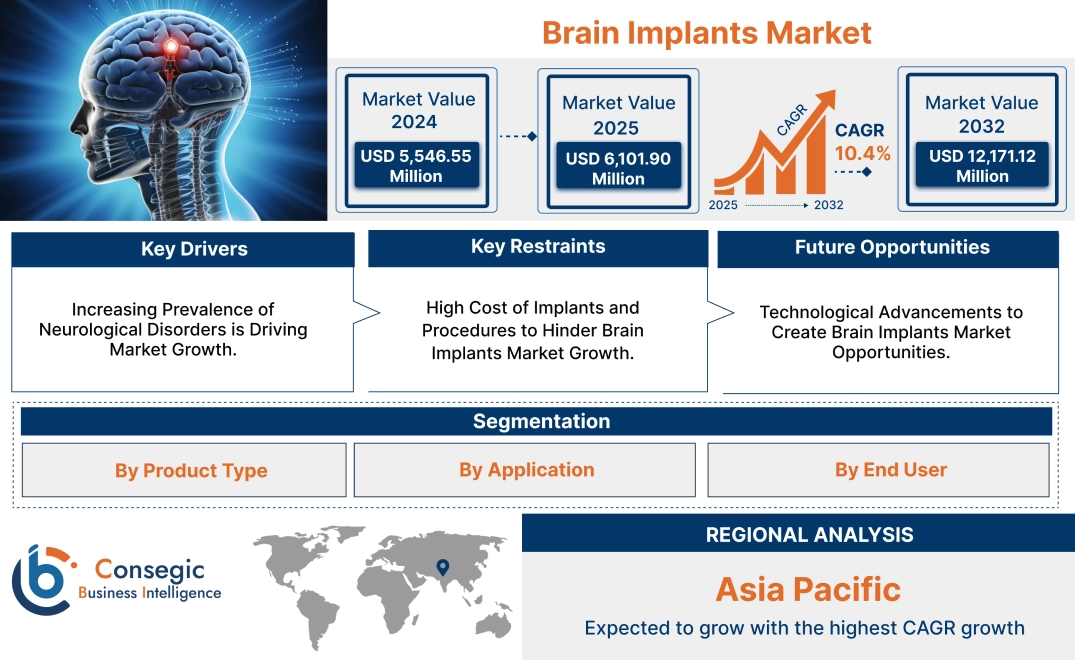
The Brain Implants Market size is growing with a CAGR of 10.4% during the forecast period (2025-2032), and the market is projected to be valued at USD 12,171.12 Million by 2032 from USD 5,546.55 Million in 2024. Additionally, the market value for 2025 is attributed to USD 6,101.90 Million.
Brain Implants Market Scope & Overview:
Brain implants are medical devices implanted through a surgical procedure which helps to either stimulate a specific area of the brain or to record neural activity. They are also known as brain-computer interfaces or neural implants. These devices are used primarily for the treatment of neurological based conditions. A few of these conditions are epilepsy, Parkinson's diseases amongst others. These devices work with the help of electrodes that are used to detect neuronal activity in order to deliver electrical impulses. This enables modulation of brain function with external devices. However, these implants face hurdles including surgical risks, high costs amongst others. Moreover, there has been a focus towards the research and development for more personalized brain implant therapies over the forecast period.
Brain Implants Market Dynamics - (DRO) :
Key Drivers:
Increasing Prevalence of Neurological Disorders is Driving Market Growth.
A few of the most common neurological disorders are Parkinson's, epilepsy, and chronic pain amongst others. This has resulted in a requirement for treatment of these conditions that are of an effective nature. This in turn has led to a demand for brain implants as they provide improved quality of life and potential symptom management.
- For instance, according to WHO, in 2021, over 3 billion individuals were suffering from neurological conditions across the globe.
Thus, the growing number of individuals living with neurological conditions is a primary factor that is having a positive impact on the brain implants market growth.
Improved Clinical Outcomes are Contributing to Brain Implants Market Expansion.
The rise in improved clinical outcome rates for brain implants in neurological condition is another factor driving the market. During clinical trials, these devices showcased effectiveness which helped to build confidence between physicians and patients. As physicians are experiencing the direct positive impact of these devices on their patient’s health has led to an increase in adoption rate.
- For instance, in 2023, according to a study published on Nature, the deep brain stimulation (DBS) technique helped to improve the cognition in individuals that are suffering from brain injuries of traumatic nature.
Moreover, these positive clinical outcomes are also having an impact on the rise in insurance coverage and reimbursement decisions. This has made these procedures more accessible.

Key Restraints:
High Cost of Implants and Procedures to Hinder Brain Implants Market Growth.
Brain implants are devices of complex nature. They require a significant amount of research to develop as well as advanced components for their manufacturing. Moreover, a need for highly skilled professionals is required to perform these kinds of complex surgeries. Combining these both factors lead to financial difficulty. For instance, in India, an average price of deep brain simulation is between USD 14,000 to USD 30,000. This high cost impacts the accessibility of these devices, particularly in developing nations, and even in developed countries. Therefore, the high-cost acts as a restraint on the market growth, which leads to the less adoption of new technologies that are promising.
Future Opportunities :
Technological Advancements to Create Brain Implants Market Opportunities.
Technological advancements in areas such as the design of the electrode, materials science, amongst others are creating lucrative opportunities. These advancements lead to enhancement of the safety and effectiveness of these devices. There has been observed an expedited progress in brain-computer interfaces (BCIs) restoring lost functions and enhancing cognitive abilities amongst others.
- For instance, in 2024, Precision has introduced two new studies at Mount Sinai and Penn Medicine which will incorporate their own brain implant known as Layer 7 Cortical Interface.
Furthermore, these advancements are providing personalized medicine approaches tailored to individual patient needs. Thus, these technological advancements are creating new opportunities for market trajectory over the forecast period.
Brain Implants Market Segmental Analysis :
By Product Type:
Based on product type, the market is categorized into deep brain stimulators (DBS), vagus nerve stimulators (VNS), spinal cord stimulators (SCS), and others
Trends in the Product Type:
- The focus on usage of DBS in conditions such as obsessive-compulsive disorder is gaining popularity
- The rise in innovations in SCS technology is improving its effectiveness in pain management.
The deep brain stimulators (DBS) segment accounted for the largest market share of 45.67% in 2024.
- Deep brain stimulators (DBS) are established devices that help in treating a variety of neurological condition, primarily Parkinsons with effectiveness.
- The versatile nature of these devices makes them a suitable option in treating a lot of other conditions as well. A few of these conditions are epilepsy, tremors amongst others
- For instance, according to NCBI, there are roughly 244 thousand DBS devices that are implanted across the globe in 2023.
- There has been strong clinical evidence supporting the benefits of DBS.
- In addition to this analysis, the growing patient awareness has helped to gain its trend as the leading device in the brain implants market expansion.
The spinal cord stimulators (SCS) segment is expected to be the fastest growing segment over the forecast period.
- The increasing occurrence of chronic pain has led to the demand for spinal cord stimulators (SCS).
- Spinal cord stimulation (SCS) is a neuromodulation technique used to manage chronic pain
- Technological advancements such as high-frequency stimulation, personalized programming, amongst others are improving the effectiveness of SCS.
- Additionally, it has expanded its applications apart from chronic back pain to conditions like peripheral neuropathy and CRPS.
- The minimally invasive nature of SCS implantation and generally favorable reimbursement policies further contribute to its market trajectory.
- Therefore, as per brain implants market analysis and trends, the spinal cord stimulators (SCS) segment is expected to be lucrative over the forecast period.

By Application:
The Application segment is categorized into Parkinson's disease, epilepsy, chronic pain, Alzheimer's disease, depression, and others
Trends in the Application:
- The focus on innovation in DBS to explore its usage while in the earlier stages of Parkinsons
- The aim towards utilizing brain implants in epilepsy patients who don't respond well to medication.
The Parkinson's disease segment accounted for the largest brain implants market share in 2024.
- Parkinson's disease holds prominence due to the use of deep brain stimulation (DBS). DBS is a well-established device used widely across the globe.
- The significant patient population affected by this neurodegenerative disorder is a primary factor contributing to segment trajectory.
- For instance, according to Parkinsons Foundation, roughly 90 thousand individuals in the U.S. are suffering from Parkinsons Disease on a yearly basis.
- Furthermore, insurance coverage for DBS procedures in many regions has contributed to its accessibility and widespread adoption.
- Thus, due to the industry analysis and trends, the Parkinson’s disease segment dominates the brain implants market trends.
The epilepsy segment is expected to be the fastest growing segment over the forecast period.
- The epilepsy segment is growing at the fastest CAGR due to the medical requirement of several individuals suffering from seizure which are not able to be controlled by medications.
- Technological advancements, particularly in responsive neurostimulation (RNS) systems, are driving this growth. They are offering targeted, closed-loop stimulation to prevent seizures.
- Furthermore, research has been focused on different types of epilepsy that contribute to greater adoption of brain implants for this condition.
- The improvements in seizure frequency are leading to better quality of life. This has had a positive impact on making these implants a more attractive option.
- Therefore, as per analysis of brain implants market trends, the epilepsy segment is expected to be lucrative over the forecast period.
By End User:
Based on End user, the market is categorized into hospitals, neurology clinics, ambulatory surgical centers, and others
Trends in the End User:
- The focus of neurology clinics is to perform less complex brain implant procedures in an outpatient setting.
The hospitals segment accounted for the largest market share in 2024 and is expected to be the fastest growing segment over the forecast period.
- Hospitals provide expertise, advanced infrastructure, well-established systems amongst others.
- The complex nature of brain implant procedures requires specialized infrastructure, advanced imaging equipment and intensive care units for post-operative monitoring.
- These procedures also demand teams that include highly skilled neurosurgeons, neurologists, anesthesiologists experienced in neurosurgical cases, and other specialists like nurses and technicians. Hospitals are well equipped to provide these teams.
- Furthermore, hospitals often serve as central hubs within established referral networks for patients with neurological disorders.
- For instance, in 2021, according to NCBI, roughly 65% percent of DBS surgeries were performed in hospitals that were staged in 2 days.
- This analysis positions the hospitals as a key end user segment within the dynamic brain implants market opportunities.
Regional Analysis:
The regional segment includes North America, Europe, Asia Pacific, the Middle East and Africa, and Latin America.

In 2024, North America accounted for the highest market share at 43.87% and was valued at USD 2,433.27 Million and is expected to reach USD 4,970.14 Million in 2032. In North America, U.S. accounted for the market share of 72.06% during the base year of 2024.
The increasing prevalence of neurological disorders due to the growth in geriatric population along with lifestyle factors is driving the market growth for North American brain implants market demand. This creates a larger portion of patients suffering from Parkinson’s, epilepsy being potential patients for brain implant therapies.
- For instance, according to Centers for Disease Control and Prevention, roughly
3 million U.S. adults have suffered from epilepsy in 2023
North America's high healthcare industry expenditure further supports the adoption of these advanced technologies. Therefore, the growing need for effective treatments for neurological conditions driving the market growth.

In Asia Pacific, the market is experiencing the fastest growth with a CAGR of 12.5% over the forecast period. Minimally invasive procedures are being prioritized, driven by investments in advanced imaging, robotics, and others. Additionally, wireless technology is enabling remote monitoring and data collection. Furthermore, research and development in brain-computer interfaces (BCIs) is growing. In addition to this, collaborations are expediting progress in areas like motor function restoration and communication enhancement. As per the brain implants market analysis, these combined factors create a strong requirement for these implants in Asia Pacific.
In the European Market, advancements in targeted stimulation and personalized programming are enhancing the effectiveness of these devices. The focus on research has led to an increase in applications of brain implants into new therapeutic areas, including Alzheimer's, OCD, and depression. These advancements have led to improvements in patients' quality of life. The quality of life is improved through symptom management, functional restoration, and reduced caregiver burden. Thus, due to the above-mentioned factors, the brain implants market demand in Europe is growing.
The Middle East and African industry is led by the rising adoption of telemedicine and remote monitoring. Telemedicine and remote monitoring improve access to specialized care for patients in remote areas. Remote monitoring of implant function enhances patient engagement and allows for timely adjustments. This in turn helps in leading to better outcomes. Furthermore, telemedicine reduces travel costs and increases healthcare efficiency. It facilitates collaboration and knowledge sharing among specialists, improving the quality of care and enabling training for local professionals. Owing to these factors, the market for brain implants in the Middle East and Africa is growing at a considerate rate.
Latin America's is experiencing a growing demand for minimally invasive procedures in the brain implants market share. Technological advancements such as advanced imaging, robotic surgery, and specialized instruments, are helping to implement these less invasive approaches. These advancements offer improved patient outcomes, such as reduced infection risk, less post-operative pain, and shorter hospital stays. This increasing demand is fueling market as more healthcare providers in the region adopt these techniques.
Top Key Players and Market Share Insights:
The Global Brain Implants Market is highly competitive with major players providing products to the national and international markets. Key players are adopting several strategies in research and development (R&D) and product innovation to hold a strong position in the global Brain Implants market. Key players in the Brain Implants industry include-
- Medtronic (U.S.)
- Boston Scientific Corporation (U.S.)
- Beijing PINS Medical Co., Ltd (China)
- Functional Neuromodulation Ltd. (U.S.)
- Abbott Laboratories (U.S.)
- NEVRO CORP (U.S.)
- Synapse Biomedical Inc. (U.S.)
- ALEVA NEUROTHERAPEUTICS (Switzerland)
Brain Implants Market Report Insights :
| Report Attributes | Report Details |
| Study Timeline | 2019-2032 |
| Market Size in 2032 | USD 12,171.12 Million |
| CAGR (2025-2032) | 10.4% |
| By Product Type |
|
| By Application |
|
| By End User |
|
| By Region |
|
| Key Players |
|
| North America | U.S. Canada Mexico |
| Europe | U.K. Germany France Spain Italy Russia Benelux Rest of Europe |
| APAC | China South Korea Japan India Australia ASEAN Rest of Asia-Pacific |
| Middle East and Africa | GCC Turkey South Africa Rest of MEA |
| LATAM | Brazil Argentina Chile Rest of LATAM |
| Report Coverage |
|
Key Questions Answered in the Report
How big is the Brain Implants market? −
In 2024, the Brain Implants market is USD 5,546.55 Million.
Which is the fastest-growing region in the Brain Implants market? +
Asia Pacific is the fastest-growing region in the Brain Implants market.
What specific segmentation details are covered in the Brain Implants market? +
By Product Type, Application, and End User segmentation details are covered in the Brain Implants market.
Who are the major players in the Brain Implants market? +
Medtronic (U.S.), Boston Scientific Corporation (U.S.), Abbott Laboratories (U.S.), NEVRO CORP (U.S.), Synapse Biomedical Inc. (U.S.), ALEVA NEUROTHERAPEUTICS (Switzerland) are some of the major players in the market.
Overview
Reputation & Certifications


Our Services
- Market Intelligence & Forecasting
- Custom Research Solutions
- Market Entry Strategy
- Competitive Intelligence
- Customer Insights
- Industry Innovation Analysis
- Investment Advisory