Jump to Content
Bread Improver Market - Size, Share, Industry Trends, and Forecasts (2025-2032)
Bread Improver Market Size:
The Bread Improver Market size is growing with a CAGR of 6.0% during the forecast period (2025-2032), and the market is projected to be valued at USD 5,205.71 Million by 2032 from USD 3,273.12 Million in 2024. Additionally, the market value for the 2025 attributes to USD 3,458.44 Million.
Bread Improver Market Scope & Overview:
Bread improver is a mixture of raw additives that are used as ingredient in bread making. These mixtures help with specific functions in dough mixing, proofing, and baking various bread products. These improvers are developed using oxidizing agents, reducing agents, enzymes, emulsifiers, and other specialized ingredients. To provide bakers with greater control and consistency throughout the bread-making process is the core function of a bread improver. This mixture improves rheological properties, fermentative activity, and proofing performance of dough. It contributes to optimal volume, texture and crumb color, extended shelf life, and enhanced flavor. As a result, by end use, these improvers are categorized into artisan bakeries, industrial bakeries, quick service restaurants, and more.

Bread Improver Market Dynamics - (DRO) :
Key Drivers:
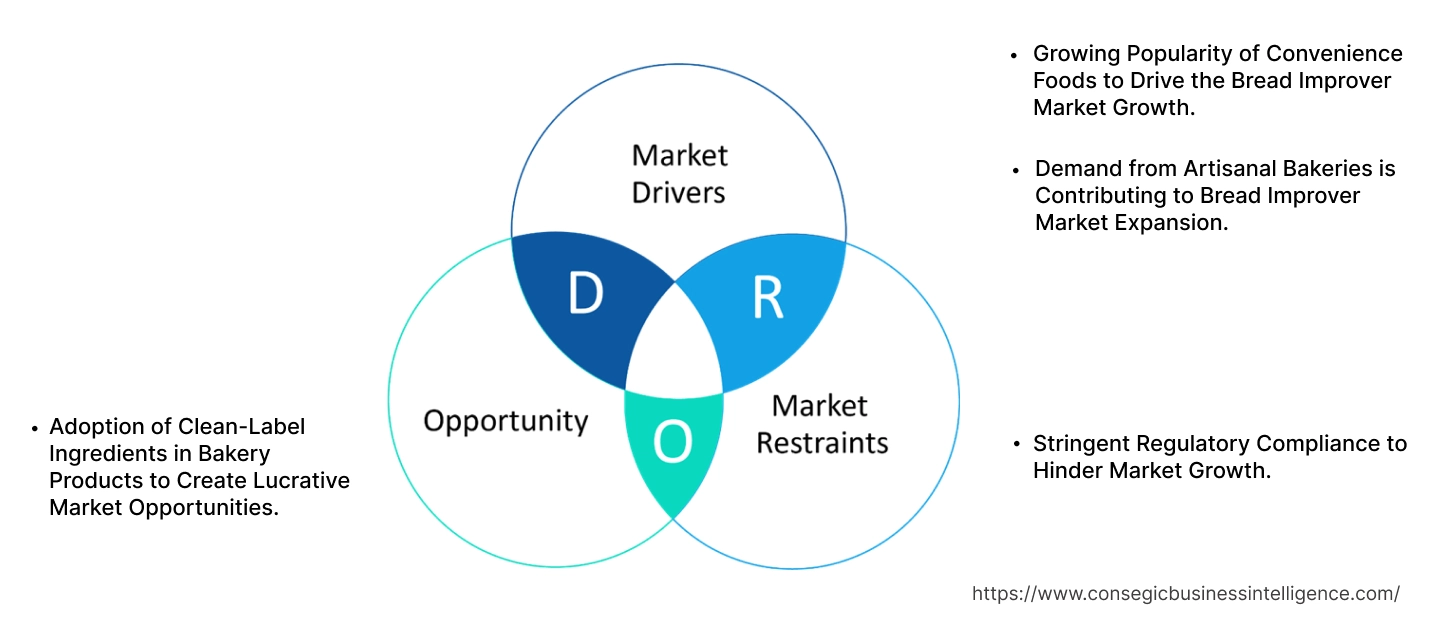
Growing Popularity of Convenience Foods to Drive the Bread Improver Market Growth.
Growing importance of modern lifestyles on convenience has fueled a surge in demand for ready-to-eat and on-the-go bakery products. Convenient bakery products include pre-sliced bread, packaged rolls, and convenient snack breads. Convenience foods need to maintain quality and freshness for extended periods. Bread improvers play a vital role in maintaining quality by enhancing shelf life, improving texture and preventing stalling.
- For instance, as per the analysis published by Tate & Lyle in 2023 almost 45% of young people in Europe are buying baked goods daily.
As a result, the growing preference for convenience foods is positively impacting the market.
Demand from Artisanal Bakeries is Contributing to Bread Improver Market Expansion.
The growing awareness related to improvement in the quality of bread products along with the inclination towards development of unique and flavorful breads are contributing to the growing adoption of bread improvers in artisanal bakeries. Artisanal bakers work with a variety of flours, each with its own characteristics further resulting in demand for improvers tailored to these specific flours and baking processes. Additionally, the growing artisanal bakery sector necessitates the utilization of the bread improvers.
- For instance, according to the data published by Open University Business School, in year 2021, 2,720 businesses were operating as artisanal bakeries making bread, pastries, and cakes in the UK.
Thus, the utilization of these improvers across the artisanal bakeries is contributing to bread improver market expansion.
Key Restraints:
Stringent Regulatory Compliance to Hinder Market Growth.
The increase in focus on protection of environment and safety of consumers has led to the imposing of stringent regulations that are required by the manufacturers to adhere to. These regulations are related to the production of bread improver, its applicability, labelling of the product, amongst others. As manufacturers need to comply with these regulations, the production of bread improves is delayed as the process of the regulatory process is lengthy as well as time-consuming in nature. Additionally, this length of time process accounts for the increase in cost required for the production of these improvers. Moreover, these factors also lead to delays in product innovations as manufacturers are required to think twice before investing in such products. Thus, the impact of stringent food regulations on bread improver market opportunities is complicated.
Future Opportunities :
Adoption of Clean-Label Ingredients in Bakery Products to Create Lucrative Market Opportunities.
A rise in the adoption of clean label products are creating potential for market growth over the forecast period. The rise in need for clean label ingredients in bakery is driven by consumer shift towards bread improvers that are made with natural ingredients and do not contain artificial additives. Manufacturers are responding by developing improvers that utilize natural ingredients that meet clean label criteria.
- For instance, according to an article published in Food Manufacture in April 2024, it is stated that consumer demand for clean-label products will increase 70% in next two years. 99% of European manufacturers see clean-label products as essential to their business strategy.
Thus, the rise in necessity of clean label products are creating lucrative opportunities over the forecast period.
Bread Improver Market Segmental Analysis :
By Type:
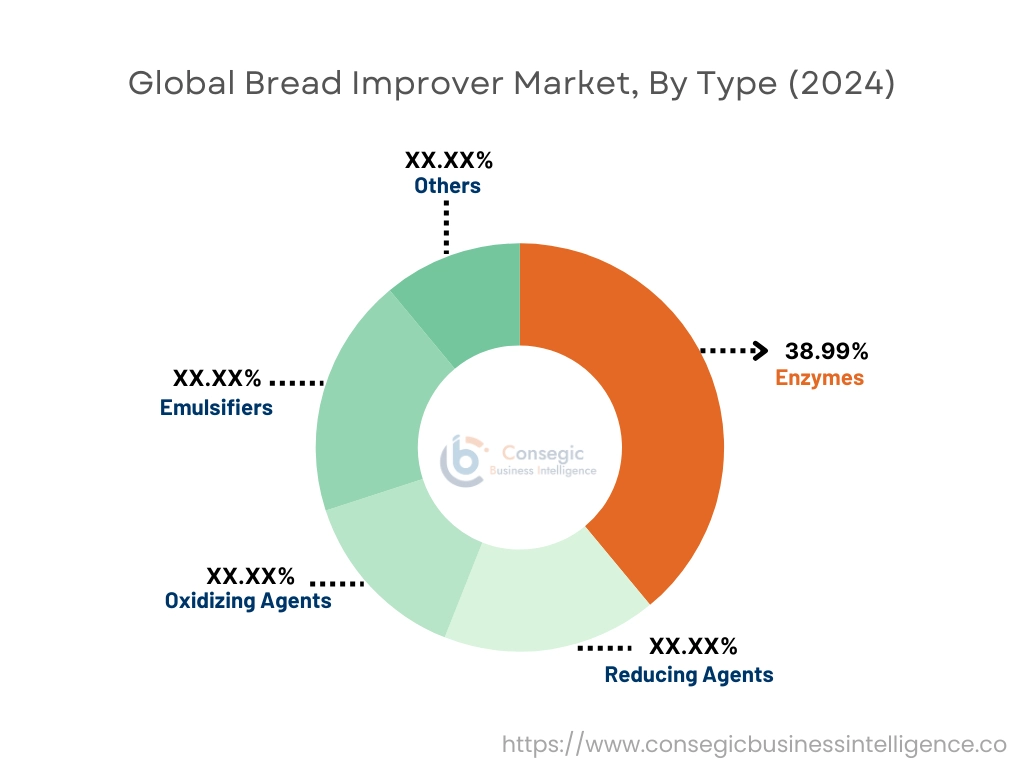
Based on type, the market is categorized into oxidizing agents, reducing agents, enzymes, emulsifiers, and others.
Trends in the Type:
- The consumer inclination towards products used in the baking sector of natural source is rising.
- The trends towards the use of improvers that target particular characteristic of dough and quality of bread.
The enzymes segment accounted for the largest market share of 38.99% in 2024 and is expected to grow with the highest CAGR over the forecast period.
- Enzymes are the substances that work as catalysts. Examples of these catalysts include amylases, hemicellulases, xylanases, lipases, proteases, and oxidases amongst others.
- The need for enzyme in improvers for bread is increasing due to the preference of individuals focusing on versatile products. They improve handling, enhance gluten development, structure and elasticity of dough.
- Additionally, the use of products of natural origin and clean label attributes by consumers is increasing. Also, the requirement for enzymes developed for particular applications is growing.
- Due to this, manufacturers operating in the market are focusing on developing bread improvers by using enzymes.
- For instance, in 2021, AB Enzymes launched enzymes for rye applications. This helps manufacturers of bread improvers to create superior rye-based products with optimized rheological properties.
- Moreover, due to the complex nature of improvers, it is expected that enzymes will be preferred by consumers over the forecast period as well. Collectively, aforementioned factors support segment trajectory in the overall bread improver market trend.
By End-Use:
The end use segment is categorized into artisan bakeries, industrial bakeries, quick service restaurants, and others.
Trends in the End Use
- The adoption rate for organic bread improver in open service restaurants is rising.
- There is increasing utilization of clean label improvers in home bakeries.
The industrial bakeries segment accounted for the largest market share in 2024.
- The industrial bakeries is dominating the market due to the large-scale adoption of population as well as the increasing need for maintaining consistency in quality, cost-effectiveness, and efficiency in their bread production.
- In addition to this, the key factor is that industrial bakeries operate on a large scale. High production volume creates a requirement for production lines which are automated. Improvers are crucial in order to tailor machineability in automated production lines to improve yields.
- For instance, in 2023, Bakels Sweden introduced Lecimax 3000 and Lecisoft Rye to develop a strong and more reliable outcome in bread production. Lecimax 3000 is a powdered bread improver for large scale production.
- Owing to the above-mentioned factors, the industrial bakeries segment holds dominant position in the overall bread improver market demand as the primary consumers of these products.
The artisanal bakeries segment is expected to grow at the fastest CAGR over the forecast period.
- The utilization of bread improver in artisanal bakery products is expected to rise due to a shift in consumer demand for high-quality and unique breads.
- In addition to this, there has been an increase in consumption of artisanal products that present distinctive flavors, textures, and ingredient is having a positive impact on market growth.
- There is growing popularity of leavened breads and sourdoughs further contributing to the trend of these improvers.
- Moreover, growing consumer emphasis on natural and clean label ingredients align with preferences of artisanal bakers.
- Thus, due to the above-mentioned factors and trends, the artisanal bakeries’ segment is expected to register the fastest CAGR over the forecast period in the overall bread improver market demand.
By Distribution Channel:
Based on distribution channel, the market is categorized B2B and B2C.
Trends in the Distribution Channel:
- The increase in busier and hectic lifestyles has led to need for convenient purchase of bread improvers through online channels.
- The growing focus on the digitalization in the supply chain is supporting the market.
The B2B segment accounted for the largest market share in 2024.
- The B2B (business to business) segment makes a leading contribution to the market due to the need for the large volume of bread improvers in the industrial settings.
- This channel involves sales of bread improvers from manufacturers to businesses such as bakeries, food service providers, and other commercial food manufacturers. B2B distribution of products is present large order volumes that characterize significant requirements of these businesses.
- For instance, in 2022, according to The Open University, for 24% of bakery owners across the UK operate their main premises as a commercial or industrial unit selling their improver types of bread across various business.
- Thus, due to the above-mentioned analysis, the B2B segment is dominating in the overall bread improver market trend.
B2C segment is expected to grow at the fastest CAGR over the forecast period.
- The business-to-consumer (B2C) channel in the market for bread improver includes direct sales to individual consumers.
- This segment is characterized by smaller package sizes designed for household use, distributed through retail channels such as supermarkets, specialty food stores, and, increasingly, online retailers.
- The rapid growth of e-commerce has significantly impacted this channel. Online retailers are becoming major players in this supply channel offering both convenience and a wider selection of improvers.
- Moreover, as per analysis, the increase in the popularity of home baking is the factors which is expected to create the segment trajectory in the overall bread improver market in the forecast years.
Regional Analysis:
The regional segment includes North America, Europe, Asia Pacific, the Middle East and Africa, and Latin America.
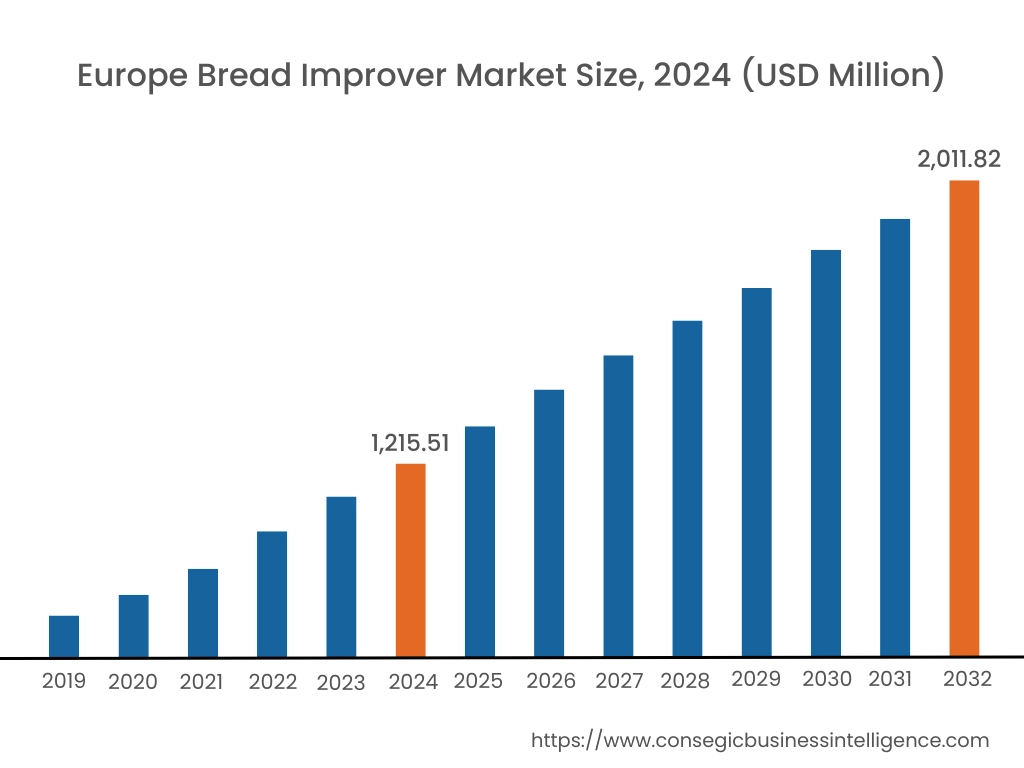
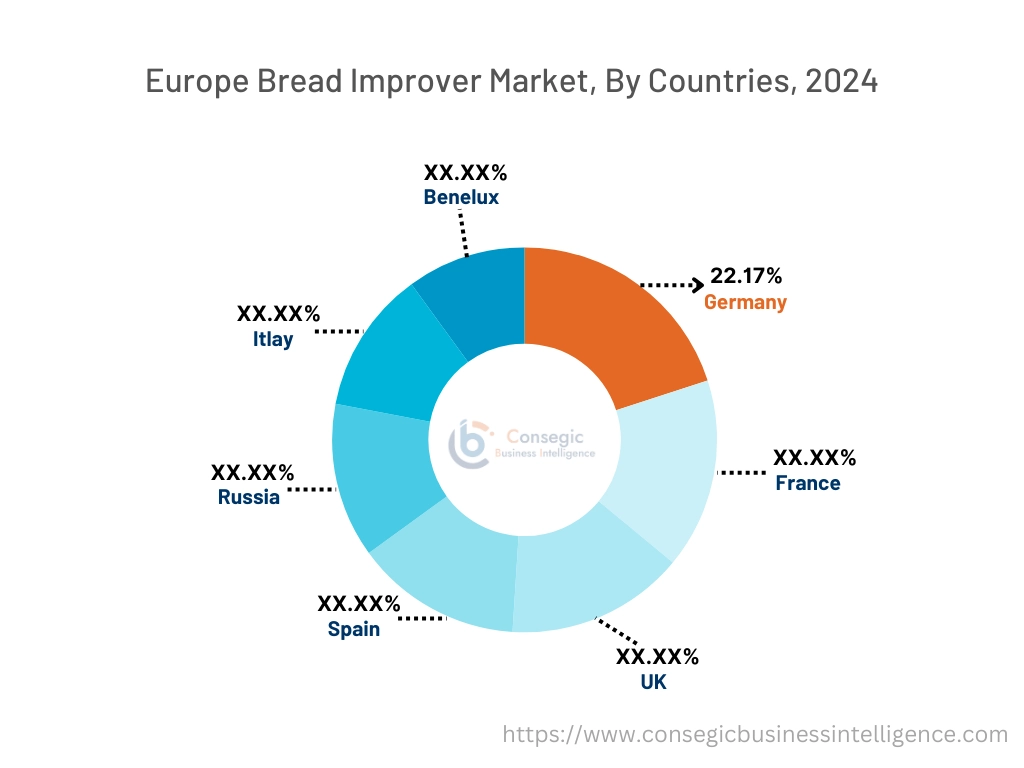
In 2024, Europe accounted for the highest bread improver market share at 37.14% and was valued at USD 1,215.51 Million and is expected to reach USD 2,011.82 Million in 2032. In Europe, the Germany accounted for the largest bread improver share of 22.17% during the base year of 2024.
The rising need for bakery products with clean label ingredients is the key factors that is leading to the market trajectory of bread improver in Europe. This surge in requirement is fueled by a growing emphasis on natural and organic ingredients. European consumers are particularly discerning ingredient lists, actively seeking products free from artificial additives, preservatives, and other ingredients perceived as natural. The European Union (EU) boasts some of the strictest and most comprehensive food safety regulations globally. These regulations are influencing the share of market in Europe.
- For instance, European government launched new regulation EU 2018/848 that has been effective from January 2022. The regulation defines a very precise use of natural flavorings in organic products. According to the regulation natural flavorings with at least 95% natural flavor are allowed in organic products. It must always originate from the named source.
Moreover, as per market analysis, the increased need for convenience food results in requirement for bread improver, for the development of various bakery products in the European region.
In Asia Pacific the bread improver market analysis is experiencing the fastest growth with a CAGR of 9.4% over the forecast period. Shift towards home baking serves a prominent role bread improver market growth in Asia Pacific. Asia consumers are increasingly adopting baking as a hobby. This results in the high preference for bread improvers to enhance texture of products. Additionally, the region is experiencing significant growth in e-commerce adoption. As a result, key players are focusing on distribution of improvers through e-commerce platforms and direct-to-consumer websites further supporting the market in Asia Pacific.
The increasing preference for convenience food is one of the primary factors creating market trajectory across North America. North American consumers modern lifestyle with by busy schedules and time constraint. Hence, there is rise in the consumption of ready-to-eat and on-the-go food products. This consequently supports the bakery sector further promoting American companies to invest in research and development to produce improvers. Bread improvers help manufacturers achieve consistency of cakes, pastries, and others. Collectively, increasing adoption of convenient food products creates bread improver market opportunities across North America.
The consumers and bakery companies in Latin America are increasingly demanding more bread improvers as bread is considered a staple food in countries across the region. The consumption of bakery products is increasing alongside urbanization and evolving lifestyles, directly driving the market. Urbanization directly results in the preference for convenient, ready-to-eat foods, including bakery items. This boosts the need for improvers that extend shelf life and preserve product quality. Thus, these factors are influencing the bread improver market analysis across the region.
The rapid industrialization is a primary factors that is influencing the rise in the use of bread improvers in food industry. As the expansion of industries occurs, the food processing sector, including the bakery industry, grows. It leads to the establishment of more large-scale bakeries and a consequent rise in demand for improvers to support the bread production needs. As a result, as the bakery industry expands coupled with rising consumer requirement for quality and convenience, the requirements for bread improvers are expected to grow in the upcoming years.
Top Key Players and Market Share Insights:
The global Bread Improver Market is highly competitive with major players providing products to the national and international markets. Key players are adopting several strategies in research and development (R&D) and product innovation to hold a strong position in the global Bread Improver market. Key players in the Bread Improver industry include-
Recent Industry Developments :
Acquisition:
- In 2024, Corbion, announced acquisition of the bread improver business from Novotech Food Ingredients, based in Delhi, India.
Product Launches:
- In 2023, Bakels Sweden is introduced two new bread improvers Lecimax 3000 and Lecisoft Rye. The one is for increased volume and a second one for enhanced softness.
Bread Improver Market Report Insights :
| Report Attributes | Report Details |
| Study Timeline | 2019-2032 |
| Market Size in 2032 | USD 5,205.71 Million |
| CAGR (2025-2032) | 6.0% |
| By Type |
|
| By End Use |
|
| By Distribution Channel |
|
| By Region |
|
| Key Players |
|
| North America | U.S. Canada Mexico |
| Europe | U.K. Germany France Spain Italy Russia Benelux Rest of Europe |
| APAC | China South Korea Japan India Australia ASEAN Rest of Asia-Pacific |
| Middle East and Africa | GCC Turkey South Africa Rest of MEA |
| LATAM | Brazil Argentina Chile Rest of LATAM |
| Report Coverage |
|
Key Questions Answered in the Report
How big is the Bread Improver market? −
In 2024, the Bread Improver market is USD 3,273.12 Million.
Which is the fastest-growing region in the Bread Improver market? +
Asia Pacific is the fastest-growing region in the Bread Improver market.
What specific segmentation details are covered in the Bread Improver market? +
By Type, End Use, and Distribution Channel segmentation details are covered in the Bread Improver market.
Who are the major players in the Bread Improver market? +
AB Mauri (United Kingdom), ADM (U.S.), Puratos (Belgium), Lesaffre (France) are some of the major players in the market.
Overview
Reputation & Certifications


Our Services
- Market Intelligence & Forecasting
- Custom Research Solutions
- Market Entry Strategy
- Competitive Intelligence
- Customer Insights
- Industry Innovation Analysis
- Investment Advisory