Jump to Content
Breakfast Cereal Market Size & Industry Share - Growth Trends & Forecasts (2026 - 2034)
Breakfast Cereal Market Scope & Overview:
Breakfast Cereal Market size is estimated to reach over 74,061.27 (US$M) by 2034 from a value of 45,742.41 (US$M) in 2025 and is projected to grow by 48,258.24 (US$M) in 2026, growing at a CAGR of 5.5% from 2026 to 2034, according to a recent report from Consegic Business Intelligence.
The second type is hot cereals which include oatmeal, hot wheat, porridges (congee), and other grain products. They are typically distributed through online stores like Amazon, Walmart, and others and offline stores such as hypermarkets, supermarkets, and others. Factors like high fiber, high protein, low sugar intake, and gluten-free cereals are driving the breakfast cereal market.
Breakfast Cereal Market Size:
Breakfast Cereal Market size is estimated to reach over USD 63,071.59 Million by 2031 from a value of USD 41,273.67 Million in 2023, growing at a CAGR of 5.5% from 2024 to 2031.

Breakfast Cereal Market Dynamics - (DRO) :
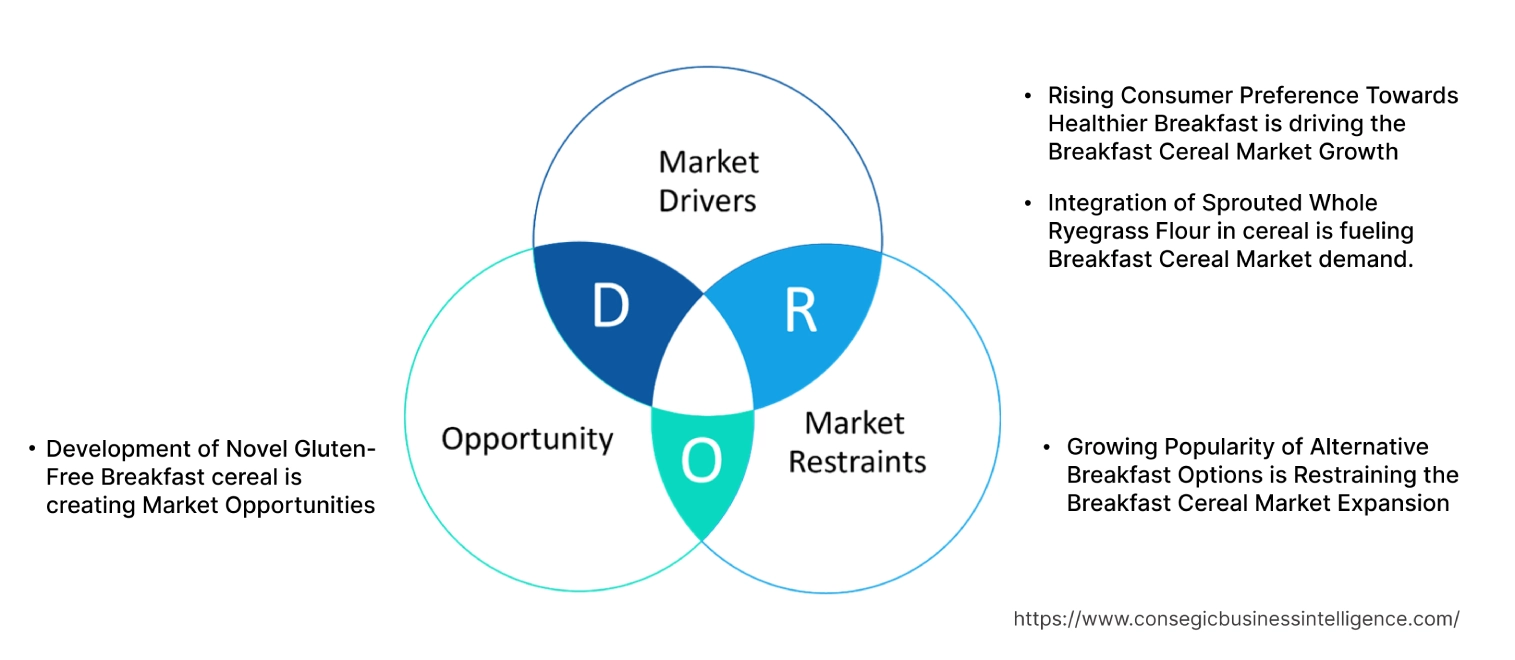
Key Drivers:
Rising Consumer Preference Towards Healthier Breakfast is driving the Breakfast Cereal Market Growth
As consumers are becoming increasingly health conscious, the incorporation of cereals in breakfast has surged. Ready-to-eat cereals offer various benefits to consumers including rich source of proteins, iron, vitamins, and minerals. Ready-to-eat cereals require no cooking or preparation, making them ideal cereal and consumed typically with milk, yogurt, or as a snack.
- In 2023, according to a research article published in Frontiers, ready-to-eat breakfast cereal is associated with better nutrient intake and diet quality in the US population.
- Children and adults consuming ready-to-eat cereal for breakfast had higher intakes of carbohydrates, dietary fiber, calcium, magnesium, iron, zinc, phosphorus, potassium, B vitamins, vitamins A and D, whole grains, and total dairy compared to consumers of non-ready-to-eat breakfast or no breakfast.
Thus, the incorporation of cereals in the breakfast menu offers various benefits making them a healthier choice among individuals and in turn driving the breakfast cereal industry.
Integration of Sprouted Whole Ryegrass Flour in cereal is fueling Breakfast Cereal Market demand.
The most common raw materials for producing breakfast cereal are wheat, maize, or corn, used mainly as refined flour, where nutrients such as dietary fibers, vitamins, and minerals are present at low concentrations.
Whereas incorporation of sprouted whole ryegrass flour in cereal production is a healthier option as it is rich in nutrients like fiber, protein, and antioxidants, aligning its use with increasing consumer preference towards a healthy diet.
- In 2023, according to a research article in Foods Journal, the ryegrass grain has a higher content of dietary fiber and phenolic compounds and a lower amount of lipids and digestible carbohydrates compared to maize. It makes ryegrass an alternative to maize to improve the nutritional quality of flour for use in breakfast cereal.
Thus, the integration of sprouted whole ryegrass flour is driving Breakfast Cereal Market expansion, by aligning with health, sustainability, and innovation-focused consumer preferences.
Key Restraints :
Growing Popularity of Alternative Breakfast Options is Restraining the Breakfast Cereal Market Expansion
The breakfast cereal market size is increasingly restrained by alternative breakfast options. Modern lifestyles prioritize convenience, driving consumers towards on-the-go meals such as protein bars, and meal-replacement shakes which are often quicker to prepare than traditional breakfasts such as eggs, grilled fish, and others.
Health-conscious consumers are also shifting to perceived healthier alternatives like smoothies and plant-based options, which offer customization and nutrient density. Younger demographics further influence this trend, favoring trendy options like avocado toast, breakfast sandwiches, and specialty coffee over cereals.
Thus, alternatives like protein bars and traditional breakfasts are hampering cereal consumption further constraining the breakfast cereal market.
Future Opportunities :
Development in IoT Protocol is expected to Promote Potential Opportunities for Market Growth.
Development of a novel gluten-free breakfast cereal using teff flour is driving innovation in the market by providing a naturally gluten-free ingredient with a high nutritional profile. Gluten-free cereals are specially designed for individuals with gluten intolerance, celiac disease, or those following a gluten-free diet. The introduction of teff flour in these cereals is attracting health-conscious consumers and those seeking diverse and nutrient-based grains in turn broadening the customer base.
- According to Foods Journal, the use of teff flour is favorable for the preparation of gluten-free breakfast cereal with superior nutritional properties and good structural characteristics. Teff flour is rich in amino acids and has a high content of micronutrients, e.g., iron, calcium, zinc, bioactive compounds, and fiber enhancing the nutritional properties of Gluten-Free Cereals.
Overall, this development of a novel gluten-free cereal using teff flour is creating breakfast cereal market opportunities by addressing consumer needs for health, sustainability, and dietary inclusivity.
Top Key Players & Market Share Insights:
The breakfast cereal market is highly competitive with major players providing products and services to the national and international markets. Key players are adopting several strategies in research and development (R&D), product innovation, and end-user launches to hold a strong position in the global breakfast cereal market. Key players in the breakfast cereal industry include -
- Kellanova (United States)
- General Mills, Inc. (United States)
- McKee Foods Corporation (United States)
- Tree House Foods Inc (United States)
- Calbee (Japan)
- Pepsico foodservice (United States)
- Nestle Switzerland (Europe)
- Post Holdings, Inc (United States)
- Weetabix (England)
- Marico (India)
Breakfast Cereal Market Segmental Analysis :
By Product Type:
By product type, the breakfast cereal market is divided into ready-to-eat cereals and hot cereals.
Trends in the Product Type:
- As per market analysis, unique flavors and high-quality ingredients of ready-to-eat cereals are increasing in popularity among consumers in Breakfast Cereal Market trends.
- As per current breakfast cereal market trends, instant hot cereal and single-serve packets make cereal preparation quick and easy increasing consumption among consumers.
Ready to Eat Cereals accounted for the largest revenue share in the year 2023.
- Ready-to-eat cereals require no cooking or preparation, making them ideal cereal and consumed typically with milk, yogurt, or as a snack.
- Many Ready-to-eat cereals are fortified with essential vitamins and minerals like iron, calcium, and B-complex vitamins to cater to daily nutritional needs.
- They are marketed to various demographics including children, adults, and health-conscious consumers.
- Popular varieties of ready-to-eat cereals include cornflakes, puffed rice, granola, muesli, and flavored cereals.
- In 2022, PepsiCo India launched Quaker Oats Muesli which is ready-to-eat breakfast cereal. It is launched in two variants, Fruit and Nut, and is available on both retail and e-commerce platforms.
- Thus, Ready-to-eat cereals are expected to dominate the Breakfast Cereal Market share by saving time and effort for consumers.
The Hot Cereal in the type is expected to grow at the fastest CAGR over the forecast period.
- Hot cereals require preparation before consumption, and it is ideal for cold climates.
- It is typically made from whole grains like oats, and millet which is rich in fiber and nutrients, making a healthier choice among the consumers.
- Hot cereals are typically tailored with fruits, nuts, and sweeteners to enhance flavor and nutrition. They are enriched with superfoods, proteins, and probiotics that cater to health-conscious consumers.
- Typically, hot cereals include oatmeal, cream of wheat, rice porridge (Congee), and others, making healthier options available for individuals.
- For Instance, in 2021, Mr Lee launched its range of instant congee in the UK market. It is available in Original Congee Rice Porridge and Chicken Congee Rice Porridge, making hot cereals available for breakfast for the European population.
- Thus, the Hot Cereals segment is expanding supported by different flavors and availability in emerging markets.
By Distribution Channel:
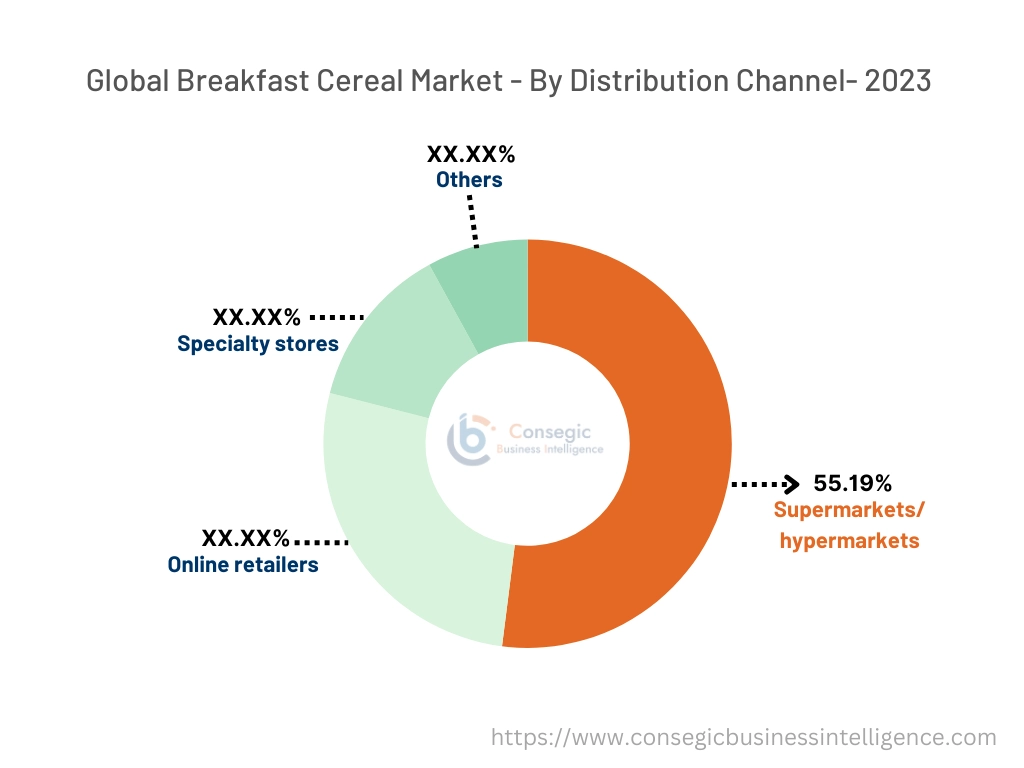
By distribution channel, the breakfast cereal market is divided into supermarkets/hypermarkets, specialty stores, online retailers, and others.
Trends in Distribution Channel:
- Supermarkets and hypermarkets are offering plant-based and nutrient-rich breakfast cereal due to growing consumer preference towards high-protein, low-sugar cereals in the current trends
- Consumers are shifting towards the online retail segment for breakfast cereal purchases due to convenience and availability of various options in the latest trends
The supermarkets and hypermarkets segment accounted for the largest revenue share of 55.19% in the year 2023.
- Supermarkets and hypermarkets are the leading retail formats for breakfast cereal, offering a wide variety of products, including both well-known brands and store brands.
- Consumers prefer supermarkets and hypermarkets for the convenience of one-stop shopping, with easy access to a broad selection of cereals.
- Supermarket chains like Sainsbury, Tesco, and Walmart are offering plant-based and nutrient-rich cereal due to growing consumer preference towards high-protein, low-sugar cereals.
- For instance, in 2024, SURREAL, the start-up breakfast brand in the UK announced its first national supermarket listing, with Sainsbury's. It will roll out the brand’s high protein breakfast cereal range; Cocoa, Frosted, and Cinnamon, across 461 stores nationwide. This will strengthen its product distribution through supermarkets by offering plant-based and nutrient-rich cereals as a breakfast option.
- Thus, supermarkets and hypermarkets are expected to dominate the distribution of the breakfast cereal market for consumers by offering wide options and convenience.
The online retail segment in the distribution channel is expected to grow at the fastest CAGR over the forecast period.
- The online retail segment is experiencing rapid growth as consumers increasingly turn to E-Commerce for convenience and variety.
- Online retailers provide easy access to a wide range of breakfast cereals, including niche and health-focused brands.
- Online retailers allow for an extensive selection of breakfast cereal, including specialty items such as organic, gluten-free, vegan, and high-protein cereals.
- Many emerging breast cereal brands are launching their products via online retail like Amazon, and Walmart, and others to cater to a larger consumer base.
- For instance, in 2022, Crispy Fantasy, officially launched their Junk-Free cereal breakfast product in the United Kingdom. The product is available in chocolate flavor and is launched via the Amazon platform entering online retail distribution channels for cereal supply.
- Thus, the online retail segment is expected to grow rapidly due to the convenience and availability of various options for a diverse consumer base.
Breakfast Cereal Market Report Insights :
| Report Attributes | Report Details |
| Study Timeline | 2021-2034 |
| Market Size in 2034 | USD 74,061.27 Million |
| CAGR (2026-2034) | 5.50% |
| Base Year | 2025 |
| By Product Type |
|
| By Distribution Channel |
|
| By Region |
|
| Key Players |
|
| North America | U.S. Canada Mexico |
| Europe | U.K. Germany France Spain Italy Russia Benelux Rest of Europe |
| APAC | China South Korea Japan India Australia ASEAN Rest of Asia-Pacific |
| Middle East and Africa | GCC Turkey South Africa Rest of MEA |
| LATAM | Brazil Argentina Chile Rest of LATAM |
| Report Coverage |
|
Regional Analysis:
The regional segment includes North America, Europe, Asia Pacific, the Middle East and Africa, and Latin America.
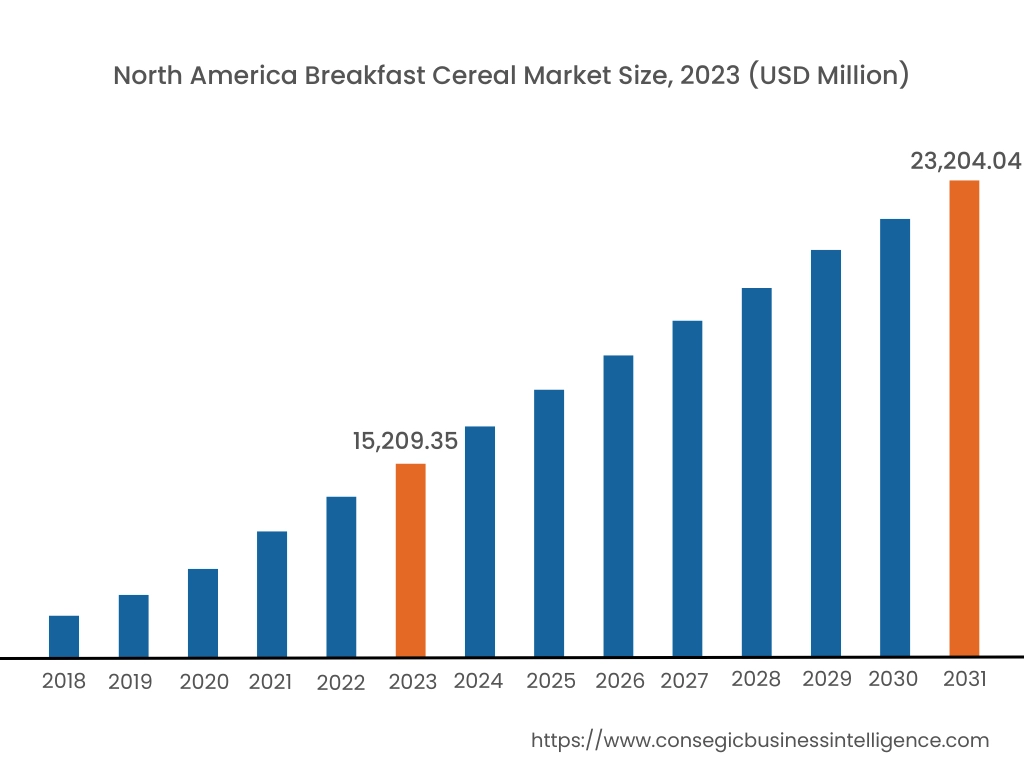
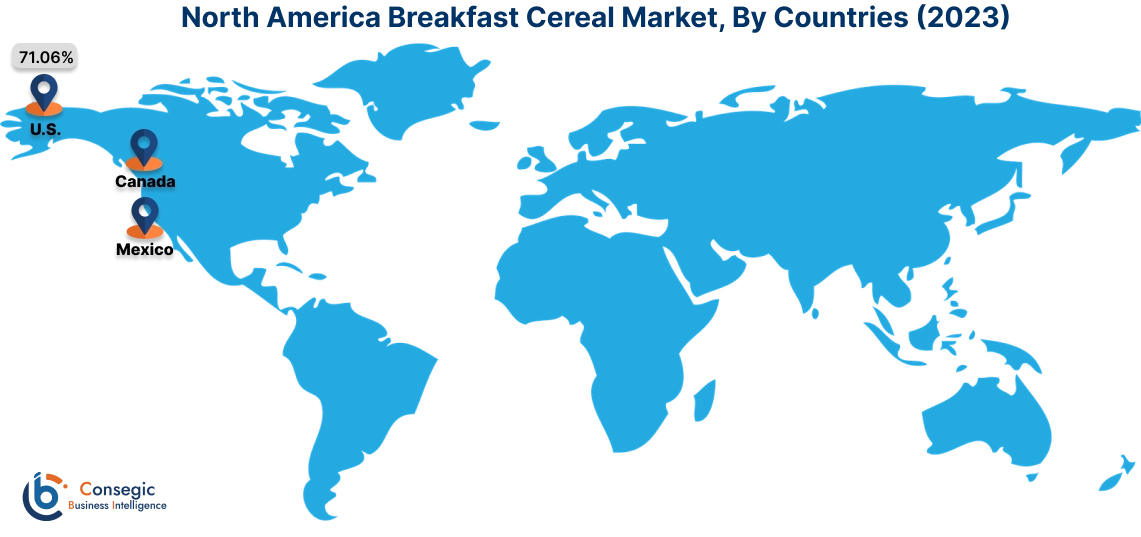
In 2023, North America accounted for the highest market share at 36.85% and was valued at USD 15,209.35 Million, and is expected to reach USD 23,204.04 Million in 2031. In North America, the U.S. accounted for the highest market share of 71.06% during the base year of 2023. The breakfast cereal market share of North America is characterized by evolving consumer preferences and a growing emphasis on health and convenience. Requirement for products like ready-to-eat cereals is particularly high, driven by busy lifestyles and the need for quick meal options. Nutritional awareness is pushing consumers toward cereals rich in whole grains, fiber, and low sugar content.
- In 2022, the Kellogg Co., a leading manufacturer of cereals in the United States, partnered with McKee Foods Corporation to introduce Kellogg’s Little Debbie Nutty Buddy cereal. This new cereal features chocolate and lightly roasted peanut butter flavors together with cereal pieces coated in fudge, making it a good option for having cereals for breakfast.
The steady growth of the breakfast cereal market in North America is expected due to rising health consciousness and product diversification as per Breakfast Cereal Market analysis.
Asia-Pacific is expected to witness the fastest CAGR over the forecast period of 6.2% during 2024-2031. Asia-Pacific region is experiencing rapid breakfast cereal market growth due to urbanization, changing dietary habits, and increasing health awareness among consumers. Countries like India, China, and Japan are driving this market supported by rising disposable incomes and a shift toward Western breakfast options. Western breakfast options include muesli, oatmeal, porridge, and others. Many breakfast cereal brands in this region are launching various flavors to cater to the rising consumer shift towards different flavors of breakfast cereals balancing both nutritional intake and taste.
- For instance, in 2024, Tata Soulfull launched Masala Muesli, a type of breakfast cereal in India. It is available in two flavors, 'Mast Masala' and 'Teekha Twist', crafted with the goodness of 16 percent crunchy millets, breaking away from conventional sweet muesli options. It offers distinctive flavors in the muesli category, providing distinct cereals options for breakfast for the Indian population.
Thus, the Breakfast Cereal Market in this region is projected to grow rapidly in upcoming years supported by consumer preferences and health awareness as per the analysis.
As per market analysis, the breakfast cereal market demand in Europe is evolving with a rising preference for healthier more sustainable options. In Western Europe, countries like the UK, Germany, and France are leading in both the production and consumption of breakfast cereal, with a noticeable shift towards high-protein, high-fiber, and low-sugar cereals. The trend is also marketed by increasing interest in organic and plant-based cereals, catering to the growing preference for vegan and gluten-free options. The rise of E-Commerce has also contributed to industry reach, although traditional retail channels like supermarkets and hypermarkets remain dominant in Europe. The market is expanding as innovations in flavors, ingredients, and formats meet the evolving preferences of health-conscious consumers.
As per the breakfast cereal market analysis, Latin America is witnessing rapid growth driven by the region’s evolving consumer preferences, with a focus on convenience and health. Brazil, Mexico, and Argentina are key markets, with Brazil being the largest consumer. The ready-to-eat cereal segment dominates, as consumers increasingly seek quick, easy meal solutions. Supermarkets and hypermarkets remain the primary distribution channels, though e-commerce is growing as online shopping becomes more popular. The demand for nutritious and health-focused cereals is rising, with brands catering to local tastes by offering products with natural ingredients, gluten-free options, and high fiber. The industry is projected to continue growth with expanding product variety and innovative marketing strategies to attract health-conscious consumers as per the analysis.
The breakfast cereal industry in the Middle East and Africa region is gradually expanding, primarily driven by shifting consumer preferences toward more convenient and nutritious food options. Countries such as UAE, Saudi Arabia, South Africa, and Egypt are at the forefront of this growth. Rising disposable incomes, increasing urbanization, and busy lifestyles are contributing to the proliferation of ready-to-eat cereals, particularly in urban areas. Consumers are also becoming more health conscious driving the demand for gluten-free, organic, and low-sugar options. International brands like Kellogg’s, and Nestle, and local brands are diversifying their offerings to cater to these evolving preferences. The market is expected to grow steadily in the coming years as health trends, urbanization, and rising affluence continue to shape consumer behavior in the region as per the analysis.
Recent Industry Developments :
Launches:
- In 2024, Nestlé and General Mills have launched upgrades for the generative AI assistant serving their Cereal Partners Worldwide (CPW) joint venture. The upgrade features specialized low-code analytical skills to better meet Cereal Partners Worldwide's needs, an elevated user interface, and support to enhance cereal production. It will cater to the rising consumer demand for cereal options for breakfast.
- In 2024, Nature’s Path, announced the first United States Department of Agriculture(USDA) certified Organic school-compliant cereal, in the United States for the National School Breakfast Program. It is intended to make nutritious, organic foods more accessible to children by providing healthier cereals on the breakfast menu.
Acquisition:
- In 2023, Weetabix acquired UK breakfast-cereal peer Deeside Cereals. This deal will bring new capabilities and additional manufacturing capacity to Weetabix, further enhancing cereal production and supply.
Key Questions Answered in the Report
How big is the Breakfast Cereal Market? −
Global Breakfast Cereal Market size is estimated to reach over USD 63,071.59 Million by 2031 from a value of USD 41,273.67 Million in 2023, growing at a CAGR of 5.5% from 2024 to 2031.
What specific segmentation details are covered in the Breakfast Cereal Market report? +
The Breakfast Cereal Market report includes specific segmentation details for product type and distribution channel.
Which is the fastest-growing region in Breakfast Cereal Market? +
Asia Pacific is the fastest-growing region in the Breakfast Cereal Market.
Who are the major players in the Breakfast Cereal Market? +
The key participants in the Breakfast Cereal Market are Kellanova (United States), General Mills, Inc. (United States), Pepsico foodservice (United States), Nestle Switzerland (Europe), Post Holdings, Inc. (United States), Weetabix (England), Marico (India), McKee Foods Corporation (United States), Tree House Foods Inc (United States), Calbee (Japan).
Overview
Reputation & Certifications


Our Services
- Market Intelligence & Forecasting
- Custom Research Solutions
- Market Entry Strategy
- Competitive Intelligence
- Customer Insights
- Industry Innovation Analysis
- Investment Advisory