Jump to Content
Breast Imaging Market - Size, Share, Industry Trends, and Forecasts (2025-2032)
Breast Imaging Market Size:
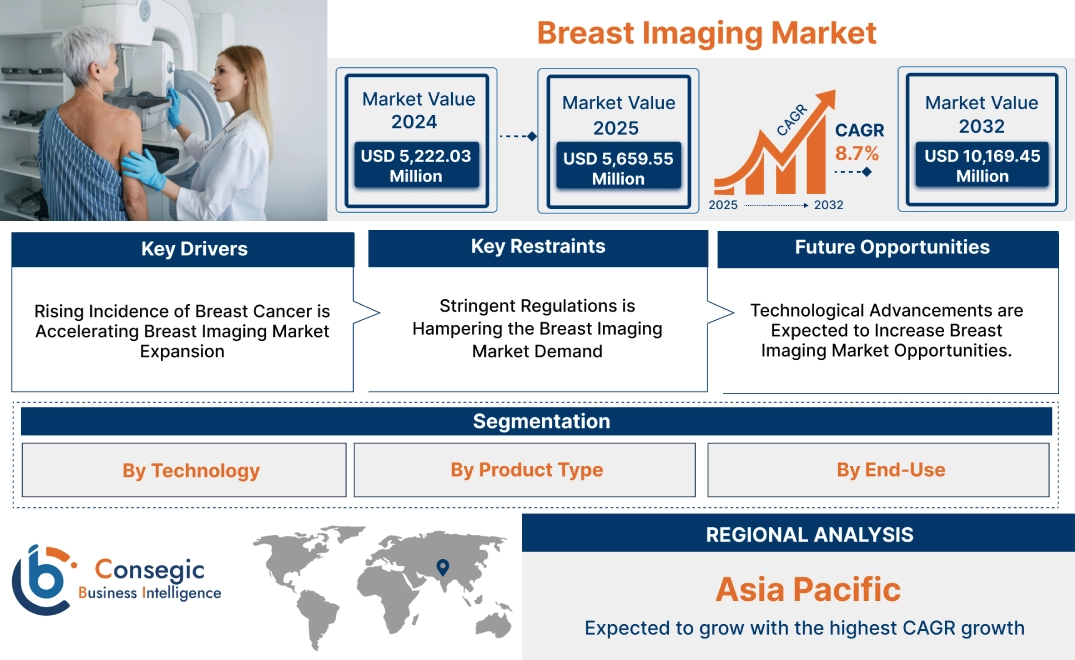
Breast Imaging Market size is growing with a CAGR of 8.7% during the forecast period (2025-2032), and the market is projected to be valued at USD 10,169.45 Million by 2032 from USD 5,222.03 Million in 2024. Additionally, the market value for the 2025 attributes to USD 5,659.55 Million.
Breast Imaging Market Scope & Overview:
Breast imaging is the use of different technologies to create pictures of breasts. These pictures are used to detect breast diseases. The primary disease includes breast cancer. This imaging is carried out with two different types. It includes ionizing and non-ionizing. Ionizing technology includes methods such as mammography, tomography, and others. These methods provide detailed images. However, they involve human exposure to radiation. Non-ionizing imaging does not use radiation. It includes methods such as ultrasound, MRI, and others. These methods are safer but do not detect all breast issues. The imaging is used for screening, diagnosis, and treatment. Screening is helpful in detecting cancer and other diseases early. Diagnosis confirms the presence of diseases. Treatment monitoring checks if therapy is working or not.
Breast Imaging Market Dynamics - (DRO) :
Key Drivers:
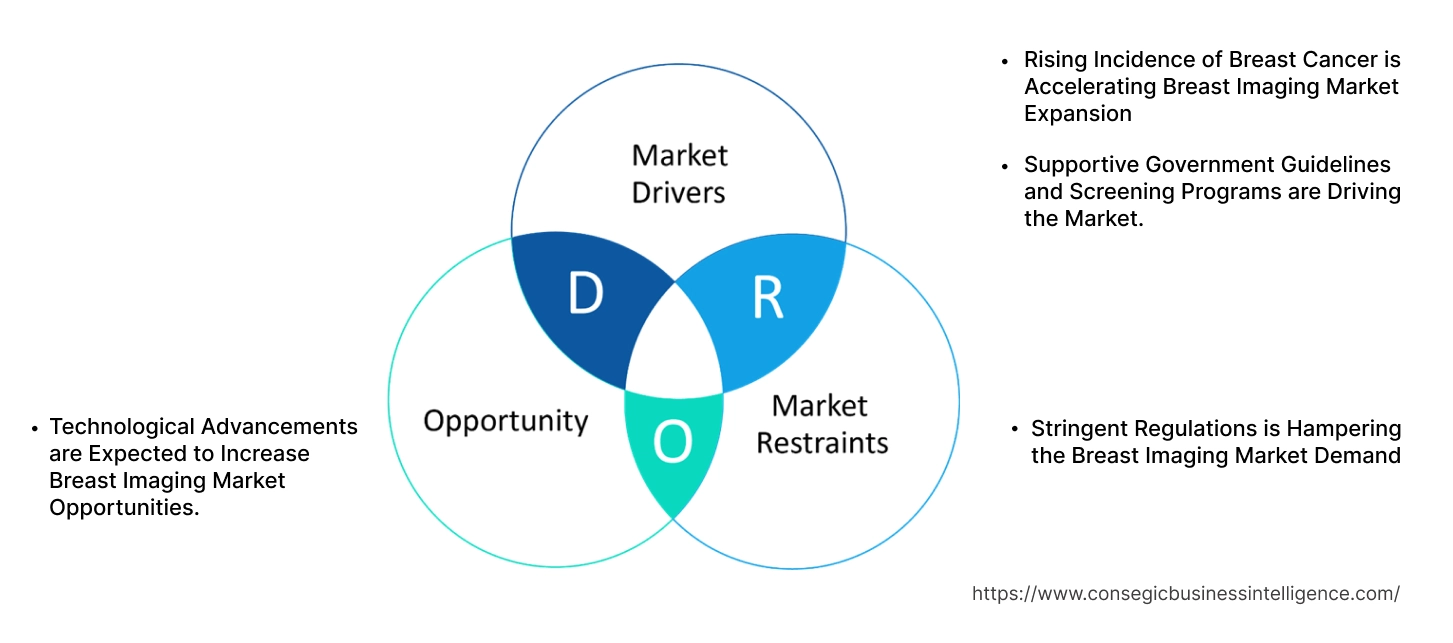
Rising Incidence of Breast Cancer is Accelerating Breast Imaging Market Expansion
Breast cancer is a disease where cells in the breast grow in an abnormal way. These abnormal cells form a tumor. Breast imaging help doctors in detecting these cancerous cells early. They use technologies such as mammograms, ultrasound, MRI, and others. Imaging also help doctors in checking if treatment is working properly or not. Globally, more people are facing lifestyle changes. Unhealthy diets, less physical activity, and genetic factors are leading to an increase in breast cancer cases.
For instance,
- According to an article published by Government of Canada, in 2024, breast cancer accounted for 25% of all new diagnosed cancer cases. This is requiring continuous imaging for diagnosis.
Overall, the rising incidences of breast cancer is significantly boosting the breast imaging market expansion.
Supportive Government Guidelines and Screening Programs are Driving the Market.
The rate of breast cancers and other diseases are increasing. This is leading to increased number of deaths in women worldwide. Governments are working to improve nations healthcare conditions. They are initiating screening programs to detect breast cancer and other diseases early. They are providing low-cost imaging tests for women. They are also framing new guidelines for medical professionals and hospitals.
For instance,
- US Preventive Services Task Force in 2024, issues new guidelines recommending screening programs from age 40, which was 50 previously. These guidelines are also enhancing detection rates among black women population. This has required increased imaging procedures.
Thus, supportive government screening programs and guidelines are accelerating the global breast imaging market growth.
Key Restraints:
Stringent Regulations is Hampering the Breast Imaging Market Demand
There are strict regulations for breast imaging devices manufacturers. These regulations are developed by different regulatory bodies. It includes FDA, EMA, ANVISA, and others. These regulations are made to check that machines are safe for use. They also keep a check for the quality of material used in it. It also evaluates that machines do not contain any harmful substances. All these requirements take a long time to get machine approval. Also, before approval manufacturers are conducting studies to prove their machines are working well. This increases the cost of development. Moreover, each country has different regulatory bodies. They have their own regulations. This creates hurdles for manufacturers who seek to commercialize internationally. Hence, the stringent regulations are hampering the breast imaging market demand.
Future Opportunities :
Technological Advancements are Expected to Increase Breast Imaging Market Opportunities.
Imaging technologies are becoming better. Manufacturers are developing machines with improved accuracy. Contrast-enhanced mammography is one example of new technology. It has the capability to detect invasive lobular carcinoma, which are considered as hard to find cancers. Proton magnetic resonance spectroscopy is another emerging technology. It helps in detailed diagnosis without radiation use. Moreover, digital breast tomosynthesis (DBT) is also changing the landscape of the market.
For instance,
- National Center for Biotechnology Information published an article in 2024, stating that DBT has more specificity in diagnosis. It catches the cancer that mammograms miss and reduces false positive results. This creates potential for manufacturers to create machines using new technologies.
Overall, technological advancements are expected to increase breast imaging market opportunities.
Breast Imaging Market Segmental Analysis :
By Technology:
Based on technology, the market is categorized into ionizing and non-ionizing.
Trends in Technology:
- AI algorithms are incorporated into imaging machines. This is improving their diagnostic capability.
- There is increasing usage of automated breast ultrasound. It captures the images of breasts automatically. It is used for women who have dense breasts.
The ionizing segment accounted for the largest market share in 2024.
- Ionizing is further categorized into full-field digital mammography (FFDM), positron emission mammography (PEM), contrast-enhanced tomography (CEM), and others
- Ionizing segment dominated the breast imaging market trends. This technology uses high-energy radiation to create images of breasts.
- The technology yield images with high sensitivity. It also detects breast cancer and other diseases with greater specificity.
- Due to its advantages, more healthcare facilities are adopting these technologies. This is helping them diagnose breast issues with more accuracy.
- For instance, MedStar Union Memorial Hospital, in 2024, started providing breast imaging service with contrast-enhanced mammography technique. This has increased the reach of imaging.
- Overall, as per the market analysis, the growing adoption of ionizing technologies is driving a segment in breast imaging market growth.
The non-ionizing segment is expected to grow at the fastest CAGR over the forecast period.
- Non-ionizing is further categorized into breast MRI, breast ultrasound, breast thermography, and others.
- Non-ionizing segment is an emerging segment. This technology offers detection of breast anomalies without using radiation.
- These techniques are beneficial for younger women with dense breasts. In them, it reduces the amount of radiation exposure.
- Moreover, these technologies are used when mammogram results are not enough to take confirm decisions regarding any disease.
- According to market analysis, there are growing concerns regarding mammography limitations. This will drive the segment. The rising prevalence of dense breast issues also supports segmental growth for the upcoming years.
By Product Type:
Based on product type, the market is categorized into medical devices, software & services, and accessories.
Trends in Product Type:
- Manufacturers are developing advanced mammography units. Their demand is increasing as they come with are combined capabilities such as tomography.
- There is growing demand for portable ultrasound devices. This will increase the imaging in remote areas.
The medical devices segment accounted for the largest market share in 2024.
- Medical devices segment dominated the breast imaging market trends. It includes devices such as mammography units, ultrasound systems, MRI scanners, and others.
- These devices create high-resolution images. These images demonstrate breast tissue in a very detailed manner. This helps doctors in evaluating breast abnormalities.
- Increased research activities are leading to the development of medical devices with improved features.
- For instance, in 2024, GE Healthcare launched a new Pristina Via mammography system for breast screening. It has new features such as low radiation dose and zero click functionality. These features are helping in improving workflow.
- According to market analysis, the development of sophisticated devices is driving segmental growth.
The software & services segment is expected to grow at the fastest CAGR over the forecast period.
- Software & services segment is emerging in the market. Software is program that is cloud-based. It is used to store and retrieve breast images.
- Services include results reading by specialists (radiologists) and training. It also includes technical maintenance.
- Cloud storage makes sharing images between hospitals and doctors easy. Services are allowing for better diagnosis. It is also allowing telemonitoring.
- Software and services make the diagnosis of breast screening faster and more accurate.
- There is a growing investment in breast screening services. Hospitals are also increasing the number of software to reduce radiologist workload. This will drive the segmental growth in the forecasted years.
By End-Use:
Based on end-use, the market is categorized into hospitals & clinics, diagnostic centers, breast care centers, and others.
Trends in the End-Use:
- Breast care centers are becoming popular choice. They are providing specialized care to patients.
- Hospitals are investing in advanced technologies. This aims to improve patient care.
The hospitals & clinics segment accounted for the largest market share of 57.66% in 2024.
- Hospitals & clinics dominated the market trends. They are the primary healthcare facilities to offer comprehensive diagnostic services.
- Hospitals & clinics have necessary infrastructure. Hospitals have separate radiology departments. They have a high level of skilled radiologists.
- They have advanced diagnostic technologies. This includes MRI, mammography, tomography, and others. This helps them with accurate diagnosis.
- Additionally, hospitals & clinics have a high volume of patients. It is because of insurance coverage and referral system. There are increasing numbers of breast cancers globally.
- For instance, according to Centers for Disease Control and Prevention, in 2021, more than 270,000 new breast cancer cases were reported in U.S. The rising cases are increasing the number of visits in hospitals and clinics for breast screening. This is driving the segment.
- Overall, as per the market analysis, rising breast cancer cases are driving segmental growth in the breast imaging industry.
The diagnostic centers segment is expected to grow at the fastest CAGR over the forecast period.
- Diagnostic centers are emerging in the market. Their importance is growing as they provide only diagnostic solutions.
- More people are visiting diagnostic centers due to their increased accessibility. They have centers both in urban and semi-urban areas.
- They are convenient for patients who do not need comprehensive care which is provided by hospitals.
- They provide imaging at lower costs. This is beneficial for routine screening and early-stage detection.
- Thus, the efforts of these centers to provide their solutions in remote areas will drive segment for the forecasted years.

Regional Analysis:
The regional segment includes North America, Europe, Asia Pacific, the Middle East and Africa, and Latin America.

In 2024, North America accounted for the highest breast imaging market share at 39.92% and was valued at USD 2,084.63 Million and is expected to reach USD 3,753.96 Million in 2032. In North America, the U.S. accounted for the breast imaging market share of 72.86% during the base year of 2024. The region is facing an aging population, lifestyle changes, and unhealthy diets are leading to an increase in breast cancer cases. This has required continuous breast screening, driving market in the region. Moreover, there are technological advancements observed in the region. 3D mammography and contrast-enhanced mammography (CEM) are improving diagnosis. Hospitals, clinics, and centers in the region are also adopting these newer technologies.
For instance,
- In 2025, GRACE Breast Imaging & Medical Spa is the first healthcare facility to install Mammomat B.brilliant. It is an advanced mammography platform. This is increasing the reach of breast screening to patients.
Overall, rising breast cancer cases, and technological advancements are driving the market demand in the region.

In Asia Pacific, the breast imaging market is experiencing the fastest growth with a CAGR of 10.7% over the forecast period. Countries such as China, India, Japan, and South Korea are building more hospitals and diagnostic centers. Governments are investing in better medical equipment and digital health. This is driving the market in the region. Many rural areas are now having access to breast screening services. This is due to mobile screening units and new healthcare policies. Moreover, many APAC countries are running awareness programs to educate women about breast cancer. Governments, NGOs, and healthcare providers are promoting mammograms and self-examinations.
Europe's breast imaging market analysis states that several trends are responsible for the progress of the market in the region. European countries are developing strong guidelines for breast cancer screening. Organizations such as the European Commission and national health agencies are recommending regular mammograms for women over 40. This is driving the market. Some countries, such as Sweden and Germany are offering low-cost mammograms. Moreover, many new breasts care centers are opening across Europe. Countries such as France, the UK, and Italy are building modern diagnostic centers. They are installing advanced mammography, ultrasound, and MRI machines. This is further supporting the market growth.
The Middle East and Africa (MEA) breast imaging market analysis states that the region is also witnessing several trends for notable surge. Healthcare industry spending in MEA is increasing. It is especially for countries such as Saudi Arabia, UAE, and South Africa. Governments are investing more money in hospitals, medical equipment, and cancer treatment. Many countries are purchasing modern breast screening machines. This includes 3D mammography and MRI to improve cancer detection. Private hospitals are also expanding their technology. This is driving the market. Moreover, governments and health organizations in MEA are launching awareness campaigns. This is to educate women about importance of breast screening.
Latin America's breast imaging market size is also emerging. Telehealth is growing fast in Latin America, especially in countries such as Brazil, Mexico, and Argentina. Many women in rural areas do not have access to breast cancer screening. Now, telehealth services is allowing for remote consultations with doctors. Patients are sending their breast screening scans online. Specialists analyze them without the need for travel. This is driving the market. Moreover, many hospitals, governments, and private companies in Latin America are working together to improve breast cancer screening. International organizations are partnering with local healthcare to bring AI-powered imaging software to improve diagnosis.
Top Key Players and Market Share Insights:
The Breast Imaging market is highly competitive with major players providing products to the national and international markets. Key players are adopting several strategies in research and development (R&D) and product innovation to hold a strong position in the global Breast Imaging market. Key players in The Breast Imaging industry include-
- GE Healthcare (U.S.)
- Hologic, Inc. (U.S.)
- Allengers (India)
- Dilon Technologies, Inc. (U.S.)
- Planmed Oy (Finland)
- Siemens Healthineers (Germany)
- Koninklijke Philips N.V. (Netherlands)
- FUJIFILM Holdings Corporation (Japan)
- Canon, Inc. (Japan)
- Aurora Healthcare (U.S.)
Recent Industry Developments :
Product Launch:
- In November 2024, GE HealthCare has launched new mammography unit Pristina Via mammography system. It is designed to enhance the breast screening experience for both patients and technologists by offering advanced features that streamline workflows, minimize repetitive tasks, and prioritize patient comfort, including zero-click acquisition, and no wait time between exposures.
- In September 2024, Siemens Healthineers received approval for its Mammomat B.brilliant mammography system. It produces 3D images of the breast in as little as five seconds. It's designed to help radiologists make confident diagnoses and reduce patient stress.
Breast Imaging Market Report Insights :
| Report Attributes | Report Details |
| Study Timeline | 2019-2032 |
| Market Size in 2032 | USD 10,169.45 Million |
| CAGR (2025-2032) | 8.7% |
| By Technology |
|
| By Product Type |
|
| By End-Use |
|
| By Region |
|
| Key Players |
|
| North America | U.S. Canada Mexico |
| Europe | U.K. Germany France Spain Italy Russia Benelux Rest of Europe |
| APAC | China South Korea Japan India Australia ASEAN Rest of Asia-Pacific |
| Middle East and Africa | GCC Turkey South Africa Rest of MEA |
| LATAM | Brazil Argentina Chile Rest of LATAM |
| Report Coverage |
|
Key Questions Answered in the Report
How big is the Breast Imaging market? −
In 2024, the Breast Imaging market is USD 5,222.03 Million.
Which is the fastest-growing region in the Breast Imaging market? +
Asia Pacific is the fastest-growing region in the Breast Imaging market.
What specific segmentation details are covered in the Breast Imaging market? +
Technology, Product Type, and End-Use segmentation details are covered in the Breast Imaging market
Who are the major players in the Breast Imaging market? +
GE Healthcare (U.S.), Hologic, Inc. (U.S.), Siemens Healthineers (Germany), Koninklijke Philips N.V. (Netherlands), FUJIFILM Holdings Corporation (Japan), and Canon, Inc. (Japan) are some major players in the market.
Overview
Reputation & Certifications


Our Services
- Market Intelligence & Forecasting
- Custom Research Solutions
- Market Entry Strategy
- Competitive Intelligence
- Customer Insights
- Industry Innovation Analysis
- Investment Advisory