Jump to Content
Brewing Enzymes Market - Size, Share, Industry Trends, and Forecasts (2025-2032)
Brewing Enzymes Market Size:
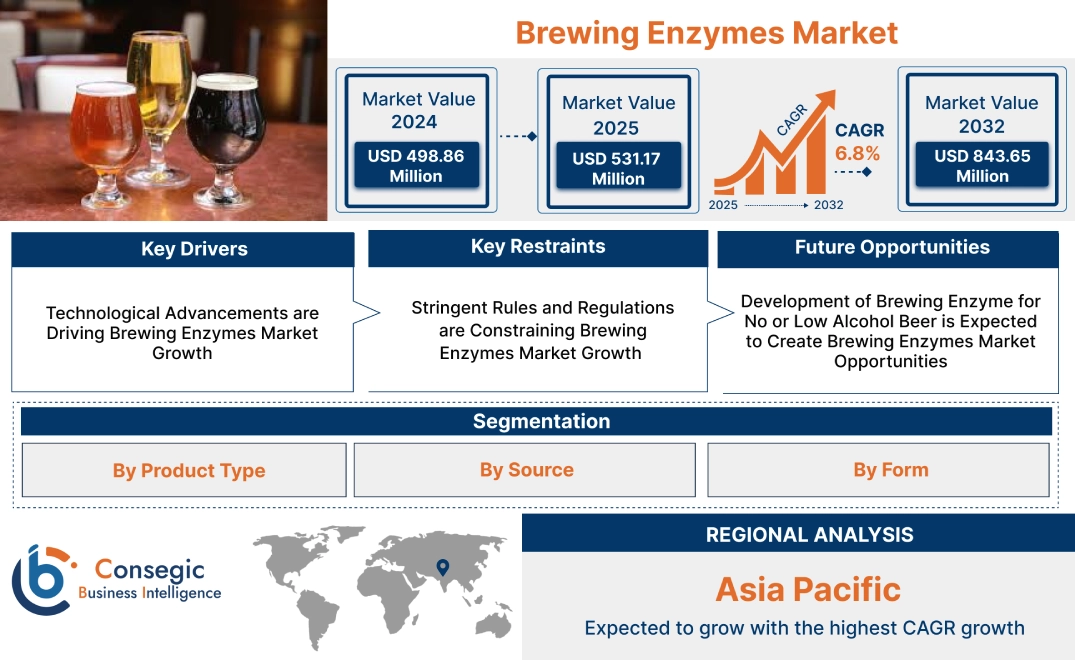
The brewing enzymes market size is growing with a CAGR of 6.8% during the forecast period (2025-2032), and the market is projected to be valued at USD 843.65 Million by 2032 from USD 498.86 Million in 2024. Additionally, the market value for the 2025 attributes to USD 531.17 Million.
Brewing Enzymes Market Scope & Overview:
Brewing enzymes are biological catalysts used in beer production to enhance fermentation, efficiency and beer quality. These enzymes break down starches, proteins, and fibers into fermentable sugar and other essential compounds. Types of brewing enzymes include amylase, protease, beta glucanase, and others. These enzymes are typically derived from microbial and plant sources. Further, microbial sources include bacteria, fungi and yeasts while plant sources include barley, wheat, and oats. Brewing enzymes are available in both liquid and dry form. With the growing beer production and rising consumer preference towards specialty beers, use of these enzymes is growing further, driving market growth.
Brewing Enzymes Market Dynamics - (DRO) :
Key Drivers:
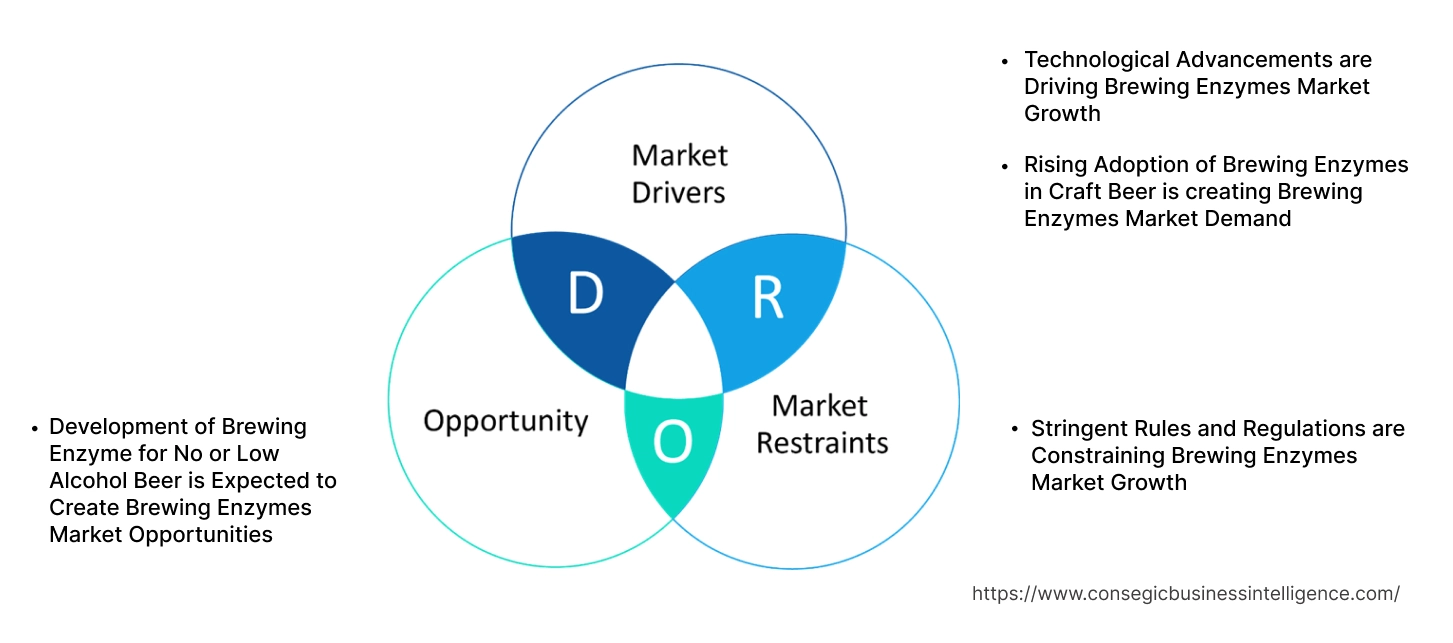
Technological Advancements are Driving Brewing Enzymes Market Growth
Technological advancements, particularly in malt extraction, are increasing efficiency and fermentation ability of brewing enzymes. These advancements are increasing the applicability of enzymes for specific brewing needs, such as improving wort filtration, increasing sugar yields, or enhancing flavor development during brewing process. The advances in extraction processes are also proving beneficial to manufacturers.
- In 2024, according to article published in Infinita Biotech Private Limited, advancements in malt extraction are enabling the identification and engineering of new brewing enzymes. They have enhanced properties such as improved flavors and increased efficiency. They are reducing environmental impact also.
Thus, technological advancements are leading to brewing enzymes market demand to enhance flavor and aroma of the beer.
Rising Adoption of Brewing Enzymes in Craft Beer is creating Brewing Enzymes Market Demand
Craft beer is beer manufactured by craft breweries, which typically produce smaller amounts of beer than larger breweries. The brewing enzymes are used in the craft beer to enhance efficiency, flavor and production of diverse beer styles. The demand for craft beer is growing due to unique flavors, higher-quality ingredients and low-calorie content further driving the market.
- In 2023, according to Brewer Association, sales of craft beer is increased by 3% in the United States as compared to the year 2022. The brewing enzymes are used in the craft beer to ensure better fermentation, clarity, and mouthfeel.
Hence, rising adoption of brewing enzymes in craft beer is leading to brewing enzymes market expansion thorough enhanced efficiency and production of diverse beer styles.
Key Restraints:
Stringent Rules and Regulations are Constraining Brewing Enzymes Market Growth
Rules and regulations are a major restraint in the market, impacting manufacturers and limiting product innovations. Government bodies such as United States Food and Drug Administration, European Food Safety Authority, and United States Department of Agriculture implement stringent rules. It includes complex approval processes, labelling requirements, and quality standards in the brewing enzyme production. Enzyme manufacturers must conduct toxicology studies, allergen assessments and stability tests before launching products, leading to increased research and development cost. Additionally, varying regulations across different regions further requires high investment cost in compliance resources. Thus, stringent rules and regulations are restraining the market growth, due to regulatory standards and high cost.
Future Opportunities :
Development of Brewing Enzyme for No or Low Alcohol Beer is Expected to Create Brewing Enzymes Market Opportunities
No or low alcohol beer is a beer that contains 0.05% or less alcohol and has less amount of carbohydrates and calories as compared to the regular alcoholic brews. The enzymes are used during the malting process of brewing to enhance taste and flavor in the no or low alcohol beer. Due to increasing health consciousness consumers are preferring no or low alcohol beer and to cater to rising demand, companies are investing in the development of brewing enzymes for this beer.
- In 2024, International Flavors & Fragrances Inc. launched DIAZYME NOLO enzyme. It is designed to enhance the taste, efficiency and production capacity of no- and low-alcohol beer. Further, DIAZYME NOLO enzyme is developed with low operational costs and reduced environmental impact.
Thus, the development of brewing enzymes for no or low alcohol beer is expected to create brewing enzymes market opportunities though low cost and less energy consumption.
Brewing Enzymes Market Segmental Analysis :
By Product Type:
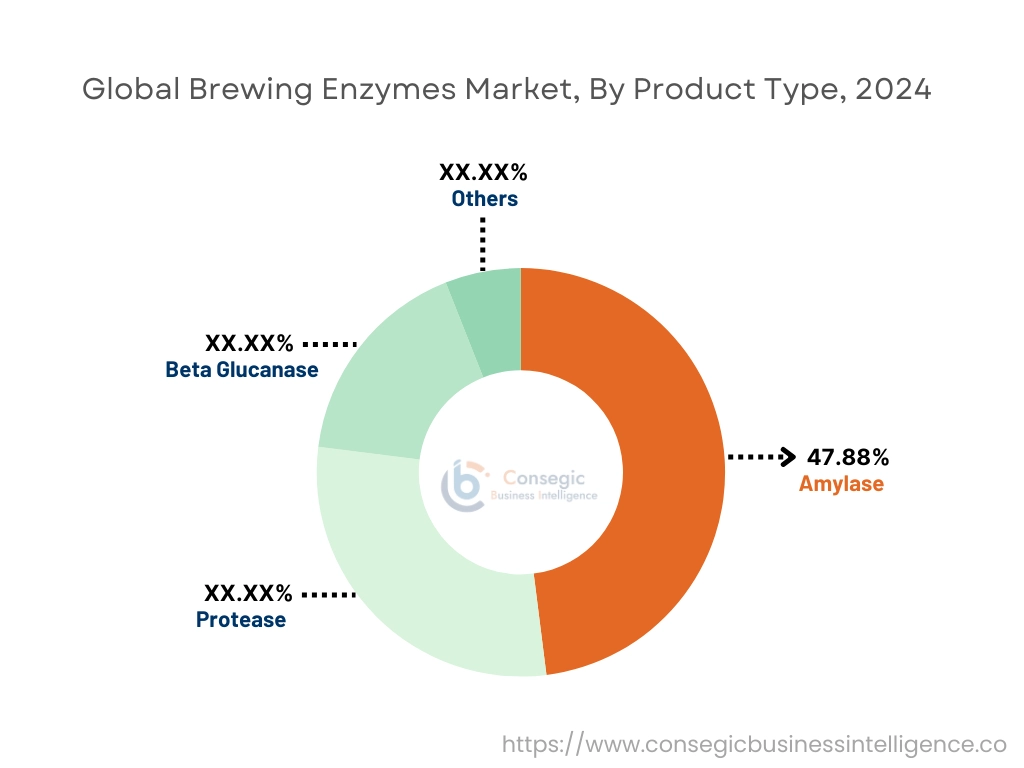
Based on product type, the market is categorized into amylase, protease, beta glucanase, and others.
Trends in Product Type:
- According to brewing enzymes market trends, alpha and beta amylase are essential for hydrolysis of starch into sugars during beer production.
- Beta glucanase is being preferred to reduce saturation time and manufacturing cost during brewing process as per market trends.
The amylase segment accounted for the largest market share of 47.88% in the year 2024.
- An amylase is an enzyme that catalyzes the hydrolysis of starch into sugars.
- Amylase particularly, alpha and beta-amylase are used during the brewing process to convert starch into soluble sugar.
- It is essential in beer production to enhance consistency, flavor and aroma.
- Further, growing consumption of beer is contributing to the use of amylase in the market.
- For instance, in 2022, according to Kirin Holdings, global consumption of beer is increased by 2.9% as compared to the year 2021. The amylase enzyme is necessary in beer for hydrolysis of starch into soluble sugar. It further increases fermentability in the beer by efficiently breaking down malts.
- Thus, amylases are extensively utilized in the market to enhance fermentation and consistency.
The beta glucanase segment is expected to grow at the fastest CAGR over the forecast period.
- Beta glucanase is an enzyme that hydrolyzes beta glucans and found in cereals, bacteria, and fungi.
- It is being used in the brewing process to degrade non starch polysaccharides such as beta glucanase into fermentable sugar.
- Beta glucanase enhances the quality of beer, reduces the saturation time and manufacturing cost of raw materials in the brewing process.
- The use of beta glucanase is growing due to reduce environmental impact and low operational cost.
- Beta glucanase also controls viscosity and is used for clarity in the production of lighter beer.
- Therefore, use of beta glucanase is growing in the market to reduce saturation time and manufacturing cost.
By Source:
Based on source, the market is categorized into microbial and plant.
Trends in Source:
- As per brewing enzymes market trends, microbial source is widely used for better stability and flavor control.
- Due to growing focus towards sustainability, plant-based brewing enzymes are preferred to reduce use of synthetic additive in brewing as per market trends.
The microbial segment accounted for the largest market share in the year 2024.
- Brewing enzymes are derived from microbial sources such as bacteria, fungi and yeasts.
- These enzymes derived through microbial source help to overcome issues such as flavor control, beer stability, and the overall expense for production in the brewing.
- Microbial brewing enzymes are essential in the brewing process to break starch into fermentable sugars.
- These enzymes also improve foam stability and reduce haze, thereby enhancing beer quality.
- Further, as the demand for low carbohydrate and premium beers is rising, the use of microbial-based brewing enzymes is increasing to improve beer quality.
- Hence, microbial sources are extensively utilized in the market for better stability and reduction in haze in the beer.
The plant segment is expected to grow at the fastest CAGR over the forecast period.
- Plant-based brewing enzymes are derived from plants such as barley, wheat, and oats.
- These enzymes are being preferred for the sustainability which reduces use of additional synthetic additive during brewing process.
- Plant-based brewing enzymes are highly utilized by the craft breweries to balance mouthfeel while maintaining brewing process efficiency.
- Further, the growing number of craft breweries is contributing to the use of plant-based brewing enzymes.
- For instance, in 2022, according to Brewers of Europe, the number of craft breweries in Europe is increased by 19% as compared to the year 2019. Plant-based brewing enzymes are used by craft breweries to improve beer clarity and to reduce operational cost.
- Hence, the use of plant-based brewing enzymes is growing in beer production to reduce environmental impact and incorporating sustainability.
By Form:
Based on form, the market is categorized into liquid and dry.
Trends in Form:
- As per market trends, brewing enzymes in liquid form are used due to high solubility and precise dosing.
- Due to improvement in filtration and wort viscosity, use of dry form is growing in the market as per market trends.
The liquid segment accounted for the largest market share in the year 2024.
- Brewing enzymes in liquid form are extensively utilized due to their high solubility, ease of handling and better dispersion during brewing process.
- Liquid forms allow for precise dosing, reduce waste and ensure consistent beer production.
- Demand for amylases and protease enzymes in liquid form is rising due to which companies are investing in the liquid form of these enzymes.
- For instance, in 2021, Brenntag launched Perforzyme enzyme product line in North America. It includes amylase and protease in liquid form. These enzymes enhance beer texture and taste during brewing process.
- Hence, liquid form is widely used in the market due to high solubility and better dispersion during brewing process.
The dry segment is expected to grow at the fastest CAGR over the forecast period.
- Brewing enzymes in dry form are preferred due to their longer shelf life, ease of storage, and enhanced filtration.
- Dry form reduces wort viscosity and enhances filtration efficiency in the beer during brewing process.
- It works by breaking down malt sugar into low carbohydrates and also extends fermentation time in beer production.
- The growth of gluten-free and high-attenuation beers has boosted the adoption of Brewing enzymes in dry form due to their ability of improving beer clarity.
- Additionally, these enzymes are cost effective and maintain high stability during transportation, which enhances its use in the market.
- Thus, use of dry form is growing in the market due to better fermentation and filtration in the beer production.
Regional Analysis:
The regional segment includes North America, Europe, Asia Pacific, Middle East & Africa, and Latin America.
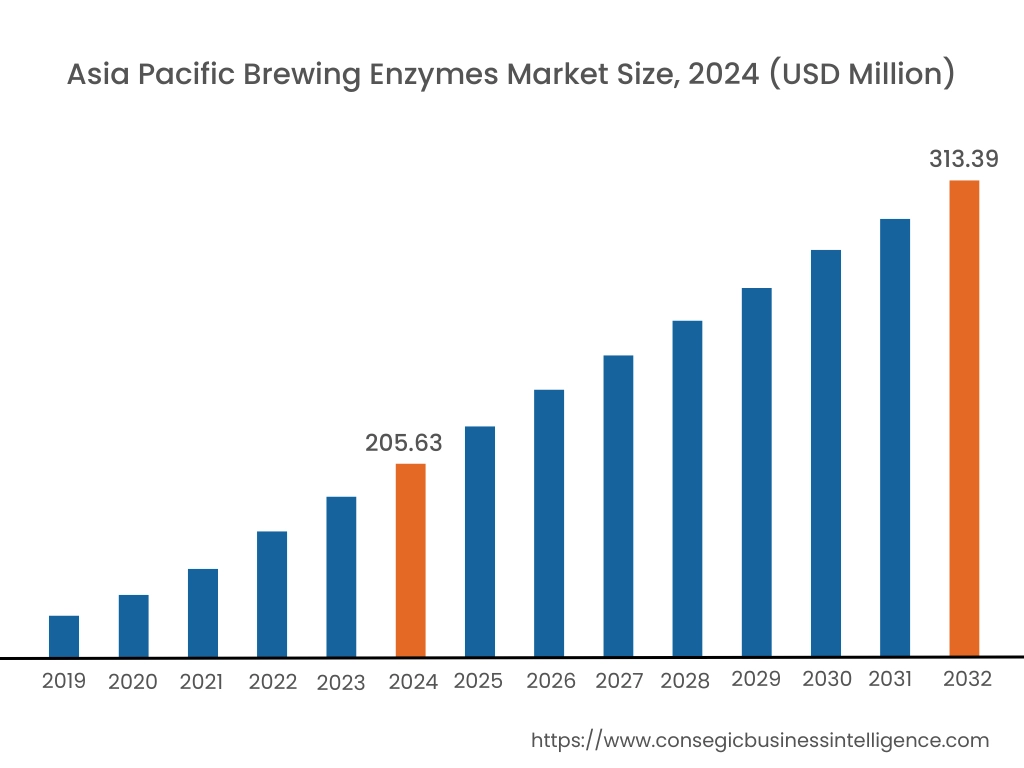
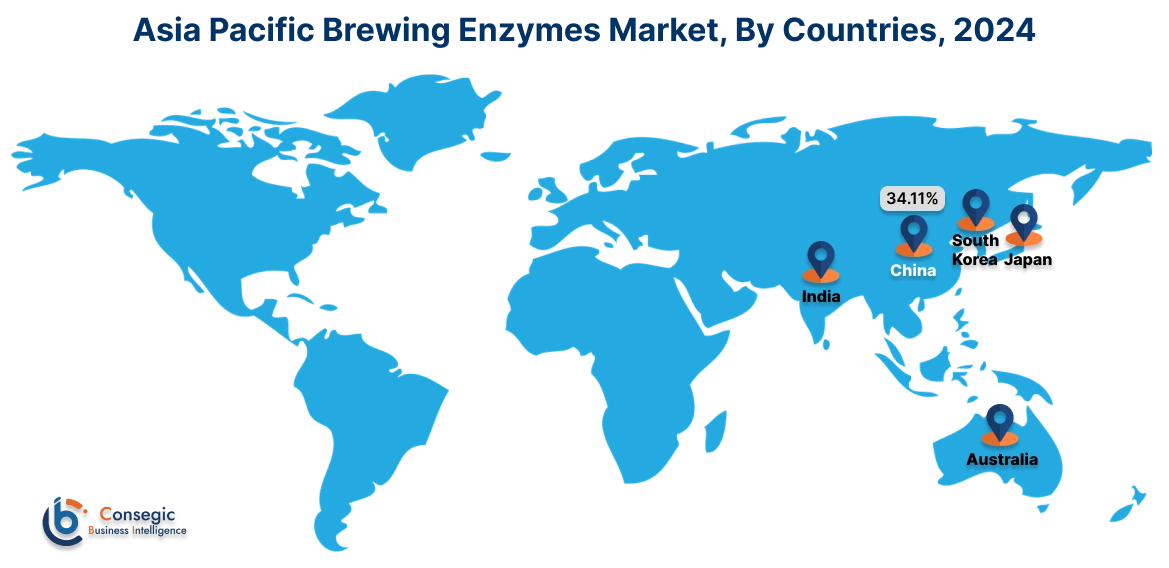
In 2024, Asia-Pacific accounted for the highest market share at 41.22% and was valued at USD 205.63 Million, and is expected to reach USD 313.39 Million in 2032. In Asia-Pacific, the China accounted for the highest market share of 34.11% during the base year of 2024.
The brewing enzymes market share of Asia Pacific region is major due to growing manufacturing sector and increasing beer production. Countries such as China, India, and Japan are major contributors in the market with large-scale production of beer. Additionally, growing investment in the production of beer is fueling demand in the market.
- In 2022, Ab InBev announced investment of USD 50 million to expand production capacity of beer production in India. It is driving the adoption of brewing enzymes to enhance the quality of the beer during brewing process. Further, these enzymes convert starches into fermentable sugar thereby improving texture and taste of the beer.
Thus, Asia Pacific is leading in the market through large scale manufacturing and expansion of local craft breweries as per analysis.
North America is expected to witness the fastest CAGR of 9.4% over the forecast period of 2025-2032. According to brewing enzymes market analysis, North America is expanding in the market driven by technological advancements. Innovations in enzyme engineering and fermentation technology have enabled breweries to optimize starch conversion, improve filtration, and reduce production time. Additionally, development of high-performance brewing enzymes increases the adjunct level in their beer production, further driving the brewing enzymes market expansion in the region. Hence, brewing enzymes market share of North America is growing due to technological advancements and advanced fermentation technologies as per market analysis.
As per brewing enzymes market analysis, the Europe region is growing rapidly in the market driven by stringent environmental regulations and strong focus on sustainability. Manufacturers are widely utilizing plant-based enzymes during brewing process for the production of beer. Countries such as Germany, United Kingdom, and Belgium are major contributors due to stringent European Union sustainability policies. Additionally, consumer preference towards organic and clean-label beers is driving the adoption of brewing enzymes in the region.
The Middle East and Africa region is experiencing gradual growth in the market, driven by rising adoption of specialty and premium beers. Consumers particularly in South Africa, UAE and Dubai are shifting towards craft and premium beers. It is driving demand for specialized enzymes such as protease, amylase, and beta-glucanase. Premium beer brands in the region are using these enzymes to improve fermentation and mouthfeel, further driving the market as per analysis.
As per analysis, the market in Latin America is driven by rising disposable income and government support for local breweries. Consumers in the region are shifting towards premium craft increasing demand for brewing enzymes to enhance flavor, and efficiency. Governments in countries such as Brazil, Mexico and Argentina are supporting brewing sector though tax incentives and relaxed regulations for microbreweries, further boosting the market growth in the region.
Top Key Players and Market Share Insights:
The brewing enzymes industry is highly competitive with major players providing products to the national and international markets. Key players are adopting several strategies in research and development (R&D) and product innovation to hold a strong position in the global brewing enzymes market. Key players in brewing enzymes industry include-
- International Flavors & Fragrances Inc. (United States)
- Novozymes A/S (Denmark)
- Brenntag (Germany)
- Associated British Foods (United Kingdom)
- Enzyme Development Corporation (United States)
- Infinita Biotech Private Limited (India)
- Kerry Group plc. (Ireland)
- DSM (Netherlands)
- Dupont (United States)
- Amano Enzyme (Japan)
Recent Industry Developments :
Launches:
- In 2023, Creative Enzymes launched brewing enzyme in the United States. This enzyme improves fermentation in the beer by increasing the adjunct level. It results in enhanced physical stability, superior chill-proof qualities and greater clarity during brewing process.
- In 2023, Weisbiotech introduced two new variants of brewing enzymes named as Deltabrew Lautermax and Deltabrew Attenumax in Europe. It reduces fermentation time, improves levels of attenuation and reduces residual carbohydratess during brewing process.
Brewing Enzymes Market Report Insights :
| Report Attributes | Report Details |
| Study Timeline | 2019-2032 |
| Market Size in 2032 | USD 843.65 Million |
| CAGR (2025-2032) | 6.8% |
| By Product Type |
|
| By Source |
|
| By Form |
|
| By Region |
|
| Key Players |
|
| North America | U.S. Canada Mexico |
| Europe | U.K. Germany France Spain Italy Russia Benelux Rest of Europe |
| APAC | China South Korea Japan India Australia ASEAN Rest of Asia-Pacific |
| Middle East and Africa | GCC Turkey South Africa Rest of MEA |
| LATAM | Brazil Argentina Chile Rest of LATAM |
| Report Coverage |
|
Key Questions Answered in the Report
How big is the brewing enzymes market? −
In 2024, the brewing enzymes market is USD 498.86 million.
Which is the fastest-growing region in the brewing enzymes market? +
North America is the fastest-growing region in the brewing enzymes market.
What specific segmentation details are covered in the brewing enzymes market? +
Product type, source, and form are covered in the brewing enzymes market.
Who are the major players in the brewing enzymes market? +
Novozymes A/S (Denmark), Infinita Biotech Private Limited (India), and Kerry Group plc. (Ireland) are some of the major players in the market.
Overview
Reputation & Certifications


Our Services
- Market Intelligence & Forecasting
- Custom Research Solutions
- Market Entry Strategy
- Competitive Intelligence
- Customer Insights
- Industry Innovation Analysis
- Investment Advisory