Jump to Content
Brisket Market - Size, Share, Industry Trends, and Forecasts (2025-2032)
Brisket Market Size:
The brisket market size is growing with a CAGR of 4.2% during the forecast period (2025-2032), and the market is projected to be valued at USD 20,511.93 Million by 2032 from USD 14,809.60 Million in 2024. Additionally, the market value for 2025 attributes to USD 15,379.16 Million.
Brisket Market Scope & Overview:
Brisket is a cut of beef taken from the lower chest or breast section of cattle. It is tough, rich in connective tissue, which requires slow cooking methods such as smoking, braising, and roasting. Brisket is either conventional or organic. Further, conventional is sourced from cattle raised with traditional feed while organic is sourced from cattle which is raised without synthetic hormones. Brisket is largely distributed through supermarkets & hypermarkets, specialty stores, e-commerce, and others. It is widely used in both home cooking and restaurants for barbeque meal. Due to its rich flavor and versatility, brisket is preferred for a healthy and nutritional diet, further driving the market growth.

Brisket Market Dynamics - (DRO) :
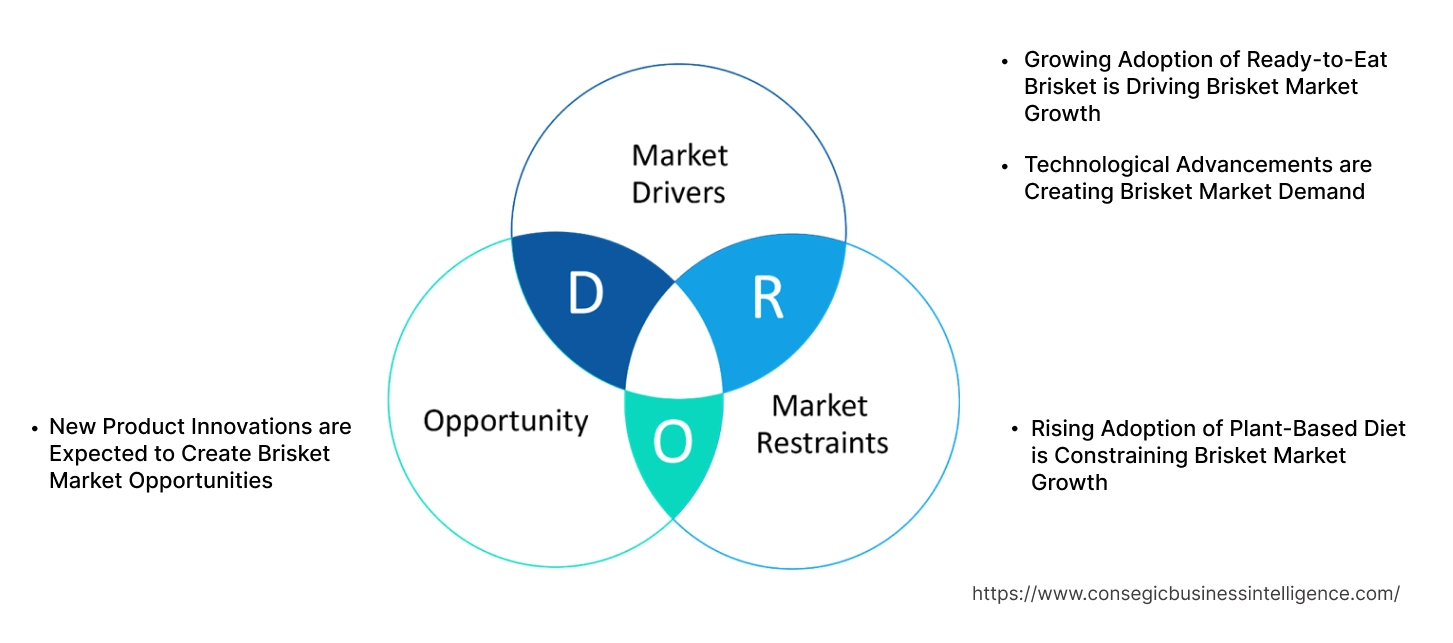
Key Drivers:
Growing Adoption of Ready-to-Eat Brisket is Driving Brisket Market Growth
The ready-to-eat brisket format is fully cooked and is packaged for immediate consumption without any further preparation. It is sold pre-sliced, shredded, or as part of a prepared meal. The adoption of ready-to-eat brisket is growing due to busy lifestyle, urbanization, and rising disposable income. To cater this, manufacturers are launching new products.
- In 2021, Sadler’s Smokehouse introduced ready-to-eat brisket in United States. This brisket is pit-smoked for 16-18 hours over slow-smoldering wood coals. Further, it is available without artificial ingredients promoting healthy diet option.
Thus, the growing adoption of ready-to-eat brisket is leading to brisket market demand due to expanding urbanization and busy lifestyles.
Technological Advancements are Creating Brisket Market Demand
Technological advancements are changing the landscape of the market. Due to hectic work schedules people prefer food options that are stored for a longer period of time. New methods such as advanced vacuum sealed packaging are providing more freshness to the products. Also, manufacturers are launching packaging products with a modified atmosphere method as it allows for packaging with extended shelf life.
- In 2023, Cirkla launched moulded fiber modified atmosphere packaging trays. These trays are highly utilized for the packaging of brisket. Additionally, these trays are made up of renewable plant fibers incorporating sustainability into the market.
Thus, advancements in modified atmosphere packaging trays are leading to brisket market expansion by extending product freshness and shelf life.
Key Restraints:
Rising Adoption of Plant-Based Diet is Constraining Brisket Market Growth
A plant-based diet is a diet consisting mostly or entirely of plant-based foods including vegetables, fruits, whole grains, and other products. Consumers prefer plant-based diet due to rising concerns about cholesterol, heart disease, and sustainability. The rise of veganism, flexitarian diets and plant-based protein options is reducing reliance on traditional meat products including brisket. Additionally, food technology advancements have led to the development of plant-based food products which have the same taste, texture and protein content as that of meat products. Thus, rising adoption of plant-based diet is constraining brisket market expansion due to rising concerns about sustainability and health issues.
Future Opportunities :
New Product Innovations are Expected to Create Brisket Market Opportunities
Product innovation within the market are creating potential for the market as they cater to evolving consumer needs and preferences. Marinated briskets are developed which are soaked in a flavorful liquid mixture. Brisket based snacks such as jerky, bite-sized brisket pieces, brisket-filled pastries, or even brisket-topped chips or crackers are manufactured. To cater to growing health consciousness manufacturers are developing healthy meal bowl as well.
- In 2024, Dunkin introduced brisket scramble bowl across its outlets in United States. This bowl features crisp hash browns with a blend of tender shredded brisket, scrambled eggs, smoked cheddar cheese, and other ingredients. Busy lifestyle and need for healthy breakfast will further boost the adoption of brisket scrambled bowl.
Thus, to cater rising demand, new product innovations are expected to create brisket market opportunities due to their delicious and flavorful content.
Brisket Market Segmental Analysis :
By Nature:
Based on nature, the market is categorized into conventional and organic.
Trends in Nature:
- According to brisket market trends, conventional brisket is largely used in barbeque products due to rich flavor and tender texture.
- Adoption of organic brisket is growing due to sustainability and chemical-free options as per market trends.
The conventional segment accounted for the largest market share in the year 2024.
- Conventional brisket refers to the beef brisket sourced from standard cattle farming practices, typically raised with traditional feed and care methods.
- It is highly consumed by customers due to its affordability, widespread availability, and strong preference.
- Conventional brisket is available widely in barbeque restaurants, retail stores and food services outlets.
- It is utilized in barbeque products due to its rich flavor and tender texture by food service manufacturers.
- For instance, in 2023, Thousand Hills Lifetime Grazed launched fully cooked barbeque products. It includes barbeque shredded conventional beef brisket and pulled pork.
- Hence, conventional brisket is highly consumed due to its rich flavor content and widespread availability.
The organic segment is expected to grow at the fastest CAGR over the forecast period.
- Organic brisket refers to the beef brisket sourced from cattle which is raised without synthetic hormones, antibiotics, and genetically modified feed.
- The demand for organic brisket is growing due to increasing consumer preference for healthier, chemical-free and ethically sourced meat products.
- Additionally, growing awareness about sustainable farming practices and animal welfare is further fueling this demand.
- Retailers and food series outlets are expanding their organic brisket offering, including fresh cuts, smoked brisket and ready to eat organic brisket meals.
- Hence, preference for organic brisket is growing due to growing sustainable farming practices and increasing consumer preference for chemical-free meat products.
By Type:
Based on type, the market is categorized into fresh and frozen.
Trends in Type:
- As per brisket market trends, fresh briskets are used widely due to high quality and minimal processing.
- Consumer preference for fresh brisket is growing due to longer shelf life as per market trends.
The fresh segment accounted for the largest market share in the year 2024.
- Fresh brisket refers to an uncooked, non-processed cut of beef source directly from the chest section of the cattle.
- It is typically sold raw from providers to customers in chilled form with minimal food processing.
- This type of brisket is highly consumed due to its versatility in various cooking methods such as slow roasting, smoking, braising or grilling.
- Use of fresh brisket is also expanding in barbeque restaurants, home cooking, and gourmet food services.
- Further, consumer preference for high-quality, minimal processed meats is driving the adoption of fresh meat products.
- Hence, fresh brisket is widely used in the market due to high quality and minimal processing.
The frozen segment is expected to grow at the fastest CAGR over the forecast period.
- Frozen brisket refers to the brisket that is vacuum-sealed and stored at low temperatures to preserve its freshness, taste, and shelf-life.
- It is commonly used in restaurants and meat preparation outlets due to convenience and longer-shelf life.
- Further, preferences for frozen brisket are high, which has led to the expansion of this product offering across the retail outlets.
- For instance, in 2022, Dickey’s Barbecue Pit expands the offering of its frozen beef brisket across the Walmart. This results in a wide supply of the products among the customers.
- Hence, the use of frozen brisket is growing among consumers due to convenience and longer-shelf life.
By Distribution Channel:
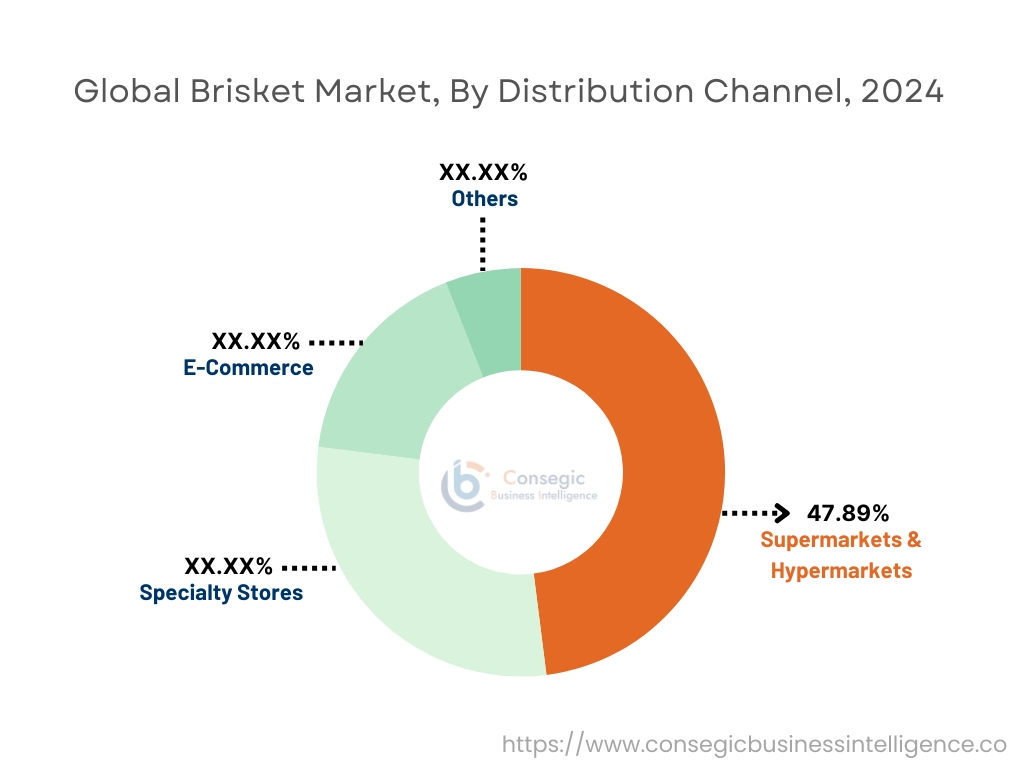
Based on distribution channel, the market is categorized into supermarkets & hypermarkets, specialty stores, e-commerce, and others.
Trends in Distribution Channel:
- Brisket is distributed widely through hypermarkets and supermarkets through an effective supply chain.
- Customers prefer e-commerce for the purchase of meat products due to convenience and easy accessibility as per market trends.
The supermarkets and hypermarkets segment accounted for the largest market share of 47.89% in the year 2024.
- Supermarkets and hypermarkets are large retail stores offering a wide variety of food, beverages and other products.
- Brisket is widely distributed through supermarkets and hypermarkets to the customers such restaurants, food service owners, and professional chefs.
- These retail stores are widely used in the urban and suburban areas due to their accessibility, product variety and convenience.
- Many hypermarkets and supermarkets stock meat products catering to the rising preference for heathier diet.
- Their supply chain networks ensure consistent availability of products and offer both conventional and organic brisket.
- Thus, briskets are widely distributed through supermarkets and hypermarkets to the customers supported by product variety and customer convenience.
The e-commerce segment is expected to grow at the fastest CAGR over the forecast period.
- E-commerce refers to the buying and selling of goods and services online through digital platforms and marketplaces.
- Adoption of e-commerce is growing in the distribution of brisket due to wider reach and customer convenience.
- Further, busy lifestyle has led to the widespread adoption of e-commerce to purchase products of various brands with detailed description and user reviews.
- For instance, in 2024, according to India Brand Equity Foundation, e-commerce sales in India represented a growth of 12% as compared to the year 2023. This includes brisket which are distributed through e-commerce to restaurant & foodservice providers, home chefs, and meal preparation brands.
- Thus, the adoption of e-commerce is growing in the market due to wider customer reach and detailed product descriptions.
Regional Analysis:
The regional segment includes North America, Europe, Asia Pacific, Middle East & Africa, and Latin America.
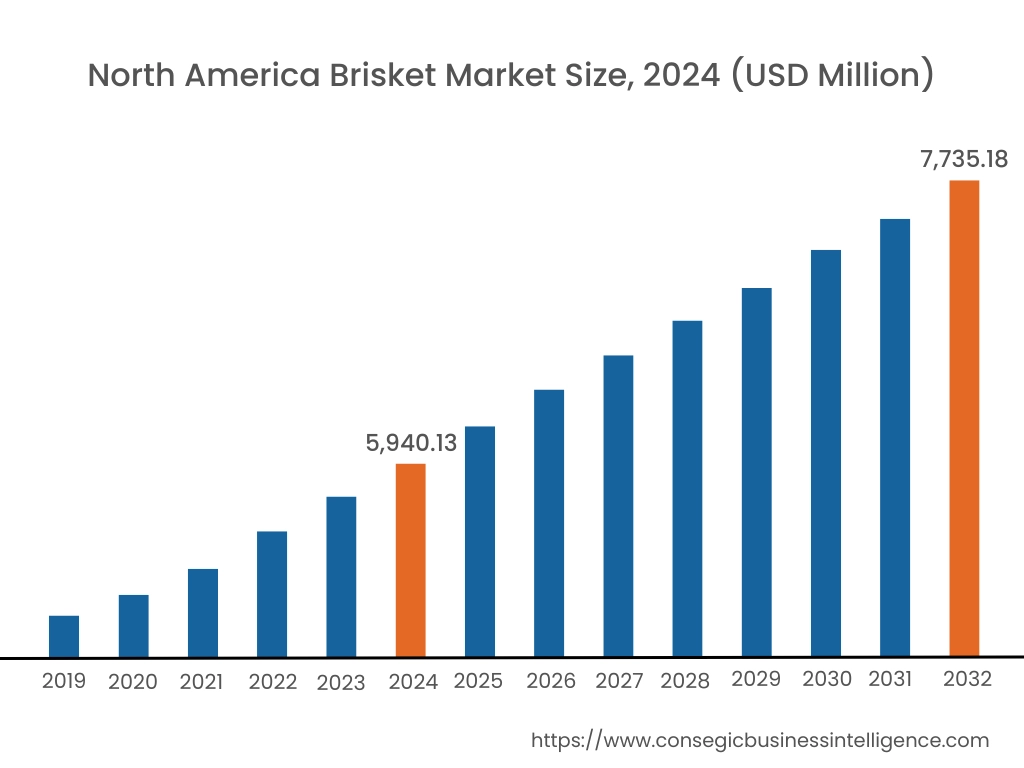
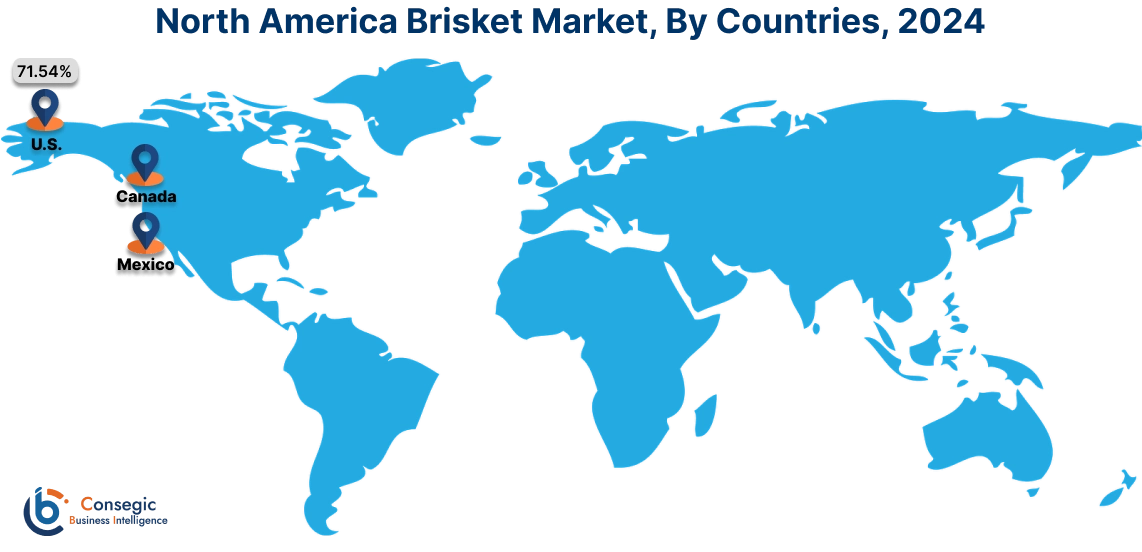
In 2024, North America accounted for the highest market share at 40.11% and was valued at USD 5,940.13 Million and is expected to reach USD 7,735.18 Million in 2032. In North America, United States accounted for the highest market share of 71.54% during the base year of 2024.The brisket market share of the North America region is major due to technological advancements. Technological advancements in vacuum sealing and modified atmosphere packaging have enhanced the shelf life of brisket. Further, companies are investing in the advanced vacuum sealing system to extend product freshness and shelf life.
- In 2024, FoodSaver launched handheld vacuum sealing system in United States. It contains countertop vacuum sealer with cordless handheld vacuum. By using this vacuum sealer, brisket packaging retains its product freshness over a longer period of time as compared to the ordinary storage methods. Further, this vacuum sealing system prevents freezer burn in the packaging.
Thus, North America is leading in the market due to technological advancements and enhanced packaging solutions as per market analysis.
Asia Pacific is expected to witness the fastest CAGR of 5.7% over the forecast period of 2025-2032. According to brisket market analysis, the Asia Pacific region is growing rapidly driven by growing consumer preference towards high protein diets. Countries such as China, India, Japan, and South Korea are major contributors in the market due to growing adoption of slow-cooked and smoked brisket. The proliferation of international food chains has further introduced various meat cooking recipes including brisket for health-conscious consumers. Hence, the brisket market share of Asia Pacific is experiencing rapid growth though rising consumer preference towards high-protein meat diets as per analysis.
As per the brisket market analysis, the Europe region is growing rapidly in the market driven by stringent environmental regulations and strong focus on sustainability. Food manufacturers and service providers are increasingly utilizing organic brisket in barbeque products. Countries such as Germany, United Kingdom, and Belgium are major contributors due to stringent European Union sustainability policies.
The Middle East and Africa region is experiencing gradual growth in the market, driven by proliferation of premium barbeque style restaurants and food service outlets. Countries such as Saudi Arabia, UAE, and South Africa are major contributors due to expanding food servicing industry. The growing interest in heathier breakfast option is fueling growth in food products such as brisket scramble bowl. Additionally, rising adoption of gourmet dining services is driving the market as per analysis.
As per analysis, the market in Latin America is driven by rising disposable income and changing lifestyle. Countries such as Brazil, Mexico and Argentina are major contributors in the region due to increased spending on premium meat products including brisket. Additionally, consumers are preferring e-commerce for the purchase of various brisket products due to convenience and busy lifestyle. It is further driving the market in the region.
Top Key Players and Market Share Insights:
The brisket industry is highly competitive with major players providing products to the national and international markets. Key players are adopting several strategies in research and development (R&D) and product innovation to hold a strong position in the global brisket market. Key players in brisket industry include-
- Cargil (United States)
- Tyson Foods, Inc. (United States)
- JBS S.A (Brazil)
- Danish Crown AmbA (Denmark)
- NH Foods Ltd. (Japan)
- Boston Brisket Company (United States)
- Hormel Foods Corporation (United States)
- Conagra Brands (United States)
- National Beef Packing Company LLC. (United States)
- Freirich Foods, Inc. (United States)
Recent Industry Developments :
Product Launches:
- In 2023, Burger King launched bacon jam brisket whopper in United States. It includes American cheese along with crispy onion strings, and a smoky, sweet bacon jam spread.
Brisket Market Report Insights :
| Report Attributes | Report Details |
| Study Timeline | 2019-2032 |
| Market Size in 2032 | USD 20,511.93 Million |
| CAGR (2025-2032) | 4.2% |
| By Nature |
|
| By Type |
|
| By Distribution Channel |
|
| By Region |
|
| Key Players |
|
| North America | U.S. Canada Mexico |
| Europe | U.K. Germany France Spain Italy Russia Benelux Rest of Europe |
| APAC | China South Korea Japan India Australia ASEAN Rest of Asia-Pacific |
| Middle East and Africa | GCC Turkey South Africa Rest of MEA |
| LATAM | Brazil Argentina Chile Rest of LATAM |
| Report Coverage |
|
Key Questions Answered in the Report
How big is the brisket market? −
In 2024, the brisket market is USD 14,809.60 million.
Which is the fastest-growing region in the brisket market? +
Asia Pacific is the fastest-growing region in the brisket market.
What specific segmentation details are covered in the brisket market? +
Nature, Type, and Distribution Channel are covered in the brisket market.
Who are the major players in the brisket market? +
Cargil (United States), Tyson Foods, Inc. (United States), and Boston Brisket Company (United States) are some of the major players in the market.
Overview
Reputation & Certifications


Our Services
- Market Intelligence & Forecasting
- Custom Research Solutions
- Market Entry Strategy
- Competitive Intelligence
- Customer Insights
- Industry Innovation Analysis
- Investment Advisory