Jump to Content
Building and Construction Plastic Market - Size, Share, Industry Trends, and Forecasts (2025-2032)
Building and Construction Plastic Market Size:
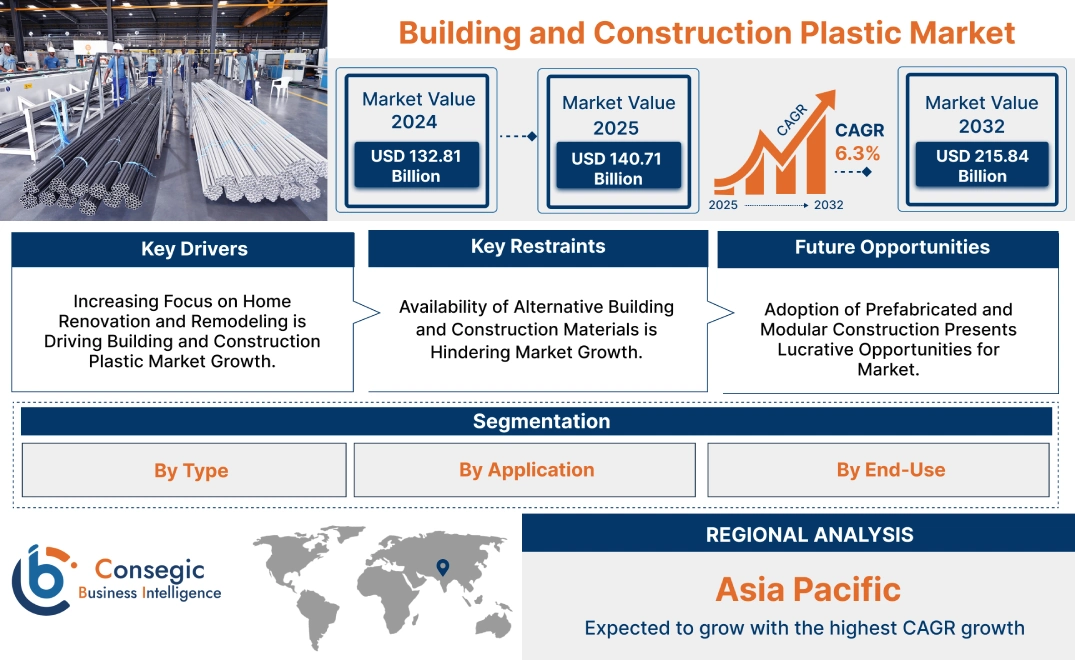
The Building and Construction Plastic Market size is growing with a CAGR of 6.3% during the forecast period (2025-2032), and the market is projected to be valued at USD 215.84 Billion by 2032 from USD 132.81 Billion in 2024. Additionally, the market value for the 2025 attributes to USD 140.71 Billion.
Building and Construction Plastic Market Scope & Overview:
Building and construction plastic refers to a variety of plastic materials used in the construction industry. They include two main categories of plastic materials such as thermoset and thermoplastic. Thermoset group includes acrylics, epoxies, and others. Conversely, key thermoplastics include polypropylene (PP), polystyrene (PS), polycarbonates (PC), polyurethane (PU), polyethylene (PE), and polyvinyl chloride (PVC), and more. These plastics offer several benefits such as lightweight nature, high impact strength, resistance to corrosion and UV, long-term durability, transparency, ease of cleaning easy fabrication, and availability in flame-rated materials amongst others. Considering the range of characteristic functionalities and benefits of these plastics are used in several applications. These applications include pipes and fittings, roofing and flooring, windows and doors, cladding and facades, structural components, insulation, and others for residential, commercial, and industrial sectors.
Building and Construction Plastic Market Dynamics - (DRO) :
Key Drivers:
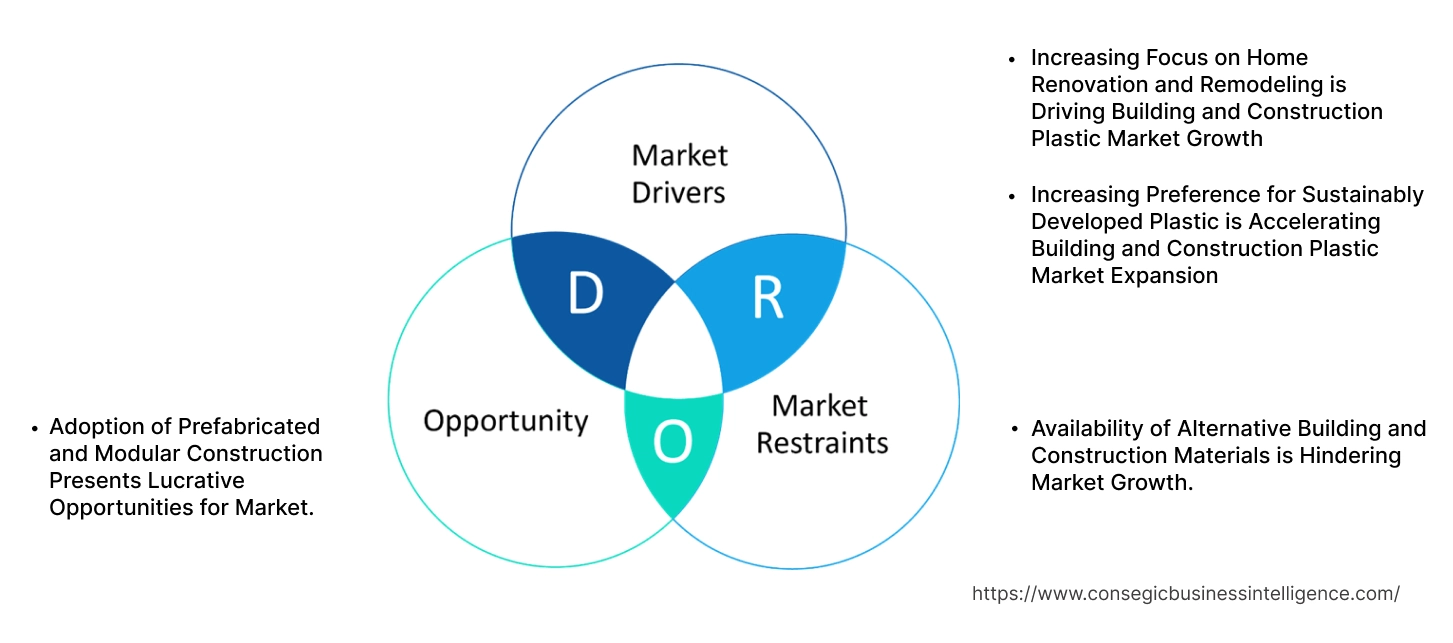
Increasing Focus on Home Renovation and Remodeling is Driving Building and Construction Plastic Market Growth.
Home renovation and remodeling refer to the process of making improvements, upgrades, or alterations to an existing residential property for various reasons, including enhancing functionality, increasing property value, updating aesthetics and others. Rising property values have encouraged homeowners to invest in their existing properties.
- For instance, according to the Renovation Nation Report provided by Money Co UK, it is stated that over 77% of UK homeowners spent money on changing or improving their properties in 2021. The average UK homeowner spent an average of USD 1,593.19 on home renovations.
This is leading to a growing requirement for plastic for several applications such as cladding, finishes, interior finishes, wall coverings, windows, doors, and roofing amongst others. Thus, considerable consumer spending on home renovation and remodeling is supporting the growing requirement for plastic in building and construction.
Increasing Preference for Sustainably Developed Plastic is Accelerating Building and Construction Plastic Market Expansion.
Sustainably developed plastic refers to plastic that is produced in a way that minimizes its environmental impact. Consumers are increasingly aware of the environmental impact of their choices, including the materials used in their homes and businesses. Programs such as LEED (Leadership in Energy and Environmental Design) are becoming more common. These programs prioritize the use of recycled, bio-based, or sustainable materials, including plastics. These factors have impacted several sectors including the building and construction plastic industry. Hence, to cater to this need, manufacturers are launching sustainably developed plastics including recycled plastics and bio-based plastics is improving.
- For instance, in 2023, BASF introduced bio-based Elastollan thermoplastic polyurethane (TPU) to enable greater sustainability construction applications, such as PU insulation panels, and sports flooring.
Thus, because of above-mentioned factors, the shift towards sustainable plastic materials in building and construction activities is contributing to building and construction plastic market expansion.
Key Restraints:
Wide Availability of Substitutes Hinder Building and Construction Plastic Market Growth.
The building and construction plastic market growth faces constraints due to the availability and competitiveness of alternative materials. Wood, including solid wood and engineered wood remains a crucial material in residential construction. Wood is widely used for framing, flooring, roofing, windows, and doors. Concrete and masonry are widely used for foundations, walls, and structural components due to their strength, durability, and fire resistance. They are preferred in larger commercial and industrial buildings. Steel and other metals are used for structural framing, roofing, and cladding. They offer high strength and durability, making them suitable for specific applications. In addition to this, stone, including natural and engineered, offers highly functional solution with aesthetic appeal. Growing commercialization of these substitutes presents pricing pressure for manufacturers of plastic for building and construction further creating negative impact on the market growth.
Future Opportunities :
Adoption of Prefabricated and Modular Construction Presents Lucrative Opportunities for Market.
Prefabrication and modular construction involve building components or entire modules in a controlled factory environment and then transporting them to the construction site for assembly. These approaches are gaining popularity due to their efficiency, cost-effectiveness, and sustainability benefits. Plastic’s combination of strength, ease of fabrication, durability, weather resistance and versatility makes it a suitable material for creating efficient and cost-effective building solutions. Additionally, government support encourages the adoption of prefabricated and modular construction.
- For instance, the Canadian government's 2024 Federal Budget introduced a new Homebuilding Technology and Innovation Fund aimed at accelerating the adoption of innovative housing technologies and materials in the country's homebuilding sector. This includes a focus on modular and prefabricated homes.
Thus, adoption of prefabricated and modular construction are creating lucrative building and construction plastic market opportunities over the forecast period.
Building and Construction Plastic Market Segmental Analysis :
By Type:
Based on Type, the market is categorized into thermoset and thermoplastic
Trends in the Type:
- The consumer inclination towards building materials developed using recycled plastic to reduce the environmental footprint of products.
- Development of higher-performance plastics such as fire-rated PU driven by safety regulations.
The thermoplastic segment accounted for the largest market share in 2024 and is also expected to grow at the fastest CAGR in the forecast years.
- Thermoplastic type occupies dominant position in the market. This type is further categorized into polypropylene (PP), polystyrene (PS), polycarbonates (PC), polyurethane (PU), polyethylene (PE), and polyvinyl chloride (PVC), and others.
- PP offers high strength, heat resistance, flexibility, and recyclability, whereas PS is valued for its lightweight nature and insulating properties.
- PC provides a combination of strength, impact resistance, transparency, and high light transmission. In addition to this, PVC remains a key material due to its versatility, durability, and cost-effectiveness.
- The need for thermoplastics is increasing due to their established production infrastructure and readily available supply chains.
- In addition to this, manufacturers operating in the market are focusing on developing advanced and sustainable thermoplastic materials.
- For instance, in September 2024, INEOS Inovyn launched NEOVYN. It is a new PVC range with reduced carbon footprint that is 37% lower than the European industry average for suspension PVC, reduced to 1.3 kg CO2 per kg PVC.
- Collectively, aforementioned factors support segment trajectory in current timeframe and are expected to boost segment in the future years.
By Application:
Based on Application, the market is categorized into pipes and fittings, roofing and flooring, windows and doors, cladding and facades, structural components, insulation, and others
Trends in the Application
- Growing use of insulated roofing panels and cool roofing membranes to reduce energy consumption.
- Increasing adoption of PVC and composite window frames with multiple chambers and advanced glazing to improve insulation and reduce energy loss.
The pipes and fittings segment accounted for the largest building and construction plastic market share in 2024.
- The pipes and fittings segment is dominating the market as they are essential components in all types of construction including residential buildings, commercial complexes and infrastructure projects.
- Plastic pipes and fittings are used for plumbing, drainage, water supply, and various other fluid transfer systems.
- Plastic pipes' dominance is attributed to their corrosion resistance, light weight, cost-effectiveness, durability, flexibility, and ease of installation. This leads to longer lifespans and reduced costs of pipes and fittings.
- In addition to this, the development of pipes using advanced plastic materials supports the segment trajectory.
- For instance, in May 2024, Westlake Pipe & Fittings, announced plans to build a new molecular-oriented polyvinyl chloride (PVCO) pipe plant at its manufacturing site in Wichita Falls, Texas.
- Owing to the above-mentioned analysis, the pipes and fittings segment dominates in the overall building and construction plastic market demand.
The insulation segment is expected to grow at the fastest CAGR over the forecast period.
- The incorporation of plastic in insulation is expected to rise due to growing focus on the adoption of energy efficient building materials.
- In addition to this, increasingly stringent building codes in many regions mandate higher levels of insulation in both new construction and renovation projects, further fueling the market.
- Furthermore, continuous technological advancements in plastic foam insulation materials, such as polyurethane and expanded polystyrene, are yielding products with enhanced performance characteristics and easier installation.
- Thus, due to the above-mentioned factors and trends, the insulation segments is expected to register the fastest CAGR over the forecast period in the overall building and construction plastic market demand.
By End-Use:
Based on end use, the market is categorized into residential construction, commercial construction, and industrial construction
Trends in the End Use:
- The increase in need for aesthetically pleasing materials that offer design flexibility and mimic the look of natural materials like wood or stone in residential settings.
- Need for high-performance plastic materials that offer superior insulation, weather resistance, and structural properties in commercial applications.
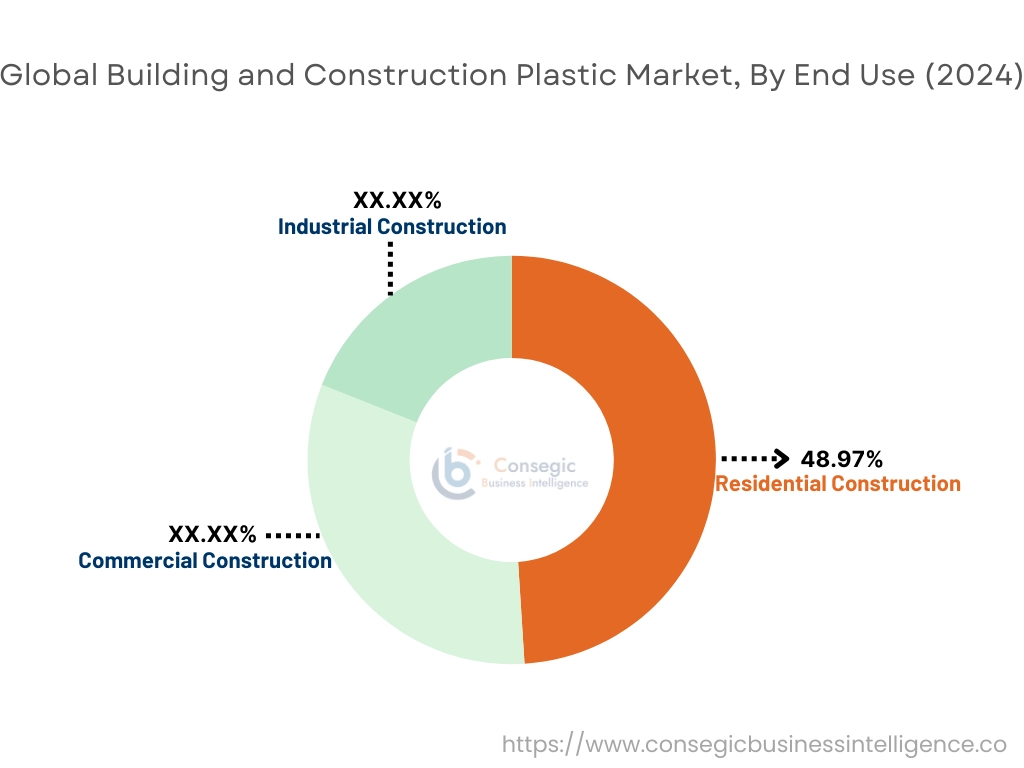
The residential construction segment accounted for the largest market share of 48.97% in 2024.
- The residential construction segment is dominating the market due to the high volume of residential building projects globally. Residential construction includes single-family homes and multi-story apartment buildings as well.
- Factors such as cost-effectiveness, durability, energy efficiency, design flexibility, and ease of installation drive plastic use in residential construction applications.
- In addition to this, growing focus on home renovation and remodelling is driving the adoption of plastic-based building materials.
- For instance, according to the data published by the Joint Center for Housing Centers of Harvard University, home improvement project spending increased from USD 328 billion in 2019 to USD 472 billion in 2022.
- Moreover, the consumers are increasingly demanding high-performance and aesthetically appealing building materials. This creates the requirement for plastics.
- Thus, due to the above-mentioned analysis, the residential construction segment is dominating in the overall building and construction plastic market trend.
The commercial construction segment is expected to grow at the fastest CAGR in the forecast years.
- Commercial buildings, including offices, retail spaces, and hotels consume a large volume of building and construction plastic.
- In commercial buildings, plastic is used for applications in piping, roofing, insulation, window frames, cladding, interior finishes amongst others.
- The growing adoption of prefabricated components is creating adoption of plastic based building materials in commercial construction projects.
- In addition to this, commercial building projects are emphasizing sustainable certification and green building standards.
- Plastics made from recycled materials with low environmental impact are being increasingly adopted in commercial construction.
- Hence, combination of aforementioned trends is creating segment expansion in overall market trajectory.
Regional Analysis:
The regional segment includes North America, Europe, Asia Pacific, the Middle East and Africa, and Latin America.
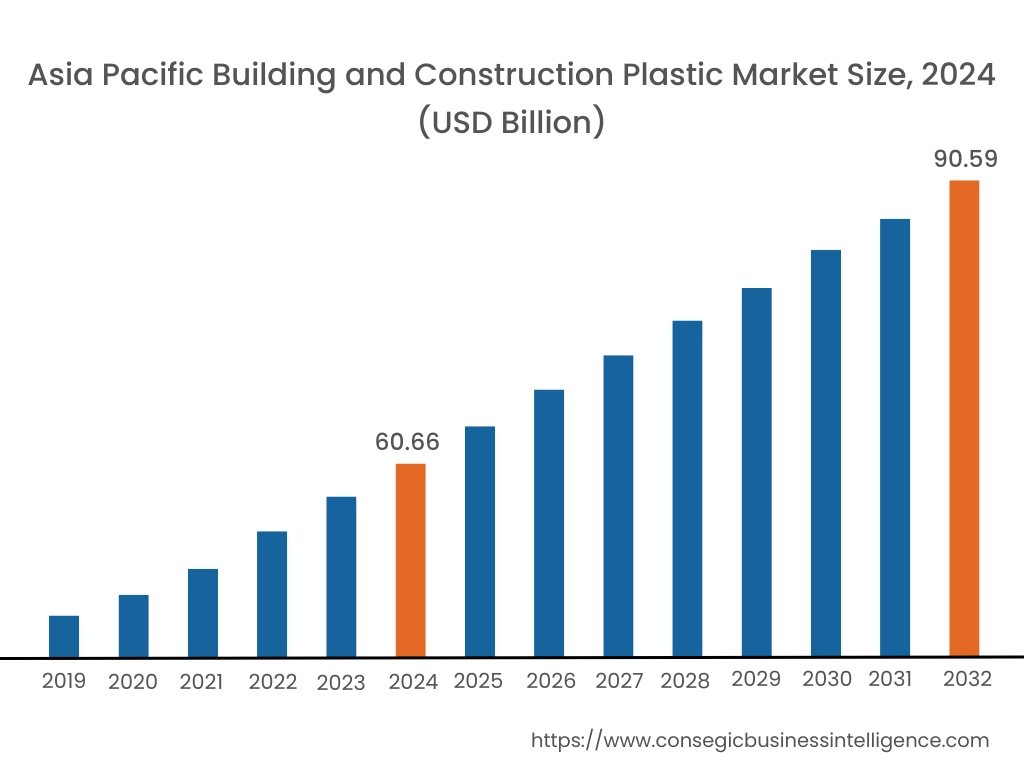
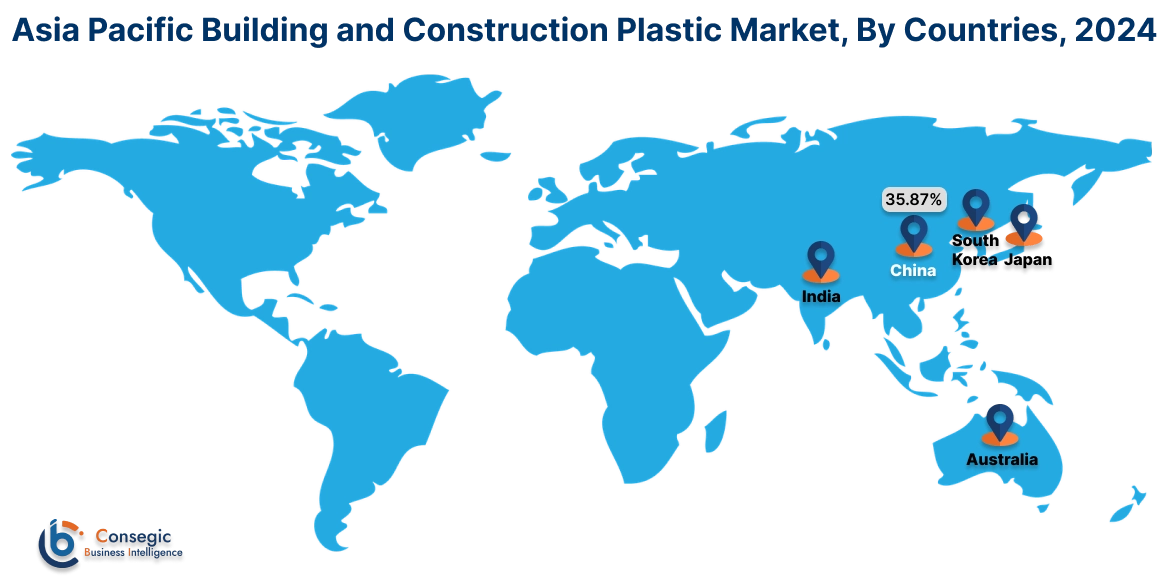
In 2024, Asia Pacific accounted for the highest building and construction plastic market share at 45.67% and was valued at USD 60.66 Billion and is expected to reach USD 90.59 Billion in 2032. In Asia Pacific, the China accounted for the largest share of 35.87% during the base year of 2024.
The rising need for high-performance building materials in residential, commercial, and industrial construction is the key factors that is leading to the large market share of building and construction plastic in Asia Pacific. The growing emphasis on home renovation and remodeling creates the need for plastics in residential construction. Additionally, many countries in the Asia Pacific region are investing in infrastructure development, including roads, bridges, airports, and public transportation systems. This infrastructure spending creates significant need for plastic pipes, geomembranes, and other plastic building materials.
- For instance, Indian Brand Equity Foundation, in June 2023, reported that the Indian Government introduced the National Industrial Corridor Development program aimed at developing new industrial cities. This program is an all-encompassing scheme with a sanctioned corpus of USD 2.41 billion.
Therefore, as per market analysis, the increased need for plastic in several applications for residential, commercial, and industrial construction is driving the market in the Asia Pacific region.
In North America the building and construction plastic market is experiencing the fastest growth with a CAGR of 8.7% over the forecast period. Shift towards prefabricated and modular construction serves a primary part in building and construction plastic market trend in North America. Off-site manufacturing of modules allows for concurrent site preparation and module production, significantly reducing overall construction time. This is a major advantage in North America, where labor costs are high, and project timelines are tight. Hence, this growth in adoption of prefabricated construction is driving the adoption of plastic for building materials. Plastics are easily molded and shaped into various forms. This allows for the precise and efficient production of complex building components off-site, further supporting building and construction plastic market opportunities in North America.
The increasing focus on development of recycled and bio-based Plastic for construction sector is one of the primary factors creating market trajectory across Europe. European countries present some of the strictest regulations across the globe. The European Union has implemented environmental policies, including directives on waste reduction, circular economy, and resource efficiency. These regulations push the construction sector to adopt more sustainable practices and materials. Hence, stringent regulations and consumer requirement is promoting European companies to invest in research and development to produce plastic from sustainable sources. Consequently, growth in the adoption of sustainably developed plastic for building and construction activities creates market demand across Europe.
The market in Middle East and Africa is dominated by higher demand building and construction plastic in industrial construction. This trend is influenced because of the rise in the investment for large-scale infrastructure projects, including new cities, transportation networks, energy facilities, and industrial complexes. These projects require vast quantities of building materials, and plastics are chosen for their cost-effectiveness, durability, and versatility. Several MEA nations are actively working to diversify their economies away from oil and gas. This involves developing new sectors, which in turn necessitates the construction of industrial infrastructure. Thus, this analysis is influencing the building and construction plastic market analysis.
The growing need for building and construction plastic in commercial construction is prominent factor supporting the market trajectory across Latin America. Many Latin American countries rely on tourism as a significant part of their economy. This leads to the construction of hotels, resorts, and related commercial facilities. This results in the demand for materials, including plastics. Both public and private sector investments in commercial real estate and infrastructure are driving the demand for plastic building materials. Collectively, higher utilization of plastic in commercial construction is boosting the building and construction plastic market analysis in Latin America.
Top Key Players and Market Share Insights:
The global Building and Construction Plastic Market is highly competitive with major players providing products to the national and international markets. Key players are adopting several strategies in research and development (R&D) and product innovation to hold a strong position in the global Building and Construction Plastic market. Key players in the Building and Construction Plastic industry include-
- BASF SE (Germany)
- INEOS (United Kingdom)
- LyondellBasell Industries Holdings B.V. (Netherlands)
- Exxon Mobil Corporation (U.S.)
- Formosa Plastics Corporation (U.S.)
- Toray Industries (Japan)
- SABIC (Saudi Arabia)
- Asahi Kasei Advance Corporation (Japan)
- Solvay (Belgium)
- LANXESS (Germany)
Recent Industry Developments :
Product Launches:
- In September 2024, INEOS Inovyn launched NEOVYN. It is a new PVC range with reduced carbon footprint that is 37% lower than the European industry average for suspension PVC, reduced to 1.3 kg CO2 per kg PVC
- In 2023, BASF introduced bio-based Elastollan thermoplastic polyurethane (TPU) to enable greater sustainability construction applications.
Building and Construction Plastic Market Report Insights :
| Report Attributes | Report Details |
| Study Timeline | 2019-2032 |
| Market Size in 2032 | USD 215.84 Billion |
| CAGR (2025-2032) | 6.3% |
| By Type |
|
| By Application |
|
| By End Use |
|
| By Region |
|
| Key Players |
|
| North America | U.S. Canada Mexico |
| Europe | U.K. Germany France Spain Italy Russia Benelux Rest of Europe |
| APAC | China South Korea Japan India Australia ASEAN Rest of Asia-Pacific |
| Middle East and Africa | GCC Turkey South Africa Rest of MEA |
| LATAM | Brazil Argentina Chile Rest of LATAM |
| Report Coverage |
|
Key Questions Answered in the Report
How big is the Building and Construction Plastic market? −
In 2024, the Building and Construction Plastic market is USD 132.81 Billion.
Which is the fastest-growing region in the Building and Construction Plastic market? +
North America is the fastest-growing region in the Building and Construction Plastic market.
What specific segmentation details are covered in the Building and Construction Plastic market? +
By Type, Application and End Use segmentation details are covered in the Building and Construction Plastic market.
Who are the major players in the Building and Construction Plastic market? +
BASF SE (Germany), SABIC (Saudi Arabia), and Solvay (Belgium) are some of the major players in the market.
Overview
Reputation & Certifications


Our Services
- Market Intelligence & Forecasting
- Custom Research Solutions
- Market Entry Strategy
- Competitive Intelligence
- Customer Insights
- Industry Innovation Analysis
- Investment Advisory